

Troubleshooting Artificial Turf Seams: A Professional Guide to Invisible Repairs
A truly invisible seam isn’t the result of simply using more adhesive. It’s a masterpiece of precision tension management and perfect grain alignment. You likely chose a premium landscape to escape the constant cycle of maintenance, so it’s incredibly frustrating when a visible line or a lifting edge disrupts the tranquility of your outdoor space. Whether you’re worried about tripping hazards or fear your entire installation is compromised, troubleshooting artificial turf seams is the first step toward reclaiming your peace of mind.
You deserve a lawn that looks as natural as the day it was installed. We’ll show you how to diagnose, repair, and prevent visible seams to restore the flawless, everlasting beauty of your property. This guide covers everything from professional bonding techniques using EverTurf Staples and Glue to understanding how crucial environmental and installation factors impact your landscape’s enduring performance. You’ll gain the expert knowledge needed to create a durable bond that lasts for years, ensuring your EverTurf Artificial grass remains a stress-free sanctuary that enhances your lifestyle and protects your most valuable asset.
Key Takeaways
- Master the science of grain alignment to ensure your turf reflects light uniformly for a truly invisible finish.
- Identify the root causes of gapping and peaking through a professional approach to troubleshooting artificial turf seams.
- Learn the “Clean, Align, and Secure” repair hierarchy to fix lifting edges and restore a safe, trip-free environment.
- Discover how utilizing professional tools like a turf kicker can precisely close gaps and return your lawn to its original, flawless state.
- Prevent future separation by choosing systems with high dimensional stability that resist the natural forces of expansion and contraction.
The Science of Seam Invisibility: Why Artificial Turf Lines Appear
Achieving a flawless landscape requires more than just high-quality materials; it demands an understanding of the physics behind the installation. A failed seam in synthetic grass isn’t always a structural disaster. While it can mean the physical separation of two rolls, it often refers to any visible disruption that breaks the illusion of a continuous, natural lawn. When you begin troubleshooting artificial turf seams, you must determine if you’re facing a mechanical failure, where the adhesive or fasteners have lost their bond, or an aesthetic failure, where the alignment simply misses the mark. Understanding the history of artificial turf helps illustrate how modern backing systems have evolved to be more stable, yet they still remain subject to the laws of physics and light reflection.
Distinguishing between these two failure types is the first step toward a permanent fix. A mechanical failure often presents as lifting edges or wide gaps, usually caused by improper application of specialized adhesives. An aesthetic failure, however, occurs when the seam is structurally sound but remains visible because the two sections of artificial grass aren’t perfectly synchronized. To identify your specific issue, look for these indicators:
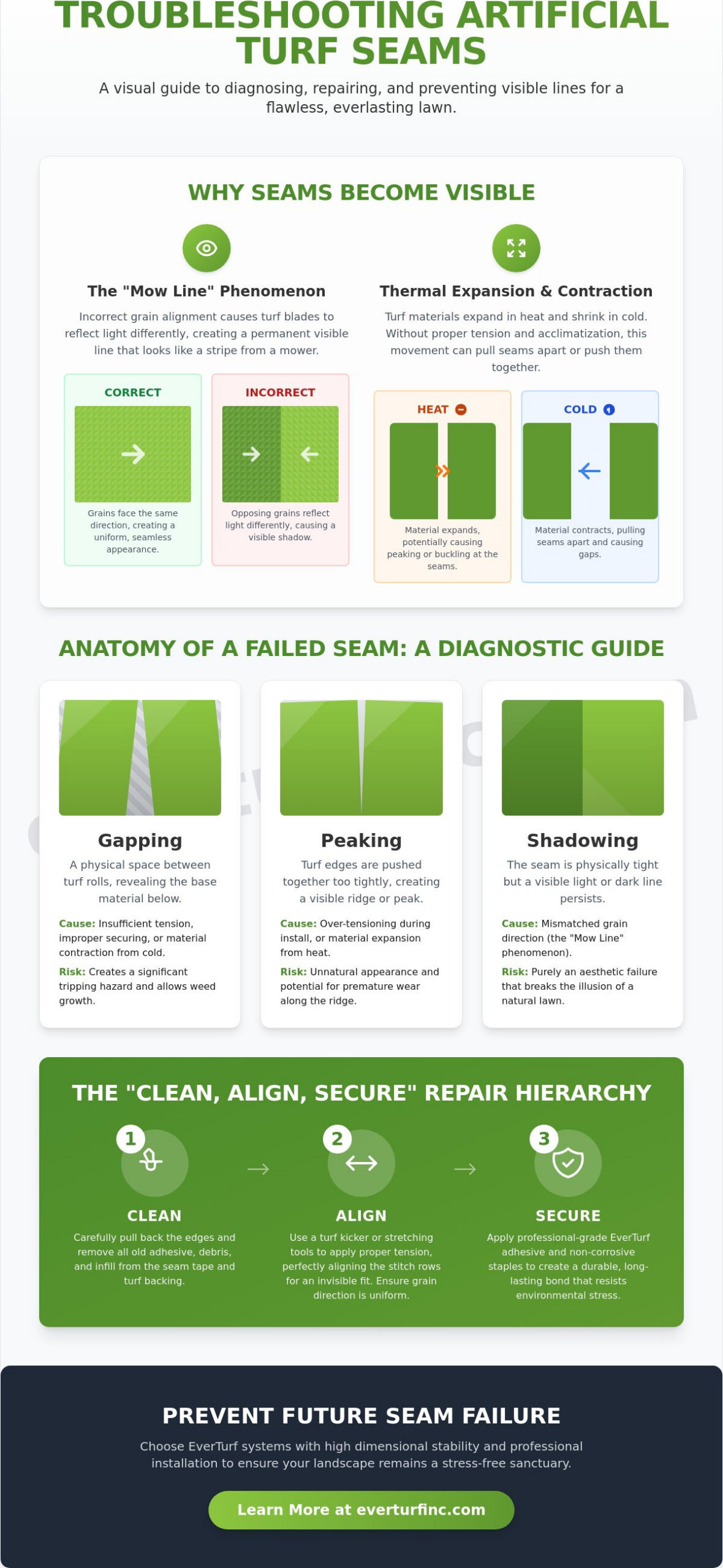
- Gapping: A physical space between the two rolls, often revealing the base material below.
- Peaking: The edges of the turf are pushed together too tightly, creating a visible ridge.
- Shadowing: The seam is physically tight, but a dark or light line persists regardless of the time of day.
Thermal Expansion and Contraction
Synthetic fibers and their backing systems are thermoplastic by nature, meaning they react to temperature shifts. In the heat of a summer afternoon, the backing material expands, which can cause seams to “creep” or push against one another. Conversely, as temperatures drop in the winter, the material contracts. This movement can pull seams apart if they weren’t properly secured with enough tension. Professional installers mitigate this by “acclimatizing” the turf. This involves unrolling the grass and letting it sit in the sun for several hours before the final cuts and bonding. This simple step allows the material to find its natural state, preventing the surprise of widening gaps once the weather turns cold.
The “Mow Line” Phenomenon
Even a perfectly bonded seam can be ruined by a mismatch in grain direction. Every roll of turf has a “grain,” which is the direction the individual blades naturally lean. If two adjacent pieces are installed with the grains facing different directions, they will reflect light differently. This creates a permanent visible shadow known as a mow line. It looks like a stripe left by a lawnmower, but it never goes away. You can easily identify the grain by “petting” the turf fibers with your hand. One direction will feel smooth and look darker, while the opposite direction will feel resistant and look shinier. Ensuring every section of your landscape “leans” toward the primary viewpoint, such as your back patio, is the secret to that coveted, invisible finish.
Anatomy of a Failed Seam: Identifying the Root Cause
Identifying why a seam has failed is the first step toward reclaiming your lawn’s aesthetic perfection. A seam isn’t just a point where two rolls meet; it’s the most vulnerable part of the entire system. When you begin troubleshooting artificial turf seams, you’ll likely find that the issue stems from one of three structural problems: gapping, overlapping, or peaking. While these may look like surface-level eyesores, they’re usually symptoms of deeper mechanical issues. For instance, improper tensioning during the initial artificial grass layout can cause the backing to “creep” over time. This slow movement happens when the turf isn’t stretched sufficiently, leading to wrinkles that eventually force the seam to buckle or pull apart.
Subbase stability also plays a vital role that many homeowners overlook. If the crushed stone base wasn’t compacted to at least 90% or 95% density, localized settling can occur. This creates a dip beneath the seam, pulling the edges downward and creating a visible valley. Additionally, the weight of the infill can exacerbate these issues. If the infill is distributed unevenly, it can put lopsided pressure on the seam, causing one side to lift. If you’re noticing widespread instability, it might be time to consider a professional artificial grass installation that utilizes a systems-based approach to prevent these structural shifts from the start.
Gapping vs. Overlapping
Gapping occurs when the two turf sections pull away from each other, leaving a visible line of backing or base material. This often happens due to cold-weather contraction or insufficient adhesive coverage. Overlapping is the opposite; it’s when the two pieces are pushed too close, creating a ridge. A good rule of thumb is that any gap wider than 1/8 of an inch will likely require a carpet stretcher or “turf kicker” to close. If the pieces overlap, you’ll need to carefully trim the excess backing without cutting into the face fibers to restore a flush, invisible transition.
Adhesive and Tape Failure
The bond is only as strong as the materials used to create it. “Spot gluing,” or applying adhesive in small dabs rather than a continuous, notched-trowel spread, is a recipe for disaster. It allows moisture to seep under the backing, which can lead to delamination or brittle glue that snaps under foot traffic. Using non-turf-specific adhesives is another common pitfall. These products often lack the flexibility needed to handle thermal expansion, causing the seam to pop open during the first major temperature swing. Look for signs of white, powdery residue or edges that feel “crunchy” when stepped on, as these indicate the bond has completely crystallized and failed.
Diagnostic Matrix: How to Categorize Your Seam Issue
Before you reach for the adhesive or specialized tools, you must accurately categorize the failure. Effective troubleshooting artificial turf seams requires a clinical eye to determine if the problem is a simple aesthetic fix or a structural hazard. Most homeowners can handle minor aesthetic adjustments, but structural failures often require the precision of a professional team to ensure the repair doesn’t become a recurring headache. Start by performing the “Finger Test.” Gently attempt to slide your finger under the edge of the turf at the seam. If the backing lifts easily from the seaming tape, the adhesive bond has failed completely. If the turf is anchored firmly but a line remains visible, you’re likely dealing with an alignment or grain issue rather than a mechanical break.
You should also inspect the “Tuft Bind” along the seam edge. Tug lightly on the individual grass blades right at the border where the two rolls meet. If the blades pull out with little resistance, the installer likely cut too close to the stitch line during the initial setup, damaging the structural integrity of the backing. This type of damage is more than just an eyesore; it’s a precursor to fraying that can eventually lead to a significant trip hazard in your backyard turf. Identifying these nuances early saves you from wasting time on temporary fixes that won’t hold.
The Seam Failure Matrix
Use the following framework to evaluate the severity and cause of your seam issues. This helps you decide whether a DIY approach is viable or if the complexity of the repair demands an expert touch.
| Symptom | Likely Cause | Urgency Level |
|---|---|---|
| Physical Gap | Thermal Contraction / Poor Tension | Medium (Debris Trap) |
| High Ridge (Peaking) | Over-tensioning / Expansion | Low (Aesthetic) |
| Fraying Edges | Poor Cut / Low Tuft Bind | High (Trip Risk) |
| Visible Line (No Gap) | Mismatched Grain / Low Infill | Low (Visual Only) |
Checking Infill Levels
Sometimes, what looks like a failed seam is actually a maintenance issue. Proper turf infill acts as a ballast, weighing the turf down and keeping the blades upright to hide the seam. Perform a “Weight Test” by stepping firmly on the seam. If the turf shifts or feels “squishy” underfoot, the lack of infill is allowing the backing to move. Low infill levels expose the edges of the turf rolls to direct sunlight and foot traffic, which can cause the blades to mat down and mimic a seam failure. Before assuming the glue has failed, try cross-brushing the area and adding a fresh layer of infill to see if the seam disappears back into the landscape.
Professional Repair Techniques for a Seamless Finish
Restoring the invisible flow of your landscape requires a disciplined hierarchy of “Clean, Align, and Secure.” Once you’ve finished troubleshooting artificial turf seams and identified the failure type, the repair must be executed with surgical precision. Professionals don’t just pull the edges together; they use a “Turf Kicker” or carpet stretcher to apply uniform tension across the entire seam. This tool allows you to close gaps that would otherwise be impossible to move by hand. For a truly undetectable result, consider the “S-Cut” technique. By cutting the edges in a subtle, non-linear wave rather than a straight line, you break up the eye’s ability to track the seam, making it disappear into the surrounding fibers.
The quality of your bonding agents determines the longevity of the repair. Using high-performance EverTurf Inc Staples and Glue ensures that the new bond can handle the same thermal stresses that caused the original failure. If the scope of your repair feels overwhelming or involves large-scale structural issues, seeking artificial turf installation near me can connect you with experts who possess the specialized tools and experience required for a permanent, worry-free restoration.
Level 1: Minor Gap Closure
Small gaps often result from minor shifts in the subbase or slight thermal contraction. You can often resolve these without a full reconstruction by utilizing the “Warm-Up” trick. Allow the sun to beat down on the turf for several hours, which makes the backing more pliable and easier to manipulate. Once the material is flexible, use a series of U-pins or staples to gently “pull” the turf back into alignment. After securing the edges, place heavy seam weights, such as unopened bags of infill, over the area for 24 hours. This constant pressure ensures the staples set firmly into the base and prevents the material from snapping back to its warped position.
Level 2: Major Seam Reconstruction
When a seam has completely delaminated or the edges have frayed, a more aggressive approach is necessary. You must first cut back the damaged sections to find “clean” backing that hasn’t been compromised by old, brittle adhesive. For high-tension areas, we utilize the “Bridge” technique, which involves using a wider seam tape than standard installations. This provides a larger surface area for the adhesive to grab. When applying the glue, aim for 100% coverage across the tape using a notched trowel. This prevents “oozing” through the fibers while ensuring there are no dry spots where moisture could later penetrate and ruin the bond.
Preventing Seam Failure with EverTurf Systems
Prevention is the ultimate luxury in home maintenance. While knowing the steps for troubleshooting artificial turf seams is essential for any homeowner, the most effective way to maintain a flawless landscape is to invest in a system designed to never fail. High-quality materials act as your long-term insurance policy against the unsightly lines and tripping hazards discussed in this guide. By choosing a system engineered for the specific demands of our local climate, you move away from the frustration of temporary fixes and toward the enduring tranquility of a perfect, year-round outdoor space. Precision is our standard, and it begins with the very first roll of turf laid on your property.
While the initial artificial turf installation cost is a significant consideration for any premium property upgrade, the long-term return on investment is found in the absence of repair cycles. A professional-grade installation utilizes a systems-based approach where every component works in harmony. This logical progression from site preparation to the final brush of infill ensures that your lawn remains a stress-free sanctuary rather than a source of weekend chores. We invite you to consult with a Reliable Visionary who understands that your time is your most valuable asset and that a permanent solution is the only one worth your investment.
The EverTurf Advantage
Our commitment to an everlasting result is built into the DNA of our products. EverTurf systems feature advanced dimensional stability, a technical specification that refers to the material’s ability to resist “creeping” or warping during extreme temperature shifts. This is achieved through our proprietary multi-layer backing technology, which provides a rigid yet flexible foundation. To ensure the seams remain invisible for decades, we utilize specialized bonding agents and anchoring techniques:
- EverTurf Glue: A high-tensile, waterproof adhesive that creates a flexible bond, allowing the turf to breathe without breaking its seal.
- Dimensional Stability: Our backing reduces the natural expansion and contraction that typically leads to gapping in inferior products.
- Specialized Infill: Beyond aesthetics, our infill acts as a ballast, providing the necessary weight to anchor the seam and protect the delicate backing from UV degradation.
Restoring Your Outdoor Peace of Mind
There is a profound sense of relief that comes from looking out at a lawn that appears as a single, continuous carpet of emerald green. A properly seamed landscape does more than just increase curb appeal; it restores your personal time. You no longer have to spend your Saturdays inspecting edges or worrying about the safety of your guests. Instead, you can enjoy the tranquility of a sophisticated environment that looks as perfect in five years as it does today. Experience the confidence of a landscape that reflects your high standards and provides a worry-free backdrop for your life. Connect with EverTurf for a sophisticated, permanent turf solution and take the first step toward a more beautiful, stress-free version of your property.
Reclaim the Flawless Beauty of Your Outdoor Space
Mastering the art of troubleshooting artificial turf seams is about more than just aesthetics. It’s about protecting your investment and ensuring your home remains a sanctuary of relaxation. By understanding the interplay between grain direction and thermal expansion, you’ve gained the tools to identify why lines appear and how to fix them with professional precision. Whether you’re adjusting minor gaps or performing a full reconstruction, the goal is always a durable bond that withstands the elements and the passage of time.
Your property deserves a permanent solution that eliminates the need for constant maintenance cycles. Our systems feature advanced dimensional stability backing to resist creeping, paired with industrial-strength EverTurf Staples and Glue for a bond that stays secure. With our national distribution and expert-level technical support, you have a reliable partner ready to help you achieve a truly undetectable result. Upgrade to a professional EverTurf system for a flawless, seamless lawn and start enjoying the tranquility of an outdoor space that stays perfect for years to come. Your dream landscape is well within reach.
Frequently Asked Questions
Can I fix a visible artificial turf seam without replacing the grass?
Yes, you can almost always fix a visible seam without replacing your entire lawn. Most issues stem from minor shifts in the subbase or adhesive delamination, which are localized problems that don’t compromise the rest of the turf. By using professional realignment techniques or applying fresh EverTurf Staples and Glue, you can restore that seamless, lush appearance and extend the life of your landscape for years.
What is the best glue to use for repairing synthetic turf seams?
The most effective adhesive for repairs is a high-performance, moisture-cured polyurethane glue specifically designed for synthetic grass. These professional-grade products, like those found in our EverTurf Staples and Glue kits, remain flexible after curing. This flexibility is vital because it allows the seam to move slightly with temperature changes without cracking or losing its grip on the backing.
Why did my turf seams start showing after two years?
Seams often become visible after a few years due to the natural settling of the subbase or the gradual loss of infill. If your crushed stone base wasn’t compacted perfectly, small dips can pull the seam downward. Additionally, troubleshooting artificial turf seams often reveals that seasonal expansion and contraction have slowly weakened a sub-par adhesive bond over several weather cycles.
How much gap is too wide to repair on an artificial lawn?
Gaps up to half an inch are generally repairable using a carpet stretcher or turf kicker to pull the edges back into alignment. If the gap exceeds this width, the tension required to close it might cause wrinkles elsewhere in the lawn. In these cases, a professional might suggest a small patch or “bridge” technique to maintain a flat, safe surface without distorting the surrounding grass.
Will using staples instead of glue make the seam more visible?
Staples alone can sometimes be more visible if they aren’t tucked deeply into the thatch, but they’re an excellent reinforcement when used with glue. While EverTurf Staples provide immediate mechanical hold, the glue creates the continuous, waterproof bond needed for an invisible finish. Combining both methods ensures your seams stay flat and secure against heavy foot traffic and pets.
Does the direction of the grass blades really matter for the seam?
Grain direction is perhaps the most important factor for seam invisibility. If the blades on one side of the seam lean in a different direction than the other, they’ll reflect light differently. This creates a permanent shadow or “mow line” that makes even a perfectly tight seam stand out. Always ensure all rolls lean toward the primary viewing area for a natural look.
How long does turf seam adhesive take to dry before I can walk on it?
Most professional turf adhesives require a full 24 hours to cure before they can handle heavy activity. While the bond may feel tacky and secure within 4 to 6 hours, walking on it too early can cause the edges to shift or “ooze” glue onto the grass fibers. Keeping the area weighted down during this period ensures a flush, permanent result that lasts.
Can heat from windows (solar reflection) cause seams to fail?
Concentrated solar reflection from energy-efficient windows can definitely cause seams to fail. These reflections act like a magnifying glass, reaching temperatures high enough to melt synthetic fibers or cause extreme backing expansion. When troubleshooting artificial turf seams, you should check for these “hot spots” in sun-drenched areas, as they can warp the material and pull even the strongest bonds apart.