
Removing Dog Urine Smell from Artificial Grass: The 2026 Professional Restoration Guide
Imagine it is a Saturday evening and your guests are arriving for a sunset dinner on the patio. Instead of the fresh, crisp atmosphere you envisioned, a sharp, ammonia-filled breeze catches the air. You’ve likely spent hours scrubbing your lawn, yet the underlying scent remains. This frustration is common for homeowners who find that surface cleaning is merely a temporary mask. Truly removing dog urine smell from artificial grass requires a deeper understanding of the nitrogen cycle trapped within the turf’s structural layers.
You invested in EverTurf Artificial grass to reclaim your weekends and enjoy a beautiful, low-maintenance landscape. It’s discouraging when that investment feels compromised by persistent pet odors. We promise to show you how to neutralize these smells at the molecular level, restoring your backyard to a pristine, fresh-smelling sanctuary. You’ll learn the professional-grade secrets to odor elimination and a 2026 maintenance routine that takes minutes, not hours. From advanced enzymatic treatments to the latest in permeable drainage technology, we’re here to help you rediscover the tranquility of your outdoor space.
Key Takeaways
- Understand the chemical transition of urea into ammonia crystals to learn why surface rinsing alone cannot restore your lawn’s freshness.
- Identify the role of infill as a bacterial sponge and discover how antimicrobial EverTurf Infill provides a permanent barrier against deep-seated odors.
- Master the science of removing dog urine smell from artificial grass using biological enzymatic cleaners that neutralize scents at the molecular level.
- Establish a high-efficiency 2026 maintenance routine that preserves your synthetic turf’s beauty while reclaiming your valuable personal time.
- Explore how specialized systems like EverTurf Artificial grass pets utilize advanced drainage to create a worry-free, pristine environment for your family.
Understanding the Science: Why Dog Urine Smells on Artificial Grass
To reclaim the freshness of your outdoor sanctuary, you must first understand the chemistry happening beneath your feet. When your dog relieves themselves on the lawn, they deposit a biological solution that begins changing the moment it hits the air. This isn’t just a liquid problem. It’s a molecular one. In a traditional yard, the soil acts as a living filter, full of microbes that process waste. Your synthetic lawn, while beautiful and durable, is a non-porous environment that requires a different approach to hygiene.
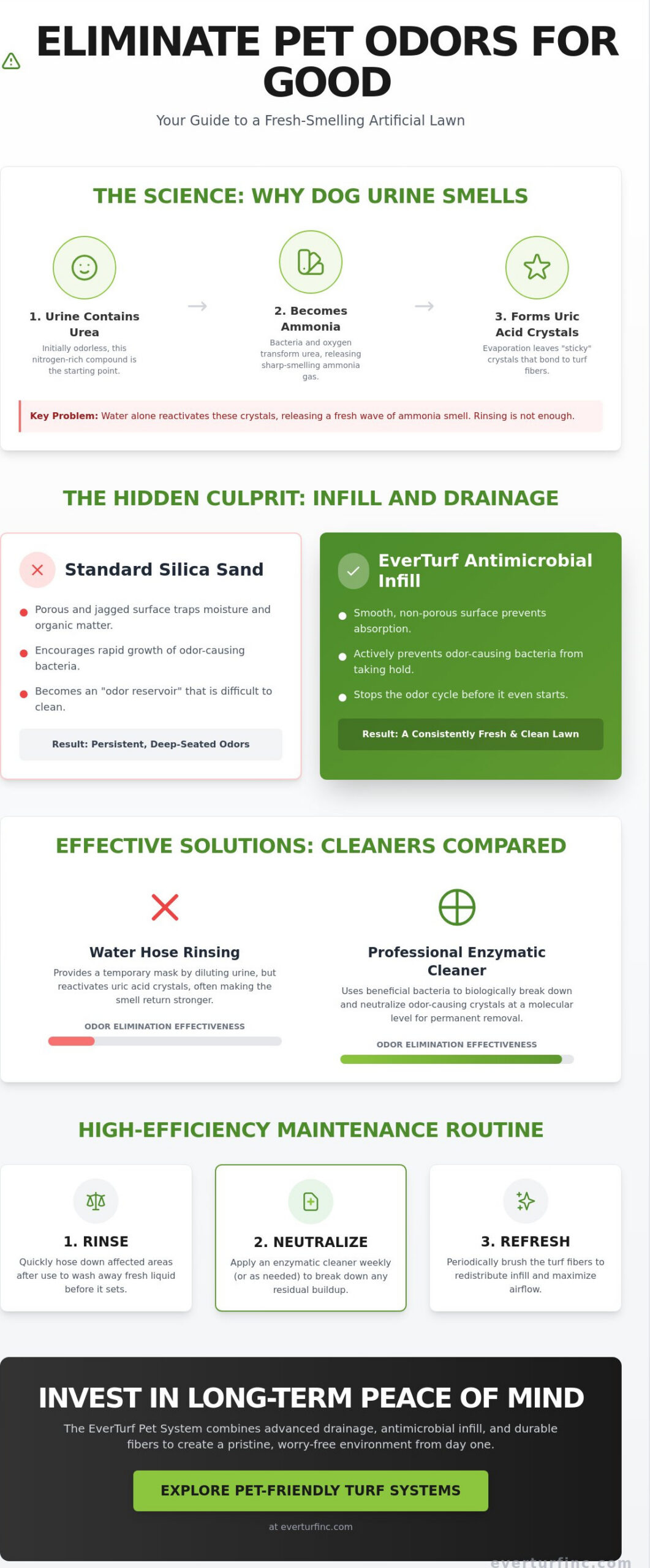
The primary challenge stems from how the chemical composition of urine interacts with synthetic fibers. Urine contains urea, a nitrogen-rich compound that is relatively odorless when it first leaves the body. However, as it encounters oxygen and environmental bacteria, it undergoes hydrolysis. This reaction transforms urea into ammonia and carbon dioxide. While natural grass allows these gases to dissipate into the earth, synthetic blades and standard infill can trap these compounds, leading to the sharp, lingering scent that many homeowners find so frustrating.
The Ammonia Trap: How Uric Acid Crystals Form
As the liquid component of urine evaporates, it doesn’t simply disappear. It leaves behind concentrated uric acid crystals. These crystals are notoriously “sticky” and bond tightly to the plastic polymers of your turf. If you’ve tried removing dog urine smell from artificial grass by only using a garden hose, you’ve likely noticed the smell returns quickly. Water alone often “re-activates” these crystals, causing them to swell and release a fresh wave of ammonia gas. Without a professional-grade neutralizer, these crystals remain embedded in the thatch, creating a persistent odor source that standard cleaning cannot reach.
Environmental Factors: Heat, Humidity, and Airflow
Weather plays a significant role in how you experience pet odors. On hot summer days, UV rays warm the turf surface, which accelerates the gaseous release of trapped ammonia. This is why a lawn might seem fine in the morning but becomes overwhelming by mid-afternoon. High humidity also plays a part, as moisture in the air prevents the ammonia from dissipating effectively, keeping the scent close to the ground. The nitrogen cycle within synthetic environments is the process where nitrogenous waste accumulates on non-biological surfaces, lacking the microbial soil life necessary to convert ammonia into harmless nitrates. Without proper drainage or specialized EverTurf Infill, your sub-base can become an “odor reservoir” where these gases congregate, waiting for the next warm breeze to remind you of their presence.
The Hidden Culprit: Why Your Infill and Drainage Matter
While many homeowners focus on scrubbing the synthetic blades, the real battle for a fresh lawn happens out of sight. Think of your turf as a complex system rather than just a carpet. If you’re struggling with removing dog urine smell from artificial grass, the issue usually isn’t the plastic fibers. It’s the material nestled between them. Infill serves as the structural support for your lawn, but in pet-heavy households, it can also become a primary sponge for waste and bacteria.
Silica Sand vs. Antimicrobial Infill
Standard silica sand is the traditional choice for many installations, yet it poses a significant challenge for pet owners. Raw sand is naturally porous and jagged, creating microscopic pockets that trap moisture and organic matter. This environment encourages rapid bacterial growth, which leads to the persistent scent of ammonia. In contrast, EverTurf Infill is engineered with a smooth, non-porous surface. These professional-grade alternatives often feature integrated antimicrobial coatings that actively prevent odor-causing bacteria from taking hold. By choosing a high-performance infill, you stop the odor cycle before it starts, ensuring your backyard remains a fragrant sanctuary for years to come.
Evaluating Your Sub-Base Drainage System
Drainage speed is your most effective defense against pet odors. Professionals measure this as the “percolation rate,” or the speed at which liquid moves through the turf and into the ground. A high-quality sub-base should consist of a thick layer of crushed stone, which allows urine to flush through the system instantly. If your drainage is sluggish, urine settles in the “thatch” layer or pools on the turf backing, creating a hidden reservoir of waste. You can evaluate your current system by checking for these common warning signs:
- Standing Water: If puddles remain for more than a few minutes after a heavy rain or cleaning, your percolation rate is too low.
- Spongy Texture: A “squishy” feel when walking on the grass indicates that liquid is trapped in the infill or sub-base.
- Localized Odors: Strong scents in specific “bathroom” areas suggest the turf backing may be clogged with fine sediment, pet hair, or debris.
Restoring a lawn often requires more than just a topical spray; it requires a foundation that works with you. If you suspect your drainage is the culprit, consider upgrading to a professional artificial turf installation near me to ensure a permanent, worry-free solution. A properly engineered base ensures that every rinse is effective, moving waste away from your living space and back into the natural environment.
Effective Solutions: DIY Remedies vs. Professional Enzymatic Cleaners
Choosing the right cleaning agent is the difference between a temporary fix and a permanent restoration. Many homeowners feel the urge to grab whatever is under the kitchen sink, but synthetic surfaces require a more calculated approach. While fragrances and “masking agents” promise immediate relief, they are often a short-term failure. These products simply layer a floral scent over the ammonia gas, creating a cloying mixture that doesn’t address the underlying uric acid crystals. For a true backyard sanctuary, you need a solution that dismantles the odor at its source.
The cost-to-benefit ratio of professional-grade turf deodorizers is significantly higher than DIY alternatives. While a bottle of high-quality enzyme cleaner might have a higher upfront price, its efficiency means you use less product over time. One thorough application can eliminate waste that would otherwise require dozens of water-only rinses. Most importantly, modern 2026 formulations prioritize the safety of your family. These cleaners are engineered to be non-toxic and pH-neutral, ensuring that your pets and children can return to the lawn as soon as the surface is dry.
The Power of Bio-Enzymatic Cleaners
Bio-enzymatic cleaners act as biological catalysts, literally “eating” the organic waste trapped within your turf system. These specialized enzymes target the uric acid crystals discussed earlier, breaking them down into harmless water and carbon dioxide. To achieve professional results, these cleaners require “dwell time.” You must allow the solution to remain damp on the turf for several hours, giving the live bacteria enough time to process the waste. The best 2026 formulations are fully biodegradable and designed to penetrate deep into the infill, ensuring that removing dog urine smell from artificial grass is a complete and lasting process.
When to Use DIY Solutions (and When to Avoid Them)
If you need an immediate rinse for a small spot, a mixture of one part white vinegar to one part water is a safe, temporary remedy. This acidic solution can help neutralize surface ammonia in a pinch. However, rely on this sparingly. Vinegar is an acid that can eventually degrade certain turf backings if used as a primary cleaning method. You should never use bleach or harsh detergents on artificial grass. These chemicals can weaken the structural integrity of the fibers and cause permanent discoloration. Additionally, avoid the temptation to use a high-pressure power washer. The intense force can actually drive pet waste deeper into the sub-base and damage the permeable backing, making future odor control much more difficult.
Step-by-Step: A Professional Maintenance Routine for 2026
Transforming your backyard into a permanent retreat requires a shift from reactive cleaning to a sophisticated maintenance rhythm. While traditional lawns demand constant labor, your synthetic system thrives on a simple, high-impact routine. This 2026 standard focuses on moving waste through the system rather than letting it sit. It’s the most effective strategy for removing dog urine smell from artificial grass while preserving the vibrant aesthetic of your property. By adopting this cadence, you ensure your investment remains a stress-free sanctuary for your family and pets.
The “flood and flush” technique is the cornerstone of professional-grade care. Instead of using a light mist that only dampens the surface, use a high-volume, low-pressure flow to saturate the turf. This volume of water pushes liquid waste through the permeable backing and into the crushed stone sub-base. Regular cross-brushing is equally vital. Using a stiff-bristled turf brush against the grain keeps the fibers upright and aerated. This prevents the thatch from matting down and trapping odors in anaerobic pockets where bacteria flourish. If you want to ensure your lawn is built to handle this level of performance, consider a professional artificial turf installation near me to optimize your drainage foundation.
The Weekly Refresh: Preventing Odor Build-Up
Consistency is your best defense against the crystallization of uric acid. Follow these three steps every week to maintain a crisp, clean environment:
- Step 1: Immediate Removal. Pick up all solid waste as soon as possible. This prevents organic matter from breaking down and staining the synthetic fibers or clogging the drainage pores.
- Step 2: The Systematic Rinse. Use your garden hose to flush “high-traffic” bathroom areas. Direct the water flow to move liquid through the backing, ensuring it doesn’t linger in the infill.
- Step 3: Maintenance Enzyme Application. Apply a light, maintenance-dose enzymatic spray to active zones. This prevents the build-up of bacteria between deeper cleanings.
The Quarterly Deep Clean
Every three months, your lawn benefits from a more intensive restoration process. Start by using a turf rake to gently loosen any compacted infill. This opens up the drainage pathways that may have become restricted by dust or pet hair. Once the surface is prepared, perform a full-lawn enzymatic saturation. Apply the cleaner liberally and allow for maximum “dwell time,” ensuring it stays damp long enough for the enzymes to dismantle any deep-seated crystals. Finally, inspect your infill levels. If the fibers look flat or the base feels thin, it’s time to top-off your antimicrobial EverTurf Infill to maintain the structural integrity and odor-fighting power of your lawn.
Investing in Odor-Resistant Turf Systems for Long-Term Peace of Mind
Choosing a system designed to handle pet waste from the start is the ultimate strategy for long-term satisfaction. Many homeowners initially view turf as a simple surface replacement, yet the shift from a high-maintenance natural lawn to an intelligent synthetic system requires a more visionary approach. By adopting a system-first mentality, you ensure that every layer of your property is optimized for hygiene and durability. This foresight simplifies the process of removing dog urine smell from artificial grass, turning a potential frustration into a manageable, minor detail of home ownership.
Engineered for Performance: EverTurf Pet Systems
EverTurf Pet Systems utilize specialized technology that sets a new standard for outdoor living. Our artificial grass for dogs features fully permeable backing designed for rapid vertical flow. This engineering allows liquid waste to exit the turf system immediately, moving it into the aggregate base before crystals can form. Beyond drainage, the fibers themselves incorporate antimicrobial properties integrated during the manufacturing process. This ensures that the defense against bacteria is permanent and won’t degrade after a few seasons of cleaning. It’s a sophisticated solution that maintains its aesthetic brilliance and structural integrity even under the heavy use of large, active pets.
Reclaiming Your Sanctuary
The emotional transition from a high-maintenance yard to a worry-free sanctuary is profound. You deserve an outdoor space that is always guest-ready, regardless of how many pets share your home. Investing in a high-quality system restores your personal time, moving you away from the endless cycle of scrubbing and toward long-term satisfaction. You’ll no longer fear that your expensive investment is being ruined by daily use. Instead, you’ll enjoy a pristine environment that looks and smells fresh year-round. This restoration of your backyard sanctuary represents a significant return on investment, both for your property value and your peace of mind.
Your journey toward a stress-free property begins with the right foundation. If you’re ready to transform your landscape into a beautiful, low-maintenance retreat, connect with an EverTurf specialist to design your odor-free oasis and experience the tranquility of a truly permanent solution.
Rediscover the Tranquility of an Everlasting Fresh Lawn
Your backyard should be a place of relaxation, not a source of lingering stress. We have explored how neutralizing odors at the molecular level with bio-enzymatic cleaners and maintaining a “flood and flush” routine can transform your outdoor experience. Truly removing dog urine smell from artificial grass is a permanent reality when you combine professional-grade technology with a proactive care cadence. By addressing the science of drainage and infill, you ensure your investment remains a pristine sanctuary for years to come.
EverTurf offers the logical evidence for this lifestyle upgrade through Antimicrobial EverTurf Infill technology, industry-leading drainage rates, and our 2026-ready sustainable synthetic fibers. It’s time to move away from the frustrations of traditional maintenance and embrace a more beautiful, stress-free version of your property. Restore your outdoor sanctuary with EverTurf’s professional pet solutions and enjoy the peace of mind that comes with a perfect, year-round environment. Step out onto a lawn that feels as fresh as it looks, every single day.
Frequently Asked Questions
Is it possible to completely remove the smell of dog urine from fake grass?
Yes, you can achieve complete odor elimination through molecular neutralization rather than surface masking. By using bio-enzymatic cleaners that dismantle uric acid crystals, you address the source of the scent permanently. When these professional treatments are paired with a high-flow drainage system and antimicrobial infill, your lawn remains as fresh as the day it was installed.
Can I use baking soda to get rid of pet odors on my turf?
Baking soda serves as a helpful temporary surface deodorizer, but it is not a permanent solution for deep-seated odors. While it can neutralize acids on the blades, it often clumps when wet and may eventually clog the fine drainage pores in your turf backing. For lasting results, rely on liquid enzymatic treatments that penetrate the entire infill layer to reach trapped waste.
How often should I clean my artificial grass if I have multiple dogs?
Homeowners with multiple pets should implement a weekly “flood and flush” routine to prevent waste accumulation in the sub-base. High-traffic bathroom areas may require spot-treatment every two to three days with an enzymatic spray. This proactive cadence ensures that removing dog urine smell from artificial grass remains a simple, five-minute task rather than an exhausting weekend chore.
Will professional turf cleaners harm my pets or the local environment?
Modern 2026 professional-grade cleaners are engineered to be biodegradable, non-toxic, and pH-neutral for maximum safety. These biological catalysts are specifically designed to be safe for children and pets once the surface has dried completely. They work by mimicking natural decomposition processes without the use of harsh, leaching chemicals like bleach or concentrated ammonia that could harm local soil.
Why does my artificial grass smell worse after I hose it down?
Odors often intensify after rinsing because water re-activates dormant uric acid crystals trapped deep within the infill. As the moisture evaporates, it carries concentrated ammonia gases upward into the air you breathe. This “re-activation” effect is a clear signal that your lawn requires an enzymatic cleaner to dissolve the crystals rather than a simple water rinse which only spreads them.
Do certain breeds of dogs have “stronger” urine that affects turf differently?
Urine concentration is typically dictated by a dog’s diet and hydration levels rather than their specific breed. However, larger dogs or those on high-protein diets produce higher volumes of urea, which leads to faster crystal formation in the thatch. Regardless of the breed, maintaining a consistent hydration schedule for your pet can help reduce the initial intensity of the waste deposited.
What is the best infill for preventing dog pee smells in 2026?
Antimicrobial EverTurf Infill is the premier choice for odor prevention in modern synthetic lawn systems. Unlike standard silica sand, which can trap bacteria in its porous, jagged surface, this specialized infill features a smooth, non-porous coating that inhibits the growth of ammonia-producing microbes. It provides a permanent structural barrier that keeps your outdoor living space fresh and sophisticated.
Can I use a carpet cleaner or steam cleaner on my synthetic lawn?
You should avoid using steam cleaners because the intense heat can permanently warp or melt the synthetic polyethylene fibers. While some low-suction carpet extractors may help with surface debris, they are not designed to reach the sub-base where the majority of pet waste resides. A systematic hose flush combined with professional enzymatic saturation remains the most effective restoration method for your turf.