



Solving Turf Expansion and Contraction Issues: A Practical Guide
What if ripples in your artificial turf point to the base or installation, not a flaw in the turf itself? Buckling, shifting seams, and pulled edges are frustrating to see, and exposed gaps can create trip hazards. Solving turf expansion and contraction issues starts with identifying what is moving and when it happens.
Temperature changes can cause synthetic materials to expand and contract, but tight edge fitting, an unstable base, or unevenly distributed infill may also contribute to movement. The right response depends on the symptom and its cause. Flattening a ripple without checking the surrounding area could leave the underlying problem unresolved.
This guide explains how to inspect common signs of movement, distinguish likely weather-related changes from installation or base issues, and choose a practical next step. You’ll also learn how preparation, compatible turf-system components, and routine care can help keep the surface smooth, stable, and ready to use.
Key Takeaways
- When solving turf expansion and contraction issues, document when and where movement appears instead of assuming the turf is defective.
- Compare ripples, seam changes, and edge gaps with weather patterns, drainage, and nearby surface conditions to narrow down possible causes.
- Inspect visible seams and edges without pulling or cutting the turf. The pattern of movement can indicate what needs closer assessment.
- Choose next steps based on the likely cause. Temperature-related movement and concerns with installation or the base may call for different responses.
- Match turf, compatible components, and care to the space, whether it’s a lawn, pet area, putting green, or sports surface.
Solving Turf Expansion and Contraction Issues Starts With the Symptoms
Ripples across a lawn, a raised seam, or a gap along an edge can make an otherwise polished outdoor space feel unfinished. Some movement may follow temperature changes, but a visible wrinkle or opening is a symptom, not proof that the turf itself has failed. Solving turf expansion and contraction issues starts with observing the pattern before attempting an adjustment or repair.
Take photos from the same viewpoints and record when each change appears, recent weather conditions, and the areas affected. Note whether the movement fades, worsens, or stays in place. If the surface is severely buckled, keep people and pets off that area until the trip risk has been assessed. Avoid pulling at seams or edges while documenting the condition.
What do ripples, seams, and edge gaps reveal?
Broad waves across the surface may point to tension, temperature-related movement, or an uneven or shifting base. A raised or separating seam directs attention to the join between turf sections, while a perimeter gap makes the edge and its restraint worth inspecting. These clues help focus your checks, but they don’t confirm a cause on their own. Record whether the issue is localized or spread across the surface, and note nearby slopes, drains, or fixed borders.
Is seasonal turf movement normal?
Synthetic materials can respond to temperature changes, expanding as they warm and contracting as they cool. This basic behavior is described in the science of thermal expansion. A small, temporary change isn’t automatically a sign of damage. The more useful distinction is whether the surface returns to an even appearance or develops persistent buckling, open seams, or loose edges.
Don’t rely on a generic temperature threshold or movement-rate estimate to decide whether your turf is within tolerance. Those details can depend on the specific product and installation guidance. Instead, compare dated observations across changing conditions. If a raised seam or gap remains, grows, or creates a hazard, have the installation assessed against the turf manufacturer’s instructions before choosing a repair.
Why Synthetic Turf Expands and Contracts With Temperature
Thermal expansion and contraction describe how a material changes size as its temperature rises or falls. Synthetic turf may respond to warming and cooling, but the visible surface is only one part of the system. Fibers, backing, seams, perimeter restraint, infill, and the prepared base work together, so movement can’t be diagnosed by looking at the grass blades alone.
The Erosion Control Technology Council discusses the causes of turf expansion and contraction, including how temperature-related movement can contribute to wrinkles or seam problems. That response is not, by itself, proof of a failed installation. Temperature can make turf move. Persistent buckling or open seams call for a closer look at the entire installation.
How turf backing and fibers respond to heat and cold
Both the visible fibers and the backing can be affected by temperature, though their exact behavior depends on the product’s construction. Sunlit areas may become warmer than shaded sections, creating different surface conditions across the same yard. If a wave appears in a sunny area, compare it with a nearby shaded section and check whether it looks different at another time of day.
Don’t assume every turf product responds identically or apply a universal expansion rate. Check the product’s technical documentation for material details, installation guidance, and any stated temperature-related tolerances. If those details aren’t available, ask the supplier or manufacturer rather than relying on a generic estimate. This product-specific check helps with solving turf expansion and contraction issues without mistaking normal temperature response for a defect.
How the base, seams, and edges affect movement
A stable, properly prepared base supports a more even finished surface. If the ground or aggregate layer beneath the turf is uneven or shifts, the surface above it may also lose its smooth appearance. Drainage patterns can offer another clue: persistent pooling or a low spot near a wrinkle may point to a base or drainage concern rather than temperature alone.
Seams join separate turf sections, while perimeter restraint helps secure the edges. If a seam opens or an edge pulls away, inspect that specific area and note whether nearby sections remain flat. The base, seams, and edges need to work together rather than resist one another. When planning a project, compare the turf and compatible components with the site’s intended use. You can explore EverTurf artificial grass and installation components as you consider options suited to your space.
Turf Expansion Problems: Compare Weather, Installation, and Base Causes
A ripple or gap can have more than one explanation. Temperature, installation tension, seam condition, edge restraint, and the base may all contribute, and their signs can overlap. Use the pattern below to guide your inspection, not to make a definite diagnosis from a photo or one unusual weather event.
| What you observe | Possible cause | What to check |
|---|---|---|
| A wave appears or changes with sunny and shaded conditions | Temperature-related movement | Record the location and appearance at different times and under different exposure conditions. Compare observations with the product’s manufacturer guidance. |
| A ripple remains in the same place | Installation tension or a base concern | Note whether the area is near a slope, low spot, or other uneven section. Persistent movement warrants closer inspection. |
| A seam repeatedly opens or lifts | Seam connection or tension issue | Document the seam’s length and whether adjacent areas also change. Don’t pull it apart to investigate. |
| An edge loosens or a gap appears at the perimeter | Edge restraint or nearby base movement | Check whether the gap follows one edge or appears in multiple places, and look for nearby drainage changes. |
Temperature-related forces interact with friction and the surface below the turf. Brock USA discusses this relationship in its analysis of expansive force and friction in artificial turf. The details of a particular installation still depend on its product and construction, so don’t use general figures to judge whether your turf’s movement is acceptable.
Signs that point toward temporary temperature-related movement
A change that appears under particular sun or temperature conditions and eases as conditions shift may be consistent with a temporary response. Look for a repeatable pattern: photograph the same location, note the time and weather, and compare it over multiple observations. Then check the manufacturer’s documentation for guidance specific to that turf. One warm day or a single picture isn’t enough to establish a cause.
Signs that warrant checking installation or the sub-base
Persistent ripples, recurring seam gaps, loose edges, or uneven areas are reasons to inspect further, especially if the condition remains as weather changes. Drainage patterns and base stability may need assessment by a qualified professional. Avoid lifting or cutting the turf. As you work through solving turf expansion and contraction issues, also consider whether the product and complete system suit the intended use, from a residential lawn to a pet area or sports surface.
How to Assess and Address Turf Expansion and Contraction
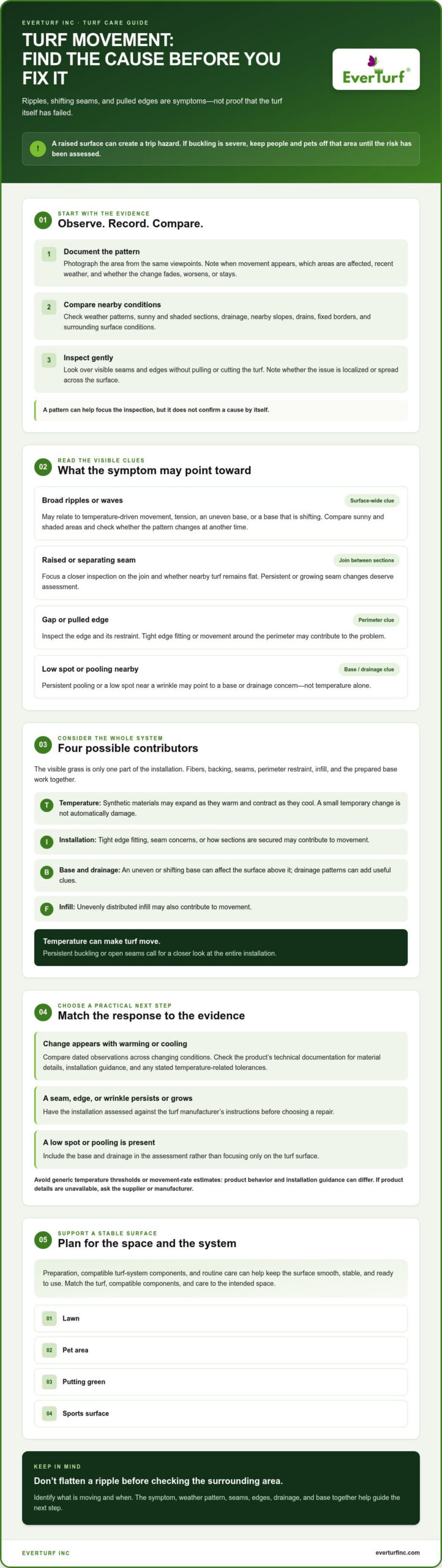
A careful assessment helps you avoid making a small surface change worse. Start with what you can observe, then compare your notes with the product’s installation guidance before deciding whether to monitor the area or request an inspection.
- Document the symptoms. Photograph each affected spot from consistent angles. Record the date, weather, sun or shade exposure, and exact location, such as a seam, perimeter edge, or low area. Note whether the movement changes between observations.
- Check the visible surface. Without lifting or pulling the turf, look for separated seams, raised edges, standing water, and uneven transitions. Note whether a ripple is isolated or spans a larger area.
- Review drainage and surroundings. Observe where water collects or flows and whether the unevenness is near a slope, drain, border, or other fixed feature. These details can help distinguish a surface change from a possible base or drainage concern.
- Consult product guidance. Check the manufacturer’s instructions for the specific turf and installation method. If the documents don’t clarify what you’re seeing, contact the installer or manufacturer before attempting a repair.
Don’t cut, stretch, pull, or add fasteners based on a guess. Improvised work can damage the backing or seams, affect drainage, or risk contacting hidden utilities. The correct approach depends on how the turf was installed and what lies beneath it.
When to repair, monitor, or request an inspection
Monitoring may be reasonable for mild movement that changes with conditions, provided the surface remains safe and the product guidance supports observation. Keep comparing photos and notes rather than relying on one inspection. If the area becomes a trip hazard, keep people and pets away until it’s assessed.
Persistent buckling, recurring gaps, loose edges, or signs of base movement call for an inspection. Repairs involving lifted turf, re-seaming, edge work, or rebuilding the base should be handled by a qualified professional familiar with the installation system. Confirm the recommended method with the installer or manufacturer before work begins.
Solving turf expansion and contraction issues is easier when the response matches the likely cause. If you’re selecting turf or compatible components for a new project, explore EverTurf artificial grass and installation components as part of planning a complete system for your space.
Prevent Recurring Turf Movement With the Right System and Support
Long-term stability starts before turf goes down. Match the product and compatible components to the site, then make sure preparation, seams, edges, and routine care suit the project’s conditions. This whole-system approach helps address factors that can contribute to movement instead of treating every ripple as a problem with the turf itself.
Different spaces have different demands. A residential lawn, pet area, putting green, and sports surface each have distinct patterns of use and performance needs. Choose turf for the intended application, and review the manufacturer’s guidance for preparing the site, managing seams and edges, and maintaining the surface. Keep drainage and the condition of the base in view, too. A product that suits one setting may not be the right choice for another.
What to review before choosing turf and installation components
Consider how the area will be used and the surface conditions it will face. Then check which installation components are compatible with the selected turf and project. Infill can contribute to system stability, while staples, glue, or pavers may be relevant depending on the installation design. Don’t assume one component or method fits every site. For more context, review an essential guide to turf infill and follow the product manufacturer’s installation instructions.
EverTurf supplies artificial grass for residential, pet, putting green, playground, roof and deck, and sports applications, along with infill and other installation components. Reviewing turf and compatible components together can help you make a more informed selection. This doesn’t replace site-specific planning or advice from the professional responsible for installation.
What details to share when seeking product guidance
Good records help others assess the situation. Share the turf product name, installation date if known, the locations affected, and clear photos. Describe the weather or sun exposure you’ve observed and whether the movement changes, stays in place, or returns. Include details about nearby seams, edges, drainage, and uneven areas. This context can help distinguish a changing surface condition from a concern that needs closer inspection.
Before attempting corrective work, compare your observations with the product documentation and consult the appropriate installation professional or manufacturer. Guidance should reflect the actual turf and installation method, especially if a repair could involve seams, edges, or the base. Thoughtful diagnosis and compatible system choices are central to solving turf expansion and contraction issues and helping create a smooth, dependable outdoor space.
To compare turf for your project, explore EverTurf artificial grass options and consider which category and components fit your intended use.
Build a More Stable Turf Surface
Ripples, raised seams, and edge gaps are clues, not automatic proof of turf failure. Track when and where movement appears, compare it with weather and drainage patterns, and check the product’s guidance before deciding what to do. Persistent buckling or recurring gaps deserve a closer inspection, not an improvised repair.
Solving turf expansion and contraction issues starts with understanding the whole system, including the turf, base, seams, edges, and compatible components. Choosing materials for the space’s intended use can also support a smoother, more dependable surface over time.
EverTurf supplies synthetic turf for residential, commercial, and athletic applications, along with turf infill, staples, glue, and pavers. Review options for your project and consider which products and components fit the intended use. Explore EverTurf artificial grass and project components to plan your next step.
Frequently Asked Questions
Why is my artificial turf expanding and buckling?
Artificial turf may buckle because temperature changes affect turf materials, but persistent waves can also signal installation tension, seam or edge concerns, or an uneven or shifting base. A wrinkle alone doesn’t prove product failure. Note where it appears, when it changes, and whether nearby seams, edges, or drainage show signs too. Compare your observations with the product’s installation guidance before choosing a corrective step.
Can hot weather make synthetic turf expand?
Yes, heat can cause synthetic turf materials to expand, just as cooling can cause contraction. The amount and visible effect depend on the specific turf and site conditions, so there isn’t one reliable threshold for every product. Sunlit and shaded areas may also have different surface conditions. Check the manufacturer’s technical documentation for product-specific information instead of applying a generic temperature figure.
How can I tell whether turf ripples are caused by heat or poor installation?
Solving turf expansion and contraction issues starts with tracking the ripple over time. Photograph the same spot, note the date, weather, and sun or shade, and record whether it changes as conditions shift. A repeatable change may be consistent with temperature response, while persistent ripples, recurring seam gaps, or loose edges merit closer inspection. Check seams, edges, drainage, and surface evenness without lifting the turf, then consult product guidance.
Will artificial grass shrink in cold weather?
Yes, synthetic turf can contract as temperatures fall because materials respond to cooling as well as heat. That doesn’t mean every seasonal change is harmful or that all turf behaves alike. Watch whether the surface returns to an even appearance or develops persistent buckling, open seams, or loose edges. Consult the product’s technical documents or manufacturer for applicable movement guidance, and avoid relying on generic rates or thresholds.
Can I fix a raised seam or edge gap myself?
Don’t pull, cut, stretch, or refasten a seam or edge before confirming the turf’s installation method and manufacturer instructions. A visible gap may involve the seam, perimeter restraint, base, or drainage, and an improvised fix could damage the backing or worsen the issue. Photograph and document it first. For recurring separation, pronounced lifting, or uncertain installation details, request assessment from the installer or a qualified professional.
What should I do if artificial turf keeps developing wrinkles?
Document recurring wrinkles before attempting a repair. Photograph each location from consistent angles, record dates and weather, and note whether the wrinkle shifts or stays in place. Check for nearby seam openings, lifted edges, standing water, and uneven transitions, but don’t disturb the surface. Persistent or spreading wrinkles may involve installation tension or base conditions. Keep people off severe buckling and consult the installer or manufacturer about product-specific next steps.
Does infill prevent artificial turf from expanding or contracting?
Infill can add ballast and help stabilize a synthetic turf system, but it doesn’t stop temperature-related material changes or correct every cause of movement. The suitable type and distribution depend on the turf and its application. If wrinkles, loose edges, or seam gaps persist, assess the broader system, including installation and base conditions, rather than simply adding infill. Follow manufacturer guidance before adjusting or replenishing it.