



Overhead & Profit Margins for Turf: Contractor’s Guide
Industry research from the National Association of Landscape Professionals shows that 52% of trade contractors miss their target profitability, driven down by unallocated operational expenses and untracked field hours. Winning a major project feels exhilarating, but few setbacks sting more than reviewing the books and realizing you barely broke even. If you’ve ever felt squeezed by rising operational expenses and aggressive competitors, mastering the math behind calculating overhead and profit margins for turf jobs is essential to protecting your business.
Sustainable profitability begins when you isolate direct field costs from general company overhead before applying margin multipliers. In this guide, you will master the step-by-step financial formulas needed to eliminate pricing guesswork, account for every hidden expense, and secure predictable net margins on every synthetic turf installation. Ahead, discover the vital mathematical distinction between markup and margin, learn how to systematically recover equipment wear and site prep time, and build a dependable pricing model that rewards your craftsmanship.
Key Takeaways
- Isolate direct job expenses from general operating costs so machine wear, dump runs, and site preparation never eat away at your bottom line.
- Master the exact formula for calculating overhead and profit margins for turf jobs to ensure every proposal reliably covers your true cost of doing business.
- Eliminate bidding confusion by learning the mathematical distinction between markup and gross margin before pricing your next large-scale installation.
- Factor in roll dimensions, pile grain direction, and cut scrap early to stop absorbing hidden material waste costs out of pocket.
- Protect your net profitability long after project completion by pairing disciplined bidding math with commercial-grade turf systems that eliminate warranty callbacks.
Understanding the Anatomy of Synthetic Turf Job Costs
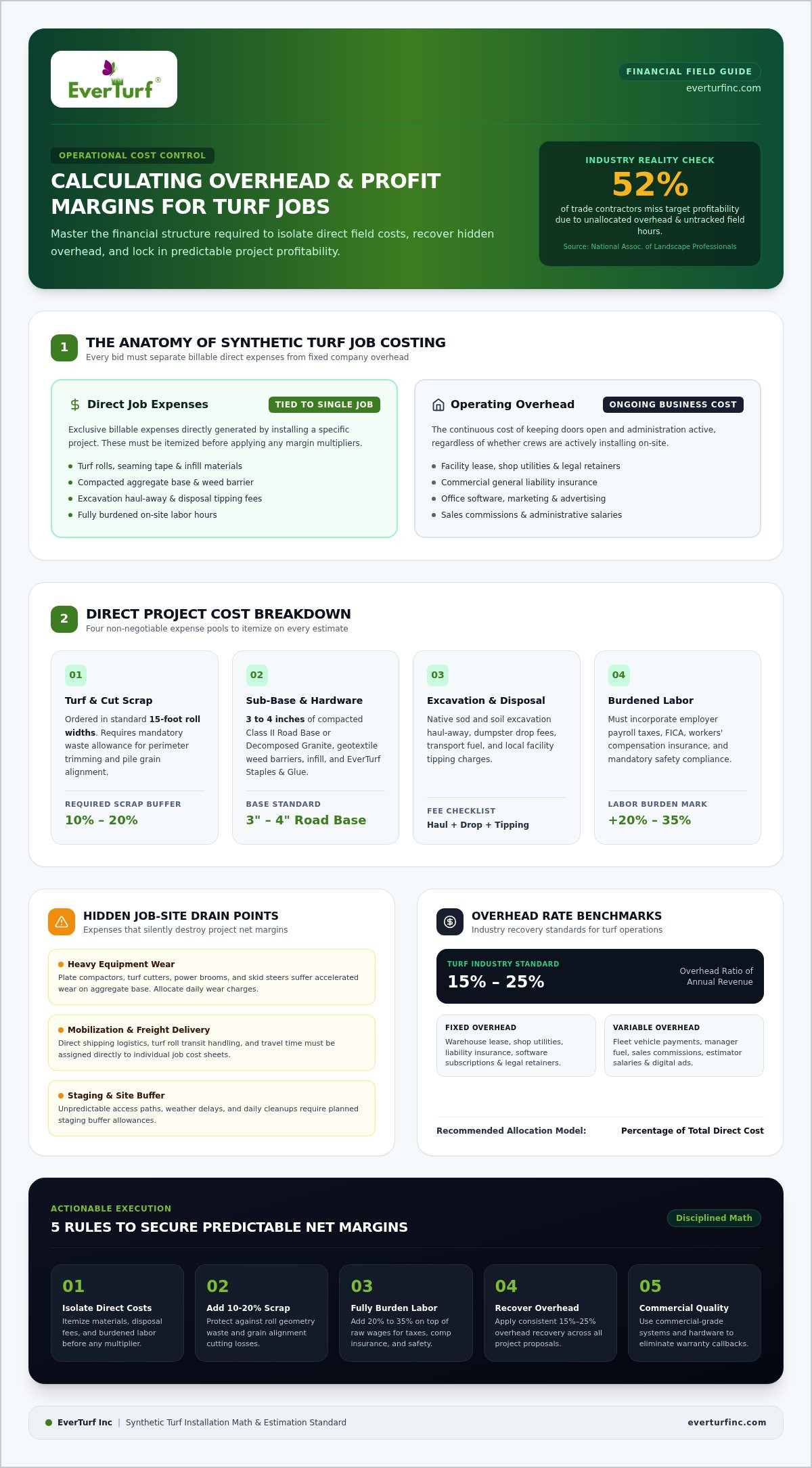
Every profitable synthetic grass installation rests on a clear financial foundation: knowing where direct job costs end and indirect operating expenses begin. Direct costs represent the billable materials, labor hours, and disposal fees tied exclusively to completing a single project. Indirect costs, by contrast, are the ongoing overhead expenses required to keep your business running regardless of whether your crews are on site. Conflating these two expense pools creates a false sense of security during bidding, causing contractors to bleed capital through unnoticed field expenses. When calculating overhead and profit margins for turf jobs, accurate job costing serves as your essential starting point.
Direct Project Costs: Materials, Labor, and Site Disposal
Direct costs require itemized accounting before applying any markup or margin multipliers. Synthetic turf involves far more than simply ordering turf rolls:
- Turf Materials and Cut Scrap: Account for full roll widths (typically 15-foot rolls) and require a standard waste allowance of 10% to 20% to accommodate irregular yard perimeters and mandatory pile grain alignment.
- Sub-Base and Hardware Supplies: Factor in compacted aggregate (such as 3 to 4 inches of Class II Road Base or Decomposed Granite), high-grade geotextile weed barriers, commercial performance infill, and heavy-duty fastening hardware like EverTurf Staples and Glue.
- Excavation Disposal: Itemize site haul-away, dumpster drop fees, and facility tipping charges for excavated native sod and soil.
- Burdened Field Labor: Apply fully burdened hourly rates that incorporate employer payroll taxes, FICA, workers’ compensation insurance, and field safety programs, which typically add 20% to 35% on top of raw wages.
Hidden Job-Site Expenses That Turf Contractors Overlook
Operational leakages rarely show up on simple material receipts. They quietly accumulate across job cycles, turning a seemingly lucrative contract into a financial loss.
Equipment wear represents a major blind spot. Heavy machinery such as plate compactors, turf cutters, power brooms, and skid steers suffer intense wear on aggregate sub-bases. Failing to allocate daily equipment usage charges leaves the business paying out of pocket for mechanical repairs and fresh cutter blades. Site mobilization and freight delivery fees also belong under direct job costing. Additionally, building a small staging allowance for unpredictable site access, adverse weather hold-ups, and thorough end-of-day cleanups ensures that calculating overhead and profit margins for turf jobs captures the true reality of field operations.
How to Calculate Your True Overhead Rate for Artificial Turf Operations
Operating expenses run continuously, even when severe weather or scheduling delays keep crews off the job site. Overhead encompasses every dollar required to keep your doors open and administrative operations running smoothly. To recover these expenses, you must determine your annual operating overhead and divide it by your billable capacity, whether measured through billable crew hours or annual project revenue. Applying this recovery rate consistently across every proposal is the foundation of disciplined estimating.
Cataloging Fixed and Variable Operating Overhead Expenses
Begin by cataloging non-job expenses from the previous twelve months into two distinct categories:
- Fixed Overhead: Costs that remain steady regardless of volume, such as warehouse leases, shop utilities, commercial general liability insurance, legal retainers, and office software subscriptions.
- Variable Administrative Overhead: Expenses that fluctuate alongside business activity, including fleet vehicle payments, fuel for management, sales commissions, estimator salaries, and digital marketing advertising.
Industry benchmarks indicate that established specialty landscape and turf operations typically carry an overhead ratio between 15% and 25% of annual revenue. Knowing your specific percentage prevents under-recovering operational overhead on complex jobs.
Selecting the Best Overhead Recovery Method for Your Business
Once you tabulate your annual overhead, choose an allocation model that aligns with your operational structure. The simplest option is the percentage of total direct cost method, which applies a flat overhead percentage across all materials, labor, and subcontractor expenses. While straightforward, it can disproportionately penalize material-heavy projects while under-recovering costs on intricate, labor-heavy builds.
A more balanced alternative is the Direct Labor Hour (DLH) method. Divide your total annual overhead dollars by the total billable field labor hours your crews generate annually. This approach produces an hourly overhead recovery rate that you attach directly to each scheduled crew-hour on site.
Never rely solely on a flat overhead rate per square foot. A 500-square-foot tiered pet lawn with difficult access demands far more managerial oversight, layout planning, and machinery run time than an open, level putting green. Wholesale partners like EverTurf support contractors with dependable logistics and commercial-grade systems, keeping field hours productive. Mastering these recovery methods makes calculating overhead and profit margins for turf jobs an objective science rather than an educated guess.
Markup vs. Margin: The Math That Protects Your Turf Profits
Many contractors conflate markup with gross margin, creating an invisible cash drain that quietly undermines an otherwise busy operation. Markup is the percentage you add on top of direct job costs to establish a contract price. Gross margin, conversely, represents the actual percentage of total revenue remaining after subtracting those direct costs. Failing to distinguish between the two leads to underpriced bids. When calculating overhead and profit margins for turf jobs, mastering this conversion ensures your proposals generate genuine retained earnings.
The Mathematical Distinction Between Gross Margin and Markup
A simple mathematical error explains why many landscape trades underbid projects. Suppose an installation carries $10,000 in combined aggregate, hardware, turf materials, and direct labor. Adding a 20% markup sets the contract price at $12,000. While that looks like a 20% profit, the resulting $2,000 spread yields only a 16.7% gross margin ($2,000 divided by $12,000). If your annual business overhead sits at 18%, that project immediately operates at a net loss.
To establish pricing based on desired margins, apply this standard conversion formula:
Markup = Desired Margin / (1 – Desired Margin)
Refer to these essential industry conversion thresholds during your bid calculations:
- 20% Gross Margin: Requires a 25.0% markup on direct costs.
- 25% Gross Margin: Requires a 33.3% markup on direct costs.
- 30% Gross Margin: Requires a 42.9% markup on direct costs.
- 35% Gross Margin: Requires a 53.8% markup on direct costs.
- 40% Gross Margin: Requires a 66.7% markup on direct costs.
Targeting Healthy Net Profit Margins in the Synthetic Grass Industry
Sustainable operations require distinct target thresholds for both gross and net returns. Established synthetic turf contractors routinely target a gross profit margin between 35% and 50% across standard installations. After accounting for administrative overhead, vehicle depreciation, and facility costs, this target preserves a healthy net profit margin between 10% and 15%.
Maintaining these targets also requires establishing a gross profit floor for every scheduled crew-day. Setting a mandatory daily contribution margin ensures each field crew produces enough gross income above direct labor and materials to cover fixed overhead burdens. Grounding your quotes in true margin math rather than arbitrary markups brings discipline and predictability to calculating overhead and profit margins for turf jobs.
Step-by-Step Guide to Pricing a Turf Installation Project
Bidding an installation accurately requires moving sequentially through direct job costs, overhead burden, and final target margins. Rushing this sequence leaves money on the table or forces you to absorb field overruns. When calculating overhead and profit margins for turf jobs, your ultimate proposal price should reflect a mathematically sound structure: Bid Price = (Direct Job Costs + Overhead Recovery Dollars) / (1 – Target Net Margin %). Following this formula shields your business from arbitrary discounting.
Calculating Complete Direct Costs for Materials and Labor
Start with exact field measurements and convert those net dimensions into gross roll orders. Turf arrives in fixed 15-foot widths, and cuts must preserve uniform pile direction. Account for at least a 10% to 20% waste factor depending on curvature and obstacles. Next, tally all companion materials required to construct a durable base, including containment edging, commercial geotextile fabric, Class II road base or decomposed granite, and perimeter nails.
Reference comprehensive estimating practices outlined in artificial turf installation cost to refine your regional sub-base budgets. Then, estimate specialized infill needs using guidelines from the turf infill guide. Determine total crew-hours required for excavation, base compaction, seaming, and infill distribution, multiplying those hours by your fully burdened labor rate to complete your direct cost baseline.
Building Contingencies for Complex Ground and Drainage Conditions
Site conditions can derail labor estimates if overlooked during initial site visits. Difficult site access, steep elevation drops, and narrow side gates quickly double excavation and hauling hours by forcing crews to wheelbarrow tons of aggregate by hand. Evaluate site friction factors before issuing a contract:
- Sub-Surface Obstacles: Unmarked irrigation lines, dense tree root networks, or buried bedrock require dedicated trenching contingencies.
- Drainage Corrections: Flat lawns with poor percolation require perforated pipe systems, catch basins, or deeper aggregate layers.
- Intricate Borders: Scribing synthetic turf around masonry and curved garden beds demands significant detail work. Account for the specialized installation methods required when laying synthetic backyard turf around landscape hardscapes.
After compiling direct costs and logistical contingencies, add your overhead allocation dollars and apply your target margin divisor. To build predictable bids backed by commercial-grade turf, adhesives, and hardware, partner with EverTurf to supply your upcoming installations and protect your bottom line from the start.
Protecting Margins Long-Term With Premium Turf Systems
Disciplined estimating secures your profit on paper, but material performance decides whether that profit stays in the bank. Bidding formulas only succeed when installations hold up under real-world conditions. When calculating overhead and profit margins for turf jobs, your long-term return depends directly on mitigating post-install failures. Re-mobilizing a crew to repair failed seams, correct uneven settling, or replace degraded turf instantly devours your projected 10% to 15% net profit margin. True margin protection requires combining meticulous financial formulas with commercial-grade materials that perform year after year.
Eliminating Profit Bleed From Callbacks and Warranty Claims
A single warranty remediation visit destroys project profitability. Between round-trip vehicle fuel, lost labor hours, and fresh material patches, non-billable service calls turn profitable jobs into net losses. Protecting your bottom line demands choosing reliable, resilient components from the outset.
Review the ultimate guide to artificial grass to match heavy-traffic applications with heavy-duty backing structures and UV-stabilized fibers. Pairing durable turf rolls with commercial-grade EverTurf Staples and Glue ensures that seams, edges, and high-impact corners remain locked in place. Secure bonds resist temperature shifts and intense foot traffic, eliminating the curling or seam separation that triggers costly return trips.
Streamlining Procurement Across Commercial and Residential Projects
Logistical delays and inconsistent material lots eat away at site productivity. Standardizing your workflow around proven wholesale systems simplifies estimating and protects field efficiency:
- Consistent Turf Quality: Rely on versatile EverTurf Artificial grass to give residential lawns and commercial properties natural aesthetics alongside long-term durability.
- Engineered Ballast: Apply specialized EverTurf Infill systems to stabilize yarn blades, promote clean vertical drainage, and resist pet compaction.
- National Distribution: Align with a reliable supplier to maintain stable wholesale pricing, uniform roll colors, and dependable lead times.
Understanding how working with EverTurf Inc supports your supply pipeline gives your business a lasting competitive advantage. Consistent wholesale systems eliminate job-site improvisations and costly warranty drains, ensuring that calculating overhead and profit margins for turf jobs delivers the lasting business growth you worked to achieve.
Lock In Predictable Profit on Every Installation
Stepping away from guesswork gives your installation business the financial certainty it deserves. Sustainable growth comes down to mastering the mechanics: capturing complete field expenses, calculating indirect overhead accurately, and applying true margin divisors rather than flat markups. When you treat calculating overhead and profit margins for turf jobs as an exact discipline, every signed proposal protects your cash flow and rewards your hard work.
Long-term profitability also depends on the physical resilience of the products you lay into the ground. Partnering with a dedicated supplier eliminates supply chain disruptions and costly warranty callbacks. With an extensive national supply catalog covering residential, athletic, and specialty turf applications, engineered commercial turf accessories including EverTurf Infill and specialized adhesives, and reliable national distribution protecting contractors against costly project delays, you can bid with total confidence. Partner with EverTurf Inc for reliable, commercial-grade turf supplies nationwide, and build outdoor spaces designed to endure.
Frequently Asked Questions
What is a healthy profit margin for an artificial turf installation contractor?
Established synthetic turf contractors target a gross profit margin between 35% and 50%, which leaves sufficient room to absorb operating overhead while retaining a net profit margin of 10% to 15%. Top-tier specialty trade operators occasionally hit 16% net on complex custom designs. Maintaining these returns requires enforcing a firm daily gross profit floor for each crew, ensuring your business stays profitable across fluctuating seasonal workloads.
How do I calculate overhead costs for my synthetic grass business?
Calculate overhead costs by totaling all indirect annual expenses, including facility rent, office utilities, liability insurance, software subscriptions, marketing campaigns, and administrative management salaries. Once you tally these annual operating expenses, divide that total by your billable capacity, such as your total billable field labor hours. This process establishes a dependable recovery rate to apply to every bid when calculating overhead and profit margins for turf jobs.
What is the difference between markup and profit margin when bidding turf jobs?
Markup is the percentage added directly to your job costs to establish a selling price, whereas profit margin is the percentage of the final contract revenue that remains after paying those costs. For instance, achieving a 25% gross margin requires a 33.3% markup on total direct expenses. Confusing the two metrics causes contractors to underprice bids, mistakenly believing they’re securing higher margins than they actually are.
Why do turf contractors frequently underestimate their total direct job costs?
Contractors usually underestimate direct costs by overlooking logistical friction and scrap factors. Synthetic grass rolls arrive in fixed widths, and aligning pile direction often requires ordering 10% to 20% extra material for trimming cuts. Estimators also routinely forget to bill for excavation disposal fees, sub-base compaction time, fuel delivery surcharges, and the daily mechanical wear that compactors, turf cutters, and power brooms endure on aggregate sub-bases.
How do callbacks and warranty repairs impact net profit margins?
Unplanned return trips quickly erase the entire net profit earned on an installation. Remobilizing a crew to fix a separated seam, re-level base aggregate, or patch curled borders consumes unbillable labor hours, fuel, and replacement materials. Because net margins typically sit around 10% to 15%, absorbing just a single unpaid half-day service remediation visit can turn an otherwise successful project into a financial loss.
Should turf installation overhead be calculated per square foot or per labor hour?
Calculating overhead per billable labor hour is far more accurate than relying on a flat square-foot rate. Every project presents unique site access hurdles, grading demands, and layout complexities that dictate crew time regardless of surface area. Distributing annual overhead expenses across total scheduled field hours ensures that intricate, labor-heavy builds recover their fair share of operational costs without penalizing simpler, open-lawn installations.
How does material quality affect the long-term profitability of synthetic turf jobs?
Sourcing commercial-grade materials directly protects your bottom line against early system degradation and client disputes. Premium turf rolls like EverTurf Artificial grass combined with EverTurf Infill and EverTurf Staples and Glue ensure that seams remain invisible and fibers stay resilient under heavy traffic. High-performing systems eliminate costly warranty callbacks, proving essential when calculating overhead and profit margins for turf jobs that generate predictable, long-term business growth.