
HOA Approval for Artificial Turf: 2026 Strategic Guide
Your HOA board isn’t looking for reasons to say “no” to your home improvement plans; they’re looking for evidence that your project will enhance the community’s collective value. It’s common to feel a wave of anxiety when facing a stack of architectural guidelines or trying to decode complex CC&R language. You deserve the tranquility of a perfect, low-maintenance outdoor space, but the fear of rejection or unexpected fines can make the process feel like an uphill battle. This initial friction shouldn’t stand between you and the lifestyle upgrade you’ve envisioned for your property.
Securing a “Yes” requires more than just a request; it requires a strategic presentation of quality and environmental stewardship. This 2026 guide reveals exactly how to get HOA approval for artificial turf using a professional framework that speaks the board’s language. We’ll walk you through the latest national legal protections, the technical performance of EverTurf Infill for superior drainage, and the aesthetic details that satisfy even the strictest architectural committees. You’re about to transform your lawn from a source of stress into a permanent, sophisticated retreat that meets every neighborhood standard with poise.
Key Takeaways
- Learn to distinguish between outdated community bans and modern architectural standards to ensure your project aligns with 2026 legal protections.
- Discover exactly how to get HOA approval for artificial turf by compiling a comprehensive submission packet that features professional-grade material samples and technical cut sheets.
- Overcome common aesthetic objections by presenting the science behind multi-tonal fibers and high-performance drainage systems like EverTurf Infill.
- Master the timeline of the Architectural Review Committee (ARC) to avoid bureaucratic delays and move your project toward a seamless approval.
- Position your synthetic lawn as a premium property enhancement that increases home value while permanently eliminating the frustrations of traditional maintenance.
Navigating the HOA Landscape for Artificial Grass in 2026
The days of homeowner associations reflexively banning synthetic lawns are fading into the past. In 2026, a shift toward water scarcity and a demand for high-end, sustainable aesthetics have forced boards to modernize their design standards. Boards today aren’t just looking at grass; they’re looking at property value preservation. A well-maintained synthetic lawn often looks better than a patchy, brown natural one, and boards are starting to see the logic in that trade-off. They’ve moved from asking “if” artificial lawns should be allowed to asking “what quality” is acceptable. Understanding this shift is the first step in learning how to get HOA approval for artificial turf without unnecessary friction.
Understanding CC&Rs and Design Guidelines
Your journey begins with a deep dive into your community’s Covenants, Conditions, and Restrictions (CC&Rs). You’ll typically find the relevant rules under the “Landscaping” or “Architectural Control” sections. Don’t be discouraged by vague terms like “harmonious appearance” or “natural look.” These are subjective markers that professional-grade artificial grass is designed to meet. Some communities have already updated their pre-approved materials lists to include high-density synthetic options. If yours hasn’t, you have the opportunity to set the gold standard for your neighborhood by presenting a solution that mirrors the lush, vibrant look of local sod while offering superior durability.
The Impact of Modern Water Conservation Laws
In 2026, state-level legislation has become a powerful ally for homeowners. You should leverage these legal protections to support your application. For example:
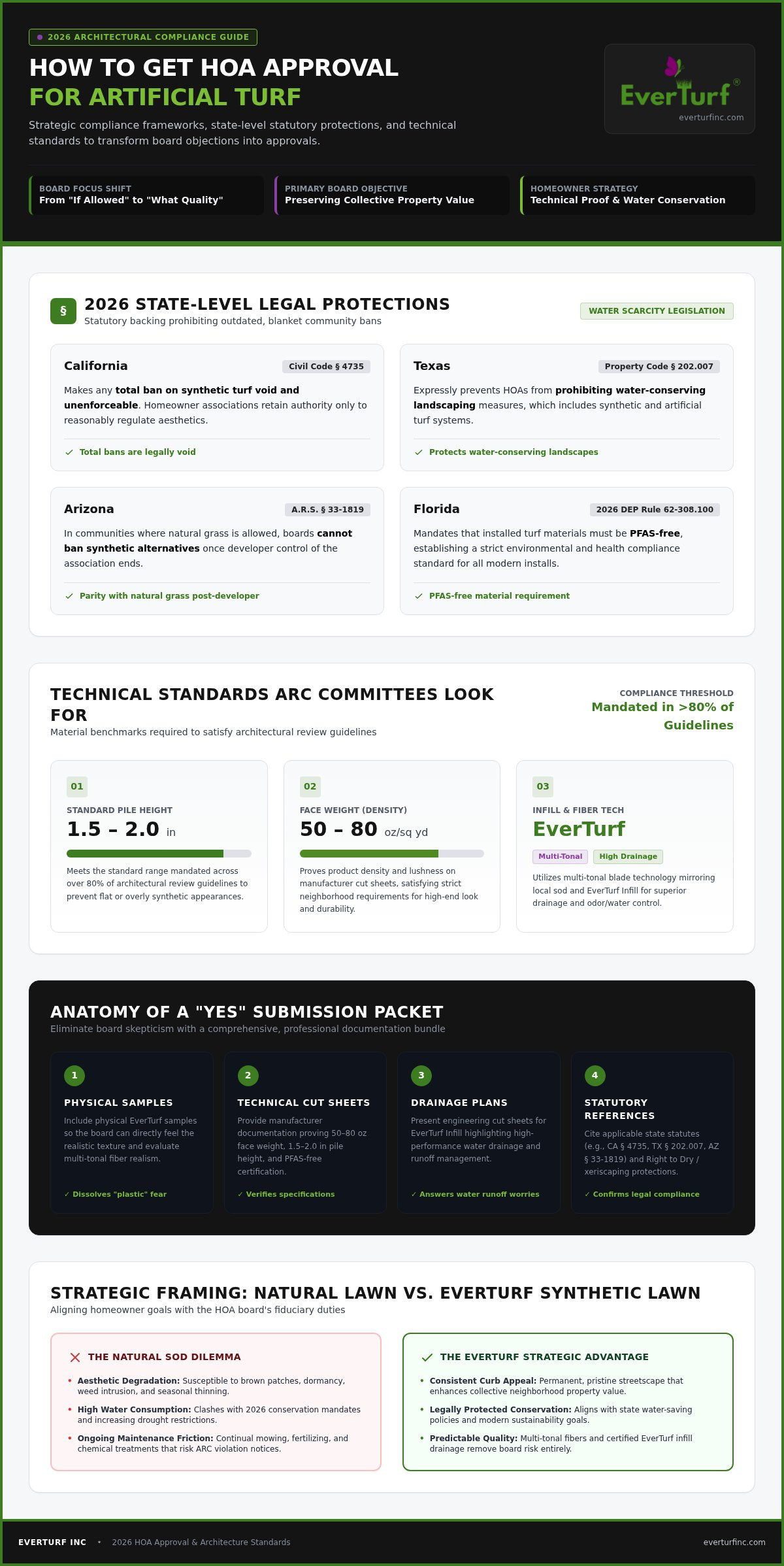
- California: Civil Code § 4735 makes any total ban on synthetic turf void and unenforceable, though boards can still regulate aesthetics.
- Texas: Property Code § 202.007 prevents HOAs from prohibiting water-conserving landscaping, including artificial turf.
- Arizona: Under A.R.S. § 33-1819, communities where natural grass is allowed cannot ban synthetic alternatives once developer control ends.
- Florida: The 2026 DEP Rule 62-308.100 now requires turf to be PFAS-free, a standard that premium products easily meet.
Positioning your backyard turf as a responsible environmental choice is a winning strategy. Mentioning “Right to Dry” or xeriscaping protections shows the board that your request isn’t just a personal preference, but a legally backed move toward sustainability. When you frame your project as a way to reduce community water consumption while maintaining a pristine streetscape, you align your goals with the board’s duty to protect the neighborhood’s long-term interests.
Compiling Your Professional HOA Approval Packet
A disorganized application invites skepticism; a polished, professional packet builds trust. When you’re determining how to get HOA approval for artificial turf, your goal is to eliminate every possible reason for a board member to say “no.” By providing a comprehensive set of documents, you demonstrate that your project is well-planned and will enhance the community’s overall aesthetic. Boards are much more likely to approve a project when they see that the homeowner has considered every technical and visual detail.
Essential Documents and Physical Samples
The most persuasive tool in your arsenal is a physical sample of EverTurf artificial grass. Boards often fear the “plastic” look of low-grade products. Seeing and feeling the realistic texture of premium fibers can instantly dissolve that anxiety. Your packet should include specific manufacturer spec sheets that highlight a face weight of 50 to 80 ounces per square yard to prove density. You should also specify a pile height between 1.5 and 2.0 inches, as this is the standard range mandated in over 80% of modern architectural design guidelines.
If your board expresses hesitation regarding the legality of your request, you can point to specific protections such as California Civil Code Section 4735. This statute renders void any community rules that effectively prohibit synthetic grass. Having these facts ready shows you’ve done your homework and understand the balance between community rules and state law. A detailed diagram of the proposed installation area, including drainage plans, further proves your commitment to a high-quality transformation.
Visualizing the Transformation: Photos and Renderings
Don’t leave the final result to the board’s imagination. High-resolution “After” renderings allow committee members to visualize the sophisticated, year-round beauty your project will bring to the streetscape. If other neighbors have already received approval, include photos of their homes as a precedent. This creates a sense of community continuity and makes it difficult for the board to deny your request without appearing arbitrary. It’s about showing that your lawn will be an asset to the entire neighborhood.
Conclude your packet with a single, clear aesthetic goal statement. For example, specify that your intent is to install a drought-resistant, multi-tonal synthetic lawn that preserves the neighborhood’s lush character while significantly reducing water consumption. This clarity leaves no room for ambiguity. If you’re ready to start building your packet, you can explore EverTurf Inc’s premium product lineup to find the perfect match for your home’s unique style.
Proving Quality: Addressing HOA Aesthetic and Technical Concerns
Winning over a skeptical board requires moving the conversation from subjective opinions to objective performance. When discussing how to get HOA approval for artificial turf, your strongest defense against the “fake” look is a deep dive into technical specifications. Modern synthetic solutions aren’t the lime-green carpets of the past. They’re engineered ecosystems designed to mimic the biological complexity of local flora while outperforming natural grass in every measurable way. Boards want to know that your lawn won’t degrade the neighborhood’s visual character, and providing logical evidence of quality is the best way to reassure them.
Pile Height, Face Weight, and Color Matching
A pile height of 1.5 to 2 inches is the industry “sweet spot” for a reason. It provides enough length to create natural shadows and movement without looking unkempt. Boards often look for a face weight between 50 and 80 ounces per square yard, which indicates a dense, luxurious surface that won’t flatten over time. Matching your turf’s color blend-incorporating olive, field green, and tan thatch layers-to local indigenous species ensures the installation feels like a harmonious extension of the neighborhood rather than a jarring departure. This level of detail proves that your project is a premium property enhancement.
Drainage and Environmental Safety Standards
Boards frequently worry about runoff and environmental impact. You can proactively address this by citing EPA WaterSense outdoor water use statistics, which show that landscape irrigation accounts for a massive portion of residential water consumption. Switching to a synthetic lawn is a high-impact conservation move that aligns with 2026 environmental priorities. To ensure the board understands the technical integrity of your lawn, present the benefits of turf infill. This component provides the necessary ballast for stability while facilitating a drainage rate that often exceeds 30 inches per hour, which is far superior to traditional soil.
Address the “Heat Island” concern by specifying modern cooling infills that can reduce surface temperatures by 30 to 50 degrees Fahrenheit. Emphasize that your chosen products are non-toxic, lead-free, and PFAS-free, meeting the strict environmental standards mandated by state laws in 2026. Finally, present a simple maintenance plan-periodic brushing and rinsing-to prove the lawn will remain pristine for a decade or more. This level of technical transparency shows the committee that your project is a sophisticated, long-term investment in the community’s collective beauty.
The Submission Process: From Application to Board Meeting
Submitting your application is the moment your meticulous preparation meets the community’s formal process. It’s natural to feel a bit of trepidation when handing over your vision to a committee, but remember that you’re presenting a solution that benefits the entire neighborhood. Understanding how to get HOA approval for artificial turf involves mastering the bureaucratic rhythm of your association. By treating the submission as a professional partnership rather than a confrontation, you set a tone of cooperation that makes a “Yes” much more likely.
Following the Official Review Timeline
Timing is everything when navigating the Architectural Review Committee (ARC). You should aim to submit your complete application packet at least 30 days before the next scheduled board meeting. Most association review windows span between 30 and 45 days from the date a packet is marked legally complete. Don’t simply drop off your documents and wait; confirm receipt in writing and ask for a preliminary review to ensure nothing is missing. This proactive step prevents the committee from restarting the clock due to a minor technicality.
It’s also wise to check your CC&Rs for a “deemed approved” clause. In certain jurisdictions, such as Nevada under NRS § 116.3175, the board has a strict 45-day statutory deadline to issue a written decision. If they fail to respond within that window, the application may be legally considered approved. Knowing these specific timelines protects your interests and keeps your project moving forward without unnecessary delays.
Presenting Your Case to the Architectural Review Committee
If you’re invited to speak at a meeting, lead with the collective benefits of your project. Focus on how a premium synthetic lawn enhances curb appeal and ensures a consistent, pristine look for the streetscape year-round. Prepare clear, concise answers for common questions regarding pet odors or drainage. You can confidently explain how high-performance systems and specialized infill prevent odors and manage heavy rain more effectively than traditional sod. This consultative approach positions you as a responsible homeowner who values the community’s standards.
Sometimes, a board may offer a “conditional approval,” perhaps requesting specific edging or a hybrid design that includes living borders. Treat these requests with grace; they are a roadmap to your final goal. Document every communication, including emails and meeting minutes, to prevent compliance disputes down the road. Clear documentation ensures that once your lawn is installed, it remains a permanent and protected feature of your home. If you need assistance gathering the technical details for your presentation, you can connect with an EverTurf specialist to get the professional support you need for a successful submission.
Turning Approval into Reality with EverTurf Solutions
Receiving your approval letter is a moment of total relief, but the journey toward a stress-free landscape is just beginning. Now that you’ve mastered how to get HOA approval for artificial turf, the final step is ensuring the physical installation matches the high-resolution renderings you presented. A premium project requires more than just high-end turf; it requires a holistic system designed for durability and community harmony. Understanding the artificial turf installation cost as a long-term investment helps you appreciate the value of professional-grade materials that won’t degrade under the local climate. This transition to a maintenance-free lifestyle restores your personal time, allowing you to enjoy your outdoor oasis rather than laboring over it.
Selecting Premium EverTurf Synthetic Grass
Choosing the right product is essential for long-term satisfaction. EverTurf offers a curated selection of textures and tones to satisfy even the most discerning architectural committees. Whether you choose EverTurf Artificial grass for a lush, residential look or the professional-grade EverTurf Putting Green Pro for a custom backyard retreat, the result is always a sophisticated color palette that mimics natural sod. When you understand how to get HOA approval for artificial turf, you know that boards demand a seamless finish. This is why we prioritize high-quality EverTurf Staples and Glue to prevent visible seams and edge lifting, which are the two most common reasons for post-installation disputes.
Professional Installation and Accessory Integration
Professional installation remains the most reliable way to maintain community standards. While DIY projects might seem tempting, they often result in drainage issues or uneven surfaces that attract board scrutiny. A professional crew ensures your lawn integrates perfectly with existing hardscapes and landscaping beds. You might even consider incorporating EverTurf Pavers to create a high-end, architecturally sound design that elevates your property’s value. These structured elements provide a polished frame for your synthetic lawn, proving to the board that your project is a premium home improvement.
Once the project is complete, conduct a final walkthrough to ensure every detail exceeds board expectations. Check that bender boards are secure and that the infill is evenly distributed for a natural appearance. Keep your warranty and maintenance guide in your permanent homeowner records. These documents serve as your final proof of compliance and quality should any future questions arise from the association. By following through with professional execution, you turn your approved plan into a permanent, beautiful reality that enhances your entire neighborhood.
Secure Your Vision of a Stress-Free Landscape
Reclaiming your weekends starts with a strategic approach to your community’s guidelines. By leveraging modern water conservation laws and presenting a meticulous application packet, you position your project as a sophisticated community asset rather than just a personal preference. Mastering how to get HOA approval for artificial turf is about proving quality through technical excellence and aesthetic harmony. Utilizing advanced EverTurf Infill technology ensures your drainage meets the highest standards, while the professional-grade finish of EverTurf Putting Green Pro satisfies even the most discerning architectural committees.
Our team acts as a reliable visionary for national homeowners, providing the logical evidence and high-performance materials needed to secure a definitive “Yes.” You’re closer than ever to enjoying a pristine, year-round outdoor space that enhances your property’s value and restores your personal time. Take the definitive first step toward your home’s transformation today.
Request Your EverTurf Sample Kit for HOA Presentation
Your vision of a perfect, low-maintenance lawn is within reach, and we’re here to help you navigate every step with poise and professional authority.
Frequently Asked Questions
Can an HOA legally ban artificial turf in 2026?
While HOAs can regulate aesthetics, many states now prohibit outright bans through legislation like California Civil Code § 4735 or Texas Property Code § 202.007. Boards must allow synthetic options but can still mandate specific colors, densities, and pile heights. It’s vital to check your state’s specific 2026 water conservation mandates before submitting your request to ensure your project aligns with current legal protections.
What are the most common reasons an HOA denies artificial grass?
Rejections often stem from concerns about plastic appearances, poor drainage, or visible seams. Boards typically deny applications that lack technical specifications or samples of high-quality products. If your packet doesn’t prove a face weight of at least 50 ounces or show a multi-tonal thatch layer, the committee might deem the product incompatible with neighborhood standards. Professional-grade materials help mitigate these common aesthetic objections.
Do I need to show my neighbors my turf plans before submitting to the HOA?
Most associations don’t strictly require neighbor approval; however, checking your CC&Rs is essential. Some communities require a neighbor awareness signature to ensure the project doesn’t impact adjacent drainage or sightlines. Gaining neighbor support early can prevent complaints during the board meeting. Providing a clear diagram of your installation area helps reassure everyone that the transition will be seamless and professional.
How many turf samples should I provide in my approval packet?
You should provide at least two distinct samples of EverTurf Artificial grass to show the board different density and color options. Including a sample of the specialized EverTurf Infill is also a smart move. This demonstrates the system’s drainage capabilities and technical integrity. Physical samples allow the committee to touch and see the realism firsthand, which is the most effective way to secure their trust.
What happens if I install artificial turf without HOA approval?
Installing without prior written consent can lead to daily fines, legal action, or a mandatory removal order at your expense. Even if your state protects the right to install synthetic lawns, you must still follow the association’s specific architectural review process. It’s always faster and cheaper to wait for the official Yes than to fight a non-compliance dispute after the project is finished.
Is there a specific pile height that HOAs prefer for front yards?
Most architectural committees prefer a pile height between 1.5 and 2 inches for visible areas. This range mimics the look of a well-manicured natural lawn without appearing too shaggy or too flat. When you’re researching how to get HOA approval for artificial turf, look for products that fall within this sweet spot. It provides the most realistic shadows and movement for a sophisticated streetscape.
How do I prove to the board that artificial turf is environmentally friendly?
Focus on water conservation and the elimination of chemical runoff from fertilizers and pesticides. You can cite government data showing that landscape irrigation accounts for a massive portion of residential water use. Highlighting that modern synthetic solutions are PFAS-free and lead-free also addresses safety concerns. Using a high-performance system reduces your home’s environmental footprint while maintaining a lush, green aesthetic year-round.
Can I appeal an HOA’s decision if they reject my turf application?
You absolutely have the right to appeal a rejection, typically through an internal board hearing or mediation. If the denial was arbitrary or violated state laws like Florida’s HB 1203, you have strong grounds for a reversal. Learning how to get HOA approval for artificial turf often involves a second presentation where you address the board’s specific technical or aesthetic concerns with updated data.