



How to Verify a Turf Installer’s License and Insurance: 2026 Guide
A printed certificate handed across your kitchen table guarantees absolutely nothing. If you want genuine protection from personal liability and substandard ground preparation, learning how to verify a turf installer’s license and insurance directly through state boards and policy underwriters is non-negotiable. Upgrading your landscape should restore your personal time and create an everlasting, lush outdoor sanctuary, not burden you with property damage or the financial fallout of an uninsured job-site injury.
We recognize how confusing technical jargon like surety bonds, indemnification clauses, and Certificates of Insurance can feel when you simply want a flawless lawn. In this 2026 guide, you’ll discover how to independently authenticate contractor credentials, validate active general liability and workers’ compensation coverage, and protect your material warranties. Ahead is the straightforward, step-by-step verification process you need to confirm qualified workmanship and safeguard your home with total peace of mind.
Key Takeaways
- Master how to verify a turf installer’s license and insurance by obtaining direct underwriter verification rather than relying on unverified paperwork.
- Differentiate between general liability and workers’ compensation coverage to shield your household from costly property damage and medical claims.
- Navigate official state licensing board databases independently to confirm active contractor standing, trade classifications, and bond history.
- Evaluate critical sub-base drainage and grading standards to protect your property and preserve manufacturer warranties.
- Ensure lasting beauty and performance by matching credentialed installation teams with high-grade EverTurf Artificial grass and specialized accessories.
Why Verifying Credentials Protects Your Synthetic Lawn Investment
Investing in synthetic grass promises freedom from relentless mowing, fertilizing, and watering. Yet that lifestyle upgrade quickly vanishes if an unqualified crew takes shortcuts on your property. Truly verified contractor status means the installer holds an active, state-approved trade specialty license and carries direct underwriter-backed insurance coverage. Learning how to verify a turf installer’s license and insurance protects you from poor craftsmanship while neutralizing severe civil exposure before a single blade of grass is laid.
Substandard excavation or flawed aggregate grading compromises drainage permeability, leading to standing water, bacterial accumulation, and buckled seams. Beyond foundational failures, unvetted labor introduces major financial hazards. Understanding the legal definition of a contractor clarifies why these credentials matter: independent contractors operate under distinct legal boundaries, and without valid trade licensing or mandatory protections, the liability for job-site property destruction shifts squarely onto your shoulders.
Financial and Legal Liabilities of Unlicensed Work
Standard homeowner insurance policies routinely exclude losses caused by uncertified commercial entities operating on your land. If an unlicensed worker severs a buried irrigation main or suffers a fall, you could face personal injury claims without homeowner policy defense. Additionally, fly-by-night operators often obtain aggregates, specialized turf materials, or equipment on credit. If the contractor disappears without settling those supplier accounts, unpaid vendors can place mechanics liens directly on your residential deed, trapping your equity in protracted legal disputes.
Protecting Manufacturer Product Warranties
Premium synthetic systems, detailed in the ultimate guide to artificial grass, demand meticulous adherence to engineering benchmarks. When homeowners master how to verify a turf installer’s license and insurance, they protect more than their immediate yard; they preserve their long-term factory warranty coverage. Leading manufacturers explicitly tie their material guarantees to qualified installation techniques.
- Sub-base depth and compaction: Inadequate dynamic compaction allows aggregate shifts, stressing synthetic backings and causing premature seam failure.
- Drainage compliance: Unverified grading violates base permeability standards, encouraging pooling that accelerates turf fiber degradation.
- Documented compliance: Retaining certified contractor agreements serves as ironclad proof of proper installation, preventing manufacturers from rejecting claims for premature wear.
Step-by-Step Guide: How to Verify a Turf Contractor’s License
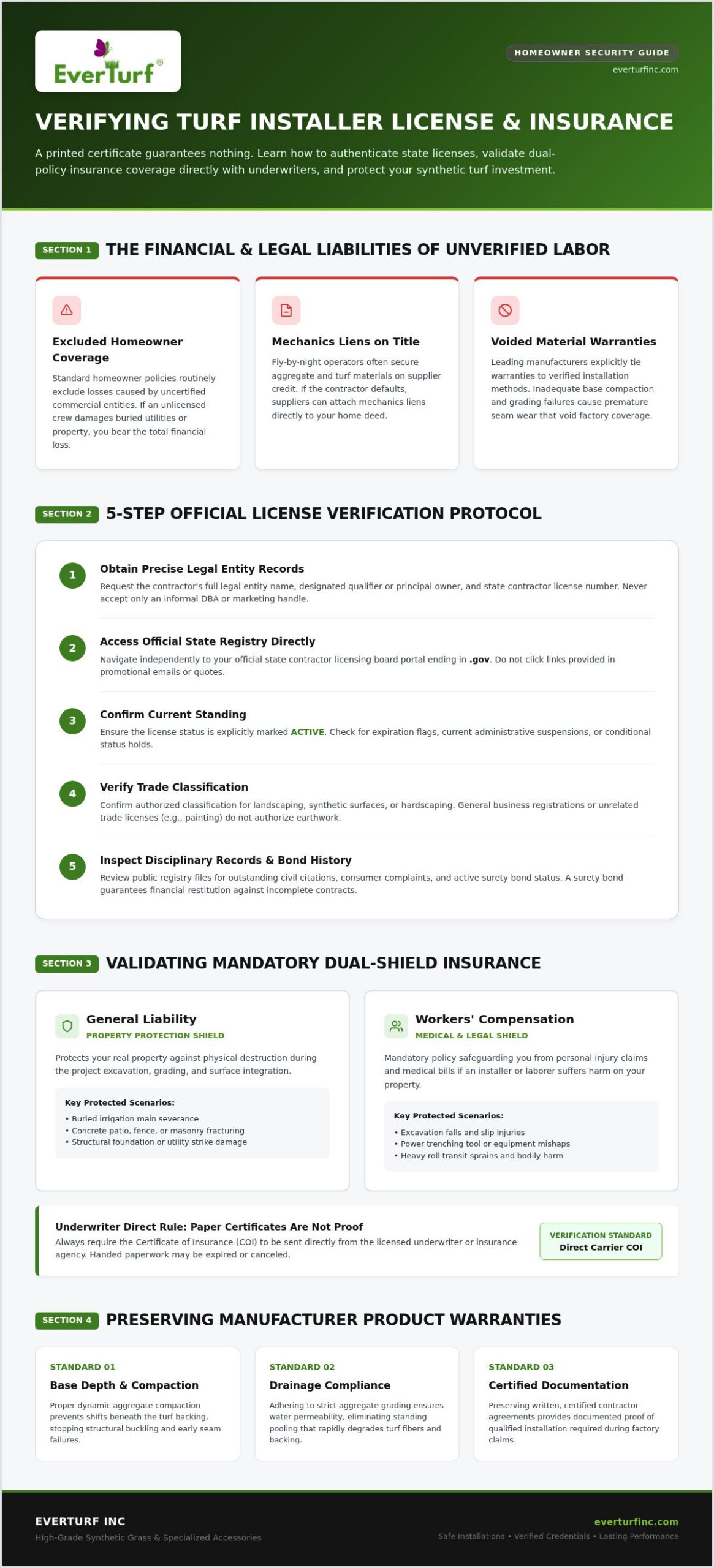
Confirming credentials requires more than accepting a photocopied certificate or trusting a marketing badge. A general business registration allows an entity to pay local taxes, but it does not grant legal permission to grade earth, alter drainage, or install exterior surfaces. To ensure your project delivers lasting beauty, follow this five-step protocol explaining how to verify a turf installer’s license and insurance through official channels:
- Obtain precise entity records: Ask for the contractor’s full legal entity name, designated qualifier or principal owner, and state contractor license number.
- Access the state registry directly: Visit your state licensing board’s portal without relying on links provided in promotional emails.
- Confirm current standing: Check that the license status reads “active” and shows no current suspensions, administrative holds, or expiration flags.
- Verify the trade classification: Ensure the license specifically authorizes landscaping, specialty synthetic surfaces, or residential hardscaping rather than unrelated trades like painting or basic maintenance.
- Inspect disciplinary records: Review the public record for civil citations, unresolved consumer complaints, or bond claims.
Taking ten minutes to check these records ensures you partner with qualified professionals who respect building standards, leaving you free to explore premium surfaces from EverTurf Inc with confidence.
Navigating State Contractor Licensing Boards
Always verify records on official government websites ending in “.gov”. You can independently verify a contractor’s license to observe how legitimate state registries display bonding status, personnel names, and disciplinary actions. Run searches using both the company’s legal name and the owner’s personal name. If the physical business address on the registry contradicts the address on your written estimate, request immediate clarification before signing contracts or paying deposits.
Understanding Trade Classifications and Surety Bonds
A legitimate turf project requires specific technical knowledge. General building licenses, landscape specialty designations, and synthetic surfacing classifications reflect distinct training, testing, and bonding standards. Unlike insurance policies that defend against third-party injuries, surety bonds serve as financial security lines for homeowners if a contractor breaches the contract or leaves an unfinished excavation. Compare the installer’s active bond limit against your project total to verify that the surety provides adequate protection.
Validating Insurance: General Liability vs. Workers’ Compensation
Insurance coverage protects your household against financial catastrophe, but many homeowners mistakenly assume any certificate offers blanket security. When discovering how to verify a turf installer’s license and insurance, you must evaluate two completely separate protections: commercial general liability and workers’ compensation. Each policy addresses entirely different risks encountered during heavy landscape transformations.
General liability shields your assets against property destruction. Installing synthetic turf involves dynamic excavation, mechanical trenching, and hauling tons of crushed aggregate. If a skid steer fractures an underground gas line, cracks an expensive decorative driveway, or damages a neighbor’s retaining wall, general liability covers those repair costs. Look for businesses maintaining at least $1 million per occurrence in commercial general liability. However, this coverage does not provide a single dollar of relief if an installer suffers physical trauma on your property.
Deconstructing the Certificate of Insurance (COI)
Never accept a physical printout or forwarded PDF handed over by a sales representative. Unscrupulous operators sometimes purchase a policy to obtain paperwork, only to cancel it immediately for a premium refund. Follow this direct verification routine:
- Demand direct issuance: Require the contractor’s independent insurance agency or broker to email the Certificate of Insurance directly to your inbox.
- Match entity titles: Verify that the named insured corresponds letter-for-letter with the business entity designated on your turf installation contract.
- Confirm active dates: Check policy inception and expiration markers to verify active status throughout your anticipated project schedule.
- Request Certificate Holder status: Have the agent list your name and home address in the certificate holder box. This obligates the insurance carrier to send formal notice if the policy is cancelled mid-installation.
The Crucial Role of Workers’ Compensation
Excavating native dirt and moving dense aggregate base involves strenuous labor, vibrating plate compactors, and razor-sharp seam cutters. If an installer breaks an ankle or herniates a disc on your property, workers’ compensation covers their emergency medical bills and lost wages. In most jurisdictions, state regulations mandate this coverage for operations employing field crews.
Homeowners often fall victim to “ghost policies,” where an independent business owner purchases coverage that explicitly excludes all laborers or misclassifies field workers under clerical payroll codes. Always ask the broker whether the workers’ compensation policy covers the field personnel physically grading your soil. Mastering how to verify a turf installer’s license and insurance eliminates these blind spots, ensuring you achieve a tranquil outdoor living space without assuming unnecessary corporate liabilities.
Vetting Installation Standards, Accessories, and Sub-Base Expertise
Technical craftsmanship matters just as much as active credentials. While understanding how to verify a turf installer’s license and insurance protects your legal standing, vetting sub-base execution protects your physical investment. A synthetic lawn is only as dependable as the foundation underneath. Skilled professionals never rush excavation; they evaluate grading, ensure sub-base permeability, and install commercial geotextile barriers to prevent weeds without impeding drainage. They also match specialized accessories to your specific layout, as detailed in the essential guide to turf infill. Always insist on a separate, written workmanship warranty that protects your installation independently from the manufacturer’s product coverage.
Questions to Ask Regarding Installation Protocols
Before signing an agreement, challenge your contractor with targeted technical questions to verify their field expertise:
- Sub-base depth and compaction: Ask what aggregate depth they use and whether they compact base layers to a minimum 90% density rating.
- Seaming technique: Inquire whether heavy-traffic seams are secured using commercial seaming tape and specialized turf adhesive rather than flimsy perimeter spikes.
- Edge perimeter securing: Ask how the perimeter will be anchored against concrete curbs, garden beds, or retaining walls to eliminate edge lift over time.
Qualified installers readily provide detailed answers that reflect the proven design methods covered in our backyard turf outdoor oasis guide.
Spotting Common Contractor Red Flags
Pay close attention to how prospective contractors conduct business during the initial consultation. Hesitation to furnish state license numbers or provide direct insurance broker contact details is an immediate warning sign. Never work with operators demanding full payment upfront before materials arrive on site. Reputable contractors operate transparently, providing itemized written proposals aligned with the benchmarks discussed in our artificial turf installation cost guide.
Ready to upgrade your property with dependable performance? Connect with certified landscape specialists by visiting EverTurf Inc to explore premium turf solutions designed for lasting enjoyment.
Selecting the Right Partner for Long-Term Turf Performance
Pairing skilled craftsmanship with premium materials turns an ordinary yard into an enduring outdoor sanctuary. Even the most sophisticated artificial turf will fail if laid over uneven aggregate or fastened with inadequate hardware. When you take the time to understand how to verify a turf installer’s license and insurance, you eliminate guesswork and protect your financial commitment. Qualified contractors respect stringent manufacturer guidelines, executing the exact mechanical cuts, uniform infill applications, and secure perimeter bonds required to ensure lasting performance across every season.
Aligning Certified Labor with EverTurf Systems
Different outdoor applications require specialized installation techniques to perform as designed:
- Precision golf spaces: Installing EverTurf Putting Green Pro demands laser-leveled sub-bases and meticulously graded cups to ensure accurate ball roll and authentic green speeds.
- Pet-friendly zones: Dedicated pet systems require antimicrobial infill integration and specialized sub-surface drainage preparation to neutralize odors and handle rapid liquid evacuation.
- Extreme weather resilience: Commercial-grade installations rely on EverTurf Staples and Glue to create bonded seams and anchored perimeters that resist heavy foot traffic and seasonal ground expansion.
A credentialed team understands how these proprietary components interact, ensuring every square foot drains efficiently, stays anchored, and retains its lush, natural texture.
Next Steps: Finalizing Your Contractor Agreement
Transitioning from planning to execution requires clear contractual boundaries. Once you have completed the process of how to verify a turf installer’s license and insurance, translate those verified credentials directly into your binding agreement. Insert the contractor’s validated state license number, official insurance policy identifiers, and broker contact info directly into the contract terms.
Never agree to open-ended billing arrangements. Instead, establish a milestone-based payment schedule tied directly to observable job phases: initial excavation, aggregate base compaction and grading, turf roll installation and seaming, and final infill distribution with site cleanup. Final disbursement should occur only after you inspect all perimeter lines, test drainage with running water, and confirm that all seams blend invisibly. By coupling strict accountability with high-performance EverTurf Artificial grass, you protect your property and reclaim your personal weekends for years to come.
Secure Your Sanctuary with Confidence and Lasting Quality
Transforming your yard should deliver effortless beauty and uninterrupted weekends, not unexpected liabilities or costly disputes. Knowing how to verify a turf installer’s license and insurance gives you complete authority over your project. You guarantee that active state trade credentials back every shovel in the ground, direct underwriter policies shield your personal assets, and verified sub-base craftsmanship preserves your long-term product protection.
Pairing that thorough due diligence with industry-leading materials completes your outdoor vision. EverTurf systems combine engineered multi-layer backing, resilient fiber technology, and specialized infills designed to deliver decades of vibrant performance in American yards. When proven installation standards meet superior turf engineering, you gain an everlasting retreat that requires no weekend chores. Take the final step toward enduring comfort: upgrade your property with verified EverTurf Artificial grass systems today and embrace the tranquil outdoor lifestyle you deserve.
Frequently Asked Questions
Can a homeowner be held liable if an uninsured turf installer gets hurt on their property?
Yes, homeowners can face severe civil liability if an uninsured contractor or laborer suffers an injury on their grounds. Without active workers’ compensation coverage carried by the installer, injured workers often file personal injury lawsuits directly against the property owner. Standard homeowner policies frequently reject claims arising from unpermitted, unlicensed commercial work. Knowing how to verify a turf installer’s license and insurance prevents these devastating financial claims before construction begins.
What is the difference between a business license and a contractor license for turf installation?
A local business license simply grants tax authorization to conduct commerce within a jurisdiction, requiring no proof of trade competency. Conversely, a state contractor license requires proven field experience, trade examination passage, background checks, and active bonding. Synthetic turf installation demands specialized earthwork, grading, and drainage knowledge. Always confirm your crew holds an active trade specialty license rather than relying solely on a generic municipal business registration.
How do I request a Certificate of Insurance from an artificial grass company?
Ask the contractor for the direct contact information of their independent insurance agent or broker. Contact the underwriter directly and request an official Certificate of Insurance sent straight to your email. Ensure your name and residential address appear in the Certificate Holder box. This step prevents fraud from altered PDF documents and guarantees that the insurer notifies you directly if the contractor cancels or defaults on the policy mid-project.
What specific insurance coverage should a synthetic turf contractor carry?
A qualified synthetic turf installer must maintain both commercial general liability insurance and workers’ compensation coverage. General liability safeguards your home against structural impacts, utility strikes, or excavation accidents occurring on site. Workers’ compensation covers medical bills and lost wages if crew members suffer physical trauma during heavy excavation. In commercial environments, many operations also carry commercial auto and umbrella policies for additional layers of financial security.
Why is a surety bond important when hiring an artificial turf installer?
A surety bond acts as a financial guarantee that protects homeowners against contractual abandonment, building code violations, or failure to settle supplier accounts. If an installer walks away from an excavated yard or unvetted vendors place mechanics liens on your property, you can file a claim against the contractor’s bond to recover financial damages. Confirming active bonding limits ensures your project has dedicated recovery funds.
Will an unlicensed installation void my artificial grass manufacturer warranty?
Yes, uncertified installations frequently invalidate manufacturer warranties on synthetic turf systems. Leading manufacturers explicitly state that material guarantees require proper base preparation, drainage grading, and certified seaming methods. If an unlicensed crew skips dynamic aggregate compaction or misaligns drainage accessories, product degradation is classified as workmanship error rather than product failure. Documenting qualified, credentialed labor preserves your warranty protection for years to come.
What should I do if a turf installer’s insurance policy expires during my project?
If an active policy lapses during your project timeline, issue an immediate stop-work order until coverage is reinstated. Never allow machinery or field crews on your grounds without continuous coverage. Contact the insurance agent named on your Certificate of Insurance to request an updated document showing the renewed effective dates. Understanding how to verify a turf installer’s license and insurance keeps your investment completely secure from start to finish.