


How to Start an Artificial Grass Installation Business in 2026
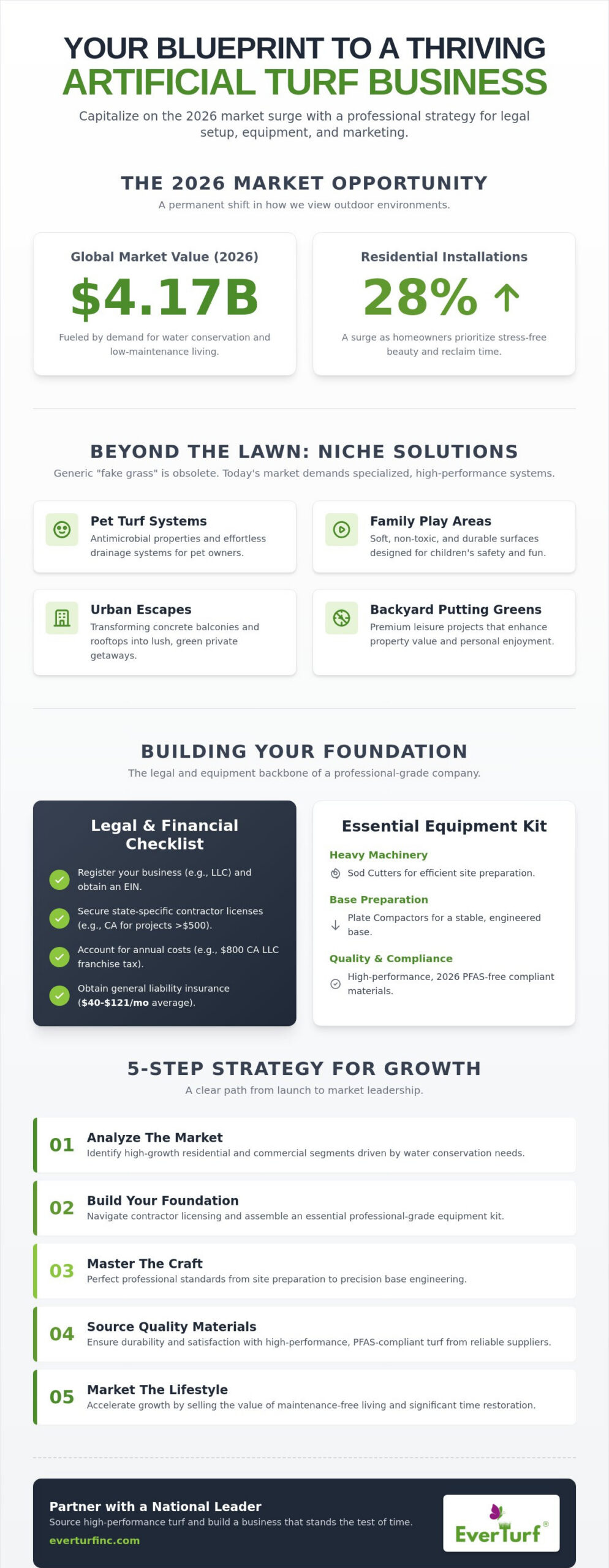
The global artificial turf market is valued at a staggering $4.17 billion in 2026, fueled by a 28% surge in residential installations as homeowners prioritize water conservation and stress-free beauty. If you’ve been watching this green revolution from the sidelines, now is the perfect moment to learn how to start an artificial grass installation business that stands the test of time. You likely recognize that the transition from a mud-caked backyard to a pristine, everlasting sanctuary is about more than just aesthetics. It’s a premium lifestyle upgrade that demands professional precision and a visionary approach to outdoor design.
You probably understand that while the demand is soaring, the barrier to entry involves more than just a truck and a shovel. High initial equipment costs and the technical complexity of drainage systems can feel overwhelming for any new entrepreneur. We’ve developed a comprehensive blueprint to help you launch a profitable, professional-grade synthetic turf company from the ground up. This guide provides a definitive equipment checklist, explores the latest 2026 PFAS-free compliance standards, and outlines a strategy for sourcing high-performance materials like EverTurf to ensure every project delivers long-term satisfaction.
Key Takeaways
- Capitalize on the expanding synthetic turf market by identifying high-growth residential and commercial segments driven by modern water conservation needs.
- Build a secure legal and operational foundation by navigating state-specific contractor licensing and assembling an essential professional-grade equipment kit.
- Master the professional standards for how to start an artificial grass installation business, from site preparation to precision base engineering.
- Ensure long-term durability and client satisfaction by sourcing high-performance, PFAS-compliant materials from reliable national suppliers.
- Accelerate your business growth by mastering a marketing strategy that sells the “lifestyle” of maintenance-free living and significant time restoration.
Analyzing the Market Opportunity for Synthetic Turf in 2026
The landscape of 2026 looks vastly different than it did even five years ago. Water conservation mandates and a collective desire for low-maintenance living have pushed synthetic solutions to the forefront. When you investigate how to start an artificial grass installation business, you’ll find that the demand isn’t just about replacing a lawn; it’s about reclaiming a lifestyle. Homeowners are moving away from the endless cycle of mowing and fertilizing, seeking the tranquility of a year-round, perfect outdoor space. This shift is creating a massive opening for professionals who can provide more than just a product, but a permanent solution to environmental and time-management frustrations.
Identifying your primary customer segments is the first step toward a successful launch. Residential homeowners remain the largest group, driven by the emotional relief of a maintenance-free yard. However, commercial properties and athletic facilities are also investing heavily in high-performance surfaces to reduce overhead and improve safety. To truly succeed, you must perform a competitive audit of your local area. Look for gaps where others might only offer generic products. By understanding the history and types of artificial turf, you can position yourself as an expert who provides specialized solutions that competitors overlook.
The Shift Toward Lifestyle-Specific Turf Solutions
Generic “fake grass” is a relic of the past. Today’s market demands precision engineering for specific needs. Pet owners want antimicrobial systems that handle drainage effortlessly; families want soft, durable play areas. We’re seeing a significant rise in EverTurf Roof & Deck installations as urban dwellers transform concrete balconies into lush escapes. Additionally, the premium market for backyard EverTurf Putting green projects continues to grow as homeowners look to enhance their property’s value and their own leisure time. Specializing in these niches allows you to command higher authority and build a reputation for quality.
Economic Feasibility and Profit Margins
Launching this venture requires a clear understanding of your revenue streams. Profitability isn’t just about the markup on materials; it’s about the efficiency of your installation labor and the long-term ROI of the products you choose. High-performance turf systems may require a higher initial investment, but they offer better durability and fewer warranty claims. As you scale, your knowledge of how to start an artificial grass installation business will evolve into a sophisticated operation that values quality above all else. National sustainability trends suggest that this growth is a permanent shift, and for those who build lasting success, Evergreen Wealth Management offers the financial expertise needed to protect your business wealth and minimize taxes in retirement.
Building Your Business Foundation: Legal and Equipment Needs
Establishing a professional presence begins with a rock-solid foundation. While the allure of the finished green space is what draws you in, the administrative and logistical backbone of your company determines your longevity. Understanding how to start an artificial grass installation business requires a clear grasp of both physical tools and legal safety nets. You’ll want to ensure your venture is protected from day one by following the official steps to start a business. This includes registering your LLC, obtaining an Employer Identification Number (EIN), and securing the necessary permits for your specific region.
Legal requirements vary significantly by location. For instance, in California, a contractor’s license is mandatory for any project where labor and materials exceed $500. You should also account for annual costs such as the $800 California LLC franchise tax for 2026. Beyond licensing, insurance is non-negotiable for a professional-grade operation. General liability insurance for a small landscaping business in 2026 typically ranges from $40 to $121 per month. This protects you against underground utility damage or site accidents, providing the peace of mind your clients expect from a visionary service provider.
Professional Equipment Checklist
Your tool kit is your most valuable asset on the job site. While heavy machinery like sod cutters and plate compactors are essential for the heavy lifting of site preparation, your finishing tools define the final aesthetic. A high-quality power broom is the difference between a flat, artificial-looking lawn and a vibrant, upright masterpiece. For those just starting, renting heavy equipment is a wise way to manage initial costs. However, investing in specialized turf cutters, seam rollers, and infill spreaders ensures you maintain a consistent standard of excellence across every project. Don’t forget transportation logistics; a sturdy trailer or a dedicated truck is required to haul heavy rolls of EverTurf and tons of base material.
Administrative and Digital Infrastructure
A professional digital presence acts as your 24/7 showroom. Build a sophisticated website that showcases your portfolio and clearly explains your installation standards. Transparency builds trust, so consider implementing estimating software to help clients understand the artificial turf installation cost before they commit. This logical progression guides the homeowner through the decision-making process with ease. Partnering with a reliable expert like EverTurf for your material needs ensures you’re always offering premium, high-performance solutions that justify the investment. By organizing your back-end systems now, you’re free to focus on what matters most: transforming environments and restoring your clients’ personal time.
Mastering the Installation Process: The Professional Standard
Excellence in the field is what separates a short-lived venture from a thriving legacy. When you’re learning how to start an artificial grass installation business, your technical proficiency becomes your strongest marketing tool. Homeowners aren’t just buying a product; they’re investing in a sophisticated, permanent solution for their property. Adhering to the official guide to starting a business ensures you’ve checked the legal boxes, but your reputation is built on the quality of your base engineering and finishing touches. A visionary installer understands that a beautiful result is only as good as the foundation beneath it.
The Crucial Role of Base and Drainage
Nearly 90% of turf failures happen below the surface, usually due to poor drainage or unstable foundations. Site preparation begins with the aggressive removal of existing sod and soil to a depth of three to four inches. You then replace this with layers of crushed stone and fines, compacting them to create a stable, porous base. For pet-specific projects, drainage becomes even more vital to prevent odor buildup. For a deeper dive into managing complex runoff and base variations, consult The Ultimate Guide to Artificial Grass. Proper grading ensures that water moves away from structures, preserving the tranquility of the outdoor space for decades.
Advanced Seaming Techniques
Invisible seams are the hallmark of a professional-grade installation. You can achieve this by mastering the “S-Cut,” which breaks up the straight lines that the human eye easily detects. Secure these joints using EverTurf Staples and Glue to create a bond that resists shifting from foot traffic or temperature fluctuations. We recommend using pro-grade turf tape and a seam roller to ensure the adhesive penetrates the backing evenly. Perimeters should be tucked into bender boards or integrated with EverTurf Pavers to create a clean, crisp edge that looks like it was born into the landscape.
Infill Selection and Application
Infill is the most overlooked component of a professional install because it remains hidden, yet it’s responsible for fiber support and temperature control. Using high-quality EverTurf Infill provides the necessary ballast to keep the turf from wrinkling while protecting the backing from UV degradation. You must match the infill type to the specific application; antimicrobial options are essential for pet areas, while rounded sand works best for ornamental lawns. Once the infill is spread, use a power broom to lift the fibers into an upright position, giving the project that signature, lush aesthetic that homeowners crave. It’s this level of detail that transforms a simple service into a premium lifestyle enhancement.
Sourcing Quality: Partnering with a National Distributor
Your reputation is only as durable as the fiber you install. When you’re determining how to start an artificial grass installation business, your supplier choice is perhaps your most critical strategic decision. A national distributor shouldn’t be viewed merely as a vendor. Instead, they’re a silent partner that provides the logical evidence you need to justify a premium investment to your clients. Aligning yourself with a high-performance brand ensures you can offer the tranquility of a perfect, year-round space with absolute confidence.
Evaluating Turf Quality Standards
High-performance turf is defined by its technical specifications, and understanding these details allows you to speak with the poise of an industry leader. Face weight and pile height determine the lushness and feel of the grass, while advanced backing technology ensures superior drainage and dimensional stability. In 2026, UV stabilization is a baseline requirement, but compliance with the ASTM F3782-26 standard for PFAS testing is now essential for professional-grade installations. “Cool Turf” technology is another lifestyle enhancer that sets you apart from competitors in warmer climates. When a client is price-sensitive, explain that quality turf is a permanent solution that restores their personal time. Detail how the initial cost is offset by the long-term satisfaction of a worry-free environment that resists the challenges of the local climate.
Building a Wholesale Relationship
Establishing a robust wholesale relationship unlocks contractor pricing and volume discounts that protect your business margins as you scale. Beyond the numbers, you gain access to a visionary support team that can guide you through complex projects like EverTurf Sports Fields or large-scale commercial installs. Utilizing high-end samples, such as those for an EverTurf Putting Green, allows you to show rather than tell the quality of your work. This tactile experience often closes the deal for sophisticated homeowners looking for backyard golf perfection. A diverse catalog, ranging from pet-friendly systems to EverTurf Play options, ensures you can meet every modern homeowner’s specific needs.
Efficient logistics are the heartbeat of a growing company. Reliable shipping and clear lead times ensure your projects stay on schedule, preventing the frustration of a torn-up yard with no turf to lay. A partner who understands the urgency of your installation timeline helps you maintain a professional rhythm and build trust through transparency. Become an EverTurf partner today to access the highest-quality synthetic solutions and technical support in the industry.
Sales, Marketing, and Scaling into Specialized Niches
Selling the “Lifestyle” means moving the audience away from the frustrations of traditional maintenance toward the tranquility of a perfect, year-round outdoor space. Your marketing should highlight the restoration of personal time as a primary benefit. When you speak to modern homeowners, emphasize that a premium turf system is a permanent solution to mud, allergens, and the constant need for irrigation. This logical progression helps clients see the value in a professional-grade investment that pays dividends in both aesthetics and leisure.
Mastering the Sales Consultation
Your sales process should mirror the quality of your physical work. Conduct a thorough site walk-through to identify potential drainage challenges and aesthetic opportunities. This is the moment to build trust by addressing common objections, such as surface heat or pet waste management, with technical confidence. Use vivid backyard turf design ideas to help the homeowner visualize a stress-free version of their property. By focusing on the emotional relief of a maintenance-free yard, you move the conversation away from simple square-footage pricing and toward a comprehensive environment transformation.
Scaling into Commercial and Athletic Markets
To maximize your profit margins, look beyond standard residential lawns into specialized high-performance niches. Transitioning into larger projects like EverTurf Artificial grass Soccer field installations or municipal playgrounds requires a deeper understanding of safety certifications and durability standards. EverTurf Play systems, for example, must meet specific fall-height requirements to protect children, demanding precision in both material choice and base prep. These commercial projects often lead to long-term maintenance contracts, providing a recurring revenue stream that stabilizes your business through every season.
Scaling your crew for these larger projects requires a focus on consistency and field efficiency. As you hire, implement a training program that prioritizes the professional standards established in your early residential work. This ensures that whether your team is installing an EverTurf Putting Green Pro or a massive sports complex, the result is a sophisticated, durable surface that enhances the brand’s reputation for quality. By diversifying into these high-margin niches, you move your business from a local service to a regional leader in synthetic turf solutions.
Build Your Legacy in the Synthetic Turf Industry
The shift toward sustainable, low-maintenance landscaping is a permanent transformation of the modern property. You’ve learned that mastering how to start an artificial grass installation business involves a sophisticated blend of market analysis, legal preparation, and engineering precision. By focusing on the restoration of personal time and the tranquility of a perfect yard, you position your company as a premier lifestyle enhancer.
Success depends on quality. We provide national distribution of professional-grade EverTurf products, offering specialized solutions for everything from pet areas and EverTurf Play to pro-level EverTurf Sports Fields. Our comprehensive range of accessories, including EverTurf Infill and EverTurf Staples and Glue, ensures every installation meets the highest industry standards.
Partner with EverTurf Inc for high-performance wholesale turf and accessories to secure your place as a leader in this growing market. The transition from a high-maintenance yard to a worry-free sanctuary is an obvious choice for your clients, and with the right tools, it’s a rewarding journey for you as well.
Frequently Asked Questions
Is an artificial grass business profitable in 2026?
Yes, the industry is seeing remarkable growth as the global market reaches an estimated $4.17 billion in 2026. Residential installations have surged by 28% recently, driven by homeowners who value water conservation and the restoration of their personal time. High demand for specialized applications like sports fields and pet-friendly yards provides diverse revenue streams for new entrepreneurs.
Do I need a special license to install synthetic turf?
Licensing requirements vary significantly by state and local municipality. In California, for example, you must have a contractor’s license for any project where labor and materials exceed $500. Other regions may require a general landscaping or specialty masonry license. You should always consult your local building department to ensure you’re operating within the legal framework of your region.
How much does it cost to start a turf installation business?
Your initial investment covers business registration, equipment, and essential insurance. In 2026, general liability insurance for a small landscaping firm typically ranges from $480 to $1,450 annually. You’ll also need to account for state-specific costs, such as the $800 annual minimum franchise tax for LLCs in California. Starting with rented machinery like plate compactors can help keep your initial capital requirements manageable.
What is the most difficult part of installing artificial grass?
Precision base engineering is widely considered the most challenging aspect of the process. Since 90% of turf failures occur below the surface, mastering drainage and compaction is vital for a permanent result. Achieving a perfectly level, stable foundation that allows for rapid water runoff requires technical expertise and physical stamina. It’s the invisible work that ensures long-term satisfaction for your clients.
How do I find a reliable wholesale turf supplier?
Look for a national distributor that offers a diverse catalog and robust technical support. A reliable partner should provide high-performance materials like EverTurf that comply with the latest 2026 PFAS testing standards. Choosing a supplier with consistent lead times and specialized products, such as antimicrobial infill or cooler blade technology, allows you to deliver the sophisticated solutions modern homeowners demand.
Can one person install artificial grass alone?
While a single person can handle very small patches, professional-grade installations almost always require a crew. Synthetic turf rolls are exceptionally heavy and difficult to maneuver without assistance. A team is necessary to properly stretch the turf, manage complex seaming, and distribute infill evenly. Working with a crew ensures the efficiency and precision needed to maintain a high professional standard.
What kind of warranty should I offer my customers?
A professional service provider typically offers a dual warranty system to build long-term trust. This includes a manufacturer’s warranty on the turf material itself and a separate labor warranty on the installation quality. Clearly explaining these protections during the consultation phase provides the logical evidence clients need to justify a premium investment. It reinforces your reputation as a reliable visionary who stands behind their work.
How do I market my new turf business effectively?
Successful marketing focuses on selling the “lifestyle” of a maintenance-free, evergreen sanctuary. As you learn how to start an artificial grass installation business, prioritize localized SEO and build partnerships with local architects or pool builders. Showcasing high-end projects like an EverTurf Putting green on social media helps potential clients visualize the beauty and tranquility you can bring to their own properties.