

Water Savings with Artificial Grass: 2026 Statistics & ROI Analysis
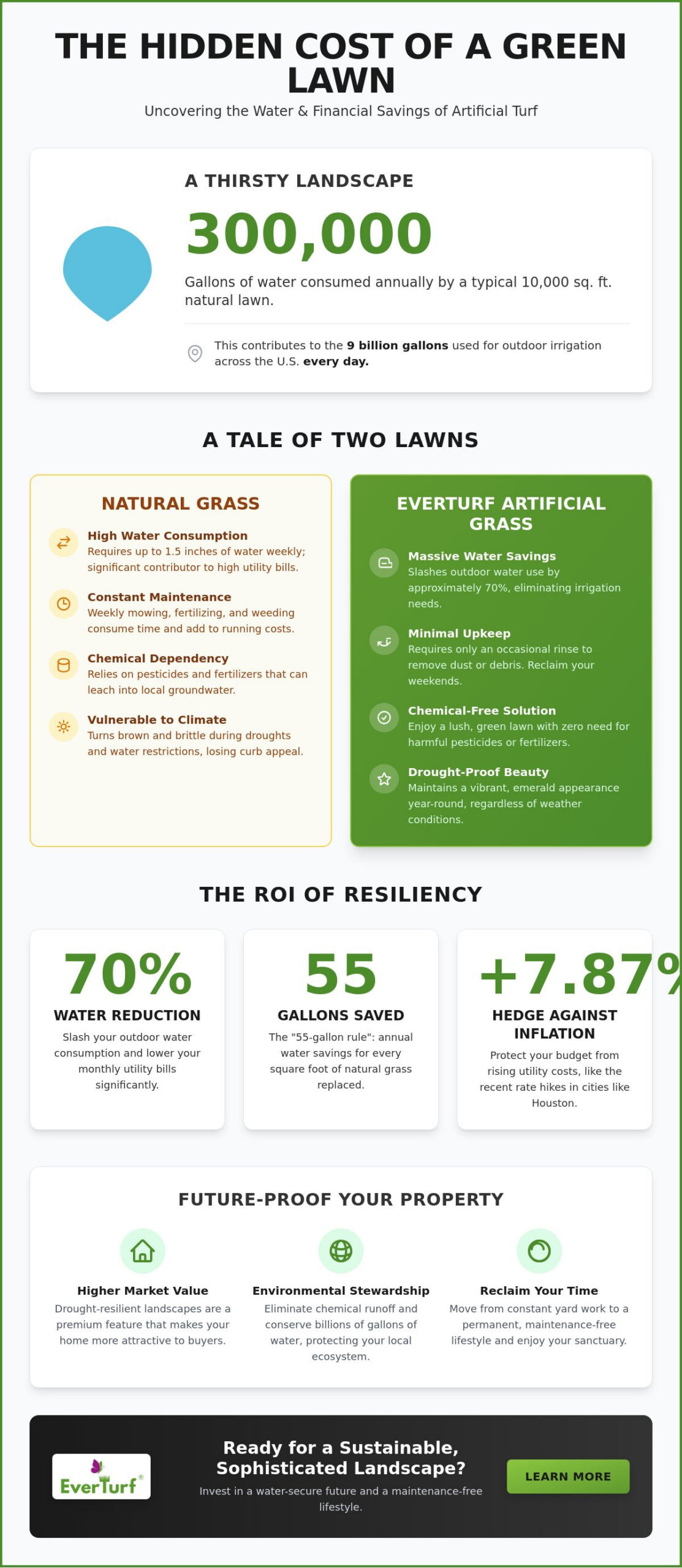
A typical 10,000 square foot natural lawn consumes nearly 300,000 gallons of water every year, a staggering figure that makes the latest water savings with artificial grass statistics more relevant than ever. If you’ve felt a sense of dread opening your monthly bill or a pang of guilt during seasonal droughts, you aren’t alone. Many homeowners are searching for a way to reclaim their time and their budget without sacrificing the beauty of a lush, green outdoor space. We understand that your home should be a sanctuary, not a source of constant maintenance and rising costs.
This guide offers a clear ROI analysis to justify your project budget and provides the data needed to secure a permanent hedge against inflation. With water rates in cities like Houston rising by nearly 8% this year, switching to EverTurf artificial grass represents more than just an aesthetic upgrade; it’s a strategic financial move. We’ll explore how synthetic turf can slash your outdoor water consumption by approximately 70% and examine the localized rebates that make the transition even more rewarding. You’ll gain the hard numbers needed to move from frustration toward the tranquility of a permanent, maintenance-free lifestyle.
Key Takeaways
- Learn why traditional lawns are becoming a financial liability as we examine updated EPA benchmarks for outdoor irrigation in 2026.
- Review the latest water savings with artificial grass statistics to understand how a standard suburban lot can slash its annual water consumption by 70%.
- Discover how EverTurf Sports Fields and commercial properties leverage scaled conservation to achieve the fastest return on investment.
- Use our ROI analysis to determine exactly when your utility savings will pay for your installation, providing a permanent hedge against rising rates.
- Explore the technical engineering of EverTurf Artificial grass that allows you to enjoy a lush, year-round landscape with zero irrigation.
The Growing Necessity of Water-Wise Landscaping in 2026
Property ownership in 2026 requires a strategic shift in how we view our outdoor environments. Traditional sod, once a symbol of the American dream, has rapidly become a significant liability for homeowners facing strict municipal restrictions and environmental challenges. According to the Environmental Protection Agency (EPA), outdoor irrigation in the United States accounts for nearly 9 billion gallons of water daily. This staggering volume is increasingly unsustainable in a climate where water scarcity is no longer a distant threat but a local reality. Understanding the latest water savings with artificial grass statistics is the first step toward transforming your property into a resilient asset.
The Environmental Cost of the American Lawn
Natural grass requires a heavy cycle of fertilizers and pesticides that often leach into local groundwater systems, creating a hidden environmental toll that many homeowners find frustrating. The carbon footprint of weekly mowing and gasoline-powered maintenance adds another layer of impact that is hard to ignore. In contrast, Artificial turf offers a durable, long-term solution that eliminates these chemical needs entirely. Xeriscaping is defined as the practice of designing landscapes that require little to no irrigation, and it has officially become the 2026 gold standard for modern, responsible property management.
Future-Proofing Your Property Against Drought
Real estate experts have observed that properties with drought-resilient landscapes maintain higher market values, especially during mandatory water restrictions. When neighbors are forced to let their lawns turn brown and brittle, your home remains a vibrant, emerald sanctuary. There’s a profound psychological relief in knowing your outdoor space will stay pristine during the peak summer heat without a single drop of guilt. High-quality artificial grass serves as the cornerstone of the modern low-maintenance oasis, allowing you to reclaim your personal time and protect your investment simultaneously. It’s a sophisticated solution that ensures your property remains a source of tranquility rather than a chore.
Residential Water Savings: Breaking Down the Numbers
Quantifying the impact of a landscape transition begins with the “55-gallon rule.” Industry experts and environmental agencies generally agree that every square foot of natural sod replaced by synthetic turf saves approximately 55 gallons of water annually. When you look at the broader water savings with artificial grass statistics, it’s clear why homeowners in high-heat zones are making the switch. In regions where temperatures frequently soar, natural Kentucky Bluegrass can require up to 1.5 inches of water per week just to stay alive. In contrast, EverTurf Artificial grass maintains its vibrant, lush appearance with zero irrigation, requiring only an occasional rinse to remove dust or pet debris.
Reducing your outdoor water consumption by 70% does more than just lower your utility bill; it fundamentally transforms your household budget. For a family in a drought-prone area, this reduction can mean the difference between tiered-rate penalties and significant monthly savings. Recent research on artificial turf highlights its role as a critical conservation tool, especially as municipal water costs continue to outpace inflation. If you’re curious about how these figures translate to your specific property, viewing our artificial turf installation options can help you visualize the scale of your potential savings.
A Square-Foot-by-Square-Foot Comparison
When planning a backyard turf project, it’s helpful to look at the long-term volume. A premium installation is designed to last 15 to 20 years, creating a massive cumulative effect on local water reserves. Over its lifespan, a single installation prevents millions of gallons from being diverted to lawn maintenance. To put this in perspective, an average 1,000 square foot turf lawn saves approximately 550,000 gallons of water over a single decade. This volume is roughly equivalent to filling 27 standard backyard swimming pools, all saved from a single residential lot.
Beyond the Meter: Secondary Savings
The financial benefits extend far beyond the water meter. Maintaining a natural lawn involves a hidden “water cost” associated with the production and application of fertilizers and seasonal reseeding. You also eliminate the constant frustration of repairing broken sprinkler heads, adjusting timers, or fixing underground pipe leaks. Our specialized EverTurf Infill is engineered to support superior drainage and blade resilience without requiring any additional water input. It’s a self-sustaining system that protects your investment while restoring your personal time, allowing you to enjoy your outdoor space rather than managing its survival.
Commercial and Athletic Impact: Scaling Conservation
While residential savings are impressive, the most dramatic water savings with artificial grass statistics emerge when we scale up to commercial and athletic applications. Large-scale properties, such as sprawling office parks and municipal complexes, often face the steepest utility hikes and most stringent usage caps. Transitioning these expansive areas to EverTurf Sports Fields or professional-grade landscapes provides an immediate and permanent reduction in overhead. A Western Resource Advocates report on turf confirms that the sheer volume of water conserved on these sites makes them a primary driver for local sustainability goals in 2026. This shift isn’t just about cutting costs; it’s about securing the long-term viability of community spaces in an era of unpredictable rainfall.
Municipalities are increasingly looking toward synthetic solutions to meet 2026 sustainability mandates. By replacing thirsty natural grass in public medians and city parks, local governments can redirect millions of gallons of water back into the potable supply. This proactive management strategy helps cities maintain their visual appeal even during peak drought stages. For developers, integrating these systems early in the design phase ensures that new projects remain compliant with evolving environmental regulations while providing a sophisticated, year-round green aesthetic that attracts high-value tenants.
The ROI of High-Performance Athletic Turf
A standard 1.32-acre athletic field typically requires between 500,000 and 1,000,000 gallons of water annually to maintain safe, playable natural grass. By installing EverTurf Sports Fields, facilities can reclaim those millions of gallons while simultaneously slashing labor costs. Natural fields require intensive “recovery” watering and specialized aeration after heavy use, which can keep a field out of commission for days. Synthetic systems eliminate this downtime entirely, providing a durable surface that withstands high-traffic soccer and football schedules without the need for constant irrigation. For golf enthusiasts and club managers, the EverTurf Putting Green Pro provides a tournament-quality surface that stays green year-round without the massive irrigation bill associated with traditional bentgrass greens.
Commercial Landscapes and Corporate Responsibility
Corporate responsibility is no longer just a buzzword; it’s a measurable metric that influences property value and tenant satisfaction. Improving ESG (Environmental, Social, and Governance) scores through water-wise landscaping demonstrates a commitment to the environment that resonates with modern investors and clients. Our EverTurf Roof & Deck solutions are particularly effective in urban centers, where they help mitigate the urban heat island effect while providing lush communal spaces. These installations transform underutilized concrete surfaces into vibrant green retreats without adding a single gallon to the building’s water footprint. By tracking water savings with artificial grass statistics, commercial managers can provide concrete data to stakeholders regarding their conservation efforts. This proactive approach ensures a welcoming environment regardless of seasonal drought conditions or municipal watering bans.
The Financial Ripple Effect: Calculating Your 2026 ROI
Evaluating the true value of a landscape transition requires looking beyond the initial setup. While traditional sod remains a recurring monthly expense, EverTurf represents a strategic capital improvement that pays dividends for decades. When you analyze the latest water savings with artificial grass statistics, the shift from a liability to an asset becomes undeniable. Most homeowners find their break-even point within five to seven years; this timeline is accelerating as municipal water rates continue to climb. By the ten-year mark, the cumulative utility savings often exceed the original artificial turf installation cost, effectively making the system a self-funding upgrade.
Modern property value in 2026 is increasingly tied to sustainability and ease of maintenance. Buyers are no longer seeking the high-maintenance burden of a natural lawn; they are looking for the tranquility of a year-round, pristine outdoor space. A professional installation provides a permanent hedge against volatile utility prices, ensuring your property remains beautiful even during strict water mandates. To understand how these financial benefits apply to your specific lot, you can explore our options for artificial turf installation near me to begin your transformation.
The Restoration of Personal Time
It’s a restoration of your weekends. By eliminating the need for mowing, weeding, and seasonal fertilization, you reclaim over 150 hours of labor every single year. This “lifestyle dividend” is perhaps the most significant return on investment for busy modern families. The emotional value of a stress-free environment cannot be overstated; you spend your time enjoying the lawn rather than working on it. This is especially true for pet owners. Choosing artificial grass for dogs saves water during clean-up and prevents the frustration of muddy paws being tracked through your home, keeping both your yard and your interior pristine.
Investment vs. Expense: A New Perspective
Traditional sod is a recurring expense that requires constant financial input to survive. EverTurf, however, is a one-time capital improvement that offers long-term security. In 2026, many regions offer significant financial incentives to help bridge the transition. For example, the City of Phoenix provides a rebate of $2.00 per square foot for turf conversion, while Chandler offers up to $1.50 per square foot. These programs, combined with the 70% reduction in outdoor water use, create a compelling financial narrative. You are essentially trading a volatile, rising cost for a fixed, reliable asset that enhances your lifestyle and your property’s marketability for the next 20 years; real estate professionals can further support this marketability by using WithEasement to access the property data and recorded easements needed for a smooth transaction.
EverTurf: Sustainable Sophistication for a Water-Secure Future
EverTurf Inc stands as the reliable visionary for 2026 landscaping, offering a sophisticated bridge between environmental responsibility and aesthetic perfection. As we’ve explored, the water savings with artificial grass statistics paint a clear picture of a more sustainable future. However, achieving these results requires more than just a surface-level change. It demands high-performance engineering designed to withstand the challenges of a changing climate while providing the tranquility of a lush, year-round sanctuary. Our commitment to national sustainability is reflected in every blade, ensuring that your property remains a vibrant asset without the burden of traditional maintenance.
The engineering behind EverTurf Artificial grass focuses on delivering maximum realism with zero water input. We utilize multi-toned fibers and varied blade shapes to mimic the organic complexity of natural sod, ensuring your lawn looks authentic from every angle. This beauty is supported by a robust system of specialized components. From the foundational EverTurf Staples and Glue to our technologically advanced EverTurf Infill, every element is chosen for its durability and performance. These components work in harmony to provide permanent results, allowing you to enjoy a flawless outdoor space that never fades, even during the harshest seasonal shifts.
Quality That Lasts a Generation
The durability of our products is specifically tailored to the extreme climates found across the United States. Whether facing the intense heat of the Southwest or the freezing cycles of the North, EverTurf Artificial grass maintains its structural integrity and vibrant color. Many homeowners find that “cheap” turf alternatives fail to deliver the same long-term ROI because they lack the UV resistance and drainage capabilities of a premium system. Choosing a high-quality installation ensures that your water savings with artificial grass statistics remain consistent over the 15 to 20 year lifespan of the product. It’s an aspirational choice that provides warmth and beauty to your home 365 days a year.
Taking the First Step Toward Conservation
Transitioning from a high-maintenance, water-heavy lawn to a worry-free sanctuary is a rewarding journey that starts with a clear vision. We invite you to consult with our experts for a custom water-savings projection tailored to your specific property and local utility rates. This personalized analysis helps you visualize the exact impact your new landscape will have on your budget and your lifestyle. You can explore our diverse range of solutions by viewing our 2026 product catalog, which features specialized options for residential yards, commercial complexes, and professional sports facilities. Reclaim your time and secure your property’s future by choosing a landscape that works for you, not the other way around.
Secure Your Property’s Future with EverTurf
Choosing a water-wise landscape is no longer just an environmental gesture; it’s a strategic financial decision that protects your home from the volatility of rising utility rates. By slashing outdoor water consumption by 70%, you transform a high-maintenance liability into a pristine, value-adding asset. The water savings with artificial grass statistics we’ve analyzed prove that a transition to synthetic turf provides a permanent hedge against inflation while restoring hundreds of hours of your personal time every year. The choice is clear. Whether you’re looking for the professional-grade performance of the EverTurf Putting Green Pro or the maximum durability of our specialized pet and play systems, our solutions are engineered to last a generation.
We provide nationwide distribution and expert installation support to ensure your transition is as smooth and rewarding as the results themselves. You deserve an outdoor sanctuary that enhances your lifestyle without the constant burden of irrigation and repair. Transform your landscape and start saving water with EverTurf today. It’s time to step into a more beautiful, stress-free version of your property where your only responsibility is to enjoy the view.
Frequently Asked Questions
How much water does the average household save by switching to artificial grass?
The average household reduces its outdoor water consumption by approximately 70% after transitioning to synthetic turf. For a standard 10,000 square foot lawn, this move saves over 200,000 gallons of water every year compared to natural sod. These water savings with artificial grass statistics highlight a massive reduction in monthly utility costs, particularly in cities like Houston where water rates rose by nearly 8% in 2026.
Is the environmental impact of manufacturing artificial turf offset by the water savings?
Yes, the long-term water conservation generally offsets the manufacturing footprint over the product’s 15 to 20 year lifespan. By eliminating the need for a portion of the 9 billion gallons used daily for U.S. outdoor irrigation, synthetic systems protect local reservoirs. Many 2026 manufacturers also focus on sustainability by using recycled content and non-toxic fiber blends to further reduce the initial environmental cost of the installation.
Do I still need to water artificial grass for cleaning or cooling?
You only need a minimal amount of water for occasional rinsing to remove dust or pet debris. Unlike natural grass that requires constant irrigation to stay alive, synthetic turf uses water only for basic maintenance. Modern innovations like cooling infills and infrared-reflective fibers also help manage surface temperatures during summer peaks without the need for constant spraying, which keeps your water bill predictable and manageable.
Are there municipal rebates for installing water-saving synthetic turf in 2026?
Many municipalities offer substantial rebates, though the specific requirements vary significantly by water district. In 2026, Phoenix offers homeowners $2.00 per square foot for turf conversion, while Chandler provides up to $1.50 per square foot. It’s vital to check local rules first; for example, the SoCal Water$mart program in Southern California explicitly forbids rebates for synthetic grass installation, while other regions require specific plant coverage ratios.
How does artificial grass help with drainage and groundwater recharge?
High-quality artificial turf features advanced backing systems that allow water to permeate the surface at rates often exceeding natural soil. This engineering prevents puddling and heavy runoff, allowing rainwater to filter through the sub-base and recharge local groundwater levels. When paired with professional installation techniques, these systems manage heavy rainfall efficiently while maintaining a pristine, mud-free environment for your family and pets to enjoy year-round.
Can I use artificial turf for a dog run and still save water on cleaning?
Yes, you’ll still see significant water savings because cleaning a dog run requires far less volume than the daily irrigation of natural grass. Specialized pet systems utilize superior drainage and antimicrobial infills to manage waste and minimize odors effectively. A quick, targeted rinse is usually enough to keep the area fresh and hygienic, allowing you to maintain a clean sanctuary for your pets without the excessive water waste.
What is the life expectancy of EverTurf artificial grass under high-heat conditions?
EverTurf artificial grass is engineered to last between 15 and 20 years, even when exposed to extreme high-heat conditions. The fibers are treated with advanced UV stabilizers to prevent the structural breakdown and fading that can occur with prolonged sun exposure. This longevity ensures that your property continues to benefit from the water savings with artificial grass statistics that justified your initial investment, providing a permanent hedge against rising utility prices.
Does synthetic turf contribute to the urban heat island effect compared to natural grass?
Synthetic turf can retain more heat than living grass, but 2026 product innovations have significantly narrowed this gap. We use specialized cooling infill materials and heat-reflective fiber technology to dissipate thermal energy more effectively than older generations of turf. While natural grass offers evaporative cooling, the extreme water volume required to sustain that process during a drought often makes synthetic a more resilient and responsible choice for urban planning.