

Calculating the ROI of Artificial Grass: A Comprehensive 2026 Guide
Your lawn should be a sanctuary that pays you back, not a recurring weekend chore that drains your bank account. While most homeowners begin their journey by asking how much does artificial turf cost per square foot, the more vital question is how quickly that premium investment transforms into a lifestyle dividend. We understand the frustration of watching your 2026 water utility bills climb while you spend your Saturdays managing chemical runoff or repairing dead patches from pets. It’s a cycle of maintenance that feels increasingly unsustainable in our modern climate.
You deserve a landscape that offers tranquility without the toil. This guide provides the exact financial and lifestyle framework to determine when your EverTurf Inc synthetic lawn pays for itself and how much you’ll save over a 20 year period. We’ll explore the latest 2026 water rebate programs, the impact of evolving installation standards, and the specific five to seven year window where your investment breaks even. By the end, you’ll have a clear justification for your home improvement budget and a roadmap to a permanently pristine outdoor space.
Key Takeaways
- Master the Total Cost of Ownership concept to visualize how a premium synthetic surface generates significant wealth over its 20-year lifespan.
- Navigate the initial investment by understanding how much does artificial turf cost per square foot relative to the skyrocketing costs of water and professional landscaping services.
- Calculate your personal “Time Dividend” to see exactly how many months of your life are restored when you eliminate mowing, edging, and fertilizing.
- Understand how drought-resistant landscaping and year-round curb appeal influence modern property appraisals and buyer interest in the 2026 real estate market.
- Identify the specific technical advantages of EverTurf high-performance solutions that ensure your lawn remains a durable asset rather than a future liability.
The Financial Foundation: Initial Investment vs. Recurring Maintenance
The Upfront Cost Components
Your initial investment covers more than just the green blades you see on the surface. It includes a multi-layered system designed for peak performance. High-quality materials like EverTurf Artificial grass represent a significant portion of this cost; they utilize advanced polymers designed to withstand intense UV exposure and heavy foot traffic. To appreciate why modern materials are so effective, it helps to look at the history and development of artificial turf, which has evolved from simple industrial carpets to sophisticated, multi-tonal fibers that mimic specific natural grass species.
Site preparation is equally critical to the longevity of your lawn. This involves excavating the existing soil, installing a compacted stone base, and ensuring a precise grade for water runoff. Professional installation also factors in the cost of specialized components like EverTurf Staples and Glue, which secure the perimeter and seams against the elements. While a DIY approach might seem like a way to reduce how much does artificial turf cost per square foot, the risk of improper drainage or visible seams often compromises the long-term ROI of the project.
Natural Grass: The Perpetual Expense
Maintaining a natural lawn is a battle against entropy that grows more expensive every year. In 2026, many homeowners are facing unprecedented utility rate hikes and drought surcharges that make traditional irrigation a luxury. Beyond the water bill, the “death by a thousand cuts” includes seasonal fertilizers, pesticides, and the rising cost of professional lawn treatments required to keep sod alive in harsh climates. These recurring expenses don’t just consume money; they consume your personal time.
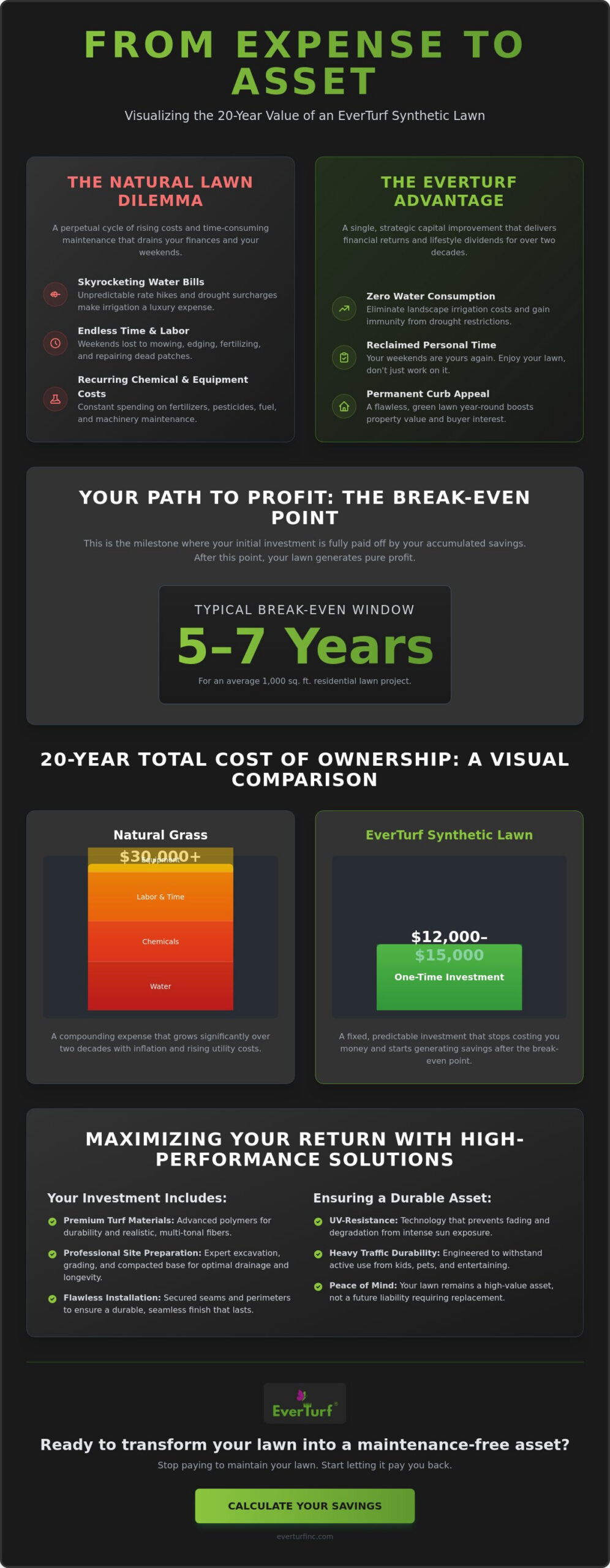
When you factor in the purchase, fuel, and maintenance of mowers and edgers, the annual cost of a natural lawn often reaches surprising levels. For the average American household, the break-even point for a synthetic lawn typically occurs between year five and year seven. After that milestone, every dollar saved on maintenance is pure profit, contributing to a stress-free lifestyle for the remainder of the product’s life. You aren’t just buying grass; you are buying back your weekends.
A Step-by-Step Framework for Calculating Your Turf ROI
Calculating your return isn’t just about the initial check you write. It’s about uncovering the hidden costs that currently vanish from your bank account every month. While searching for how much does artificial turf cost per square foot provides a baseline for the investment, applying a structured framework allows you to see the exact moment your lawn becomes a self-funding asset. Use this four-step process to map your financial transition and visualize your long-term savings.
- Step 1: Identify your current annual lawn care expenditure. Sum up your costs for water, fertilizers, pesticides, and professional labor (Total A).
- Step 2: Estimate the total cost of your synthetic turf project. This figure represents the comprehensive installation, which is the primary driver when homeowners ask how much does artificial turf cost per square foot (Total B).
- Step 3: Factor in minimal synthetic maintenance. Include small costs for occasional rinsing, debris removal, or specialized grooming (Total C).
- Step 4: Apply the Payback Formula. Divide Total B by the difference of Total A minus Total C to find your break-even year.
The Standard Residential Formula
For a typical 1,000 square foot landscape in 2026, the payback period often settles into a comfortable five to seven year window. This calculation accounts for a national average water savings of 55 gallons per square foot annually, representing a staggering reduction in utility reliance. From these savings, you only need to subtract the minimal cost of annual turf grooming and occasional infill replenishment to find your net monthly gain. The result is a predictable financial path that leads to a decade or more of maintenance-free beauty.
Specialized ROI: Putting Greens and Pet Areas
Different lifestyles yield different dividends. For golf enthusiasts, an EverTurf Putting Green Pro installation pays for itself by eliminating country club fees and the travel time spent driving to the range. Pet owners see a different kind of ROI; they avoid the constant cycle of sod replacement and professional indoor carpet cleaning caused by muddy paws. Utilizing a high-quality EverTurf Infill is a strategic choice here, as it protects the fibers from premature wear and extends the overall life of the system. If you’re ready to see how these numbers apply to your specific property, you can explore our performance-grade solutions to begin your customized calculation. This tailored approach ensures your outdoor space reflects your priorities while remaining a sound financial decision.
Beyond the Ledger: Quantifying the Lifestyle Dividend
Focusing solely on how much does artificial turf cost per square foot ignores the most valuable currency you possess: your time. While the financial break-even point is a critical metric, the lifestyle dividend begins the very first Saturday you wake up without a list of yard chores. We view your outdoor space as an extension of your home’s living area; it’s a sanctuary designed for relaxation rather than labor. If you are also looking to upgrade your interior surfaces to match your new outdoor aesthetic, you can discover Frankly Flooring for a comprehensive range of quality options. By quantifying the hours returned to your life, the true value of your investment becomes clear.
The transition to a synthetic surface also provides a health and safety dividend that is difficult to capture on a traditional ledger. You’re creating a mud-free, allergen-free environment where children and pets can play immediately after a rainstorm. By eliminating the need for toxic pesticides and heavy fertilizers, you ensure a safer footprint for your family and the local ecosystem. Your usable square footage effectively increases because your yard is no longer a “no-go zone” during the dormant winter months or muddy spring thaws.
Reclaiming Your Weekends
Maintaining a pristine natural lawn is a part-time job that many homeowners didn’t realize they applied for. Conservative estimates suggest that the typical property owner spends over 150 hours annually on the cycle of mowing, weeding, edging, and fertilizing. In contrast, an EverTurf landscape requires only 4 to 6 hours of light grooming per year. If you assign even a modest hourly rate to your personal time, the “shadow cost” of a natural lawn becomes staggering. Beyond the math, there is a profound psychological ROI in eliminating the guilt of an overgrown yard during busy seasons or long vacations.
Water Conservation as a Financial Hedge
Choosing a synthetic surface acts as a powerful financial hedge against an unpredictable climate. As municipal water restrictions become more common and drought surcharges increase, your EverTurf installation protects your property value from the sight of a dying, brown landscape. This form of drought-proofing ensures your home maintains peak curb appeal regardless of local weather patterns. For a deeper look at the technical specifications that make this longevity possible, consult The Ultimate Guide to Artificial Grass. Investing in durability today means securing your peace of mind for the next two decades. When you evaluate how much does artificial turf cost per square foot, remember that you are pricing the permanent restoration of your personal freedom.
Property Value and Market ROI: Does Turf Increase Home Worth?
Homeowners often fixate on the immediate expense when they ask how much does artificial turf cost per square foot, but the savvy investor looks at the equity added to the property. In the 2026 real estate market, a home’s exterior is no longer just a patch of grass; it’s a critical component of the property’s overall valuation. First impressions are everything in a digital-first listing environment. A lawn that remains vibrant and “Always Green” regardless of the season provides a massive competitive advantage, ensuring your home stands out against properties with dormant or patchy natural sod.
Appraisers are increasingly recognizing the tangible value of drought-resistant landscaping. As water conservation becomes a standard priority for modern buyers, a landscape that requires zero irrigation is seen as a future-proof asset. Unlike a high-end kitchen remodel that might become dated within a decade, a functional and beautiful outdoor space is a timeless improvement. Buyers are willing to pay a premium for the “Move-In Ready” factor, knowing they won’t have to inherit the burden of lawn maintenance or the cost of reviving a neglected yard.
The Resale Premium
In competitive markets, synthetic turf can increase a home’s closing price by 3 to 7 percent as buyers prioritize sustainable, low-maintenance features. Utilizing a premium product like EverTurf Artificial grass ensures that your landscape maintains a like-new appearance even years after the initial installation. This sustained aesthetic appeal is a key factor in reducing “Days on Market.” When prospective buyers see a flawless lawn during an open house, they immediately envision a lifestyle of relaxation rather than a future of weekend labor. If you’re curious about how this investment scales with your property size, evaluating how much does artificial turf cost per square foot is the first step toward securing this resale advantage.
Commercial and Rental Property ROI
For owners of multi-family units or commercial spaces, the return on investment is even more immediate. Increased tenant retention is a direct result of providing pet-friendly amenities that remain clean and odor-free. Commercial property managers can effectively lower their operating overhead by eliminating the need for a recurring landscape crew and the associated noise pollution of mowers. Additionally, the ROI of EverTurf Roof & Deck is unmatched for urban properties; it transforms underutilized flat roofs into premium social spaces that command higher rents. Whether you’re managing a single-family home or a commercial complex, you can consult with our landscape visionaries today to design a high-value outdoor solution that pays dividends for years to come.
Maximizing Your Return with EverTurf High-Performance Solutions
Securing a superior return on your landscape investment requires more than a simple comparison of price points. While the initial inquiry often centers on how much does artificial turf cost per square foot, the true measure of success lies in the product’s ability to withstand the test of time. A low-cost alternative might save money today, but it often leads to premature thinning, fading, and costly replacements within a few years. Choosing the EverTurf product line means investing in a sophisticated, permanent solution that prioritizes durability and long-term satisfaction.
Meticulous attention to detail during the installation process further protects your capital. We utilize specialized accessories like EverTurf Staples and Glue to ensure seams remain invisible and edges stay secure against the elements. These technical components prevent the shifting and lifting that often plague inferior installations. By combining professional expertise with high-performance materials, we move you away from the frustrations of constant repairs toward the tranquility of a perfect outdoor space. It’s a consultative approach that builds trust through transparency and a clear passion for transforming environments.
Durability: The Silent ROI Driver
Resilience is engineered into every fiber of our synthetic surfaces. Our UV-stabilized polymers prevent the ROI collapse associated with sun-bleached or brittle grass; this is a common issue with entry-level products in high-heat climates. Proper drainage is equally vital. A dry, well-ventilated base ensures your lawn lasts years longer by preventing structural degradation and maintaining the integrity of the subgrade. For those seeking a granular breakdown of these variables, our guide on Artificial Turf Installation Cost offers a transparent look at the 2026 pricing landscape.
Choosing the Right Product for Your Goal
Matching the specific density of your turf to your expected foot traffic is the key to ensuring a full 20 year lifespan. Whether you’re designing a high-impact play area or a serene ornamental garden, our experts help you avoid the pitfalls of over-engineering or under-speccing your project. Evaluating how much does artificial turf cost per square foot provides the entry point, but the product’s resilience determines the finish line. Envisioning your new sanctuary is easier when you explore our curated gallery of Backyard Turf designs. We stand behind every installation with industry-leading warranties, offering you the logical evidence and emotional peace of mind needed to justify a premium investment.
Secure Your Everlasting Landscape Today
Transitioning to a synthetic lawn is a strategic move that aligns your financial goals with your desire for a tranquil lifestyle. We’ve explored how the initial question of how much does artificial turf cost per square foot is merely the gateway to a much larger story of reclaimed time and increased property equity. By choosing a system with a 20 year expected product lifespan and utilizing specialized EverTurf Infill, you’re ensuring that your outdoor sanctuary remains a high-performing asset for decades. Our national distribution network ensures you receive consistent, elite quality regardless of your location.
You’re not just installing grass; you’re ending the cycle of maintenance frustration and entering a new era of weekend freedom. Now is the perfect time to move beyond the calculator and start your transformation. Calculate your personalized savings with an EverTurf expert and discover how simple it’s to achieve a worry-free, beautiful environment. Your future self will thank you for the time and tranquility you’ve restored to your daily life. We look forward to helping you envision a more beautiful version of your property.
Frequently Asked Questions
How many years does it take for artificial grass to pay for itself?
Most homeowners reach a break-even point within five to seven years of installation. This timeline is driven by the immediate elimination of professional lawn services, fertilizers, and expensive irrigation. After this initial period, the absence of recurring maintenance costs translates into pure monthly savings for the remainder of the lawn’s 20 year lifespan.
Does artificial turf actually increase the resale value of my home?
Real estate data from 2026 indicates that drought-tolerant, low-maintenance landscaping can increase a home’s closing price by 3% to 7%. Modern buyers prioritize sustainable features that offer year-round curb appeal and a stress-free lifestyle. This “Always Green” advantage often leads to more competitive offers and fewer days on the market compared to homes with traditional sod.
What is the average annual maintenance cost of synthetic grass vs. natural sod?
Synthetic grass maintenance is remarkably minimal, requiring only occasional rinsing and light grooming to keep fibers upright. In contrast, natural sod demands a perpetual cycle of mowing, edging, and seasonal chemical treatments. By switching to a synthetic surface, you eliminate the “death by a thousand cuts” expenses that make traditional lawns a constant financial drain.
How does the cost of water in 2026 affect my ROI calculation?
Rising utility rates and new drought surcharges in 2026 have made water-intensive lawns a significant financial liability. When you evaluate how much does artificial turf cost per square foot, you’re essentially pricing a permanent hedge against future water restrictions. Eliminating the need for roughly 55 gallons of water per square foot annually creates substantial long-term protection for your household budget.
Can I improve my ROI by installing the artificial grass myself?
While a DIY approach saves on initial labor, it often lowers your total ROI due to common failures in drainage and seam integration. Professional installation ensures the structural integrity required to reach the full 20 year product lifespan. Most homeowners find that the peace of mind and durability provided by experts secure a much higher return than the short-term savings of a self-installation.
How long does EverTurf artificial grass last before it needs replacement?
High-performance EverTurf systems are engineered to maintain their beauty and resilience for 15 to 20 years. Our advanced UV-stabilized fibers prevent the fading and thinning that plague entry-level products. This extended durability ensures that your investment continues to provide aesthetic and functional value long after the initial payback period has concluded.
Are there tax incentives or rebates for installing synthetic turf?
Many municipalities in regions like Arizona and Florida offer conservation rebates for homeowners who replace natural grass with water-efficient landscaping. Some programs provide incentives of up to $2.00 per square foot for grass removal. It’s critical to obtain pre-approval from your local water authority before starting your project to ensure you qualify for these active 2026 credits.
Does the type of infill I choose affect the long-term ROI?
The choice of infill is a silent but vital driver of your lawn’s longevity. Utilizing specialized EverTurf Infill protects the base of the fibers from matting and premature wear, especially in high-traffic or pet areas. This small technical detail keeps your lawn looking like new for years longer, maximizing the total value you extract from your initial investment.