


Creating a Turf Installation Contract Template: A Practical 2026 Guide
What if the smoothest turf project starts not with the first roll, but with a clear agreement? Creating a turf installation contract template helps turn assumptions into written commitments, especially around who prepares the site, installs the surface, and handles cleanup.
A beautiful, low-maintenance outdoor space may be the goal, but both the homeowner and installer need clarity before work begins. It’s easy to agree on the look and overlook the specifics: turf type and quantity, base and drainage details, infill, project timing, payment milestones, or how changes and delays will be handled.
This guide offers a practical, customizable framework for documenting the work, materials, schedule, responsibilities, changes, and final review. You’ll see which project details to spell out, how to distinguish product specifications from installation labor, and what to discuss before signing. Use it to prepare for an informed conversation with your installer, and consult a qualified attorney when you need legal guidance. With expectations recorded upfront, you can focus on the finished space rather than sorting out avoidable surprises.
Key Takeaways
- Use a written agreement to define the project scope, materials, timing, payment terms, and each party’s responsibilities.
- Record turf specifications and quantities, then clearly separate included work from exclusions such as site preparation, edging, or cleanup.
- When creating a turf installation contract template, leave project-specific fields for milestones, change approvals, and completion expectations.
- Keep product warranty information distinct from any installer workmanship commitments, and include only terms both parties have confirmed.
- Treat a sample template as a starting point, then review the completed agreement with the installer and seek qualified legal advice when needed.
Why an artificial turf installation contract should define the whole project
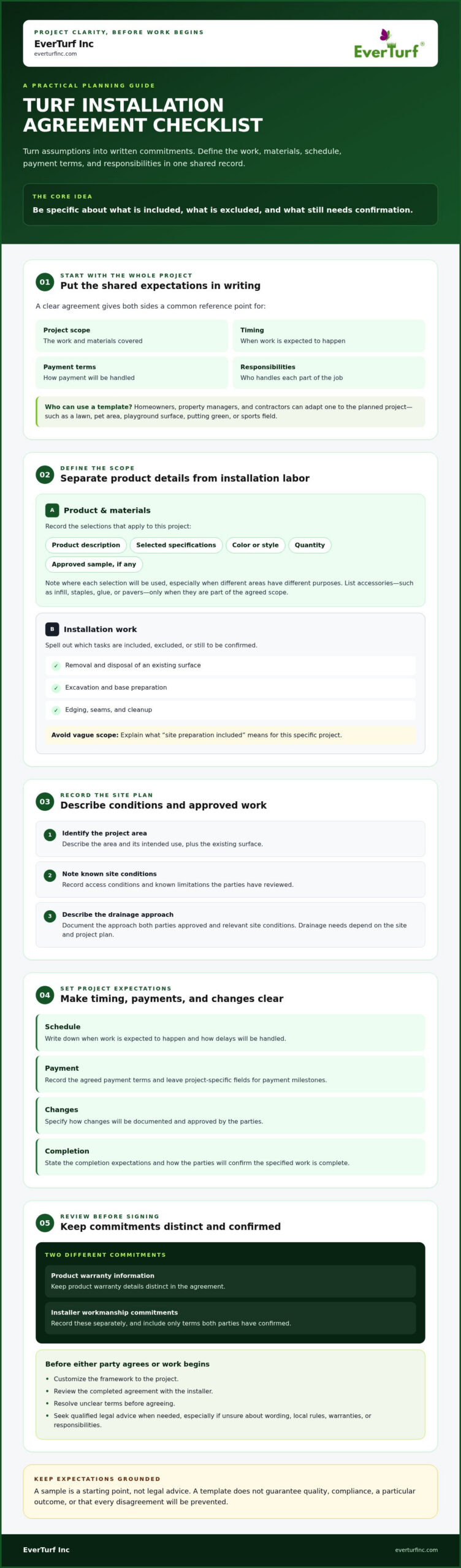
A turf project can look straightforward until the parties have different ideas about what “installation” includes. A written agreement gives both sides a shared record of who is involved, what work and materials are covered, when the work is expected to happen, how payment is handled, and which responsibilities belong to each party. As a specific type of construction contract, it should describe the agreed work clearly enough for both sides to refer back to it.
Define the boundaries of the job, not just the turf. Does the installer’s scope include removing an existing surface, excavation, base preparation, edging, seams, disposal, and cleanup? Are materials such as turf, infill, staples, glue, or pavers included, or supplied separately? Mark each item as included, excluded, or to be confirmed, and note project-specific extras in writing. Clear details can reduce mismatched expectations, though no template can prevent every disagreement or guarantee a particular result.
Who should use a turf installation contract template?
Homeowners, property managers, and contractors can use a template to organize expectations for a synthetic turf project. The details should fit the planned use: a residential lawn, pet area, playground surface, putting green, or sports field may call for different product specifications and completion criteria. When creating a turf installation contract template, treat it as a framework to customize, not a one-size-fits-all agreement. Each party should review the completed document and resolve unclear terms before agreeing or before work begins.
What a clear agreement can and cannot do
Written responsibilities and completion criteria give everyone a common reference point. For example, the agreement can state which party handles site preparation and disposal, identify the selected materials, and explain how the parties will confirm that the specified work is complete. These records can support a more informed conversation if expectations differ later.
A template isn’t legal advice, and using one doesn’t guarantee quality, compliance, or a particular outcome. State-specific legal requirements and project-specific risks may affect which terms are appropriate. If either party is unsure about the document’s wording, local rules, warranties, or allocation of responsibilities, ask a qualified attorney to review it before signing. That review can help clarify the agreement without assuming a generic sample suits every project.
Specify turf, site preparation, drainage, and installation work
“Install artificial turf” leaves too much open to interpretation. A useful scope describes the selected surface and the work needed to prepare and finish the specific area. While creating a turf installation contract template, separate product specifications from installer labor so it’s clear what is being supplied, what work is being done, and what falls outside the agreement.
How should the contract identify turf and materials?
Use project-specific fields to record the product description, selected specifications, color or style, quantity, and any approved sample. Identify where each selection will be used, especially if a project includes different surfaces for different purposes. For product-selection context, readers can also consult The Ultimate Guide to Artificial Grass.
List accessories only when the project includes them. Depending on the agreed scope, these could include infill, staples, glue, or pavers. Don’t assume a component is included just because it may be used in an installation. For a wider look at available turf categories and components, explore EverTurf Inc turf and installation components.
How should site preparation and drainage be described?
Describe the project area and the conditions the parties have reviewed. Note the existing surface, access conditions, and known site limitations, then spell out which preparation and finishing tasks are included or excluded. For example, clarify responsibility for removal and disposal, excavation, base preparation, edging, seams, and cleanup. Avoid relying on a broad phrase such as “site prep included” without explaining what that means for this project.
Drainage needs depend on the site and the agreed project plan. Record the drainage approach the parties have approved, along with relevant site conditions, rather than assuming one method fits every property. Describe the specified work without promising performance that hasn’t been confirmed.
These fields can turn the scope into a checklist that both parties can review:
- Work area: Project boundaries and existing surface.
- Materials: Turf selection, quantity, approved sample, and included components.
- Labor: Preparation, base, edging, seams, drainage work, and cleanup, each marked included or excluded.
- Site conditions: Known limitations and how newly discovered conditions will be recorded.
If concealed or unexpected conditions require additional work, document what was found and get the parties’ written approval of any scope or payment change before proceeding. This creates a clear record without assuming how every unforeseen condition should be handled.
Set expectations for schedule, payments, and project changes
A defined scope still needs a workable plan for timing and payment. As you create a turf installation contract template, use fill-in fields rather than assumed deadlines or standard payment rules. The parties can record the terms they’ve actually discussed and agree on how changes will be handled before they affect the work.
What schedule details belong in the agreement?
Write in the anticipated start and completion dates, or specify a scheduling window if exact dates depend on other conditions. Identify what must happen first, such as providing site access, making owner decisions, securing applicable approvals, or confirming that the site is ready. State how both parties will communicate schedule changes and where revised dates will be recorded.
Use this checklist to make the timeline clear:
- Start conditions: Record the agreed prerequisites, responsible party, and how readiness will be confirmed.
- Work milestones: Identify the planned stages and any milestone dates or sequence the parties have agreed to.
- Completion expectations: Describe what work must be finished and how the parties will confirm completion.
- Delay communication: Explain how either party will report a delay and document an updated schedule.
Weather, site access, material availability, and newly discovered site conditions may affect timing. Don’t promise a universal buffer or assume a particular delay policy. Instead, state how the parties will share updates, assess the impact, and confirm any schedule adjustment in writing.
How should payments and change orders be recorded?
Include fill-in fields for each agreed payment milestone, amount, due date, payment method, and any other written payment terms. The amounts and dates should match the parties’ agreement; don’t rely on generic sample figures or assume a deposit rule. Make clear which milestone or event triggers each payment so both sides can track what is due.
Changes need the same clarity. Before additional or revised work begins, create a dated written change record that describes the new or adjusted work, explains any effect on the schedule, and states revised payment terms if applicable. Both parties should approve the change in writing. This helps prevent an informal conversation from becoming an unclear addition to the original scope.
Keep the signed agreement and approved changes together. A record of dates, decisions, and approvals gives both parties a reliable reference as the project moves from preparation through completion.
Address warranties, completion, and legal review before signing
A downloaded template isn’t automatically suitable or legally sufficient for every turf project. As you create a turf installation contract template, treat warranty and completion clauses as project-specific fields to confirm with the relevant parties, not promises to copy from a generic form. If a term is unclear or local requirements may apply, pause and seek qualified legal review before signing.
How can the agreement document warranties and responsibilities?
Keep product coverage separate from any installation workmanship commitment. The contract can identify the manufacturer’s product warranty documents, if provided, and list any separately agreed workmanship terms, but include only confirmed details. Don’t assume or invent warranty lengths, coverage, exclusions, or guarantees. Attach or identify the applicable documents so everyone knows which terms are being referenced.
Clarify who supplies and installs each material or component, and who should receive questions about it. For example, the parties can record the responsible contact for the turf, infill, or other items included in the project. This helps distinguish product questions from concerns about installation work without implying that one party is responsible for every issue.
What should happen at project completion?
Agree on a practical review process before work begins. Compare the finished project with the written scope and any approved changes. Record observations in a dated completion note, including work the parties accept as complete and any agreed corrections or incomplete items. For each outstanding item, identify the responsible party and the agreed follow-up expectation.
- Inspection date: [Date]
- Work reviewed: [Scope items or project areas]
- Outstanding items: [Description, responsible party, and follow-up expectation]
- Acknowledgement: [Party names, signatures, and dates]
Signatures can acknowledge that the review took place and document the observations recorded. Don’t describe a sign-off as waiving legal rights or resolving issues beyond what the parties have expressly agreed. If the effect of an acknowledgement is uncertain, ask a qualified attorney familiar with applicable state law to review the wording. A sample template is a starting point, not a substitute for advice about a particular project.
For help identifying the turf and components relevant to your project, explore EverTurf turf and materials, then confirm product and warranty details with the appropriate parties before adding them to an agreement.
Adapt this turf installation contract template to your project
Use the sample below as an educational starting point, not a ready-made legal agreement. Creating a turf installation contract template means tailoring each field to the actual project, removing sections that don’t apply, and attaching any referenced plans or product specifications. Confirm every blank with the other party before signing. Seek qualified legal review if you’re unsure whether the wording fits your project or applicable law.
Copy-ready fields for a basic turf installation agreement
Parties and project
- Owner or client: [Full name and contact information]
- Contractor: [Legal or business name and contact information]
- Project address and work area: [Address, boundaries, and attached plan, if applicable]
Work and materials
- Scope of work: [Describe agreed labor and installation tasks]
- Materials: [Product description, selected specifications, quantity, approved sample, and included components]
- Exclusions: [List work or materials not included]
- Site conditions and access: [Known conditions, limitations, and access arrangements]
Schedule and payment
- Start and completion expectations: [Dates or agreed scheduling windows, including dependencies]
- Payment terms: [Agreed amounts, milestones, methods, and due dates]
Changes, completion, and records
- Change process: [How revised scope, schedule, and payment terms are documented and approved]
- Completion review: [How work is reviewed and how outstanding items are recorded]
- Warranty documents and commitments: [Identify attached product documents and any separately agreed workmanship terms]
- Notices: [Agreed contact details and method for project communications]
- Signatures: [Party names, signatures, and dates]
A final review checklist before the parties sign
Compare the written scope with the approved plan. Check that included and excluded tasks, product details, responsibilities, attachments, schedule, and payment terms are complete and consistent. Remove irrelevant fields, and don’t leave blanks that could later be mistaken for agreed terms. If you’re using budgeting or material references, Artificial Turf Installation Cost: The 2026 Buyer’s Guide and The Essential Guide to Turf Infill may offer useful context; confirm project-specific terms separately.
For a closer look at turf options and components that may be relevant to your project, explore EverTurf turf and installation components. Then make sure the selections in your agreement match the materials and responsibilities the parties have actually confirmed.
Set Your Turf Project Up for a Clear Start
A well-prepared agreement turns project assumptions into details both parties can review. When creating a turf installation contract template, define the work and materials, make schedule and payment terms explicit, and document how changes, completion, and warranty information will be handled. Customize every field to the project, attach relevant specifications, and seek qualified legal review if any terms or local requirements are uncertain.
With responsibilities recorded before work begins, you can move toward your finished outdoor space with greater clarity. EverTurf supplies synthetic turf for residential, commercial, and athletic uses, along with components such as infill, staples, glue, and pavers. Explore the options that may suit your project at EverTurf synthetic turf and installation components, then confirm selected materials and responsibilities with the parties to your agreement.
Clear planning today can help make the path to a beautiful, lasting space feel more straightforward.
Frequently Asked Questions
What should be included in an artificial turf installation contract?
Include the parties’ names, project address, work area, scope, selected turf and materials, exclusions, schedule, payment terms, change process, completion review, warranty documents, and signatures. Spell out who handles site preparation, removal, disposal, edging, seams, and cleanup rather than relying on a general phrase like “install turf.” Attach plans, product details, or approved samples referenced in the agreement so both parties can identify the agreed project.
Can I use a generic contractor agreement for artificial turf installation?
You can use a general contractor agreement as a starting point, but it may not cover turf-specific details. Adapt it to identify the surface and materials, site preparation, drainage approach, seams, edging, and project exclusions. Creating a turf installation contract template around the actual work helps clarify what’s supplied and what labor is included. Review the completed terms with the other party, and seek legal advice if you’re unsure about suitability.
How do I describe turf materials and site preparation in a contract?
Identify the turf by its product description, selected specifications, color or style, quantity, and any approved sample. List components such as infill, staples, glue, or pavers only if they’re included in the project. Describe the work area, existing surface, access conditions, known limitations, and agreed preparation, base, edging, seam, drainage, and cleanup tasks. Mark exclusions clearly and attach any referenced specifications or plans.
What happens if the installer finds unexpected conditions after work begins?
Document the condition and discuss its effect on the work before proceeding with extra tasks. The agreement should explain how the parties will record the finding, any proposed scope change, schedule impact, and revised payment terms. Use a dated written change record and obtain both parties’ approval before additional work begins. Don’t assume the original agreement covers unforeseen conditions or that a verbal discussion changes its written terms.
Should an artificial turf installation contract include a warranty?
It should identify any applicable product warranty documents and separately record any workmanship commitment the parties have confirmed. These are different terms, so don’t imply that a product warranty covers installation work or that an installer commitment covers product defects. Attach or identify the relevant documents, and confirm their terms with the responsible party. Don’t insert a warranty length, coverage, exclusion, or guarantee unless it’s verified and agreed.
Is a turf installation contract template legally binding in every state?
There’s no safe assumption that one template will be legally sufficient for every project or state. Whether an agreement is enforceable can depend on its wording, the circumstances, and applicable law. A downloadable sample is an educational starting point, not a guarantee of compliance or legal effect. Have a qualified attorney familiar with the relevant state law review the completed contract if you’re uncertain about its terms or requirements.
Who should review a turf installation contract before signing?
Both parties should read the completed agreement and confirm that the scope, materials, exclusions, schedule, payment terms, and responsibilities match their understanding before signing. Ask the installer to clarify any unclear project details, and verify product or warranty information with the party responsible for it. A qualified attorney can review legal wording, state-specific concerns, and project risks. Don’t sign with unresolved blanks or terms you don’t understand.