
ADA-Compliant Playground Turf Requirements: A 2026 Guide
What if the turf itself isn’t the deciding factor in whether a playground is accessible and safe? A surface can look smooth and inviting yet still fall short if the complete system hasn’t been designed, tested, and installed for the play area. Understanding ADA compliant playground turf requirements starts with separating wheelchair accessibility from impact-attenuation safety, then checking how each applies to the finished surface.
It’s reasonable to want a clear answer before comparing materials. But a product label alone can’t confirm that a playground meets the standards that apply to its surface, routes, and play components. This guide explains what to investigate so you can compare systems and ask focused questions before choosing one.
You’ll learn how ASTM F1951 accessibility testing differs from ASTM F1292 impact testing, what to check in test reports, and why the base, drainage, installation details, and maintenance matter. We’ll also outline how to assess a complete turf system, including EverTurf Play, with your project designer, supplier, and qualified installer. The goal is a clearer path from product research to a finished play space that supports access and safety.
Key Takeaways
- Use the ADA compliant playground turf requirements as a starting point, then assess how the full play area supports accessible routes and play components.
- Compare accessibility and impact-attenuation reports separately, checking that each identifies the tested surfacing assembly and conditions.
- Look beyond turf fibers: review the specified infill, shock pad, base, seams, transitions, drainage, and maintenance plan.
- Clarify who will verify the design, product documentation, installation, and final acceptance before the project begins.
- When evaluating EverTurf Play, request current product-specific documentation and confirm its scope with your project professionals.
What ADA-Compliant Playground Turf Requirements Actually Cover
A playground surface is only one part of an accessible play area. The ADA compliant playground turf requirements must be considered alongside the routes that connect play spaces, the play components those routes serve, and the condition of the complete installed surface. A turf product label can’t establish that the overall design meets every applicable requirement.
Accessible surface, defined: A surface that meets applicable ground-surface and accessibility criteria in the tested and installed conditions. That finding alone does not guarantee that the whole playground site complies with the ADA.
How the ADA Standards address playground routes and ground surfaces
The 2010 ADA Standards for Accessible Design address play areas in Sections 240 and 1008. In practical terms, Section 1008 covers accessible routes and other access features within play areas. Routes connect the play area to accessible play components, helping people with disabilities reach and use the spaces the design makes accessible. The specific requirements depend on the play area’s layout and components.
Ground surfaces on accessible routes must be firm, stable, and slip-resistant. Playground surfacing also has specific provisions under Section 1008, including a reference to ASTM F1951 for wheelchair accessibility. For a plain-language overview of playground surfacing materials and accessibility considerations, see the linked background resource. Use the ADA Standards and project professionals to confirm what applies to your design.
Accessibility is not the same as fall-protection performance
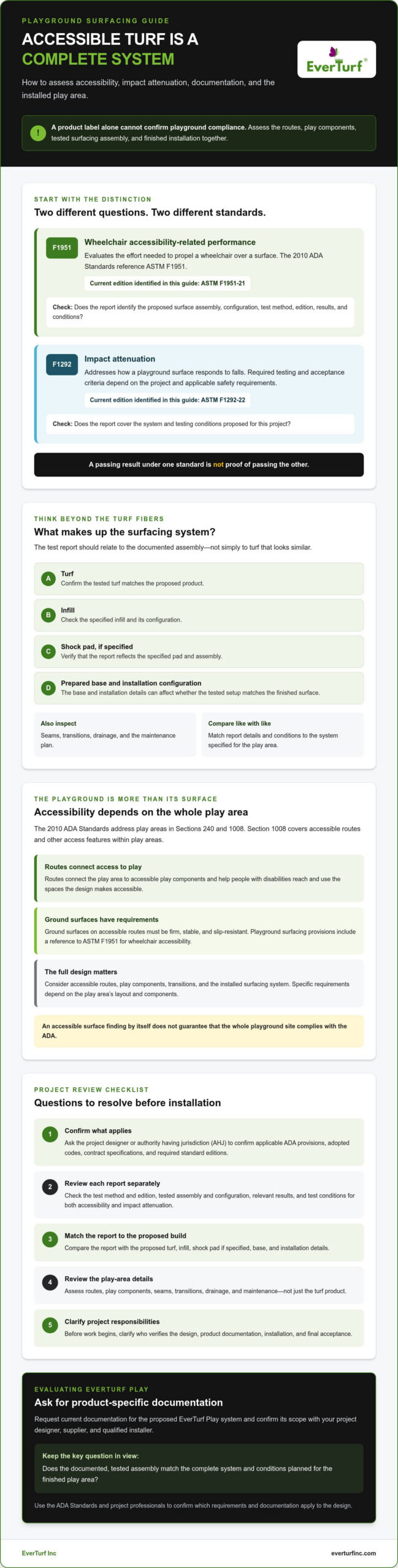
ASTM F1951 evaluates the effort needed to propel a wheelchair over a surface. The 2010 ADA Standards reference ASTM F1951, while ASTM F1951-21 is the current edition identified for this guide. Confirm with the project designer and authority having jurisdiction which edition and documentation the project requires. A report should relate to the proposed surface assembly and test conditions, not just the turf fibers.
ASTM F1292 addresses impact attenuation, a separate measure of how a playground surface responds to falls. ASTM F1292-22 is the current edition identified for this guide, but the required testing and acceptance criteria depend on the project and applicable safety requirements. A passing result under one standard is not proof of passing the other.
- F1951: Accessibility-related surface performance for wheelchair use.
- F1292: Impact attenuation for fall protection where applicable.
Evaluate the full design, including routes, play components, transitions, and the installed surfacing system. That system may include turf, infill, a specified shock pad, and the prepared base. Each detail can affect whether the tested configuration matches the finished play area.
Which Playground Turf Standards and Test Reports Should You Check?
Useful test documentation answers more than “Did it pass?” It identifies what was tested, how it was assembled, and the conditions covered. Those details let your project team compare the reports with the system specified for the playground. For the governing play-area provisions and their relationship to ASTM surface standards, consult the U.S. Access Board standards for play areas. Then ask the designer or authority having jurisdiction (AHJ) to confirm applicable ADA provisions, adopted codes, contract specifications, and standard editions.
Test evidence applies to the documented system and testing conditions, not automatically to every installation that uses similar turf. Reports on turf fibers alone may not answer whether the proposed assembly is appropriate for your project. The turf, infill, shock pad if specified, base, and installation configuration can all matter.
| Standard and purpose | What the report should identify | Questions for your project team |
|---|---|---|
| ASTM F1951 Wheelchair accessibility-related surface testing |
Test method and edition; tested surface assembly and configuration; relevant test results and conditions | Does the sample match the proposed turf, infill, base, and installation details? Which edition does the project require? |
| ASTM F1292 Impact attenuation |
Tested assembly and conditions; reported impact results; applicable test locations or configurations | Does the report address the project’s fall height and use zone? Who will verify performance after installation and over the surface life cycle? |
Review accessibility documentation
For ASTM F1951, check that the report describes the tested surface system rather than naming only the turf product. Compare its configuration with the proposed assembly, including infill and base details where applicable. ASTM F1951-21 is the current edition identified for this guide, but have the designer or AHJ confirm which edition applies to your project.
Review impact-attenuation documentation
ASTM F1292 addresses impact attenuation. ASTM F1292-22 is the current edition identified for this guide. Review the reported results and test conditions, and don’t infer performance beyond what the report states. Confirm with the project team whether the documentation addresses the equipment’s fall height and required use zone. Establish who is responsible for any post-installation checks and ongoing verification.
Use the ADA compliant playground turf requirements as a framework for questions, not as a substitute for project-specific review. If you’re comparing systems, you can review playground turf offerings and request current, product-specific documentation to discuss with your project professionals.
How to Compare Playground Turf Systems Without Assuming Compliance
Compare the complete assembly, not just the visible turf. Depending on the design, that may include turf, infill, a shock pad, base preparation, seams, and transitions to adjoining surfaces. A product may have useful test evidence, but it can’t make an inaccessible entrance, route, or play-component layout accessible. Consider the ADA compliant playground turf requirements alongside the full site design and the conditions the project team expects the finished surface to meet.
Use this checklist to organize comparisons. Ask suppliers for documentation, then have the designer and other responsible project professionals determine whether it meets the project’s requirements.
| Area to compare | What to check | Who should confirm |
|---|---|---|
| Documentation | Current reports, test methods and editions, tested materials, assembly details, and test conditions | Supplier provides documents; designer reviews suitability |
| Accessibility evidence | Whether the tested system and configuration match the proposed surface; consult the ASTM F1951 standard | Designer or authority having jurisdiction confirms project applicability |
| Impact testing | Reported results, tested assembly, and whether testing addresses the project’s equipment and fall-height needs | Designer and responsible safety professionals |
| Drainage and transitions | How water moves through or away from the assembly, and whether edges, seams, and adjoining surfaces are addressed | Designer and qualified installer |
| Maintenance and verification | Care instructions, inspection responsibilities, and how wear or damage will be documented and addressed | Owner or operator, with guidance from project professionals |
Questions to ask a playground turf supplier
Request current test reports and ask exactly which materials and assembly they cover. Compare those details with the proposed turf, infill, pad, base, seams, and installation specifications. Ask for compatible-component guidance and written maintenance instructions. Then confirm with the project designer whether the reports address the intended use and required performance criteria. A general product statement is not project-specific proof.
Check installation and maintenance details
A tested system and a finished installation aren’t automatically identical. Ask how the installer will follow the specified assembly and address consistent surface levels, secure seams, transitions, and drainage. Compaction, wear, displaced infill, or damage may affect surface condition over time. Agree in advance who will inspect, document issues, and arrange follow-up, using the project’s maintenance plan rather than assuming one universal schedule.
EverTurf supplies EverTurf Play, a playground-surface offering. To assess its fit, request current product-specific reports and confirm which assembly and conditions they cover with your project professionals. You can review playground turf options as part of that comparison.
A Project Checklist for Planning Accessible Playground Turf
A clear sequence keeps accessibility, safety, and installation details connected from the first design conversation through final review. Treat the ADA compliant playground turf requirements as part of a coordinated project, not a last-minute product check. The designer, surface supplier, installer, owner or operator, and authority having jurisdiction (AHJ) each have a role in confirming the decisions within their responsibility.
Before selecting a surface system
- Map the play area. Identify entrances, accessible routes, play components, use zones, changes in level, and transitions to adjacent surfaces. Ask the designer to show how routes connect the areas and components intended to be accessible.
- Confirm project criteria. Have the designer and AHJ identify applicable ADA provisions, adopted codes, contract requirements, relevant test methods, and required standard editions. Clarify the criteria before comparing proposals.
- Request system-specific evidence. Ask each supplier for current reports and specifications, and check that they identify the proposed materials and tested assembly. Compare components together, including turf, infill where used, any specified shock pad, base, seams, and edge details. A dedicated guide to turf infill can help explain why infill should be evaluated as part of the system rather than in isolation.
- Coordinate responsibilities. Confirm who supplies each component, who installs the specified assembly, who reviews the reports, and who will verify the completed work. Put those responsibilities in project documents so key checks aren’t left assumed.
Before approving the completed playground
Review the installed surface against approved specifications and the documentation for the proposed assembly. Ask the responsible project professionals to check route connections, entrances, transitions, seams, surface condition, and any tests required by the project. If materials or installation details differ from what was documented, ask the designer to determine whether the change affects the review.
Plan for the life of the surface, too. Record who owns inspections, which conditions to monitor, how findings will be documented, and how observed wear or damage will be addressed. The appropriate inspection process depends on the project and system, so establish it with the responsible professionals rather than relying on an assumed universal schedule.
Use this checklist to prepare focused questions for a supplier and your project team. To explore EverTurf’s playground turf options, request current product-specific documentation and confirm its relevance to your planned assembly with the project professionals.
How EverTurf Play Fits Into a Playground Surfacing Evaluation
EverTurf Play is a playground-surface offering from EverTurf. Its name alone, however, doesn’t establish that a particular installation meets accessibility or impact-attenuation requirements. The ADA compliant playground turf requirements apply to the project as designed and installed, so evaluate the proposed surface assembly and its documentation against the criteria your project professionals identify.
EverTurf supplies synthetic turf and related components, but don’t assume that product availability includes engineering, ADA certification, or installation services. Confirm who is responsible for specifying and installing the full system, and who will review its suitability for the site.
What to verify when considering EverTurf Play
Ask EverTurf for current product specifications and any available accessibility or impact-attenuation reports. Check the exact configuration each report covers, including the materials and test conditions. Then compare that documented assembly with the system proposed for your playground. Turf, infill, a specified shock pad, base preparation, seams, and transitions may all be relevant to the comparison.
Have the project designer review the documents against project requirements and applicable standards. If a report describes a different configuration from the one planned, ask the designer whether the difference affects its usefulness. Don’t rely on appearance, a general product description, or a broad compliance claim without supporting, product-specific evidence.
Practical next steps for your project team
Before requesting product information, prepare the intended play-area layout, the project’s performance criteria, and the documents that identify required tests or editions. This gives the supplier a clearer basis for responding and helps the designer compare the offered system with the plans. For broader context on synthetic grass materials and assemblies, consult an artificial grass guide alongside the project-specific specifications.
- Ask which EverTurf Play specifications and test reports are currently available.
- Confirm the reports’ tested assembly and conditions, then compare them with the proposed components and installation details.
- Have the project designer determine whether the documented evidence addresses the project’s needs.
These checks help keep product information, project requirements, and installation decisions aligned. Explore EverTurf playground turf options and request details relevant to your project. Share the proposed assembly and requirements with your designer so they can assess the documentation without treating the product name as proof of whole-site compliance.
Build Confidence Into Your Playground Surfacing Plan
Accessibility and impact attenuation are separate considerations, and neither can be confirmed by a turf label alone. Use the ADA compliant playground turf requirements to review relevant test reports, compare the documented assembly with the planned installation, and coordinate routes, transitions, and maintenance with your project professionals.
EverTurf Play is a playground-surface offering, and EverTurf supplies synthetic turf and related installation accessories. Request current product-specific information, then have your designer assess whether the documented system fits your project’s requirements. That review can help your team move forward with greater clarity and create a play space designed with access and safety in mind.
Explore EverTurf playground turf options and request details to discuss with your project team.
Frequently Asked Questions
What does ADA-compliant playground turf mean?
ADA-compliant playground turf means the surface has been considered as part of an accessible play area, not simply selected by product label. Review includes applicable routes and ground surfaces, play components, and how the system is installed. For the ADA compliant playground turf requirements, project teams should verify relevant ADA provisions, applicable codes, test reports, installation details, and the completed layout with qualified professionals. A passing surface test alone doesn’t establish whole-site compliance.
Does artificial turf automatically meet ADA playground requirements?
No, artificial turf doesn’t automatically meet ADA playground requirements. Accessibility depends on the applicable provisions and the complete installed play-area design. Review whether routes and transitions are accessible, whether the surface meets relevant criteria, and how play components connect to those routes. Before selecting or approving a system, ask the project designer and authority having jurisdiction to confirm which requirements apply and what documentation they expect to see.
What is ASTM F1951 used for in playground surfacing?
ASTM F1951 is a test method used to assess the effort required to propel a wheelchair over a playground surface. The report should identify the tested assembly, configuration, method, and conditions so you can compare them with the system proposed for your project. ASTM F1951-21 is the current edition identified for this guide, but confirm the applicable edition and project requirements with the designer or authority having jurisdiction.
Is ASTM F1292 the same as ADA compliance?
No, ASTM F1292 impact-attenuation testing is not the same as ADA compliance. It evaluates a different performance concern from accessibility-related requirements, which include access to relevant areas and surface usability. A result under either test method doesn’t prove that every site requirement is met. Ask the project team to identify applicable standards, editions, and criteria, then review the documentation and overall design as separate but coordinated parts of the evaluation.
Can playground turf meet both accessibility and impact-attenuation requirements?
A complete surfacing system may be evaluated for both accessibility and impact attenuation, but the evidence must match the proposed assembly and project conditions. Request applicable reports and compare their tested materials and configuration with the specified system. Where relevant, ask whether impact documentation addresses the equipment’s fall height and use zone. Have the project designer confirm that the evidence addresses the project criteria. Don’t assume one test result answers every requirement.
What documents should I request before choosing playground turf?
Request current product specifications, relevant test reports, installation instructions, and maintenance guidance. Check that each report identifies the tested assembly and conditions, then compare those details with the proposed turf, infill, shock pad if specified, base, and installation configuration. Ask the project designer or authority having jurisdiction to confirm applicable standards, editions, codes, and acceptance criteria. A general marketing statement isn’t a substitute for documentation tied to the system under review.
Does playground turf need ongoing inspection to remain accessible?
Project teams should establish inspection and maintenance responsibilities because wear, movement of system components, or damage can change the surface over time. Follow the system’s documented care instructions and any project-specific requirements. Decide who will inspect and record the surface condition, how deterioration will be reported, and who will determine corrective action. Ask qualified professionals to help set an appropriate process, since one inspection schedule won’t suit every site or system.