


Common Artificial Grass Installation Mistakes to Avoid for a Flawless 2026 Landscape
A flawless landscape is 90% invisible foundation and 10% precision finishing. Skipping the groundwork is the fastest way to turn a premium investment into a frustrating eyesore. You’ve likely envisioned a sanctuary where the grass stays vibrant regardless of the season, yet many projects fail due to poor drainage or visible seams. Understanding the common artificial grass installation mistakes to avoid is the difference between a temporary fix and a permanent lifestyle upgrade. It’s about more than just aesthetics; it’s about the technical integrity that keeps your outdoor space functional and inviting for years to come.
We know you value your time and the restoration of your weekends. You deserve a lawn that handles heavy rainfall and high-energy pets without lingering odors or drainage failures. This guide helps you master the nuances of artificial turf installation so you can enjoy a durable, beautiful, and odor-free environment. We’ll walk through the essential preparation steps, including proper base compaction and the latest 2026 standards for PFAS-free materials. You’ll learn how to secure the perfect seam and choose the right EverTurf Infill to ensure your property remains a sophisticated, stress-free retreat that lasts for decades.
Key Takeaways
- Master sub-base preparation to prevent sinking and uneven surfaces, ensuring your landscape remains perfectly level and stable for decades.
- Implement advanced drainage strategies and non-woven weed barriers to eliminate standing water and persistent pet odors from your outdoor sanctuary.
- Identify common artificial grass installation mistakes to avoid, such as misaligned pile directions or visible seams that compromise the natural beauty of your property.
- Select the ideal combination of specialized turf and EverTurf Infill to protect the backing from UV damage and ensure long-term durability in high-traffic areas.
- Learn professional finishing techniques like the ‘S-cut’ seam and power brushing to achieve a lush, vibrant appearance that restores your personal time.
The Foundation: Why Sub-Base Preparation is the Most Critical Phase
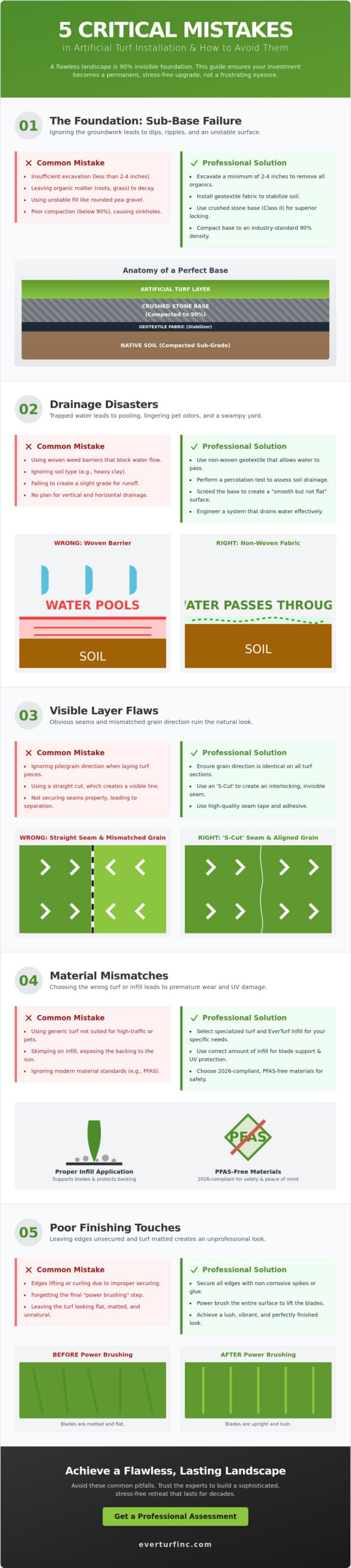
Your dream landscape begins long before the first roll of green is unrolled. While the lush surface captures the eye, the technical integrity of your lawn depends entirely on the invisible layer beneath. One of the most common artificial grass installation mistakes to avoid is treating the sub-base as an afterthought. Without a stable, well-engineered foundation, even the highest quality turf will eventually succumb to dips, ripples, and drainage failures that disrupt the tranquility of your outdoor space.
Professional-grade installation requires a deep understanding of soil mechanics. Your turf is only as good as the soil beneath it, and ignoring the specific needs of your property’s ground can lead to costly repairs later. Looking back at the history of artificial turf, we see that the most successful projects are those that prioritize structural stability. This means achieving a compaction ratio of 90%, the industry standard for preventing the dips and valleys that often plague DIY attempts. When you integrate your lawn with EverTurf Pavers, this foundation becomes even more critical to ensure a flush, sophisticated transition between materials.
Excavation and Soil Stabilization
The first step toward a permanent solution is the removal of native soil. You must remove at least 2 to 4 inches of earth to clear out grass, roots, and organic matter. If left behind, this material will decay over time, creating “soft spots” that eventually turn into sinkholes. After clearing the area, we look for any remaining unstable ground. Applying a high-quality geotextile fabric across the sub-grade acts as a stabilizer. It prevents the native soil from mixing with your new aggregate while allowing water to pass through freely, protecting the long-term shape of your landscape.
Aggregate Selection and Leveling
Choosing the right base material is a science. While some suggest pea gravel, professional installers prefer crushed stone or “class II road base.” These sharp-angled aggregates provide superior locking when compacted, creating a stone-hard surface that won’t shift underfoot. The goal is to create a surface that’s “smooth but not flat.” You want a slight grade to facilitate natural runoff, preventing water from pooling in the center of your lawn. We use a process called “screeding” to achieve this. By pulling a straight edge across the aggregate, we remove high spots and fill in the lows, ensuring a professional-level finish that looks flawless from every angle. This meticulous attention to detail is what separates a DIY job from a premium, long-lasting environment.
Drainage Disasters: Preventing Standing Water and Pet Odors
Proper drainage is the lungs of your landscape. Without a clear path for water to exit, your outdoor sanctuary can quickly become a swampy, stagnant environment. One of the most common artificial grass installation mistakes to avoid involves neglecting the physics of fluid dynamics. High-quality synthetic systems rely on a dual approach: vertical drainage, which allows water to pass directly through the turf backing, and horizontal drainage, which guides excess moisture across the sub-base toward a designated exit point. While critics often point to the environmental impact of artificial turf regarding soil health, a properly engineered drainage system actually mimics natural percolation, protecting the ecosystem beneath your property.
Before any turf is laid, performing a “percolation test” is essential. Dig a small hole, fill it with water, and time how long it takes to drain. If the water lingers for hours, your soil is likely clay-heavy and requires a more robust aggregate layer. Another frequent error is choosing the wrong weed barrier. While you want to prevent growth, you must use a “non-woven” geotextile. Woven barriers can act like a plastic sheet, trapping water and causing it to pool, whereas non-woven options allow for rapid moisture transfer. If you’re unsure about your yard’s soil composition, a quick professional site assessment can reveal exactly which drainage configuration fits your property.
Engineering the Slope for Optimal Runoff
Precision grading is the secret to a dry lawn. We recommend calculating a 1% to 2% slope, which is subtle enough to remain invisible to the naked eye but steep enough to prevent pooling in the center of your lawn. This is particularly vital for EverTurf Roof & Deck installations, where water must be channeled toward existing scuppers or drains. In low-lying areas or regions with heavy rainfall, integrating French drains or catch basins at the perimeter ensures that even the most intense storms won’t disrupt your tranquility.
Pet-Specific Drainage and Odor Prevention
Homeowners with furry family members must prioritize a system designed for high-capacity use. A major mistake is using standard infill in a heavy-use pet zone, as it can trap moisture and bacteria. When installing artificial grass for dogs, the sub-base permeability must be significantly higher to facilitate the rapid breakdown of pet waste. High-performance drainage-backed turf ensures that moisture and waste move swiftly through the system, preventing the concentrated ammonia buildup that causes persistent odors. By combining this with specialized antimicrobial EverTurf Infill, you create a pristine environment that stays fresh and inviting year-round.
Mastering the Visible Layer: Grain Direction and Invisible Seams
Achieving a seamless, natural aesthetic is the ultimate goal for any homeowner investing in a premium landscape. While the base provides the structure, the visible layer provides the emotional reward of a perfect, year-round lawn. Among the most common artificial grass installation mistakes to avoid is neglecting the subtle science of grain alignment and seam precision. A poorly executed seam doesn’t just ruin the look; it detracts from your property value and serves as a constant reminder of a job left unfinished. By mastering the ‘S-cut’ technique, you can ensure that your lawn looks like a single, continuous carpet of lush greenery rather than a series of disconnected strips.
The ‘Pile Direction’ rule is your first line of defense against an artificial look. Every roll of turf has a grain, and if these grains don’t face the same way, your lawn will appear in different shades of green, creating a distracting patchwork effect. Using professional-grade EverTurf Staples and Glue is essential during this phase. It provides the necessary bond to prevent seam separation during the intense heat of summer or the freezing cycles of winter. When seams aren’t secured correctly, you risk the ‘mohawk’ effect, where the edges of the turf overlap and push upward, creating a visible ridge that is impossible to hide.
The Art of Grain Alignment
Positioning your turf rolls correctly is about more than just matching directions. You should always face the pile toward the primary viewing area, which is typically the house or a central patio. This angle captures the light in a way that minimizes the ‘sheen’ of the synthetic fibers, enhancing the deep, realistic colors of the blades. Even in complex, curved areas, maintaining grain consistency is vital. It requires careful planning and precision cutting to ensure that every section of your yard contributes to a unified, tranquil environment.
Precision Seaming and Fastening
Applying the right amount of adhesive is a delicate balance. Too much glue can seep up through the backing and mat the fibers, while too little leads to weak bonds. We recommend a consistent application rate that allows the seam tape to fully saturate without overflowing. For fastening, a staggered staple pattern is superior to a straight line. This technique mimics the root structure of natural grass and prevents the turf from lifting or shifting as the ground expands and contracts. If you notice ‘seam-peaking’—where the edges point upward—address it immediately by weighting the seam before the glue sets to ensure a flat, invisible finish.
Material Mismatches: Choosing the Wrong Turf and Infill
Selecting the right materials is a decision that defines the next two decades of your outdoor experience. A common artificial grass installation mistakes to avoid is the “one-size-fits-all” approach to product selection. Every environment has unique demands. A quiet side yard requires a different technical profile than a high-traffic family play area. When you choose a product that isn’t engineered for its specific purpose, you risk premature wear, matted fibers, and a landscape that loses its luster within just a few seasons. True luxury lies in the precision of the match between your lifestyle and the synthetic system you install.
Activity-specific design is the hallmark of a sophisticated landscape. For those perfecting their short game, EverTurf Putting Green Pro offers the exact stimp speeds and ball-roll consistency required for professional-grade practice. Conversely, families with children should look toward EverTurf Play, which prioritizes impact attenuation and softness. Using a specialized sports product for a residential lawn, or vice versa, creates a mismatch in both performance and aesthetics. You deserve a solution that feels as good as it looks, tailored to how you actually use your property.
Selecting the Right Turf for Your Lifestyle
Blade geometry plays a significant role in how your lawn recovers from foot traffic. W-shaped and V-shaped blades are engineered for high resilience, standing tall even after heavy use, while U-shaped blades offer a softer touch for barefoot comfort. Many homeowners fall for the “Face Weight” myth, believing that a heavier turf is always superior. This isn’t the case. While a higher face weight can indicate density, it must be balanced with the intended use. For instance, EverTurf Sports Fields require a specific backing and blade structure to handle intense athletic pivots, which would be unnecessary and overly rigid for a balcony or roof deck.
Infill: The Secret to Longevity
If the turf is the body of your lawn, the turf infill is its soul. Infill protects the delicate backing from UV damage and provides the ballast needed to keep the blades upright. One of the most frequent errors is under-infilling, which leads to a “flat” look and allows the fibers to degrade under the sun’s rays. In 2026, raw silica sand is no longer the standard. Modern homeowners now choose EverTurf Infill with antimicrobial coatings to prevent bacteria growth and enhance hygiene.
Thermal regulation is another critical factor in a high-end installation. Specialized infills can reduce surface temperatures by 15% to 20%, ensuring your lawn remains comfortable even during the peak of summer. Achieving this requires a precise calculation of pounds-per-square-foot based on your specific pile height. Too little infill leaves the blades unsupported; too much creates a messy, abrasive surface. By investing in the right materials and quantities, you secure a permanent, tranquil environment that stands the test of time. To find the perfect combination for your specific project, explore our professional installation services and let our experts guide your selection.
Professional Finishing: Securing Edges and Initial Maintenance
The final moments of an installation are where your vision truly crystallizes. While the previous sections focused on the technical skeleton and muscle of your lawn, the finishing touches provide the character and soul of the space. One of the common artificial grass installation mistakes to avoid is rushing the perimeter work. A lawn that looks beautiful in the center but frays or lifts at the edges loses its premium feel instantly. We utilize the “tucking” technique, where the turf is meticulously folded and secured against pavers or bender boards, creating a clean, hidden edge that looks as though the grass grew naturally right up to the stone.
After the turf is secured, power brushing becomes the priority. This isn’t just a cleaning step; it’s the process that gives your lawn its “bloom.” Factory-rolled turf arrives flat, and the mechanical action of a power brush helps the blades stand tall, setting the turf’s memory for years to come. You should expect a 30-day settling period as the infill drops deeper into the thatch. This natural progression is part of the system’s design, ensuring the backing remains protected and the surface feels firm underfoot. Choosing a professional installer often leads to a significantly higher ROI, as a Reliable Visionary understands how these final nuances impact the longevity and value of your property.
Edge Detail and Perimeter Security
Perimeter security is your defense against edge lift, which often occurs in high-wind zones or areas with heavy foot traffic. We use EverTurf Staples to anchor the edges every few inches, preventing pets or lawn equipment from catching the backing. If you’re integrating grass with existing garden beds, precision is key to protecting tree roots while maintaining a sharp aesthetic. A well-finished edge ensures your lawn remains a permanent, worry-free sanctuary that requires no traditional mowing or fertilization.
The Post-Installation Checklist
Once the installation is complete, a thorough rinse and brush removes factory dust and static, revealing the vibrant colors of your new landscape. We recommend a simple quarterly maintenance schedule to preserve the everlasting look of your investment. During the final inspection, look for trapped fibers, which are blades caught beneath the seam glue, and gently release them with a brush. This attention to detail guarantees that every inch of your lawn reflects the quality and tranquility you’ve worked to achieve, finally giving you back the personal time you deserve. By identifying common artificial grass installation mistakes to avoid during this final phase, you ensure a flawless transition to a maintenance-free lifestyle.
Transform Your Vision into an Everlasting Reality
A masterfully installed landscape is more than just a visual upgrade; it’s a commitment to your long-term peace of mind. You now understand that a perfect lawn is built from the ground up, starting with a rock-solid foundation and ending with meticulous edge detail. Identifying the common artificial grass installation mistakes to avoid ensures your investment yields the tranquility and restored personal time you deserve. From the 90% compaction of your sub-base to the precise alignment of the turf grain, every technical nuance contributes to a seamless, high-end result that looks natural from every angle.
Whether you’re perfecting your short game with EverTurf Putting Green Pro or creating a pet-friendly retreat with specialized EverTurf Infill for superior odor control, precision is your greatest asset. Our national supply network ensures you have access to premium synthetic grass that stands up to the environmental demands of 2026. It’s time to move away from the frustrations of traditional maintenance and step into a worry-free outdoor space. Design your maintenance-free oasis with EverTurf’s professional-grade solutions today. Your journey toward a pristine, year-round sanctuary begins with a single, confident choice.
Frequently Asked Questions
Can I install artificial grass directly on top of existing natural grass or weeds?
You should never lay turf directly over living grass or weeds. Doing so is a major error because the organic matter beneath will rot, leading to an uneven surface and unpleasant odors. Professional installation requires excavating 2 to 4 inches of native soil and replacing it with a stable aggregate base. This process ensures your lawn remains level and beautiful for decades.
How do I make sure my artificial turf doesn’t get too hot for my pets in the summer?
Selecting the right infill is the most effective way to manage surface heat for your pets. EverTurf Infill with thermal regulation technology can reduce turf temperatures by 15% to 20% compared to standard sand. On exceptionally hot days, a quick rinse with a garden hose provides immediate relief. This combination keeps your outdoor sanctuary comfortable and safe for every family member.
What happens if I don’t use enough infill during my installation?
Insufficient infill leads to matted fibers and premature wear of the turf backing. Without enough weight and support, the grass blades lose their memory and flatten under foot traffic. This is among the common artificial grass installation mistakes to avoid, as it also leaves the backing vulnerable to UV degradation. Proper infill levels maintain the lush, upright appearance that defines a premium landscape.
Is a weed barrier really necessary for synthetic turf installations?
A non-woven weed barrier is essential for a high-performance system. It serves two purposes: preventing airborne seeds from taking root in your infill and keeping your aggregate base from mixing with the native soil. Avoid woven barriers, as they can trap water and cause drainage issues. Using the correct geotextile fabric ensures a clean, worry-free environment that stands the test of time.
How can I tell if my installer is cutting corners on the sub-base preparation?
You can spot corner-cutting by observing the compaction process and aggregate choice. A professional installer will use a vibratory plate compactor to reach 90% compaction rather than just hand-tamping the surface. If they use only sand instead of crushed stone for the base, the foundation will eventually shift. Demand transparency regarding excavation depths to ensure your project’s long-term structural integrity.
What is the best way to hide the seams between two rolls of artificial grass?
Mastering the “S-cut” technique is the secret to making seams virtually vanish. By cutting the edges in a subtle wave pattern rather than a straight line, you break up the visual seam for the human eye. Combine this with perfect grain alignment and EverTurf Staples and Glue to secure the rolls. This meticulous approach creates a single, continuous carpet of green that enhances your property’s overall aesthetic.
Can I install synthetic turf on a slope or uneven ground?
Synthetic turf performs exceptionally well on slopes when anchored correctly. You must use additional staples or specialized glue to prevent the turf from shifting downhill over time. For uneven ground, the area must be graded and smoothed during the sub-base phase to prevent water from pooling in low spots. Proper preparation allows you to transform even the most challenging terrain into a tranquil, year-round retreat.
How long does a professional artificial grass installation typically take?
A typical residential installation usually takes between 1 and 3 days to complete. This timeline depends on the size of your yard and the complexity of the excavation required. Larger projects, such as EverTurf Sports Fields, will naturally require more time for precision grading and seaming. Our efficient process minimizes disruption to your life, quickly restoring your personal time in a beautiful new environment.