7 Critical Signs You Need to Replace Your Artificial Turf in 2026
Is your once-vibrant backyard quietly becoming a source of stress rather than a sanctuary? You initially chose synthetic grass for the promise of a permanent, pristine landscape, but even high-quality legacy systems eventually reach their limit. If you’ve noticed persistent pet odors that won’t lift or matted fibers that refuse to stand up after brushing, you’re likely seeing the first signs you need to replace your artificial turf. It’s frustrating to watch a luxury investment lose its luster, especially when you value the tranquility of a maintenance-free lifestyle.
This guide helps you identify exactly when your synthetic lawn has reached the end of its functional life and why a 2026 upgrade is a tactical performance boost for your property. We’ll examine seven critical indicators, from visible seam failures to drainage issues that impact your pets’ comfort. You’ll learn how modern advancements in thermal protection and eco-friendly materials can restore your personal time and provide the long-term satisfaction you deserve. It’s time to trade the frustrations of an aging lawn for the confidence of a sophisticated, year-round outdoor environment.
Key Takeaways
- Understand the standard 15-20 year lifecycle of premium synthetic grass and how environmental factors like UV exposure impact your specific replacement timeline.
- Identify the definitive signs you need to replace your artificial turf, including permanent fiber matting and the presence of backing deterioration.
- Apply the “25% Rule” to decide if a localized repair is sufficient or if a full replacement is necessary to avoid a mismatched, “checkerboard” aesthetic.
- Explore how 2026 technology, such as fully permeable backings and advanced thermal cooling, offers a significant performance upgrade over legacy turf systems.
- Learn how to manage a seamless transition by properly recycling old materials and preparing your sub-base for a long-lasting EverTurf installation.
Understanding the Real-World Lifespan of Synthetic Grass
High-quality synthetic surfaces generally offer a 15 to 20 year lifecycle when they’re professionally installed and maintained. However, this timeline isn’t a fixed guarantee. The history and development of artificial turf shows that while durability has improved significantly, local environmental factors ultimately dictate the expiration date of your lawn. Intense UV exposure can break down older polymers, while consistent heavy foot traffic can crush fibers beyond the point of recovery. It’s helpful to distinguish between simple aesthetic wear, like minor fading, and structural failure, such as backing rot or crumbling. Recognizing the early signs you need to replace your artificial turf ensures you don’t wait until the system fails completely, potentially damaging your property’s sub-base.
The standards for synthetic landscapes in 2026 are vastly superior to the technology available just a decade ago. We now view a lawn as a high-performance system rather than just a floor covering. If your current grass feels like a relic of the past, it’s likely because the industry has moved toward more sophisticated, lifestyle-focused solutions that prioritize both beauty and technical endurance.
The “Legacy Turf” Problem
Many homeowners are currently living with “legacy” systems installed over ten years ago. These older products often lack modern heat-reduction technology, causing them to absorb and retain solar energy. In contrast, modern EverTurf is engineered to stay cooler and feel more natural underfoot. Legacy drainage systems often rely on simple perforated holes that can become permanently clogged with fine silt or organic debris over time. When this happens, the lawn loses its ability to manage moisture, leading to hygiene issues that no amount of surface cleaning can fix. Older fibers also tend to feel like “stiff plastic” because they lacked the resilient cross-sections found in today’s premium installations.
Maintenance vs. Natural Aging
Consistent care is the key to longevity, but even the best routine can’t stop the clock forever. Poor maintenance, especially neglecting your turf infill, can cut a lawn’s lifespan in half. Infill acts as a protective cushion for the turf blades and the backing. If you’ve reached a point where your grooming routine no longer lifts the fibers or if you’re constantly fighting signs you need to replace your artificial turf like persistent odors, your maintenance is no longer effective. At this stage, the material has likely reached its functional end, and moving toward a modern replacement is the most cost-effective way to restore the tranquility of your outdoor space.
5 Critical Signs You Need to Replace Your Artificial Turf
While fading might be the most obvious change, it often signals a deeper issue than just a loss of color. Identifying the specific signs you need to replace your artificial turf requires looking past the surface. When a synthetic lawn reaches its limit, the material transitions from a lifestyle asset to a maintenance burden. Recognizing these indicators early allows you to plan a strategic upgrade before the system fails completely.
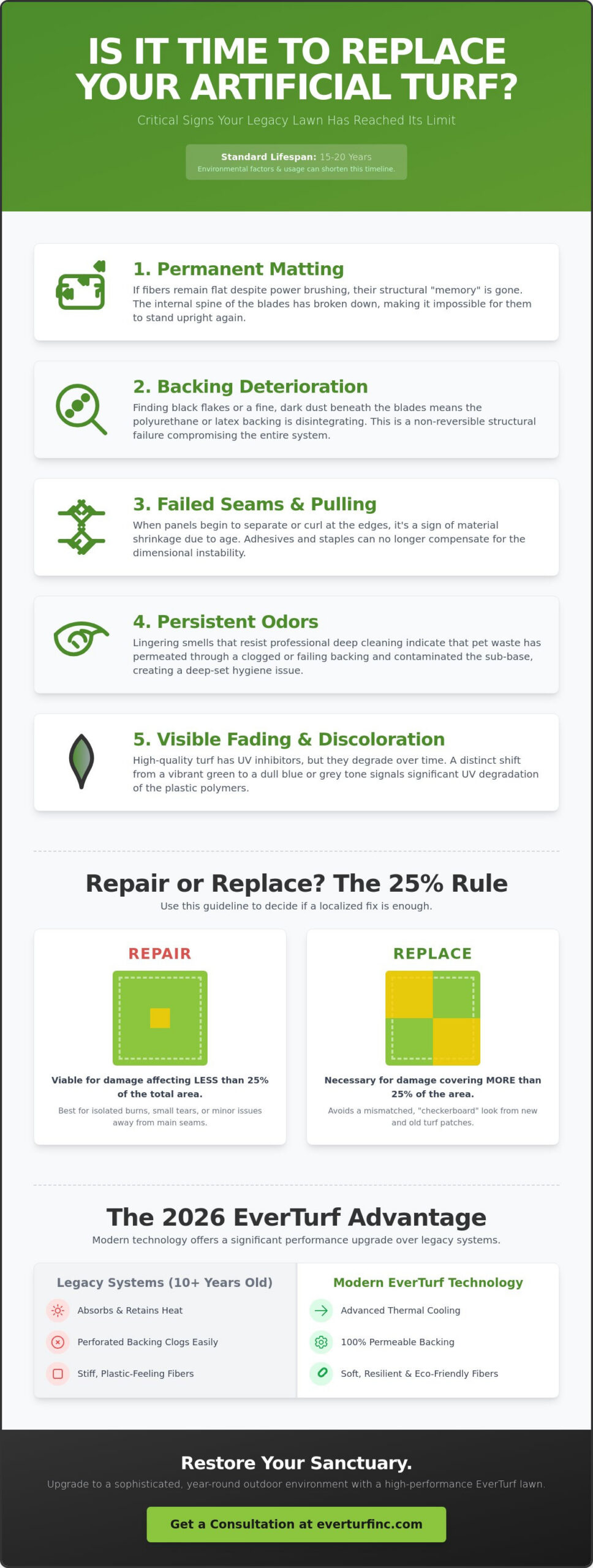
- Permanent Matting: If your grass remains flat despite your best efforts with a power brush or groomer, the fibers have lost their structural “memory.” This happens when the internal spine of the blade breaks down, making it impossible for the lawn to stand upright again.
- Backing Deterioration: Peek underneath the blades. If you find black flakes or a fine, dark dust, the polyurethane or latex backing is disintegrating. This is a non-reversible structural failure that compromises the entire installation.
- Failed Seams and Pulling: When panels begin to pull apart or curl at the edges, even premium EverTurf Staples and Glue can’t compensate for the shrinking, aging material.
- Persistent Odors: Odors that resist deep professional cleaning usually indicate that pet waste has permeated the sub-base, creating a hygiene issue that surface treatments can’t fix.
- Visible Fading: High-quality turf stays green for decades. A distinct shift toward blue or grey tones suggests significant UV degradation of the plastic itself, indicating the material is becoming brittle.
Structural Failure: The Backing and Seams
A brittle, crumbling backing isn’t just an eyesore; it’s a safety hazard. As the backing loses its flexibility, the entire system becomes unstable underfoot, especially for active children or athletes. Shrinking turf panels create visible gaps and trip hazards that disrupt the clean lines of your property. You can test your turf integrity with a simple “pull test.” Gently tug on a cluster of blades in a high-traffic area. If they pull out with little resistance or the backing feels like dry crackers, the structural integrity is gone. If you’re seeing these issues, it’s worth considering a professional assessment of your current landscape.
Performance Failure: Drainage and Odors
Standing water is a clear distress signal. It often means the sub-base has compacted or the turf’s drainage perforations are permanently blocked by organic buildup. For pet owners, this is particularly problematic as it traps bacteria and ammonia. The science of pet odor retention in older, less porous turf styles makes it nearly impossible to maintain a fresh environment. Upgrading to specialized artificial grass for dogs with fully permeable backings provides a permanent solution for superior drainage and hygiene.
Repair vs. Replacement: When is a Fix No Longer Enough?
Deciding whether to patch a small area or overhaul your entire landscape is a strategic choice for any homeowner. While minor burns or small tears are often fixable, widespread issues usually suggest that the system has reached its limit. We recommend following the “25% Rule” as a financial benchmark. If more than 25% of your lawn requires patching or professional structural attention, a full replacement becomes the more cost-effective path. Investing in a new installation ensures you aren’t simply throwing good money after bad by trying to revive a failing product. Recognizing these signs you need to replace your artificial turf early saves you from the frustration of a lawn that never looks quite right despite constant effort.
Patching old turf is notoriously difficult due to dye-lot variations and natural weathering. Even if you manage to find the exact same product from years ago, the original grass has likely faded slightly from UV exposure. This creates a “checkerboard” effect where new green patches clash with the older material, diminishing the sophisticated look of your property. Additionally, you must evaluate the sub-base. If the ground is sinking or shifting, the turf must come up regardless. Reinstalling brittle, aged material over a newly stabilized foundation is rarely successful and often leads to premature failure of the seams.
Calculating the “Maintenance Tax”
The “Maintenance Tax” is the cumulative cost of specialized cleaners, power brushes, and repeated small-scale repairs required to keep an aging lawn functional. You shouldn’t spend your valuable personal time “reviving” a lawn that’s past its prime when you could be enjoying the tranquility of a new EverTurf Artificial grass installation. While professional cleaning services provide a temporary boost, they can’t restore the structural integrity of degraded fibers. A new system offers a “set it and forget it” lifestyle, restoring your weekends and providing long-term peace of mind.
The Aesthetic Compromise
Old, matted turf doesn’t just look tired; it actively lowers your property value and curb appeal. A pristine landscape is a hallmark of a well-maintained home, and a failing lawn sends the wrong message to guests and neighbors. There’s a profound psychological benefit to a fresh start. Using high-quality backyard turf as a design reset allows you to reimagine your outdoor space as a modern oasis. This transition moves you away from the daily signs you need to replace your artificial turf and toward a more beautiful, stress-free version of your property that stays perfect year-round.
The Benefits of Upgrading to 2026 Synthetic Turf Technology
Modern turf technology has evolved rapidly, turning what was once a simple plastic carpet into a sophisticated environmental system. If you’ve identified the signs you need to replace your artificial turf, you’re actually standing at the threshold of a significant lifestyle upgrade. The 2026 standards for synthetic landscapes focus on three core pillars: thermal comfort, hydraulic efficiency, and visual authenticity. These advancements don’t just solve the problems of your old lawn; they transform your property into a high-performance sanctuary. While the physical signs you need to replace your artificial turf are often visible, the underlying performance failures are what truly disrupt your daily routine.
One of the most impressive leaps is in thermal performance. Older turf could become uncomfortably hot under the summer sun, but modern cooling technologies now keep surfaces 20% to 30% cooler than legacy products. This is achieved through heat-reflective pigments and advanced fiber geometries that manage solar absorption. Beyond comfort, the shift toward hyper-realism has eliminated the “fake green” look. Today’s EverTurf Artificial grass utilizes multi-tonal blades and varied textures to mimic the subtle imperfections of natural sod. For those with specific hobbies or needs, specialized systems like EverTurf Putting Green Pro or EverTurf Play offer tailored density and resilience that generic products simply cannot match. If your project includes specialized sports areas, you may also want to explore Cricket Practice Nets to create a professional-grade training facility alongside your new turf.
Cool-Touch and Anti-Glare Fibers
Engineered fiber shapes, such as U, V, or W cross-sections, do more than just provide a soft feel. These structures reflect sunlight at different angles, significantly reducing the “sheen” or glare associated with older, flat-blade designs. This technology ensures your lawn looks like lush, healthy sod from every viewing angle, rather than a reflective plastic sheet. For families with children or pets, these cool-touch fibers provide a critical safety benefit, allowing for bare-foot play even during the peak of a high-temperature afternoon in our local climate.
Advanced Drainage for Pet Owners
Legacy systems often relied on simple hole-punched perforations that could easily clog with organic debris. Modern 2026 systems utilize fully permeable backings that allow liquids to flow through every square inch of the material. When you pair this with EverTurf Infill, which is designed to neutralize ammonia, you effectively eliminate the “pet smell” problem that plagues older installations. This hydraulic efficiency is several times faster than 2010-era technology, ensuring your lawn stays dry and hygienic. For a complete aesthetic overhaul, many homeowners are now integrating EverTurf Pavers to create a modern, high-drainage hardscape that complements their lush new turf.
If you’re ready to leave the frustrations of your aging lawn behind, explore our latest artificial grass installation options to see how 2026 technology can restore your outdoor lifestyle.
Planning Your Transition to a New EverTurf Lawn
Once you’ve recognized the definitive signs you need to replace your artificial turf, the path toward a renewed landscape begins with a strategic plan. Transitioning from a failing legacy system to a modern 2026 installation is more than a simple swap; it’s an opportunity to correct past drainage failures and upgrade your home’s aesthetic value. The process starts with the responsible removal of your old lawn. We prioritize eco-conscious disposal methods, ensuring that aging synthetic materials are diverted from landfills through specialized recycling programs. This move away from the frustrations of a degraded yard toward the tranquility of a fresh start provides immediate emotional relief and long-term property benefits.
Evaluating your current sub-base is the most critical technical step in this transition. If your previous lawn suffered from sinking areas or persistent odors, the underlying foundation likely requires remediation. We assess the existing crushed stone base to determine if it can be reused or if it needs fresh compaction and grading. Ensuring the sub-base is perfectly leveled and porous is the only way to guarantee that your new EverTurf Artificial grass will maintain its pristine appearance and superior drainage for the next 20 years. Professional installation is essential here, as it secures the longevity of your investment and validates your comprehensive product warranty.
The Replacement Process
The transition follows a precise sequence: professional removal, base remediation, and the meticulous layout of your new turf. Modern 2026 installation techniques have advanced significantly, utilizing sophisticated “hidden seam” technology that makes the joins between turf panels virtually invisible. This is a vast improvement over the visible, high-tension seams of a decade ago. For those planning their project, we recommend reviewing our artificial turf installation cost guide to understand how different material choices and site conditions influence your overall budget. This transparency helps you make an informed decision without the pressure of unexpected expenses.
Choosing Your Next EverTurf System
Selecting the right product involves matching your specific lifestyle needs to the technical specifications of our lineup. If you have active children, EverTurf Play offers the impact-absorption and durability required for high-energy environments. For those looking to refine their short game, EverTurf Putting Green Pro provides a professional-grade surface with consistent ball roll. Each system is enhanced by specialized EverTurf Infill, which supports the fibers and facilitates the advanced drainage we discussed in previous sections. Making the right choice now ensures you won’t have to look for signs you need to replace your artificial turf for a very long time. It’s time to reclaim your weekends and enjoy a perfect, maintenance-free sanctuary. Contact EverTurf Inc for a professional assessment of your current lawn and take the first step toward a more beautiful home.
Reclaim the Tranquility of Your Outdoor Sanctuary
Your backyard should be a source of pride, not a list of maintenance chores. Identifying the specific signs you need to replace your artificial turf is the first step toward restoring the effortless beauty of your property. We’ve explored how structural failures like backing rot and permanent matting signal it’s time to trade legacy frustrations for 2026-standard performance. Upgrading allows you to benefit from 2026-standard UV and thermal protection, ensuring a surface that stays cool and vibrant for decades. This transition isn’t just a repair; it’s a strategic investment in your home’s long-term value.
With over 10 specialized turf systems tailored to every lifestyle and national distribution of professional-grade EverTurf Infill, we offer more than just a surface. We offer a permanent lifestyle enhancement that gives you back your time. Don’t settle for a lawn that has reached its limit when you can enjoy the peace of a pristine, year-round landscape. Upgrade your lifestyle with a high-performance EverTurf Artificial grass lawn today and rediscover the joy of a stress-free outdoor space. You deserve a sanctuary that remains as beautiful as the day it was installed.
Frequently Asked Questions
How long does artificial turf typically last before needing replacement?
High-quality artificial turf typically lasts between 15 and 20 years when it is professionally installed and properly maintained. While budget-tier products might only offer a 5 to 8 year lifespan, premium systems are engineered for much longer endurance. The actual duration depends on factors like local UV intensity and the frequency of foot traffic. Regular grooming and keeping infill at the correct levels can help you reach the upper end of this timeframe.
Can I just put new artificial grass over my old turf?
No, you cannot install new artificial grass directly over an old layer of turf. A successful installation requires a stable, porous, and perfectly graded sub-base to ensure proper drainage and a smooth, level surface. Leaving old material underneath traps moisture and organic debris, which leads to mold growth and an uneven foundation. Proper removal and base remediation are essential steps for a sophisticated and lasting result.
Is it worth replacing my turf if it is only faded but not torn?
Replacing faded turf is a strategic choice based on your aesthetic standards and your home’s curb appeal. While fading is often cosmetic, it usually indicates that the UV stabilizers in the plastic have degraded, making the fibers brittle and prone to breaking soon. If the color shift toward blue or grey tones disrupts the tranquility of your outdoor space, upgrading to modern technology will restore the aspirational look of your property.
What is the most common reason artificial turf fails prematurely?
The most common reason for premature failure is a poor initial installation, specifically regarding the sub-base and drainage system. If the ground wasn’t properly excavated and compacted, the turf will eventually sink, wrinkle, or develop trip hazards. Additionally, neglecting to maintain proper infill levels leaves the backing exposed to UV damage and allows fibers to mat down. Choosing seasoned experts ensures your landscape avoids these avoidable technical signs you need to replace your artificial turf.
How much does it cost to remove and replace artificial grass in 2026?
The total investment for removal and replacement depends on your property’s size, site accessibility, and the specific EverTurf system you choose. While labor for site preparation is a factor, the primary value lies in the quality of the new 2026-standard materials and specialized infill. We suggest requesting a professional assessment to ensure your budget aligns with the high-performance standards and long-term satisfaction you expect for your home.
Will new artificial turf get as hot as my old lawn did?
Modern 2026 turf systems are engineered to stay significantly cooler than older legacy lawns. Advanced cooling technologies and heat-reflective pigments can keep surface temperatures 20% to 30% lower than traditional synthetic products. While all outdoor surfaces absorb some heat, this new generation of fibers allows for a much more comfortable experience for bare feet and pets, even during the peak of a high-temperature afternoon in our local climate.
Can pet odors be fixed without replacing the entire turf system?
Surface-level pet odors can often be managed with specialized cleaners, but deep-seated smells usually require a more permanent solution. If uric acid has permeated the sub-base due to poor drainage in an older system, cleaning the top layer won’t solve the underlying hygiene issue. Upgrading to a fully permeable backing and antimicrobial infill is the most effective way to eliminate persistent odors and restore a fresh, stress-free environment for your family.
How do I know if my turf sub-base needs to be replaced along with the grass?
You will know your sub-base needs attention if you notice visible sinking, pooling water, or significant shifting in the turf’s surface. A healthy base should remain firm and porous; however, if it has compacted or eroded over time, it must be remediated before a new lawn is laid. Assessing the foundation during the removal process is one of the clearest signs you need to replace your artificial turf system entirely to ensure a perfect result.