
Artificial Grass Lifespan and Warranty Explained: A 2026 Homeowner’s Guide
Would you trust a “lifetime” promise if the fine print shifted the goalposts after just a few seasons? Many homeowners view synthetic turf as a final restoration of their personal time, yet they often worry that intense heat or pet activity might quietly void their protection. This artificial grass lifespan and warranty explained guide cuts through the noise to reveal what actually keeps a premium landscape lush for decades. While standard products typically offer a 10 to 15 year window, a sophisticated, professionally installed system can easily grace your home for 20 years or more.
We understand the desire for a permanent, beautiful solution that doesn’t require a law degree to decode. You want the peace of mind that comes from knowing your investment is secure against fading, melting, or manufacturing defects. This guide promises to demystify the latest 2026 industry standards, including the new ASTM F3782-26 PFAS testing protocols, so you can choose with absolute confidence. We will walk through the specific maintenance steps required to keep your EverTurf warranty valid and explain exactly how to protect the long term beauty of your outdoor sanctuary.
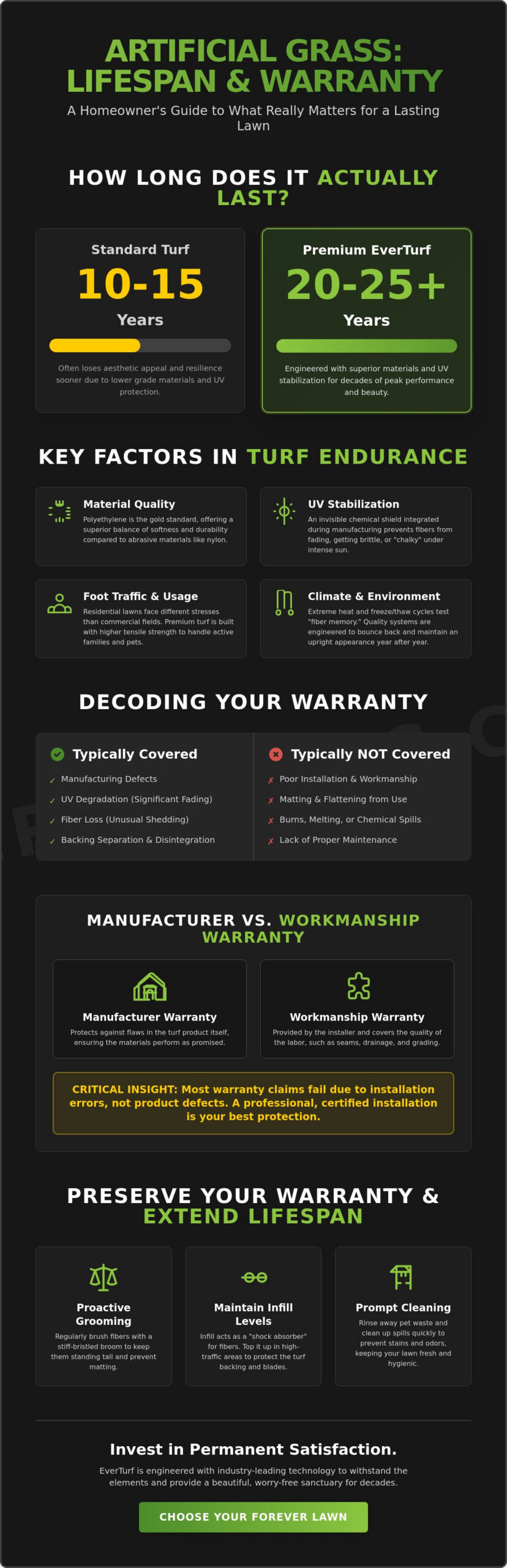
- Learn how premium synthetic turf maintains its lush, vibrant appearance for 15 to 25 years and how to distinguish between a functional lifespan and a purely aesthetic one.
- Navigate the complexities of the industry with our artificial grass lifespan and warranty explained guide, focusing on the critical differences between manufacturing defects and common maintenance issues.
- Discover why most warranty claims fail due to installation errors rather than material flaws, and how to ensure your foundation is built for permanent satisfaction.
- Master the proactive grooming and infill techniques that act as a protective “shock absorber,” preserving your warranty while keeping your lawn upright and resilient.
- Understand how EverTurf products are engineered with superior UV stabilization and high-tensile strength to withstand the rigors of the American climate.
How Long Does Artificial Grass Actually Last? (Lifespan Expectations)
Choosing a permanent landscape solution is about reclaiming your weekends and creating a sanctuary that lasts. To make an informed investment, you need the artificial grass lifespan and warranty explained in clear terms that reflect your daily reality. Lifespan isn’t simply the time it takes for a product to fall apart; it represents the functional window where the fibers remain resilient, soft, and visually indistinguishable from natural grass. While budget-grade materials might lose their luster within a decade, premium synthetic turf carries an industry average of 15 to 25 years of peak performance.
The history of artificial turf demonstrates how far engineering has come from the stiff, plastic carpets of the 1960s. Today’s high-end systems distinguish between structural failure and cosmetic wear-and-tear. A structural failure, such as the backing completely disintegrating, is incredibly rare in modern manufacturing. Most “end-of-life” scenarios for turf are actually cosmetic, occurring when the fibers finally lose their ability to stand upright or when the color begins to shift after decades of sun exposure. This is why UV stability is the primary driver of longevity in any synthetic landscape.
Factors Influencing Synthetic Turf Longevity
The DNA of your lawn dictates its endurance. Polyethylene is the gold standard for residential landscapes because it offers a perfect balance of silky softness and rugged durability. It typically outlasts nylon, which, while strong, can be too abrasive for bare feet and prone to moisture retention. We integrate specialized UV stabilizers during the extrusion process to create an invisible chemical shield. This protection prevents the fibers from becoming brittle or “chalky” under the relentless sun. For families with active children or large dogs, selecting specialized products like EverTurf Play ensures the system can handle heavy footfall without sacrificing its plush texture.
Residential vs. High-Traffic Commercial Usage
Commercial installations often demand specific pile heights and higher stitch densities to withstand the constant grind of public use. In a residential setting, your backyard turf design determines how well the system resists the flattening effects of foot traffic. Extreme weather also plays a role. The repeated cycles of intense summer heat followed by freezing winters can impact “fiber memory,” which is the grass’s ability to bounce back after being compressed. Premium systems are engineered to maintain this memory, ensuring the blades stand tall year after year. By having the artificial grass lifespan and warranty explained before you buy, you can match the right product to your specific environment, ensuring your outdoor space remains a source of tranquility for the long haul.
Decoding Artificial Turf Warranties: What’s Covered and What’s Not
Securing a premium landscape is an investment in your property’s future and your own peace of mind. To protect that investment, you need the artificial grass lifespan and warranty explained with total transparency. Most homeowners feel a sense of relief when they see a 15 year or “lifetime” label, but the true value lies in the specific protections against UV degradation and manufacturing defects. A standard manufacturer warranty typically covers the structural integrity of the fibers and the backing, ensuring the grass doesn’t literally fall apart or turn a strange color due to sun exposure. However, it’s vital to understand that “matting,” where the fibers lay flat over time, is almost never covered. Matting is considered a maintenance issue rather than a defect, which is why following industry installation and maintenance guidelines is the best way to keep your lawn looking pristine.
You should also distinguish between a Manufacturer Warranty and a Workmanship Warranty. The manufacturer protects you against material flaws like fiber shedding or backing separation. Conversely, a workmanship warranty is provided by the installer and covers the labor, including seam strength and proper drainage. If your lawn begins to sink or wrinkle, that’s an installation issue, not a product defect. To ensure your project is handled with the precision it deserves, you might consider scheduling a professional consultation to discuss your specific site needs.
Understanding the Proration Trap
Many homeowners are surprised to find that a long warranty period doesn’t always mean a free replacement. Proration is the reduction of claim value over the product’s age. This means if your turf fails in year 12 of a 15 year warranty, the manufacturer might only credit you 25% of the original cost toward a new purchase. While some premium offerings provide “full replacement” periods for the first few years, others operate on a “credit-based” system from day one. Knowing these details upfront helps you avoid the frustration of unexpected costs down the road.
The Fine Print: Common Exclusions to Watch For
Even the most robust coverage has its limits. Acts of God, such as floods, fires, or extreme wind damage, are standard exclusions in the industry. A more modern concern is reflective melting caused by “Low-E” windows. These energy efficient windows can act like a magnifying glass, concentrating sunlight into a beam hot enough to melt synthetic fibers and void your coverage instantly. Additionally, if you have furry family members, you must ensure you are using specialized artificial grass for dogs. Standard turf warranties can sometimes be voided by pet urine if the product wasn’t specifically rated for pet use, making it essential to choose a system designed for high-performance drainage and odor control.
Why Most Warranty Claims Fail: Installation vs. Product Defects
Having the artificial grass lifespan and warranty explained is only half the battle. You must also understand where the manufacturer’s responsibility ends and the installer’s begins. It’s a common misconception that a 15 year warranty covers every bump or wrinkle that appears in your yard. In reality, manufacturing defects like excessive fiber shedding or backing separation are statistically rare. Most homeowners who attempt to file a claim soon discover that their issues stem from sub-surface failures, which are explicitly excluded from product warranties. If your lawn begins to sink or develop “waves,” the manufacturer will point to the ground beneath the grass, not the grass itself.
Poor drainage is the silent killer of synthetic landscapes. When water traps beneath the surface instead of flowing through the backing, it can cause the sub-base to erode or collapse. This is why a separate labor warranty from your installation team is just as important as the product certificate. Extensive research on turf materials and their interaction with various infills has helped engineers create more porous systems, but the foundation must still be built to exacting standards to prevent long-term settling. Without a stable base, even the most expensive turf will eventually lose its aesthetic appeal.
The Critical Role of Base Preparation
A 20 year horizon isn’t achieved by the grass alone; it’s earned through meticulous base preparation. We utilize a combination of road base and decomposed granite to create a stable, permeable foundation that resists shifting during heavy rain or temperature swings. Proper compaction is the only way to avoid the “lumpy lawn” syndrome that plagues cut-rate installations. Once the base is set, securing the perimeter with EverTurf Staples and Glue ensures that the edges remain locked in place. This prevents the creeping and shifting that leads to unsightly gaps or exposed backing over time.
Seams and Edging: The Weakest Links
Visible seams are almost always an installation error rather than a product flaw. When two pieces of turf are joined, the “grain” must be perfectly aligned and the gap between them must be consistent to the millimeter. If the seam is too tight, it creates a ridge; too loose, and you’ll see a white line of backing. Beyond the seams, the edging requires a technique called “tucking,” where the grass is folded into a trench to hide the backing and prevent fraying. Integrating EverTurf Pavers creates a sophisticated, high-end border that provides both a visual frame and a structural anchor for the entire system, ensuring your sanctuary remains beautiful and safe for decades.
Proactive Maintenance: Preserving Your Warranty and Extending Lifespan
Owning a synthetic lawn is about reclaiming your weekends, but a small investment in care ensures that time remains worry-free for decades. To keep your artificial grass lifespan and warranty explained and enforceable, you must view maintenance as a protective strategy rather than a chore. Most manufacturers require “normal care” to keep a warranty active, which includes preventing the build-up of organic matter. If leaves or soil are left to decompose on the surface, they can create a layer of fertile ground where weeds might take root. This doesn’t just ruin the aesthetic; it can eventually compromise the drainage perforations in the backing.
Similarly, if you have pets, regular rinsing is essential for more than just odor control. While premium turf is designed to handle waste, allowing ammonia to concentrate in specific spots can eventually degrade the high-tensile backing materials. A simple weekly spray with a garden hose keeps the system fresh and the structural integrity intact. Consistent grooming also prevents fiber matting, which is a common reason for premature aesthetic wear that warranties typically won’t cover.
The Importance of EverTurf Infill Replenishment
Think of your turf infill as the lifeblood of your landscape. It sits at the base of the fibers, acting as a “shock absorber” that protects the backing from the physical impact of foot traffic and the chemical impact of direct UV exposure. Infill acts as a ballast to prevent turf expansion and contraction during seasonal temperature swings. Over time, heavy rain or high activity can displace these granules. We recommend checking your infill levels every six months and topping them off to ensure the fibers remain supported and the backing stays shielded from the elements. This simple step prevents the backing from cracking and ensures your artificial grass lifespan and warranty explained stays on track for its 20-year potential.
Cleaning and Grooming Protocols
Regular grooming is the secret to maintaining that “just-installed” look. Using a specialized power brush is often the most efficient way to lift flattened fibers in high-traffic zones, but a simple plastic rake also works well for smaller residential areas. You should avoid metal rakes or stiff wire brushes, as these can snag the thatch or scratch the polyethylene blades. When it comes to spills, stick to mild dish soap and warm water. You must avoid bleach or acidic cleaners at all costs, as these harsh chemicals can strip the UV stabilizers from the fibers and void your manufacturer coverage instantly. For a professional-grade result, you can order premium maintenance supplies directly from our team to ensure every product you use is safe for your specific turf model.
Investing in Longevity with EverTurf Artificial Grass
Selecting the right turf is an investment in your home’s future and your own personal time. At EverTurf, we’ve engineered our products to meet the specific challenges of the American climate, where temperature swings and intense sun can quickly degrade inferior materials. Having the artificial grass lifespan and warranty explained helps you see the value in our high-tensile strength fibers and advanced UV stabilization. These technical specifications aren’t just numbers on a page. They’re the reason your lawn will remain a vibrant, lush sanctuary while others begin to fade or become brittle after only a few seasons.
A truly permanent solution requires a complete, integrated system. We don’t just provide the grass; we offer a curated selection of components, including EverTurf Infill and specialized adhesives, designed to work in perfect harmony. This synergy prevents the expansion and contraction that leads to wrinkles and seam failures. Because we operate with a national reach, you gain the security of knowing our support team will be available to assist you a decade from now. You aren’t just buying a product. You’re entering a partnership with a reliable visionary dedicated to the long-term tranquility of your outdoor space.
Specialized Solutions for Every Environment
Every property has a unique rhythm, and our product line reflects that diversity. For those who seek the perfect practice space, EverTurf Putting Green Pro delivers high-performance ball roll and exceptional durability that mimics the finest courses. Families often gravitate toward EverTurf Play, which incorporates extra cushioning and superior fiber resilience to ensure a soft, safe landing for children. For larger projects, our EverTurf Sports Fields are engineered to withstand the highest levels of athletic wear, maintaining structural integrity under the most demanding conditions. Matching the product to your specific lifestyle is the first step in ensuring your landscape outlasts the competition.
The EverTurf Promise of Quality
We take pride in our transparency, especially regarding the fine print of protection. Our documentation provides a clear artificial grass lifespan and warranty explained without the use of confusing marketing jargon or hidden proration traps. We believe that an informed homeowner is a confident one. By providing access to the same professional-grade installation accessories used by top-tier contractors, we empower you to secure a result that lasts. It’s time to move away from the frustrations of traditional maintenance and toward the enduring beauty of a masterfully crafted landscape.
Protect your investment with EverTurf high-performance solutions.
Secure Your Vision of an Everlasting Landscape
Choosing to transition from the constant cycle of lawn maintenance to a permanent synthetic sanctuary is a gift of time to yourself. You now have the artificial grass lifespan and warranty explained with the clarity needed to make a sophisticated investment. Remember that while premium engineering provides the foundation for a 20 year result, your commitment to proactive grooming and proper infill levels ensures that beauty never fades. By distinguishing between manufacturing defects and installation excellence, you can move forward with the confidence that your outdoor space will remain a source of tranquility for decades to come.
We stand behind our products with a 15-Year Industry Leading Warranty and utilize UV-stabilized high-performance fibers to resist the harshest environmental stressors. Our national distribution and support network mean you are never alone in your journey toward a more beautiful property. It’s time to replace the frustration of traditional upkeep with the long-term satisfaction of a perfect, year-round lawn. Explore EverTurf’s Premium Synthetic Grass Collection today and begin the restoration of your personal time. Your sanctuary is waiting.
Frequently Asked Questions
Does dog urine void an artificial grass warranty?
Dog urine won’t typically void your warranty if you’ve chosen a system specifically engineered for pets. These specialized products feature permeable backings designed to handle high-frequency drainage. However, using a standard landscape turf not rated for animals can lead to ammonia crystallization that damages the backing material, which some manufacturers may exclude as “misuse.”
How much does it cost to replace artificial turf after 15 years?
The cost to replace an aging system depends on the complexity of removing the old material and disposing of the existing infill. Homeowners often find that if the original “road base” foundation was professionally compacted and remains stable, the second installation is more efficient. This is because the most labor-intensive part of the project, the base preparation, may only require minor leveling rather than a full excavation.
What is the most common reason an artificial grass warranty is denied?
Most warranty claims are denied because the issue stems from an installation error rather than a product defect. Manufacturers are responsible for the structural integrity of the fibers and backing, but they won’t cover “waves,” sinking, or seam separations. These problems are almost always the result of poor base compaction or improper anchoring during the initial setup.
Can I install fake grass myself and still keep the manufacturer warranty?
You’ll generally keep the manufacturer’s product warranty with a DIY installation, but you lose the security of a workmanship guarantee. If the fibers themselves degrade prematurely due to a factory flaw, you’re covered. If the lawn wrinkles or the drainage fails because of a DIY mistake, the manufacturer will not provide compensation for the failure.
How do I know if my turf is fading or just dirty?
Perform a “rinse test” on a small, inconspicuous area using water and a mild, pH-neutral soap. Environmental dust, pollen, and hard water minerals can create a dull film that mimics the appearance of UV fading. If the original vibrant green returns after a gentle scrub and rinse, your turf is simply dirty and doesn’t have a manufacturing defect.
Does the warranty cover the cost of labor to replace defective grass?
Most standard manufacturer warranties cover only the cost of the replacement material and don’t include the labor for removal or re-installation. This is an essential detail in the artificial grass lifespan and warranty explained, as labor often accounts for a significant portion of the project. You should always check if your installer offers a separate labor warranty to bridge this gap.
How often should I add more EverTurf Infill to maintain my warranty?
We recommend inspecting your infill levels every six months to ensure the base of the fibers remains protected. Infill acts as a vital ballast and UV shield for the backing material. If you notice the grass blades are beginning to lean or the “thatch” layer is visible, it’s time for a light replenishment to keep the system within warranty specifications.
Will a 22-year-old turf lawn still look good?
A 22-year-old lawn can still look remarkably beautiful if it was built with premium, UV-stabilized fibers and received consistent care. While you may see some cosmetic softening of the blades or a slight change in texture, a high-quality system will remain a functional, green sanctuary. The key to this longevity is avoiding harsh chemicals and keeping the infill levels consistent over the decades.