


Turf for Special Needs Playgrounds: A Buying Guide
What if the best turf for an inclusive playground depends as much on what lies beneath it as on the grass itself? Choosing turf solutions for special needs playgrounds means assessing the complete surface system, not assuming turf alone will provide accessible movement or fall protection. That distinction matters when children use wheelchairs, explore through touch, or need a comfortable route between play features.
It’s understandable to want one surface that supports varied mobility needs, feels comfortable, drains well, and doesn’t demand constant upkeep. Those goals depend on how the system is designed and maintained, including its base and any cushioning layer. A surface that supports one priority may involve trade-offs in another.
This guide compares playground turf with other surfacing options using consistent criteria: accessibility, impact safety, sensory experience, drainage, and maintenance. You’ll learn what to look for in system details, how standards fit into the decision, and what information to include in a project brief. With those needs defined, you can evaluate EverTurf Play as part of a project-specific surface plan.
Key Takeaways
- Choose turf solutions for special needs playgrounds by starting with children’s mobility, sensory needs, play activities, and accessible routes.
- Evaluate the complete surface system, including turf, infill, base, drainage, edges, and any impact layer, rather than judging by appearance alone.
- Compare turf with rubber surfacing and engineered wood fiber using consistent criteria such as access, impact testing, drainage, upkeep, and transitions.
- Build a project brief that captures fall heights, equipment zones, site drainage, and transitions before narrowing your surface options.
- Explore how EverTurf Play and compatible components can fit into a project-specific playground surface plan.
What Should Turf Solutions for Special Needs Playgrounds Accomplish?
An inclusive playground surface is a firm, stable, and appropriately protective part of a wider play environment designed to help children with different abilities reach and use play areas. This is a design goal, not a claim about any particular turf product. Turf alone can’t establish accessibility or guarantee safe play. The complete system, surrounding layout, and ongoing condition all matter.
Start with the people who will use the space, the activities it needs to support, and the conditions at the site. A smooth-looking surface may still be difficult to cross if routes are narrow, transitions are abrupt, or the base and drainage aren’t suited to the location. Comparing playground surfacing options can help frame the material decision. The project brief should connect surface requirements to the whole play experience.
Which playground users and activities should the surface support?
Plan for wheelchair and mobility-device users, children who transfer from a device to play equipment, and caregivers who accompany or assist them. Map routes from entrances to equipment, seating, and activity areas. Identify where users may need room to turn, pause, or move alongside one another.
Consider more than movement. Children may prefer different textures, sounds, or levels of stimulation, and they may take part in active, imaginative, social, or quieter play. Note where caregivers need clear sightlines and room to supervise. These details help define what the surface must support without assuming one material suits every child or activity.
Why is the surface only one part of inclusive design?
A usable surface can’t compensate for an inaccessible route, equipment that can’t be reached, limited turning space, or a difficult transition between areas. Consider how the entrance, pathways, play features, seating, and social spaces connect. Accessibility is a continuous journey through the playground, not an isolated patch of surfacing.
The 2010 ADA Standards for Accessible Design provide a reference for accessible play areas, including requirements related to playground surfaces. Project-specific applicability and testing needs depend on the playground and its design. Use the standards as part of the planning process, alongside intended users and activities, rather than treating them as a product label or a guarantee of inclusive play.
Before comparing turf solutions for special needs playgrounds, record user needs, play activities, access routes, supervision needs, and site conditions in one brief. This gives the project team a practical basis for evaluating a complete surface system instead of choosing by appearance alone.
How Do Turf, Infill, Base, and Impact Layers Work Together?
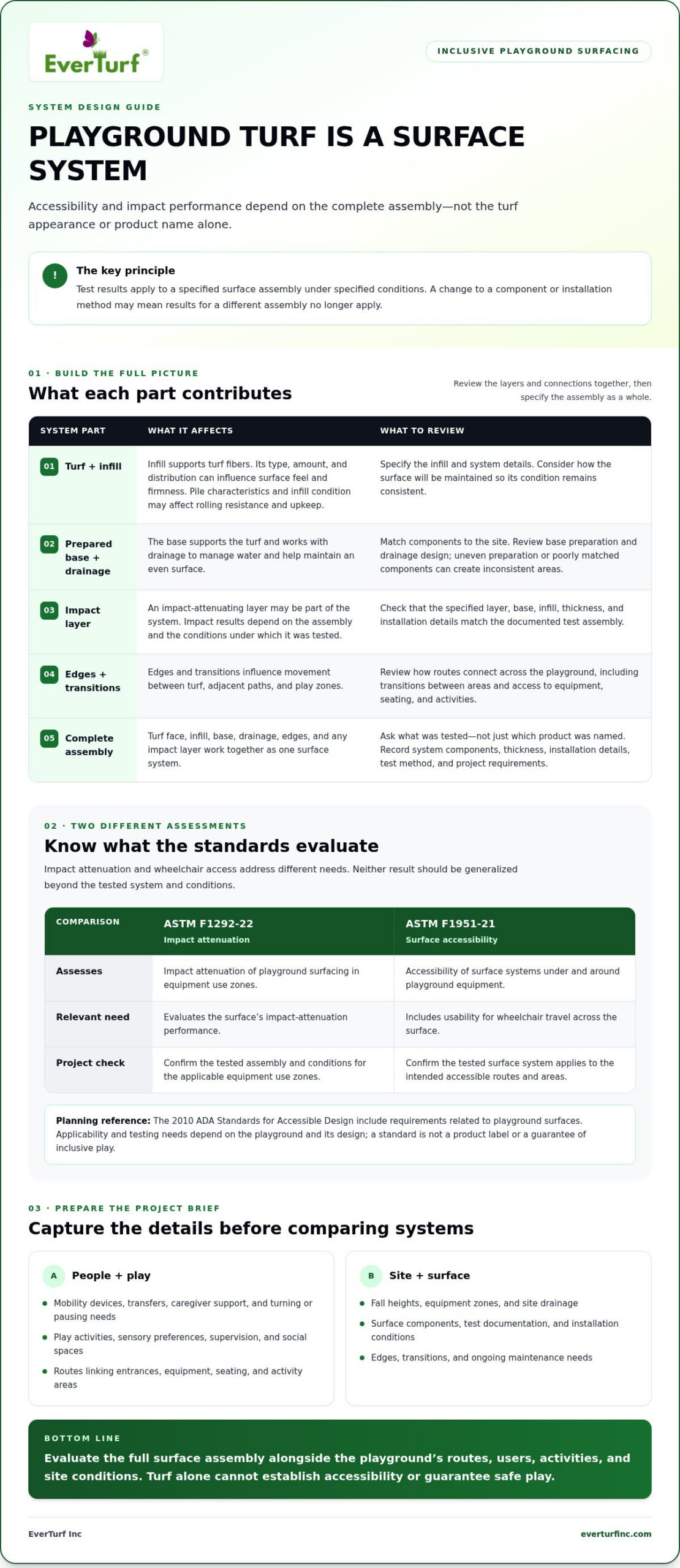
A playground turf surface is a system of connected layers, not a roll of grass placed over the ground. The turf face, infill, prepared base, drainage design, perimeter edges, and any impact-attenuating layer all contribute to how the finished area performs. If a component or installation method changes, test results for a different assembly may no longer apply.
A turf label cannot establish system performance because accessibility and impact results apply to a tested surface assembly under specified conditions, including its components, thickness, and installation. A sample’s appearance or a claim about one layer doesn’t show how the complete surface performs beneath equipment or along accessible routes. For broader project planning, the U.S. Access Board guidelines explain how accessible routes, play areas, and surfacing fit together.
What do ASTM F1292 and ASTM F1951 assess?
ASTM F1292-22 evaluates impact attenuation of playground surfacing in equipment use zones, while ASTM F1951-21 assesses the accessibility of surface systems under and around playground equipment, including their usability for wheelchair travel. They address different needs: cushioning a fall and supporting access across the surface. Neither result should be generalized beyond the tested system and conditions. Include the applicable editions, test method, and project requirements in the design review.
For a turf system, look for documentation that identifies what was tested rather than assuming a product name proves compliance. The impact layer, base, infill, and installation details matter to the result. Field conditions can also differ from laboratory conditions, so account for how the installed surface will be evaluated and maintained.
How do infill, drainage, and the base affect usability?
Infill helps support turf fibers, but its type, amount, and distribution can influence surface feel and firmness. Pile characteristics and infill condition may also affect rolling resistance and the upkeep needed to keep the surface consistent. EverTurf Infill is one component to consider within the specified system, not a stand-alone accessibility feature.
The prepared base supports the turf and works with the drainage design to manage water and maintain an even surface. Poorly matched components or uneven preparation can create inconsistent areas. Edges and transitions also influence how users move between the turf and adjacent paths or play zones. Include these details in the project specification, then assess performance as a complete assembly.
Learn more about EverTurf playground turf as part of a project-specific system discussion.
How Does Playground Turf Compare with Other Inclusive Surfacing Options?
No surface type is automatically the safest or most accessible choice. Synthetic turf, poured-in-place rubber, rubber tiles, and engineered wood fiber each bring different considerations for movement, impact protection, drainage, upkeep, transitions, and repairs. Compare complete systems against the playground’s activities and site conditions, not material names alone.
The table separates broad material characteristics from the evidence a project needs. These are general considerations, not guarantees: actual performance depends on the specified system, site design, installation, and maintenance.
| Surface type | Access and transitions | Impact, drainage, and upkeep | Evidence and replacement planning |
|---|---|---|---|
| Synthetic turf | Can create a continuous-looking play area; firmness and wheelchair usability depend on the full assembly and transitions. | Drainage, cleaning, infill care, and cushioning depend on the system design and site. | Review applicable impact and accessibility test results for the specified assembly. Plan for inspection and localized repair needs. |
| Poured-in-place rubber | A continuous surface can reduce joints, though edges and connections to paths still need attention. | Impact performance, water movement, and upkeep vary with the installation and product system. | Confirm testing for intended use zones and plan how damaged or worn areas will be repaired. |
| Rubber tiles | Tile joints and edges can affect rolling and transitions; layout and secure installation matter. | Impact and drainage characteristics depend on tile design, joints, and base conditions. | Look for relevant system documentation and account for replacing individual tiles or sections. |
| Engineered wood fiber | Loose fill can shift or need replenishment, which may affect accessible routes over time. | Drainage and impact performance depend on depth, containment, site conditions, and regular maintenance. | Plan for recurring checks, redistribution, and replenishment; assess the surface against applicable criteria. |
When might synthetic turf suit an inclusive playground?
Synthetic turf may suit a project seeking a grass-like appearance across connected play areas. That visual continuity doesn’t establish wheelchair access or fall protection. Evaluate documentation for the specified system’s relevant accessibility and impact testing, including ASTM F1951 and ASTM F1292 where applicable. Consider drainage, cleaning, infill care, and transitions alongside the initial surface choice.
What trade-offs should buyers compare across surface types?
Compare how each option handles firm travel routes, cushioning needs, seams or edges, water, routine care, and eventual repairs. A unitary surface may reduce loose material along routes, while tile joints or turf transitions still need careful planning. Loose-fill material requires attention to depth and displacement. For turf solutions for special needs playgrounds, base the decision on documented system performance and a realistic maintenance plan, not a universal ranking of materials.
What Should You Check Before Choosing Special-Needs Playground Turf?
A clear brief helps the project team compare complete surface systems against the playground’s real needs. Use this checklist to consider user experience, site details, safety evidence, and long-term care together.
- 1. Start with users, play activities, and routes. Describe how children with different mobility, sensory, and support needs will move between entrances, equipment, seating, and activity areas. Include play styles and caregiver supervision needs without reducing children to a single diagnosis or ability.
- 2. Map the site. Record dimensions, existing grades, entrances, drainage patterns, and intended play zones. Note where the surface meets paths, structures, or other materials.
- 3. Document equipment and fall zones. Record equipment locations and fall heights so the surface system can be evaluated for the intended use areas.
- 4. Identify access goals and review roles. Note the applicable accessibility goals and who will review the overall playground design and surface requirements.
- 5. Compare system-specific evidence. Review relevant impact-attenuation and wheelchair-accessibility test documentation. Record the tested assembly, conditions, and applicable standard editions rather than relying on a product label.
- 6. Plan for care and repair. Compare routine cleaning, infill management, inspections, drainage upkeep, and how damaged or worn areas may be addressed over time.
Which project details belong in the initial brief?
Make the brief useful to the whole design team. Pair a site plan with notes about routes, turning areas, transitions, equipment zones, and where water collects after rain. Describe intended activities and user needs in practical terms, such as reaching a play feature or moving from the entrance to a quiet area. For a refresher on material basics, see this guide to artificial grass fundamentals.
How can buyers compare evidence and long-term care?
Keep test reports alongside the system specification and note which components and conditions the results cover. Then compare the maintenance tasks needed to preserve a consistent surface. Infill is one part of the system; this guide to turf infill provides added component context. A well-prepared brief makes it easier to assess turf solutions for special needs playgrounds against the project’s priorities.
Include EverTurf Play in your review of playground turf options and surface-system requirements.
How Can EverTurf Play Fit into an Inclusive Playground Project?
Once the project criteria are defined, include EverTurf Play, EverTurf’s playground turf offering, in the larger surface-system plan. Compare the proposed system with the playground brief, including access routes, play zones, site drainage, impact-safety goals, and maintenance expectations. Don’t assume one turf product will meet every need.
How should buyers evaluate EverTurf Play for their project?
Use the same criteria as for any surface option: how the specified assembly relates to accessible movement, intended play areas, water management, transitions, and ongoing care. Review relevant system documentation for the conditions and components it covers, and compare that evidence with the project’s documented goals. Product appearance alone can’t establish accessibility or impact performance.
Include infill and other installation accessories in the discussion as components of the specified system. EverTurf offers infill, staples, glue, and pavers; their role depends on the project design and how the complete surface is specified. For broader material context, explore the complete artificial grass guide.
What are the next steps toward a better-informed selection?
Bring the project team a concise brief that describes intended users and activities, routes between entrances and play areas, equipment zones and fall heights, site grades and drainage patterns, and transitions to adjacent surfaces. Include maintenance priorities and identify who will review the playground’s accessibility and safety goals.
Then compare system documentation with those goals. Keep track of which assembly was evaluated, the test conditions, and the care needed to maintain the surface over time. This makes it easier to assess turf solutions for special needs playgrounds as complete project choices rather than stand-alone products.
Explore EverTurf Play for your playground project as you shape a surface plan around your site, users, and documented performance needs.
Build a Playground Surface Plan Around Every Child
Choosing turf solutions for special needs playgrounds starts with the full play experience, not the grass’s appearance. Consider who will use the space, how routes connect play features, and how the complete surface system addresses documented accessibility and impact needs. Compare materials using the same criteria, including drainage, transitions, routine care, and repair planning.
A clear project brief turns those priorities into a focused product discussion. EverTurf Play is EverTurf’s playground turf offering, and project components may include infill, staples, glue, and pavers. Their role depends on the surface system specified for the site, so keep performance documentation and maintenance needs central to the decision.
Thoughtful planning gives the project team a practical foundation for choosing a surface that supports broader participation. Explore EverTurf Play for your playground project and take the next step toward a considered surface plan.
Frequently Asked Questions
Does artificial turf meet ADA requirements?
Artificial turf doesn’t automatically meet ADA requirements just because it’s labeled for playground use. Accessibility depends on the complete playground design and applicable requirements, including routes, transitions, equipment access, and surface performance. Use the ADA Standards for Accessible Design as a project reference, then determine which provisions apply. Review documentation for the specified surface system and its test conditions. A turf label alone isn’t evidence of project-specific compliance.
Is artificial turf safe for children with special needs?
No surface can be called universally safe for every child or play environment. Evaluate the complete system alongside intended users, equipment zones, fall heights, and access routes. Review applicable impact-attenuation test documentation, and consider sensory preferences, play activities, and caregiver supervision. A qualified project team should assess how these factors work together across the playground. The goal is to make an informed choice for the specific site and its users.
Can wheelchairs move across artificial turf?
Wheelchair movement across artificial turf depends on the full system, including infill, base, transitions, and installation conditions. ASTM F1951-21 is a relevant reference for assessing wheelchair use on playground surfaces, but results apply to the tested system and conditions. Compare documentation for the proposed assembly, and consider routes across the whole play area, including entrances and connections to equipment or seating. Don’t assume every turf surface performs alike.
What is the difference between ASTM F1292 and ASTM F1951?
ASTM F1292-22 addresses impact attenuation for playground surfacing, while ASTM F1951-21 addresses accessibility of playground surface systems for wheelchair use. They assess different performance questions, so evidence for one doesn’t replace evidence for the other. Before relying on either standard, identify the applicable edition and test method, the assembly and conditions covered by the results, and the requirements relevant to the specific playground project.
Does playground turf need a special base or padding?
The required system depends on the site, equipment, drainage, accessibility goals, and impact requirements. A prepared base supports the surface assembly, while an impact-attenuating layer may be specified for particular fall conditions. Not every turf installation uses the same layers. Review documentation for the complete system and its tested configuration, and consider how the base and drainage plan relate to the site conditions and intended play areas.
How do you choose between playground turf and rubber surfacing?
Compare playground turf and rubber surfacing using the same criteria: accessible movement, impact performance, transitions, drainage, routine upkeep, and repair planning. Look for documentation tied to the proposed system and intended use, rather than relying on material type alone. Neither option is automatically right for every project. Start with users and play activities, then compare how each system aligns with the site, documented performance needs, and long-term care plan. This creates a clearer basis for choosing turf solutions for special needs playgrounds.