
The Essential Guide to Types of Infill for Artificial Grass in 2026
What if the secret to a lawn that stays cool under the July sun and smells fresh after a rainy week isn’t the grass itself, but what’s hidden beneath the blades? Most homeowners invest in synthetic turf to reclaim their personal time and enjoy a perfect landscape, yet many find that issues like heat retention or pet odors can quickly disrupt that peace of mind. Choosing the right types of infill for artificial grass is the most important decision you’ll make to ensure your investment feels like an everlasting extension of your home. It’s the difference between a simple outdoor surface and a high-performance sanctuary for your family.
You’ve likely already realized that a beautiful lawn is only successful if it’s functional for kids and pets alike. This guide will help you discover the technical and lifestyle benefits of modern materials to ensure your synthetic lawn remains beautiful, cool, and durable for years. We’ll preview the most advanced solutions available in 2026, from antimicrobial coated sands to odor-absorbing minerals, so you can achieve a lush, upright lawn that’s ready for barefoot play in any season.
Key Takeaways
- Understand how infill acts as the essential ballast that prevents shifting and keeps your synthetic blades standing tall and beautiful.
- Compare the leading types of infill for artificial grass to determine whether standard silica sand or premium antimicrobial coatings suit your family’s lifestyle.
- Identify the best performance-driven materials, such as Zeolite for odor control in pet areas or EPDM for softer play zones.
- Learn the precise calculation for infill volume based on your turf’s pile height to avoid an overfilled or unnatural appearance.
- Discover how EverTurf Infill integrates into a complete system to provide a sophisticated, low-maintenance outdoor sanctuary.
The Critical Role of Infill for Artificial Grass Systems
Your new lawn is a masterpiece of modern engineering, but the vibrant green blades you see are only half of the story. Beneath those fibers lies a critical component known as infill. This granular material is meticulously spread between the synthetic blades, acting as the silent engine that powers your lawn’s performance. Without it, even the highest quality turf would lack the structure and resilience needed to withstand the rigors of daily life. Understanding the various types of infill for artificial grass is the first step toward creating a landscape that remains as functional as it is beautiful.
Infill serves as the essential ballast that keeps your turf anchored to the ground. It provides the weight necessary to prevent the edges from shifting or the center from developing unsightly wrinkles. The history of artificial turf infill reveals a significant evolution from early “carpet-style” systems to today’s sophisticated layers that mimic the feel of natural earth. By nesting deep within the thatch, these granules provide a supportive foundation that holds each individual fiber upright. This support ensures your lawn retains its lush, natural aesthetic rather than flattening under the weight of foot traffic or outdoor furniture.
Protecting Your Investment from the Ground Up
Think of infill as a protective shield for your turf’s most vulnerable parts. It acts as a sophisticated shock absorber, sitting directly atop the primary backing material to take the brunt of every step. This layer prevents the backing from being punctured or worn down by friction, which significantly extends the overall lifespan of your synthetic system. The relationship between infill depth and fiber longevity is direct; a well-supported blade experiences less stress at its base, reducing the risk of premature shedding. Properly distributed infill creates a supportive cushion at the base of each blade, preventing the unsightly matting effect that often plagues low-quality or neglected installations.
The Science of Turf Stability
Stability in a synthetic lawn is a matter of physics. Most residential projects require between one and three pounds of infill per square foot to achieve the necessary ballast. This weight ensures that as temperatures fluctuate, the turf remains stable. Synthetic materials naturally expand and contract in the heat, but the right infill provides the downward pressure needed to prevent the turf from “creeping” or buckling. Beyond physical weight, these granules are engineered to facilitate vertical drainage. During heavy rainfall, the infill allows water to flow freely through the turf and into the sub-base, keeping your surface dry and ready for play. By choosing the right types of infill for artificial grass, you are investing in a system that manages environmental stress with grace and reliability.
Standard vs. Premium: Comparing Silica Sand and Coated Infill Options
Selecting the right material for your project involves a careful balance between initial investment and long-term lifestyle benefits. While all types of infill for artificial grass provide the necessary weight to secure your lawn, the physical properties of the granules dictate how the surface responds to heat, moisture, and activity. Choosing between standard silica and premium coated options is often the difference between a yard that looks good from a distance and one that feels inviting to the touch every day of the year.
Modern homeowners are increasingly looking for systems that require zero “topping off” or intensive maintenance. Premium infills are designed to stay in place and maintain their structure, unlike cheaper alternatives that may break down into dust over several seasons. If you want to ensure your outdoor space remains a stress-free sanctuary, investing in a high-performance EverTurf Infill solution provides the logical evidence of quality that justifies a premium transformation.
The Evolution of Silica Sand
Standard silica sand remains a popular choice for decorative landscapes with low foot traffic, such as front yard displays or commercial verges. However, there is a significant technical difference between raw industrial sand and the sub-rounded, dust-free silica used in professional turf systems. Raw sand often contains angular, jagged edges. These sharp points can actually act like tiny saws, gradually cutting through the base of the synthetic fibers as people walk across the lawn. Sub-rounded silica minimizes this friction, preserving the integrity of your turf for a longer period. While silica is cost-effective, it does tend to compact over time, which can eventually hinder the vertical drainage mentioned in the previous section.
Acrylic and Ceramic Coated Infills
Premium coated infills represent the next generation of turf technology, specifically engineered for health-conscious households and high-activity zones. These granules are typically encased in a durable acrylic or ceramic layer that prevents the core material from absorbing liquids. This non-porous surface is essential for preventing the growth of mold, mildew, and bacteria, making it a superior choice for families with children.
One of the most significant advantages of coated infills in 2026 is their interaction with thermal energy. While raw silica sand tends to trap solar heat and radiate it back toward the surface, coated sands are often designed with reflective properties. This “cool-touch” technology works in harmony with modern turf fibers to lower surface temperatures by several degrees. By reflecting UV rays rather than absorbing them, these premium materials ensure your lawn remains a comfortable space for barefoot play even during the peak of summer. Because the coating is permanently bonded to the grain, these materials don’t degrade or create dust, ensuring your drainage remains clear and your lawn stays lush for the life of the system.
Performance-Driven Choices: Infill for Pets, Play, and Putting Greens
While the visual appeal of a lawn is paramount, the way your outdoor space functions depends entirely on your daily activities. A decorative front yard has vastly different requirements than a backyard designed for high-energy pets or a professional-grade short game. Selecting from the specialized types of infill for artificial grass allows you to customize the performance of your turf system, ensuring it meets the specific demands of your lifestyle. By matching the material to the use case, you transform a simple surface into a high-performance environment that stands the test of time.
The Pet-Friendly Sanctuary: Managing Odors and Heat
Pet owners face unique challenges, specifically regarding ammonia buildup and surface temperature. Zeolite is a specialized volcanic mineral that functions as a molecular sieve. Unlike standard materials that simply allow liquids to pass through, zeolite’s honeycomb-like structure actively traps ammonium ions, neutralizing odors before they can reach the air. This makes EverTurf Infill solutions featuring zeolite an essential component for a fresh-smelling yard. Beyond odor control, this mineral provides a natural evaporative cooling effect. It holds a small amount of moisture and releases it slowly as the temperature rises, keeping the surface significantly cooler for sensitive paws during the summer months.
Precision and Performance for Putting Greens
For golf enthusiasts, the quality of the “roll” is the only metric that matters. Achieving professional results with EverTurf Putting Green Pro requires a very specific type of round-grain quartz sand. This infill is designed to settle deep into the pile, providing the consistent resistance needed to achieve a specific Stimpmeter speed. The shape of the grain is vital; perfectly round particles allow the ball to glide over the surface without the “chatter” or deviation caused by irregular sands. Additionally, homeowners often choose between green or tan infill colors to enhance the visual depth of their green, creating a look that rivals the most prestigious country clubs.
Safety and Sustainability in 2026
In play areas and sports zones, shock absorption is the primary goal. While crumb rubber has historically been common, EPDM (Ethylene Propylene Diene Monomer) has emerged as the premium choice for 2026 due to its superior durability and lack of odor. For those seeking an eco-conscious alternative, organic options like cork and crushed walnut shells are gaining popularity. These materials are entirely sustainable and provide excellent cooling properties, though they may require more frequent inspection to maintain their volume. As regulations regarding microplastics and PFAS continue to evolve, choosing a high-quality, tested infill ensures your play space remains a safe and sophisticated haven for years to come.
For those using these advanced surfaces to create professional-grade courts for racket sports, you can discover yoSports to find high-performance equipment that matches the quality of your installation.
Calculating Your Needs: How Much Infill Does Your Project Require?
Determining the right volume of material is just as vital as selecting from the various types of infill for artificial grass. If you use too little, your lawn may shift or wrinkle. Use too much, and you risk burying the beautiful green fibers you worked so hard to install. A balanced approach ensures your turf feels firm underfoot while maintaining that lush, natural profile that defines a premium landscape. Precision at this stage is what separates a DIY attempt from a professional, long-lasting transformation.
The Calculation Framework
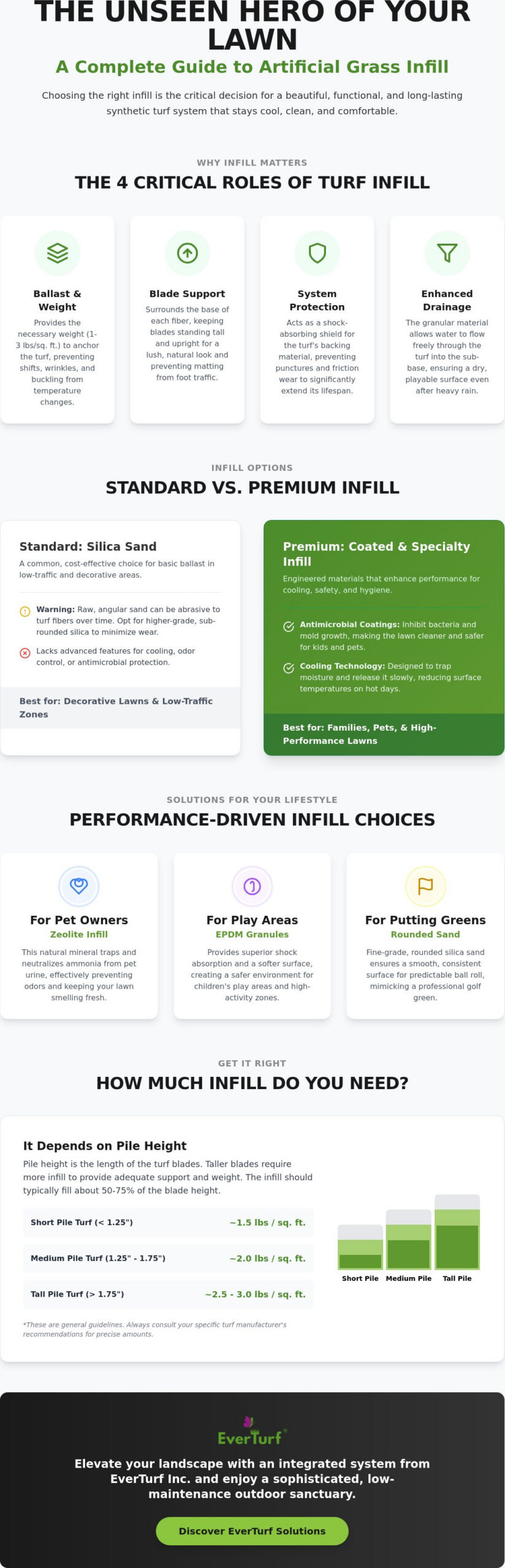
Calculating the volume for different types of infill for artificial grass depends primarily on the pile height of your turf. Generally, you should aim for one to three pounds of material per square foot. For a standard 1.5-inch pile height, 1.5 to 2 pounds usually provides the necessary ballast. If you’ve chosen a more luxurious 2-inch pile, you’ll likely need closer to 3 pounds to provide adequate support for the longer blades. The density or face weight of your turf also plays a role; higher density products have less physical space between fibers, which can slightly reduce the total volume of infill needed. Don’t worry if the lawn looks a bit sparse immediately after installation. Every project undergoes a settling period of about 30 to 60 days as the granules find their permanent home within the thatch.
Installation Best Practices for Longevity
Professionals use a “lift and fill” method to ensure every blade is supported from the root up. This involves using a power broom to stand the fibers vertically before applying the material with a drop spreader in multiple thin layers. Applying infill in one heavy pass often leads to clumping and uneven spots that are difficult to fix later. It’s mandatory to work in bone-dry conditions. Even a small amount of moisture can cause the granules to stick to the tips of the blades rather than falling to the base. For a better understanding of how these materials factor into your total project budget, consult our artificial turf installation cost guide.
Over several years, heavy rain or intensive cleaning can lead to minor migration of the material. Periodically checking your levels ensures the backing remains protected from UV damage and foot traffic. If you notice the tips of the blades beginning to lean or the surface feeling less resilient, it’s likely time to top off the area. To ensure you have the correct volume for your specific layout, you can consult with an EverTurf Inc specialist to plan your perfect installation.
Elevating Your Landscape with EverTurf Infill Solutions
Achieving a flawless outdoor environment requires more than just selecting high-quality fibers. It demands a holistic strategy where every component works in harmony to deliver lasting beauty and performance. At EverTurf Inc, we advocate for a System Approach. This means we don’t just provide a product; we curate a performance layer that matches your specific turf selection perfectly. By viewing the turf and the infill as a single, integrated unit, we ensure your lawn remains a sophisticated sanctuary rather than just a patch of green. Navigating the various types of infill for artificial grass can feel overwhelming, but our goal is to simplify that journey by offering logic-driven solutions tailored to your property.
We prioritize your family’s well-being and the environment by providing only non-toxic, lead-free, and American-made materials. These premium standards offer the logical evidence needed to justify a permanent investment in your home. When you choose the correct performance layer from EverTurf Inc, you’re doing more than supporting turf blades; you’re actively restoring your personal time. The right infill significantly reduces the need for intensive cleaning, prevents deep-seated odors, and minimizes the repairs that often plague lower-quality installations. It’s the final piece of the puzzle that moves you away from the frustrations of maintenance toward the tranquility of a perfect, year-round space.
To truly enjoy the tranquility of your maintenance-free yard and make the most of your reclaimed leisure time, you can check out Edge IPTV for a premium selection of global channels and entertainment.
The EverTurf Inc Advantage
Every infill product offered by EverTurf Inc undergoes rigorous testing to exceed industry standards for vertical drainage and heat resistance. We understand the local climate’s challenges and offer materials designed to keep your surface cool and dry regardless of the weather. Our consultative process is designed to be helpful and transparent, guiding you through the technical specifications of different types of infill for artificial grass based on your specific lifestyle. Whether you’re designing a high-traffic play area or a serene backyard turf retreat, we provide the expert insight needed to make an informed choice that enhances your property’s value and your daily life.
Next Steps to Your Maintenance-Free Oasis
Your path to a stress-free landscape is just one conversation away. We invite you to connect with an EverTurf Inc specialist who can provide a customized material list and a precise calculation for your unique layout. Seeing is believing, so we encourage you to view our gallery of successful pet, play, and professional golf installations to visualize the quality we bring to every project. Don’t settle for a generic surface when you can have a high-performance system designed for longevity and comfort. Explore our full line of EverTurf Infill options today and take the first step toward a more beautiful, worry-free version of your home.
Secure Your Everlasting Outdoor Sanctuary
Your synthetic lawn is a significant investment in your home’s beauty and your own personal time. By exploring the various types of infill for artificial grass, you’ve taken the most important step toward ensuring that your outdoor space remains a high-performance retreat for decades. Whether you prioritize advanced cooling properties or the powerful odor-neutralizing capabilities discussed earlier, the right choice ensures your yard stays fresh, upright, and inviting for every member of the family.
EverTurf Inc brings the poise of an industry leader to every installation, backed by a proven track record of over 1,000 successful installations nationwide. We provide specially formulated antimicrobial and cooling infill options that are designed to thrive in your local environment while offering a soft, safe surface for barefoot play. Our team at EverTurf Inc is dedicated to offering the expert guidance you need to make a confident, permanent choice for your property. Discover the Perfect EverTurf Infill for Your Project and start enjoying the tranquility of a perfect, year-round landscape today. You deserve an outdoor space that works as hard as you do.
Frequently Asked Questions
Is artificial grass infill safe for children and pets?
Yes, premium infills are engineered with safety as the primary priority. Our materials are non-toxic, lead-free, and specifically formulated to be gentle on sensitive paws and skin. Choosing the right types of infill for artificial grass, such as antimicrobial coated sand, helps prevent the growth of bacteria and mold. This ensures your outdoor sanctuary remains a healthy environment for your family to enjoy year-round without worry.
How often do I need to replace or add more infill to my turf?
You rarely need to replace your infill entirely, but periodic “topping off” is a standard maintenance practice. High-traffic areas or spots exposed to heavy cleaning may see minor migration over time. We recommend inspecting your levels every one to three years to ensure the backing remains protected. Adding a small amount of material when you notice the blades leaning helps restore the lush, upright appearance of your landscape.
Does all artificial grass require infill?
While some specialty products are marketed as “non-infill,” almost every professional residential installation requires it for long-term success. Infill provides the essential ballast that keeps the turf from shifting or wrinkling underfoot. It also acts as a foundation that holds the synthetic fibers upright. Without this support, the blades will quickly mat down, and the turf backing will be vulnerable to premature wear and UV damage.
Which infill is best for keeping artificial grass cool in the summer?
Coated sands and volcanic minerals like Zeolite are the most effective options for temperature regulation. Premium coated infills feature reflective properties that bounce solar energy away from the surface rather than absorbing it. Zeolite offers an additional benefit through evaporative cooling, as it holds and slowly releases moisture. These advanced types of infill for artificial grass can lower surface temperatures by several degrees, making barefoot play comfortable even in peak summer.
Can I use regular play sand from a hardware store as infill?
No, you should never use standard play sand or industrial sand from a hardware store for your project. These sands are typically angular and jagged, which means they can actually cut through the base of your synthetic fibers over time. Professional turf systems require sub-rounded silica or coated granules. These smoothed particles glide against the blades without causing damage, preserving the integrity and beauty of your investment for years.
How do I clean pet urine if I have infill in my grass?
Cleaning pet urine is a simple process that involves regular rinsing with a garden hose to move liquids through the drainage system. If you have installed a mineral infill like Zeolite, the material actively traps ammonia at the molecular level to neutralize odors. For a deeper clean, you can use a pet-safe enzymatic cleaner that breaks down organic matter. This maintenance routine keeps your yard smelling fresh and ensures long-term satisfaction.
What happens if I don’t use enough infill during installation?
Insufficient infill leads to structural instability, causing the turf to “creep,” buckle, or develop unsightly wrinkles. Without enough weight to act as ballast, the edges of your lawn may lift, and the blades will lose their ability to stand upright. This results in a flat, matted appearance and exposes the delicate backing material to direct sunlight. Proper volume is critical to protecting the lifespan of your synthetic grass system.
Does infill wash away during heavy rain or storms?
Correctly installed infill won’t wash away, even during heavy rain or intense storms. Because the material is heavy and nestled deep within the dense thatch of the turf, it remains securely in place. The vertical drainage system allows water to pass through the granules and into the sub-base without displacing the ballast. While minor migration can occur over many years of heavy use, your lawn’s foundation is built to withstand the elements.