


The Different Types of Artificial Grass: A Comprehensive 2026 Guide
Not all artificial grass is created equal, and choosing the wrong type could leave you with a lawn that looks more like a putting green carpet than a lush, natural landscape. If you’ve spent any time researching the different types of artificial grass, you already know the feeling: a sea of technical specifications, face weights, and fiber materials that raises more questions than it answers. Which pile height looks most realistic? Will it retain too much heat in summer? What about drainage for those heavy rainstorms?
You’re right to take this decision seriously. A synthetic turf installation is a long-term commitment to your home and your lifestyle, and the product you choose needs to perform beautifully for years to come. The good news is that once you understand how each type of turf is engineered for a specific purpose, the confusion disappears and the right choice becomes remarkably clear.
This guide breaks down every major category of artificial grass available in 2026, from pet-friendly systems and high-traffic sports surfaces to residential lawns and rooftop retreats, so you can match the perfect performance system to your specific needs and finally reclaim your weekends.
Key Takeaways
- The three primary synthetic fibers—Polyethylene, Polypropylene, and Nylon—each serve a distinct purpose, and knowing the difference is the first step toward a smarter, longer-lasting investment.
- Understanding the different types of artificial grass by lifestyle application, from child-safe play systems to sports fields, means you can match a performance-engineered product to your exact daily needs.
- Two technical specifications—face weight and pile height—reveal more about a turf’s true quality and realism than any marketing description ever could.
- A simple three-step selection framework covering traffic level, aesthetic goal, and drainage needs eliminates guesswork and guides you to the right product with confidence.
- Modern 2026 turf systems, including purpose-built infill solutions, are specifically engineered to combat heat retention—one of the most misunderstood challenges in synthetic turf ownership.
The Evolution of Synthetic Turf: Understanding Material Types
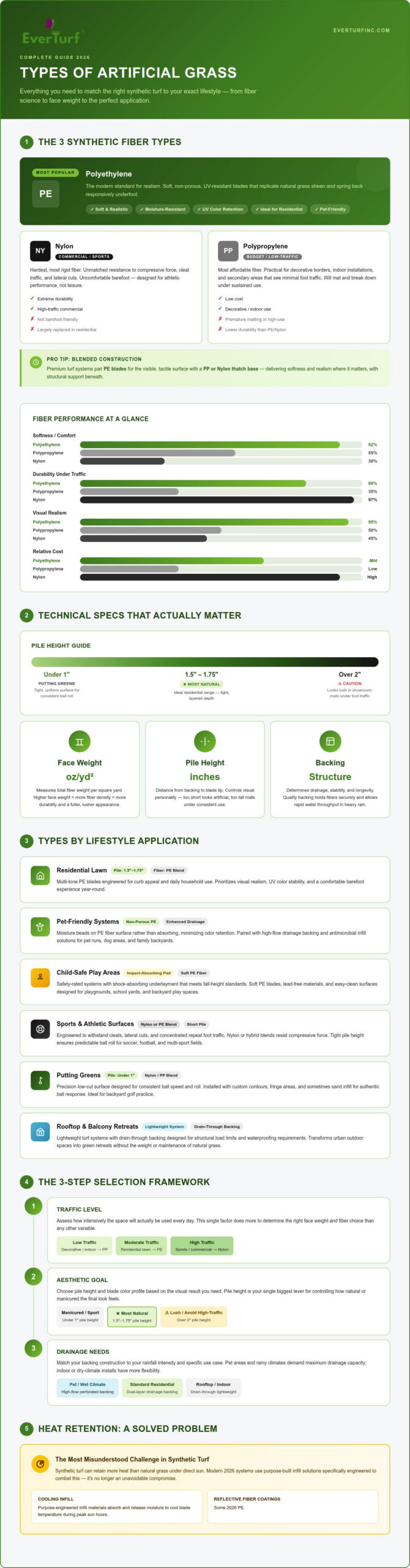
Every artificial grass product you’ll encounter in 2026 is built from one of three synthetic polymer families: Polyethylene (PE), Polypropylene (PP), or Nylon. That’s it. Three materials, each with a distinct molecular structure, and each engineered to solve a different performance problem. Understanding how these fibers actually behave underfoot, under pressure, and under the sun is the foundation of every smart turf decision.
Polyethylene: The Modern Standard for Realism
Polyethylene has earned its place as the dominant fiber across the types of artificial grass available today, and the reasons go well beyond softness. PE fibers are extruded with a slightly waxy, non-porous surface that replicates the natural sheen of a living grass blade. When you walk across a quality PE lawn, the blades flex and spring back with a responsive, organic quality that stiffer materials simply can’t replicate.
That non-porous surface does something else critical: it resists moisture absorption. Liquids, including pet waste, bead on the fiber’s surface rather than soaking in, which means odors have far less material to cling to. For homeowners with dogs or children who spend real time on the lawn, this is a practical advantage that compounds over years of use. PE’s vibrant color retention also holds up well against UV exposure, maintaining its natural green tones without fading into the washed-out, artificial look that gives older turf a bad reputation.
Nylon and Polypropylene: Niche Performance Solutions
Nylon sits at the opposite end of the performance spectrum. It’s a harder, more rigid fiber with an exceptional ability to withstand compressive force and high-friction movement, which is exactly why it appears in commercial athletic surfaces and high-traffic commercial zones rather than residential front lawns. Its resilience under cleats, repeated lateral cuts, and concentrated foot traffic is unmatched, but that rigidity makes it uncomfortable for casual barefoot use. Nylon’s role in residential settings is largely over, replaced entirely by the more refined feel of modern PE formulations.
Polypropylene occupies a different niche: the budget-conscious, low-traffic application. PP fibers are less expensive to produce, making them a practical choice for decorative borders, indoor installations, or secondary areas that see minimal foot traffic. They lack the durability of PE and the toughness of Nylon, so using PP in a high-use backyard lawn will result in premature matting and fiber breakdown.
Many premium turf systems address this intelligently by using a blended construction, pairing PE blades for the visible, tactile surface with a PP or Nylon thatch layer at the base. This approach delivers the softness and realism of polyethylene where it matters most, while the denser base layer adds structural support and a more convincing natural appearance. It’s a design philosophy that reflects how far synthetic turf engineering has come from the flat, monochromatic carpets of earlier decades.
Technical Specifications: Decoding Quality and Durability
Fiber material gets most of the attention in turf research, but the specifications that actually determine how a product performs over a decade of real use live in three numbers: face weight, pile height, and backing construction. These aren’t marketing figures. They’re engineering measurements, and learning to read them is the clearest advantage you can give yourself before making any purchasing decision across the types of artificial grass available today.
Pile Height and Aesthetics
Pile height is the measurement from the top of the backing to the tip of the blade, and it controls the entire visual personality of a turf system. Short pile products, typically under one inch, produce the tight, uniform surface you’d want for a putting green installation, where ball roll consistency demands a controlled, low-cut surface. Residential lawns, by contrast, read as most natural in the 1.5 to 1.75 inch range, where blades have enough height to catch light and create the gentle, layered depth of a well-maintained grass lawn.
One trap worth avoiding: longer isn’t always better. Pile heights above two inches can look impressively lush in a showroom but tend to mat under consistent foot traffic, especially in pathways, play areas, and pet runs. Once the blades flatten and don’t recover, no amount of brushing fully restores the original look. Matching pile height to your actual traffic pattern, not just your aesthetic goal, is what separates a lawn that looks great for years from one that looks worn within eighteen months.
Architectural context matters here too. A contemporary home with clean lines and geometric landscaping often suits a shorter, denser pile that reads as crisp and intentional. A traditional property surrounded by mature trees and organic garden beds typically calls for a longer, more varied blade structure that blends naturally into its surroundings.
Face Weight and Density
Face weight measures the total amount of fiber material per square yard of turf, expressed in ounces. It’s the single most reliable indicator of synthetic turf longevity because it tells you how much material is actually there to withstand years of compression, UV exposure, and daily use.
For residential applications, a face weight between 60 and 90 ounces represents the performance sweet spot. Products below 60 ounces often feel thin underfoot and show wear patterns quickly. Products above 90 ounces can be excellent, but the incremental durability gain rarely justifies the additional cost for a standard home lawn. Within that 60 to 90 ounce range, density directly affects hand-feel: a denser product has more blades per square inch, which creates a fuller, more upright surface that springs back after foot traffic rather than lying flat.
It’s also worth understanding what face weight doesn’t tell you. A high face weight achieved with very long pile blades can actually underperform a moderate face weight product with a shorter, denser construction. The relationship between the two specifications is what matters, not either number in isolation. A turf product with a 70-ounce face weight and a 1.5-inch pile is fundamentally different from one with the same face weight spread across a 2-inch pile. The former will almost always hold its shape better under real-world conditions.
Thatch and Backing: The Hidden Architecture
Beneath the visible blades, two components do critical structural work. The thatch layer, a curled or textured fiber woven at the base of the upright blades, mimics the natural dead-grass layer found in real lawns. It creates visual depth, disguises infill material, and gives the surface a lived-in, organic quality that single-layer products simply can’t replicate. A well-designed thatch layer is often the difference between turf that photographs beautifully and turf that actually looks convincing at eye level.
The backing system anchors everything. Quality residential turf typically features a dual-layer polyurethane or latex backing with perforated drainage holes, allowing water to pass through at a rate sufficient to handle heavy rainfall without pooling. Dimensional stability, the backing’s resistance to stretching or shrinking with temperature changes, determines whether seams stay invisible and edges stay flush years after installation. A backing that shifts seasonally will eventually reveal itself in ripples, gaps, or lifted edges, regardless of how beautiful the fiber above it is.
If you’re evaluating products and want a clearer picture of how these specifications translate to a finished installation, exploring EverTurf’s full range of turf systems offers a useful reference point for how face weight, pile height, and backing construction are balanced across purpose-built applications.
Types of Artificial Grass by Lifestyle Application
Material science only tells half the story. The other half lives in how a turf system is actually used: who’s on it, how often, and what they’re doing when they’re there. This is where most turf research falls short, cataloguing fiber types without connecting them to the daily realities of a backyard with dogs, a play area with active kids, or a rooftop terrace in an urban high-rise. The types of artificial grass that perform best over the long term are those engineered for a specific lifestyle job, not just a general category.
Child-Safe Play Systems
EverTurf Play systems are purpose-built around one non-negotiable priority: impact absorption. Children fall. Repeatedly and enthusiastically. A play surface needs to cushion those falls without sacrificing the upright, resilient blade structure that makes the surface look and feel like a real lawn. This is achieved through a combination of a higher-density polyethylene construction and a compatible shock-absorbing infill layer beneath the blades. The result is a surface that passes standard fall-height safety thresholds while remaining soft enough for barefoot play.
Artificial Grass for Pets
Dogs demand a completely different performance profile. The primary engineering challenge isn’t softness or aesthetics; it’s rapid, reliable drainage. EverTurf’s pet-specific systems pair a non-porous polyethylene blade with a highly perforated backing that channels liquid waste through the surface and into the sub-base immediately. There’s no pooling, no saturation, and critically, no sustained contact between organic waste and the fiber itself. This drainage-first design is what separates a pet system from a standard residential product, and using the wrong category here is a mistake that compounds with every passing week.
Roof, Deck, and Urban Installations
EverTurf Roof & Deck products solve a structural problem that ground-level turf never faces: weight load. Rooftop terraces and elevated balconies have strict load-bearing limits, so these low-profile systems use a thinner, lighter backing construction without sacrificing the visual quality of a well-finished surface. They’re engineered to drain efficiently without a traditional aggregate sub-base, making them the practical choice for urban homeowners who want a green, livable outdoor space without the infrastructure of a full ground installation.
Athletic and Professional-Grade Surfaces
Performance turf is where fiber engineering becomes genuinely specialized. The EverTurf Putting Green Pro uses a short, dense, precision-cut pile specifically calibrated for consistent ball roll. Unlike residential turf, where slight variation in blade height adds to the natural appearance, a putting surface demands absolute uniformity. Every millimeter of pile height directly affects how a putt breaks, so the manufacturing tolerances on a quality putting green product are considerably tighter than anything in the residential range.
EverTurf Sports Fields for soccer and football introduce a different set of demands entirely. These surfaces endure lateral cuts, cleated footwear, and sustained high-impact use that would flatten a residential product within a season. The fiber construction shifts toward a more resilient, stiffer blade profile that resists the compressive force of athletic movement. Critically, turf infill plays a structural role here that it doesn’t always play in residential applications: it holds blades vertical under repeated lateral pressure, maintains consistent surface hardness across the field, and distributes impact energy evenly. Without the right infill system, even a premium sports fiber will mat and lose its performance properties within months.
Landscape and Ornamental Turf
For backyard turf and front lawn applications, EverTurf Artificial Grass systems prioritize visual realism above all other performance criteria. The most convincing residential installations use a multi-tonal blade construction, weaving field green, lime green, and tan fibers together in a single product. That color variation is what gives a finished lawn its depth and dimension, replicating the natural variation of a real grass sward rather than the flat, single-color appearance that made early synthetic turf so easy to identify.
EverTurf Pavers extend this landscape thinking into hardscape integration. Geometric paver-and-turf combinations have become a defining feature of contemporary landscape design, and these systems are engineered to sit flush with standard paver thicknesses so the finished surface reads as a cohesive, intentional design rather than two separate materials placed side by side. It’s a detail that elevates the entire outdoor space from functional to genuinely beautiful.
The Selection Matrix: How to Choose Your Perfect Turf
All the fiber knowledge in the world doesn’t help if you can’t translate it into a confident purchasing decision. A practical selection framework cuts through the noise. Three variables, evaluated in sequence, will narrow the entire landscape of types of artificial grass down to a shortlist of genuinely suitable products: how hard the surface will work, how you want it to look, and how quickly it needs to drain.
Evaluating Your Traffic and Usage
Start by categorizing your installation into one of three traffic tiers, because this single factor determines more about the right product than anything else.
- Low/Ornamental: Front yard curb appeal, decorative borders, or a rooftop terrace that sees occasional foot traffic. A lower face weight product with longer pile performs beautifully here because it’s never under sustained compressive stress.
- Moderate/Residential Active: A backyard used daily by a family, including children and casual entertaining. This is where the 60 to 90 ounce face weight range earns its place, and pile height should stay under 1.75 inches to resist matting.
- High/Active Pet or Athletic: A dedicated dog run, a play zone, or any sports surface. These installations demand a performance-grade construction with drainage-first backing, purpose-built infill, and a fiber resilient enough to recover from daily lateral movement.
Blade shape is the underappreciated variable that determines how well a turf holds up within its traffic tier. A C-shaped or U-shaped blade has a curved cross-section that creates structural resistance to flattening, much like a corrugated material is stronger than a flat sheet of the same thickness. W-shaped blades take this further, offering even greater rigidity under compressive force while maintaining a soft tactile surface. Flat blades, common in budget products, simply lack that structural geometry and mat permanently under consistent foot traffic. Checking blade shape before purchasing is a quick way to separate genuinely durable products from those that will look worn within a year.
Traffic tier also directly shapes your budget planning. A low-traffic ornamental installation carries a fundamentally different cost profile than a high-traffic pet system that requires specialized infill, perforated backing, and a properly engineered sub-base. Reviewing the full picture of artificial turf installation cost before committing to a product category ensures your budget is allocated where performance actually matters.
Color, Luster, and Visual Realism
Aesthetics are the second variable, and the details here are finer than most buyers expect. The single most important quality indicator for visual realism isn’t color; it’s luster. High-gloss fibers reflect sunlight in a way that immediately reads as synthetic, especially at midday when the sun is directly overhead. Low-luster or matte-finish fibers scatter light the way a natural blade of grass does, which is why premium products specify this characteristic explicitly.
Color selection deserves regional consideration. A cool-toned field green looks at home in the Pacific Northwest, where it echoes the deep greens of the surrounding landscape. In drier, sun-bleached climates, a warmer blend with more tan and olive tones reads as far more natural than a saturated green that wouldn’t survive a real summer drought.
Before finalizing any product, take the sample outside and evaluate it at three different times: morning, midday, and late afternoon. Turf that looks convincing under overcast showroom lighting can reveal an unnatural sheen the moment direct sunlight hits it at a low angle. That fifteen-minute test eliminates more buyer’s remorse than any specification sheet.
Drainage and the Heat Factor
Heat retention is the other environmental variable that 2026 turf systems are specifically engineered to address. Synthetic fibers absorb and radiate heat more readily than natural grass, and in sun-exposed installations this is a genuine comfort consideration. The most effective mitigation strategies combine a light-colored or heat-reflective infill material with a low-luster fiber that absorbs less solar radiation to begin with. Organic infill options and specialized cooling infill products are increasingly available for exactly this purpose, reducing surface temperatures meaningfully compared to traditional crumb rubber systems.
Getting these three variables right, traffic tier, visual realism, and drainage, is what separates a turf installation you’ll love for a decade from one you’ll second-guess every summer. Explore EverTurf’s full range of turf systems to see how each product is engineered to perform across all three dimensions.
Why EverTurf Solutions Lead the Industry
Choosing the right fiber and the right specifications only gets you halfway there. The other half is the system behind the surface: the infill that holds blades vertical under pressure, the adhesives and fasteners that keep seams invisible through years of seasonal change, and the expertise to match every component to your specific installation. That complete-system thinking is what separates EverTurf from suppliers who simply sell rolls of turf and leave the rest to chance.
A Complete System, Not Just a Surface
Every EverTurf installation is built around an integrated approach. EverTurf Infill isn’t an optional add-on; it’s a structural component that maintains blade posture, regulates surface temperature, and distributes impact energy across the entire installation. Without the right infill matched to the right turf system, even premium fiber underperforms. Similarly, EverTurf Staples and Glue ensure that edges stay flush, seams stay hidden, and the entire surface behaves as a single unified piece rather than a collection of panels waiting to shift.
This integrated philosophy extends across every application in the EverTurf range, from residential backyard lawns and EverTurf Play surfaces to EverTurf Roof and Deck installations and full-scale EverTurf Sports Fields. Whether the project is a compact urban terrace or a commercial athletic facility, the same commitment to component compatibility runs through every recommendation. That’s what allows EverTurf to support both residential homeowners and commercial athletic project managers with equal confidence.
Envision your property not as a maintenance obligation, but as a sanctuary. No irrigation schedules. No mowing windows. No seasonal reseeding. Just a consistently beautiful outdoor space that performs exactly as intended, every day of the year.
The EverTurf Commitment to 2026 Innovation
The types of artificial grass available in 2026 reflect years of refinement in fiber geometry, backing construction, and infill science. EverTurf’s catalog is built around that progress, prioritizing durability and aesthetic excellence in every square foot rather than chasing volume with budget-grade materials. The result is a range of purpose-built systems that genuinely earn the word “evergreen” in the most practical sense: surfaces that look as considered in year eight as they did on installation day.
Your ideal turf system exists within that catalog. The clearest next step is connecting with an EverTurf expert who can match your specific traffic patterns, climate conditions, and aesthetic goals to the right product. Explore the full range of EverTurf turf systems and take the first step toward a lawn that works as hard as you do, without ever asking anything in return.
Your Perfect Lawn Is One Decision Away
Navigating the different types of artificial grass doesn’t have to feel overwhelming. The core insight is straightforward: match the engineering to the lifestyle. Whether that means a drainage-first system for a dog-friendly backyard, a precision-cut surface for the EverTurf Putting Green Pro, or a lightweight rooftop installation that transforms unused urban space into something genuinely livable, the right product exists for every application.
Three things matter most: your traffic level, your visual standard, and your drainage requirements. Get those three variables right, and every other specification falls into place naturally. EverTurf’s nationally distributed range of high-performance synthetic turf systems, backed by a complete installation accessory ecosystem including infill, staples, and glue, means you’re never choosing a surface in isolation. You’re choosing a complete, integrated solution.
The lawn you’ve been envisioning is closer than you think. Explore EverTurf’s full range of high-performance turf solutions and take the first step toward a beautiful, maintenance-free outdoor space that stays evergreen, year after year.
Frequently Asked Questions About Types of Artificial Grass
What is the most realistic type of artificial grass for 2026?
The most realistic types of artificial grass in 2026 use multi-tonal polyethylene fibers woven together in field green, lime green, and tan to replicate the natural color variation of a real lawn. Blade geometry matters just as much as color: C-shaped and W-shaped cross-sections catch and scatter light the way a natural blade does, avoiding the flat, uniform sheen that makes older synthetic turf easy to identify. A low-luster, matte-finish fiber evaluated in direct outdoor sunlight is your clearest quality indicator.
Which type of artificial turf is best for dogs and pets?
Pet-specific turf systems are engineered around one priority: drainage speed. A non-porous polyethylene blade prevents liquid waste from soaking into the fiber itself, while a highly perforated backing channels moisture through the surface immediately rather than allowing it to pool or saturate. This drainage-first construction is fundamentally different from a standard residential product, and using a general-purpose lawn turf in a dedicated pet area is a mistake that compounds with every passing week. EverTurf’s pet-specific systems are purpose-built for exactly this use case.
Does artificial grass get too hot in the summer sun?
Synthetic turf does absorb and radiate more heat than natural grass in direct sun, but it’s a manageable challenge rather than a dealbreaker. The most effective mitigation combines a low-luster, matte-finish fiber that absorbs less solar radiation with a light-colored or heat-reflective infill material beneath the blades. Organic and specialized cooling infill products have improved considerably and can reduce surface temperatures meaningfully compared to older crumb rubber systems. Shade from trees or structures makes a significant additional difference in sun-exposed installations.
What is the difference between polyethylene and nylon grass?
Polyethylene fibers are soft, flexible, and UV-stable, making them the standard choice for residential lawns where barefoot comfort and visual realism are priorities. Nylon is a harder, more rigid fiber with exceptional resistance to compressive force, which is why it appears in commercial athletic surfaces rather than home installations. The trade-off is straightforward: nylon holds up under cleats and high-friction movement better than any other material, but it’s uncomfortable for casual use. For almost every residential application, polyethylene delivers a far superior daily experience.
How long does high-quality synthetic turf typically last?
A properly installed, high-quality synthetic turf system can maintain its performance and appearance for fifteen years or more with basic maintenance. Longevity depends heavily on three factors: face weight and fiber density, the quality of the backing and infill system, and whether the product was matched correctly to its actual traffic level. A premium 70-ounce polyethylene turf in a low-traffic ornamental setting will outlast a lower face weight product in a high-traffic pet run by a considerable margin, regardless of the marketing claims on either product.
Do I need a different type of turf for a backyard putting green?
Yes, absolutely. A putting surface requires a short, dense, precision-cut pile specifically calibrated for consistent ball roll, which is a fundamentally different engineering brief than a residential lawn. Standard residential turf has intentional variation in blade height to create a natural appearance, but that same variation causes unpredictable breaks on a putt. The EverTurf Putting Green Pro is purpose-built with tighter manufacturing tolerances to deliver the uniform surface that accurate short-game practice demands. Using a general residential product as a putting surface will produce inconsistent results.
What is face weight and why does it matter for my lawn?
Face weight measures the total amount of fiber material per square yard of turf, expressed in ounces, and it’s the most reliable single indicator of how a product will hold up over time. More fiber means more material resisting daily compression, UV exposure, and foot traffic. For residential lawns, a face weight between 60 and 90 ounces represents the practical performance range. Below 60 ounces, products tend to feel thin and show wear patterns quickly; above 90 ounces, the incremental durability gain rarely justifies the additional cost for a standard home application.
Can I install artificial grass on top of an existing deck or patio?
Yes, and it’s one of the most practical applications available. EverTurf Roof and Deck systems are specifically designed for elevated surfaces, using a thinner, lighter backing construction that respects load-bearing limits while still delivering a finished, visually polished surface. These systems drain efficiently without a traditional aggregate sub-base, which makes them well-suited for rooftop terraces, balconies, and concrete patios. The key distinction from a ground installation is that the sub-base engineering changes entirely, so selecting a product purpose-built for elevated use rather than adapting a standard lawn product is essential.