
Artificial Turf ROI for Commercial Properties: 2026 Guide
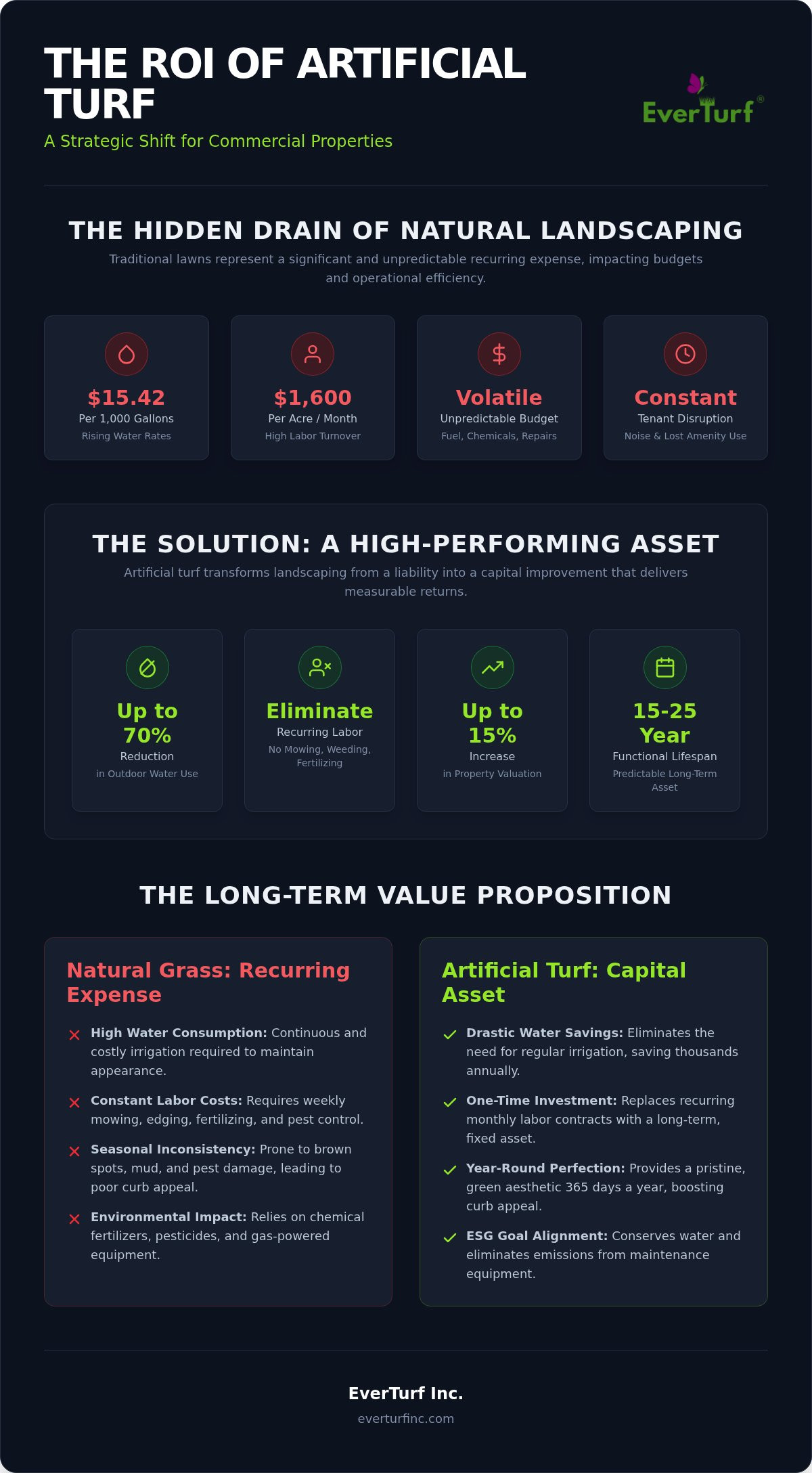
Could the very landscape meant to attract tenants be the silent drain on your 2026 operating budget? With commercial water rates now averaging $15.42 per 1,000 gallons and labor costs for traditional maintenance reaching up to $1,600 per acre each month, that thirsty lawn often represents a mounting financial burden rather than a premium asset. It’s frustrating to watch utility bills climb while struggling with inconsistent curb appeal and high staff turnover. Understanding the ROI of artificial turf for commercial properties is no longer just about aesthetics; it’s a strategic move to protect your bottom line against volatile environmental and economic shifts.
We know you value both quality and time, which is why this guide offers a clear path toward long-term relief. You’ll learn exactly how to calculate the break-even point for commercial-grade synthetic turf and identify the specific utility savings that return capital to your pocket. We’ll preview the timeline for when an EverTurf installation pays for itself, explore how “always-green” aesthetics drive property valuation, and examine the 2026 regulations that make water-efficient landscaping a necessity for the modern property owner.
Key Takeaways
- Learn how to transition landscaping from a recurring monthly expense into a high-performing capital asset that preserves your bottom line.
- Use our specialized formula to determine the ROI of artificial turf for commercial properties, identifying the exact break-even point for your portfolio.
- Identify how to slash outdoor water expenditures by up to 70% while removing the burden of high-turnover landscaping labor.
- Elevate your property’s market valuation and support ESG goals with a pristine, year-round aesthetic that requires zero seasonal downtime.
- Discover why selecting premium components like EverTurf Infill is the most important factor in extending the functional lifespan of your synthetic installation.
Beyond Aesthetics: Why Commercial Properties are Switching to Synthetic Turf
Commercial landscaping has undergone a fundamental transformation. For decades, a lush lawn was simply a line item in the maintenance budget; it was an expected but draining monthly cost. Today, forward-thinking property managers view their outdoor spaces through the lens of Total Cost of Ownership (TCO). This shift occurs because natural grass often fails to meet the rigorous 2026 standards for commercial efficiency and environmental compliance. By consulting a comprehensive overview of artificial turf, it’s clear that synthetic solutions have evolved from niche athletic products into sophisticated financial tools. Choosing this path directly impacts the ROI of artificial turf for commercial properties by replacing unpredictable service fees with a stable, high-performing asset.
The Hidden Drain of Natural Landscaping
Beyond the obvious water bill, natural landscaping carries a heavy burden of invisible costs. Fuel for mowers, chemical fertilizers, and the remediation of pesticide runoff create a constant financial and environmental leak. Then there’s the issue of maintenance downtime. Whenever a crew is on-site, the noise and physical obstruction render outdoor amenities unusable for tenants. This “lost time” is an opportunity cost that traditional analysis often ignores. In an era of labor scarcity, finding reliable crews to manage these tasks has become increasingly expensive. This leads to volatile maintenance contracts that can disrupt your quarterly projections and leave your property looking neglected during peak seasonal transitions.
Shifting from Expense to Asset
Real estate professionals now recognize that high-quality artificial grass acts as a capital improvement rather than a recurring drain. This investment stabilizes long-term property budgets by removing the variables of drought restrictions and rising utility rates. Because the surface remains pristine regardless of the season, it provides a psychological anchor for tenant retention. People want to live and work in environments that feel vibrant and cared for every day of the year. This consistent beauty fosters a sense of pride and permanence that natural grass simply cannot maintain without excessive intervention.
This “always-green” advantage translates directly to property appraisal. Quality synthetic landscaping can boost property values by up to 15% as buyers prioritize low-maintenance infrastructure. When you view turf as a predictable 15 to 25 year investment, the ROI of artificial turf for commercial properties becomes undeniable. It’s about moving toward the tranquility of a perfect outdoor space while securing a measurable financial hedge against future inflation and resource scarcity. This strategic upgrade ensures your property remains competitive and visually stunning for decades to come.
Calculating the ROI of Artificial Turf for Commercial Portfolios
Understanding the financial mechanics of your landscape is the first step toward long-term relief. While the upfront investment is higher than traditional sod, the ROI of artificial turf for commercial properties is driven by the total elimination of recurring operational drains. It’s about looking past the initial check and toward a decade of predictable, lowered expenses. By transforming a variable cost into a fixed capital asset, you gain a level of budgetary control that natural grass simply cannot provide.
The Turf ROI Formula: Gain vs. Cost
Turf ROI measures the cumulative savings in water, labor, and chemicals against the initial installation cost over the product’s lifespan. To calculate this accurately, you must first quantify your “Avoided Costs.” Start by reviewing your ledger for the past 12 months. Total your water bills, landscaping contracts, fertilizer applications, and equipment repairs. This total represents your annual baseline. When calculating the initial investment, don’t forget to include high-quality turf infill and professional installation accessories. These components are essential for ensuring the system lasts long enough to realize its full financial potential.
The standard 5 year outlook is the benchmark for professional commercial analysis. Most properties reach their break-even point within 4 to 5 years. After this threshold, every dollar saved on water and labor becomes pure profit. While natural grass upkeep costs typically rise with inflation and labor scarcity, your synthetic surface remains a fixed cost. This predictability is a powerful tool for portfolio managers who need to stabilize their net operating income (NOI) and provide clear projections to stakeholders.
Factoring in the Time Horizon
Return profiles vary based on how you use the space. High-traffic areas, such as dog parks or amenity decks, often see a much faster return because they require the most intensive natural grass maintenance and frequent resodding. If you’re analyzing the long-term ROI of artificial turf, it’s vital to choose materials that can withstand the specific environmental stressors of your region. Durability is the ultimate protector of your investment. A surface that lasts 20 years instead of 10 effectively doubles your return over the life of the product.
Transitioning to a maintenance-free environment doesn’t just save money; it restores your most valuable asset: time. If you’re ready to see how these numbers apply to your specific project, you can explore our commercial installation options to begin your property’s transformation. By focusing on the ROI of artificial turf for commercial properties, you’re not just buying grass. You’re securing a worry-free future for your portfolio and creating a more beautiful, stress-free version of your property.
Direct Cost Savings: Water, Labor, and Maintenance Reduction
The most immediate relief you’ll feel after a transition to synthetic surfaces is the sudden drop in monthly operating expenses. While the previous section detailed how to calculate the ROI of artificial turf for commercial properties, the actual drivers of that return are the daily costs you no longer have to pay. By removing the biological demands of natural grass, you effectively cut the cord on several of the most volatile expenses in property management. This isn’t just about saving pennies; it’s about a fundamental restructuring of your landscape’s financial impact.
Drastic Reduction in Utility Expenditures
Water is often the largest variable in a commercial budget, especially in arid regions where drought surcharges can double or triple a standard bill. A typical 1,000 square foot lawn in a dry climate can consume over 170,000 gallons of water every year. At the 2026 average commercial rate of $15.42 per 1,000 gallons, that single patch of grass represents a significant recurring drain. Switching to synthetic solutions can reduce your outdoor water use by up to 70%. This creates a massive hedge against utility inflation and removes the constant need for expensive irrigation system repairs, which are notorious for hidden leaks and high replacement costs.
Eliminating Labor and Equipment Overhead
Full service commercial landscape maintenance is a labor intensive commitment that can cost between $800 and $1,600 per acre each month. These fees cover a constant cycle of mowing, edging, and aerating, all of which require gas powered equipment that creates noise pollution and disturbs tenants. When you remove these tasks from the schedule, you also eliminate the annual “re-sodding” costs that plague high traffic areas. Beyond the payroll savings, there’s a significant reduction in liability. Removing chemical fertilizers and pesticides from your property lowers the risk of environmental runoff and potential insurance claims related to chemical exposure. You’re left with a pristine environment that looks perfect without the need for a constant, noisy, and expensive human presence.
By focusing on these direct savings, the ROI of artificial turf for commercial properties becomes a clear matter of operational efficiency. You’re trading a high maintenance liability for a low maintenance asset. This transition allows you to reallocate those recovered funds into other property improvements that drive revenue, rather than simply pouring them into the ground to keep a lawn alive. The result is a more profitable portfolio and a significantly more peaceful environment for everyone who visits your property.
Indirect ROI: Property Value, Tenant Retention, and Brand Image
While direct utility savings offer immediate relief, the true ROI of artificial turf for commercial properties often manifests in ways that don’t appear on a water bill. A property’s visual standard sets the tone for every interaction a tenant, customer, or investor has with your brand. When your landscape remains vibrant through every season, you’re not just saving money; you’re actively building equity. This “always-green” advantage ensures your curb appeal never fluctuates, protecting your reputation as a premium provider even during the harshest weather transitions. It’s about moving away from the frustrations of seasonal brown patches toward the tranquility of a perfect, year-round environment.
Curb Appeal and Year-Round Performance
The same backyard turf principles that create residential oases are now driving commercial lease rates. Quality landscaping can increase property values by up to 15%, making synthetic turf a powerful tool for asset appreciation. Tenants are willing to pay a premium for environments that feel clean, modern, and consistently beautiful. By eliminating the muddy walkways common with natural grass, you reduce vacancy rates and foster long-term tenant loyalty. There’s also a secondary benefit for your interior maintenance: removing mud and grass clippings at the source significantly lowers the cost of cleaning lobby floors and common area carpets. This reduction in tracked-in debris is a subtle but effective way to lower your total building upkeep costs.
Reclaim underutilized spaces by transforming rooftops, balconies, and concrete decks into lush, revenue-generating amenity spaces. These areas become social hubs for office workers or retail shoppers, increasing the time they spend on-site and the value they derive from your property. It’s a strategic way to maximize your square footage without adding the weight or drainage complications of natural soil and irrigation systems. This transition from dead space to a functional oasis provides a measurable boost to your property’s marketability.
Sustainability Credits and ESG Goals
In 2026, corporate sustainability is a core component of ESG (Environmental, Social, and Governance) reporting. New regulations, such as the mandate in Southern Nevada to remove all non-functional turf by the end of 2026, are forcing a shift toward water-wise alternatives. Switching to synthetic turf directly supports water conservation targets, helping your property qualify for LEED points. Many municipalities offer substantial financial incentives to offset the transition. For instance, the Southern Nevada Water Authority provides businesses $5 per square foot for replacing grass. By leveraging these rebates, you lower your initial capital outlay and improve the ROI of artificial turf for commercial properties from day one. You’re also reducing your carbon footprint by eliminating gas-powered mowers and chemical runoff.
Ready to elevate your property’s value while meeting your sustainability targets? You can schedule a professional site evaluation to explore a customized solution for your portfolio. By choosing a sophisticated, permanent landscape, you’re investing in a more beautiful and stress-free version of your commercial environment.
Maximizing Your Return with EverTurf Commercial Solutions
The financial projections we’ve discussed throughout this guide only hold true if your chosen system survives the rigors of commercial use. Product quality is the single most important variable in ensuring the ROI of artificial turf for commercial properties actually materializes over the next two decades. Selecting a cut-rate material might lower your initial capital outlay, but it often leads to premature matting, fiber degradation, or drainage failure. We believe in providing a sophisticated, permanent solution that protects your time and your budget by performing flawlessly for 15 to 25 years.
High-Performance Turf Systems for High-Traffic Areas
Every commercial space has a unique rhythm. An ornamental streetscape requires a different density and pile height than a high-traffic dog park or a multi-family amenity deck. For athletic environments, choosing specialized products like EverTurf Sports Fields ensures the surface can withstand the concentrated wear of constant foot traffic. These systems utilize UV-stabilized fibers that resist the fading and brittleness caused by intense sun exposure. This is vital for maintaining the “always-green” aesthetic that drives property value. Effective drainage is equally critical. Our systems move water quickly through the backing, which prevents the standing water issues that can lead to costly foundation repairs or safety hazards for your tenants.
The Role of Specialized Accessories
A truly durable installation is a complete ecosystem rather than just a layer of grass. High-quality components like EverTurf Infill do more than just keep the blades upright; they act as a shock absorber that protects the turf backing from heavy use. This prevents the primary backing from stretching or tearing, which is the leading cause of early replacement. In addition, using professional-grade EverTurf staples and glue ensures that seams remain invisible and secure, even under the stress of maintenance equipment or high-volume foot traffic. These technical details are the logical evidence that justifies a premium investment.
Investing in your property should bring a sense of relief, not a new set of maintenance headaches. By partnering with a Reliable Visionary who understands the local climate and commercial demands, you ensure your landscape remains a high-performing asset for the long haul. This transition from a high-maintenance situation to a worry-free one is an obvious and rewarding choice. If you’re ready to transform your outdoor environment into a stress-free oasis, calculate your commercial property’s ROI with an EverTurf quote today.
Secure Your Property’s Financial Future
Transitioning to a high-performance synthetic landscape is more than a design choice; it’s a strategic move to stabilize your portfolio against rising utility and labor costs. By shifting from a recurring maintenance expense to a durable capital asset, you reclaim both your budget and your personal time. We’ve explored how direct savings on water and labor combine with indirect gains in property value to create a compelling financial narrative. The ROI of artificial turf for commercial properties is anchored in this balance of immediate relief and long-term appreciation.
As a Reliable Visionary in the industry, EverTurf provides specialized high-performance infill systems and specialized solutions for sports and commercial use that ensure your investment lasts for decades. With our national distribution and support, you gain a partner dedicated to your property’s enduring beauty. Take the first step toward a more profitable and stress-free environment today. Request a Commercial Quote and ROI Analysis from EverTurf to see how an everlasting result can transform your outdoor space into a permanent, worry-free asset.
Frequently Asked Questions
What is the average break-even point for commercial artificial turf?
Most commercial installations reach their break-even point within 4 to 5 years. This timeline is often accelerated in regions with high water rates or intensive labor costs. After this initial period, the drastic reduction in utility and maintenance bills translates into pure operational savings. It’s a strategic way to stabilize your long-term budget while enjoying a pristine, maintenance-free environment that looks perfect every day.
How does artificial turf affect commercial property valuation?
Quality landscaping, including synthetic surfaces, can increase property values by up to 15%. Appraisers and investors value the “always-green” curb appeal and the significant reduction in monthly operating expenses. By improving the net operating income through lower utility costs, the ROI of artificial turf for commercial properties becomes a powerful driver for asset appreciation and higher resale potential in a competitive market.
Can I get LEED points for installing synthetic grass?
Yes, synthetic turf contributes to several LEED credit categories, specifically under Water Efficiency and Sustainable Sites. By eliminating potable water use for irrigation, properties can earn significant points toward certification. This alignment with ESG goals makes synthetic solutions an attractive choice for corporate portfolios looking to demonstrate environmental leadership while reducing their overall carbon footprint from mowing and chemical use.
How much does maintenance cost for artificial turf compared to natural grass?
Maintenance for synthetic turf is significantly lower, often costing 70% to 90% less than natural grass upkeep. While natural lawns require constant mowing, fertilizing, and aeration, synthetic surfaces only need occasional rinsing and debris removal. You eliminate the need for expensive landscaping crews and gas-powered equipment, replacing a high-maintenance liability with a low-maintenance asset that stays beautiful without the constant noise or expense.
Does artificial turf help with municipal water restrictions?
Artificial turf is the most effective way to bypass municipal water restrictions and drought surcharges. Because it requires zero irrigation, your property remains lush and green even when local mandates prohibit watering natural grass. This is especially critical in regions like Southern Nevada, where laws require the removal of non-functional turf by the end of 2026. Switching ensures your property stays compliant and visually stunning.
What is the expected lifespan of commercial-grade synthetic turf?
High-quality, commercial-grade synthetic turf typically lasts between 15 and 25 years with proper care. The longevity of your investment depends on the quality of the fibers and the integrity of the installation. Choosing UV-stabilized materials and professional-grade systems ensures that the ROI of artificial turf for commercial properties is maximized over two decades of heavy use, providing a permanent, worry-free solution for your landscape.
How do I factor in the cost of turf infill when calculating ROI?
You should factor in turf infill as a necessary part of the initial capital investment rather than a recurring cost. While it adds to the upfront price, high-quality infill protects the turf backing from premature wear and ensures proper drainage. By extending the functional lifespan of the surface, specialized infill prevents the need for early replacement, which is a key variable in securing a favorable return.
Are there tax benefits for commercial water-saving landscaping?
Many municipalities offer substantial financial incentives, such as the $5 per square foot rebate provided by the Southern Nevada Water Authority. While specific tax benefits vary by jurisdiction, the reduction in operating expenses can improve your tax position by increasing your property’s net income. We recommend consulting with a tax professional to explore how water-wise landscaping incentives and depreciation can further enhance your project’s financial profile.