



How to Stop Weeds from Growing Through Turf: The Definite 2026 Prevention Guide
What if the secret to a flawless lawn isn’t a thicker barrier, but a smarter approach to what happens after the installation? Many homeowners invest in synthetic grass to escape the endless cycle of pulling and spraying, only to feel misled when a stubborn sprout appears. Understanding how to stop weeds from growing through turf requires looking past the “zero maintenance” myth and focusing on the organic environment on top of your EverTurf Artificial grass. It’s frustrating to fear that a few weeds might damage your expensive backing, but the solution is simpler and more sophisticated than you might think.
We’re here to restore your peace of mind and your personal time. This definitive 2026 guide shares the professional secrets to achieving a 100% weed-free sanctuary, from precision installation techniques to smart habits that keep your yard pristine. You’ll discover exactly where these invaders come from and how to implement a maintenance routine that takes minutes rather than hours. We’ll walk you through the latest in non-toxic prevention and the structural choices that ensure your emerald-green view remains undisturbed for years to come.
Key Takeaways
- Distinguish between sub-base penetration and surface germination to identify the most effective treatment for any stray growth.
- Implement a multi-layer defense system that utilizes heavy-duty commercial fabric and a compacted crushed stone foundation.
- Learn how to stop weeds from growing through turf by establishing a simple maintenance rhythm that prevents organic debris from becoming fertile soil.
- Discover how the specialized backing and EverTurf Infill work together to create an environment where unwanted seeds cannot thrive.
- Restore your personal time with a proactive care strategy that keeps your synthetic lawn looking pristine and emerald-green year-round.
Can Weeds Actually Grow Through Artificial Turf?
The promise of a “zero maintenance” lawn is one of the most common reasons homeowners switch to synthetic grass. While it’s true that you’ll never need to mow or fertilize again, the idea that a lawn is completely immune to nature is a slight exaggeration. Understanding how to stop weeds from growing through turf starts with acknowledging that while maintenance is drastically reduced, it isn’t entirely eliminated. Modern artificial turf is a sophisticated engineering marvel, but it still exists within a living ecosystem where seeds are constantly on the move.
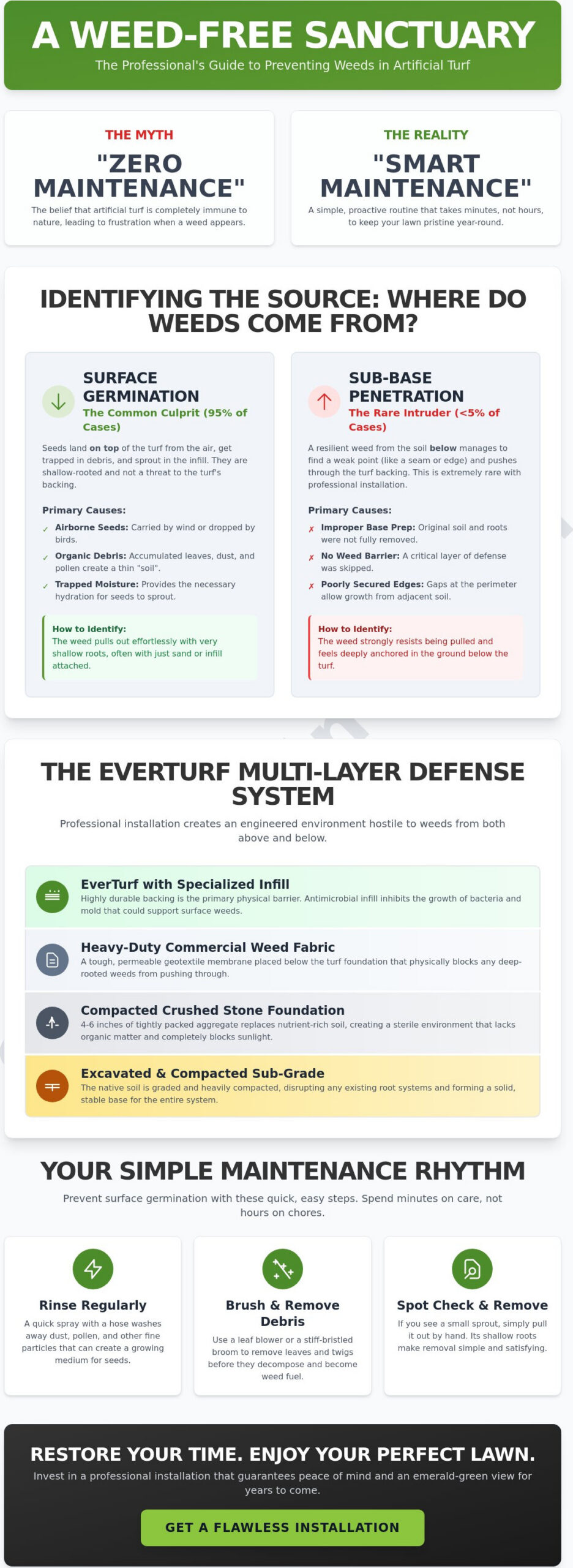
To maintain a truly pristine outdoor space, you must distinguish between two very different types of growth. The first is sub-base penetration, where a weed attempts to push through the turf from the soil beneath. The second, and far more common, is surface germination. This occurs when seeds land on top of your grass and find enough organic material to sprout. High-quality backing acts as your primary physical deterrent, but nature is persistent. Even the most advanced systems have potential weak spots. These usually include the perimeter edges, the seams where two rolls meet, and the drainage holes essential for water runoff.
Debunking the Sub-Base Growth Myth
It is physically difficult for the vast majority of common weeds to pierce a professional-grade, multi-layered backing. When you choose a premium product, the dense weave of the material creates a barrier that most root systems simply cannot penetrate. This defense is bolstered by a properly installed, compacted crushed stone sub-base. By removing the top layer of soil and replacing it with tightly packed aggregate, you eliminate the loose, nutrient-rich environment weeds need to thrive. Sub-base weed suppression is a calculated combination of extreme soil compaction and a total lack of sunlight.
The Surface Germination Reality
If you spot a weed in the center of your lawn, it likely didn’t come from the dirt below. Instead, wind-blown seeds often land in the infill, finding a temporary home among the blades. If dust, leaves, or pet hair are allowed to accumulate, they create a thin layer of “soil” that facilitates growth. Even the most robust weed barrier cannot prevent a seed from falling from the sky. This is why learning how to stop weeds from growing through turf involves managing the surface environment just as much as the foundation. Moisture trapped in organic debris provides the final ingredient for a seed to wake up, making regular clearing a vital part of your long-term satisfaction. By staying proactive, you ensure that your backyard remains a sanctuary of tranquility rather than a source of frustration.
Surface Seeds vs. Sub-Base: Identifying the Source
To effectively master how to stop weeds from growing through turf, you must first become a bit of a detective. Most homeowners assume a sprout means the barrier has failed, but the visual evidence often tells a different story. If you pull a weed and it comes away effortlessly with just a small amount of sand attached to its roots, you’re looking at a surface germinator. These shallow-rooted invaders are usually airborne, carried by the wind or dropped by birds passing over your property. In contrast, a weed that resists your pull and feels anchored deep below likely has a taproot that found a way through a drainage hole or a seam.
Proximity to natural garden beds and overhanging trees significantly increases the volume of seeds landing on your lawn. While these environmental factors are often unavoidable, identifying the source allows you to adjust your maintenance strategy. Airborne seeds are the leading cause of growth on mature synthetic lawns, thriving on the tiny amounts of dust and moisture that settle between the blades. If you’re planning a new project, professional artificial grass installation can help mitigate these risks from the start.
The Role of Infill in Weed Growth
The choice of infill plays a crucial role in creating either a hospitable or a hostile environment for seeds. Standard sand infill can sometimes trap moisture and microscopic nutrients, providing just enough sustainment for a seed to sprout. Choosing specialized options like antimicrobial infill can help mitigate this by inhibiting the growth of bacteria and mold that might otherwise support plant life. For a deeper dive into making the right choice for your project, consult the essential guide to turf infill to see how it impacts your lawn’s longevity.
When Weeds Do Break Through: The Edge Effect
Even with a perfect installation, the perimeter of your lawn remains the most vulnerable zone. This “edge effect” occurs because the transition between your synthetic grass and natural soil or garden beds provides a gap where persistent weeds can find light and space. Proper tucking during the installation process is essential to seal these boundaries. Securing the edges with EverTurf Staples and high-strength glue ensures that there are no highways for weeds to travel through. If you notice growth concentrated at the seams, it’s a sign that the bond may have weakened, allowing seeds to reach the base layer. Ensuring a tight, professional seal is the ultimate secret to how to stop weeds from growing through turf permanently.
The Essential Multi-Layer Defense System
Achieving a permanent, maintenance-free result isn’t about luck; it’s about engineering a landscape that nature cannot easily reclaim. To truly master how to stop weeds from growing through turf, you must view your lawn as a multi-layered defense system rather than just a carpet of green. When these components are installed correctly, they create a formidable environment that blocks the three things weeds need most: sunlight, loose soil, and stable moisture. By establishing this structural “fortress,” you protect your investment and ensure your weekend remains yours.
A professional-grade installation relies on four distinct layers of protection:
- Layer 1: Commercial Weed Barrier. This heavy-duty fabric acts as the primary physical shield against sub-surface growth.
- Layer 2: Compacted Crushed Stone. A four-inch base of tightly packed aggregate provides a foundation that is too dense for most root systems to penetrate.
- Layer 3: EverTurf Artificial Grass Backing. Our high-density backing is engineered with precision-punched drainage holes that allow water to pass while remaining too small for weeds to exploit.
- Layer 4: EverTurf Infill. This final layer weighs the turf down and fills the space between fibers, making it difficult for wind-blown seeds to reach a stable rooting point.
Choosing the Right Weed Barrier Fabric
Not all fabrics are created equal. While woven fabrics are common, non-woven geotextile barriers often offer superior protection for synthetic lawns because they provide excellent permeability without sacrificing strength. A pro-level tip is to place your weed barrier directly above the compacted base rock rather than beneath it. This prevents the infill from migrating down into the stone while simultaneously blocking any seeds that might try to germinate in the aggregate layer. UV-stabilized fabrics prevent long-term degradation under the turf, ensuring your protective layers don’t crumble or lose their integrity over the decades.
Structural Integrity: Seams and Adhesives
The strength of your defense is only as good as its weakest point. Seams and perimeters are the most common areas where nature tries to break through. Utilizing EverTurf Glue and specialized seam tape creates an impenetrable, waterproof bond that leaves no room for opportunistic roots. We supplement this bond with EverTurf Staples, placed at precise intervals to prevent the “lifting” that occurs during temperature shifts. This tight seal ensures that moisture flows directly into the drainage system rather than pooling at the seams, which is a critical step in how to stop weeds from growing through turf. When the edges are secured and the seams are fused, you’ve effectively closed the “highways” that weeds use to reach the surface.
How to Stop Weeds from Taking Root: A Step-by-Step Guide
Once your multi-layer defense is in place, the focus shifts from construction to stewardship. Mastering how to stop weeds from growing through turf is largely about managing the environment on top of the blades. While your sub-base blocks the earth below, wind and wildlife bring organic matter from above. Leaves, twigs, and even airborne dust can settle into the fibers, eventually decomposing into a thin layer of fertile “soil” that invites seeds to stay. By removing these precursors to growth, you ensure your lawn remains a tranquil sanctuary rather than a germinating ground for weeds.
A proactive maintenance routine is the key to long-term satisfaction. Follow these steps to keep your surface pristine:
- Clear Debris Regularly: Use a leaf blower or a plastic rake to remove organic matter before it breaks down into the infill.
- The “Pull and Plug” Method: If you spot a surface-level sprout, simply pull it out by hand. Since these weeds are rooted in the infill and not the soil, they’ll come away easily without damaging the backing.
- Seasonal Deep Cleaning: Rinse your lawn with water twice a year to wash away pollen and dust that can accumulate in the EverTurf Infill.
- Spot Treatment: For persistent areas near garden borders, use a turf-safe solution to discourage regrowth.
The Power of Regular Power Brushing
Brushing is perhaps the most effective way to maintain the integrity of your lawn’s defense. A power brush redistributes the infill, keeping the “weed-fighting” layer active and the blades standing tall. This mechanical action breaks up early-stage root systems before they can anchor themselves into the fibers. For high-traffic areas, we recommend a quick brushing once a month. Low-traffic zones typically only require attention once every quarter to remain in peak condition. This simple habit restores the lush, emerald-green aesthetic while simultaneously disrupting the life cycle of any opportunistic seeds.
Pet-Safe Weed Management Strategies
For households with furry companions, chemical safety is a top priority. Many homeowners are moving away from traditional herbicides due to environmental and health concerns. A simple mixture of white vinegar and water is an excellent non-toxic alternative for spot-treating surface growth. If you require something stronger, specially formulated products like OxyTurf X are available for $49.95 per gallon and offer a pet-safe way to eliminate invaders without harming your turf fibers. To learn more about maintaining a healthy environment for your pets, explore the complete guide to artificial grass for dogs. If you’re ready to transform your backyard into a worry-free retreat, contact us for professional artificial grass installation today.
The EverTurf Advantage: Engineered for Resilience
EverTurf isn’t just a surface; it’s a promise of an everlasting outdoor sanctuary. While general maintenance is helpful, the true secret to how to stop weeds from growing through turf lies in the structural integrity of the product itself. We’ve engineered our systems to be inherently hostile to invasive growth while remaining soft and inviting for your family. EverTurf Infill plays a vital role in this defense by filling the gaps between blades with a dense, non-organic material that makes it nearly impossible for wind-blown seeds to find a stable place to take root. This resilience comes from a deep understanding of the local climate and the biological persistence of weeds.
Our approach treats weed prevention as a comprehensive ecosystem. From the density of the fibers to the chemical composition of our adhesives, every detail serves a purpose. Standard products often focus solely on aesthetics, but we prioritize the technical specifications that prevent long-term frustrations. This commitment to quality ensures that the tranquility of your perfect lawn remains undisturbed by the labor-intensive challenges of traditional landscaping. When you choose a professional system, you’re investing in a permanent solution that values your time above all else.
Superior Backing Technology
The foundation of our synthetic grass is our advanced backing technology. Unlike standard perforated backings that can stretch or tear under the pressure of aggressive root systems, EverTurf’s backing maintains its dimensional stability for decades. We use a multi-layered, reinforced weave that optimizes drainage without creating the large access points that weeds often exploit. To understand the full scope of these quality standards, you can refer to the ultimate guide to artificial grass. This superior barrier is the first line of defense in how to stop weeds from growing through turf, providing the logical evidence needed to justify a premium investment in your home.
Complete Installation Solutions
A high-quality product is only as effective as the installation behind it. We provide a complete suite of components, including EverTurf Staples and Glue, specifically designed to seal the perimeter and seams against “weed highways.” These specialized adhesives create a permanent, waterproof bond that nature cannot easily break. By combining our high-performance turf with a meticulously prepared sub-base, we create a synergy that stifles growth from the ground up. If you’re ready to envision a stress-free version of your property, you can request a quote for a complete, weed-resistant backyard turf system. Our team offers the region-specific expertise needed to transform your environment into a worry-free masterpiece.
Reclaim Your Time with a Flawless, Weed-Free Lawn
Transforming your outdoor space into a sanctuary of tranquility doesn’t have to be a constant battle against nature. You’ve discovered that the secret to how to stop weeds from growing through turf is a sophisticated combination of superior engineering and simple, smart habits. By addressing the source of growth, whether it’s airborne seeds on the surface or persistent roots in the sub-base, you can maintain a pristine, emerald-green view year-round. A multi-layer defense system, anchored by high-quality materials and regular power brushing, ensures your yard remains a place for relaxation rather than labor.
As a trusted national distributor of professional-grade turf, we specialize in providing homeowners with long-term peace of mind. Our systems feature industry-leading backing technology and pet-safe, eco-friendly infill options designed to resist organic buildup and stifle invaders. It’s time to move away from the frustrations of traditional maintenance toward the stress-free lifestyle you deserve. Explore EverTurf’s High-Performance Weed-Resistant Systems and start your journey toward a perfect, everlasting landscape. Your dream of a beautiful, worry-free lawn is well within reach.
Frequently Asked Questions
Can I use a standard weed killer on my artificial grass?
You can use most water-based weed killers on your synthetic lawn, but you must avoid oil-based products that can degrade the synthetic fibers. Standard herbicides like those containing glyphosate are generally safe for the turf material itself; however, we recommend eco-friendly alternatives like white vinegar to protect your local environment. Always test a small, inconspicuous area first to ensure no discoloration occurs on your specific grass type.
Do I really need a weed barrier if I’m installing turf over concrete?
You don’t need a weed barrier when installing over concrete because the solid surface acts as a permanent physical block. Since weeds cannot grow through solid masonry, your primary focus should be on managing surface seeds that land in the infill. Ensure your drainage system is clear, as standing water and trapped silt on concrete can create a small nursery for airborne seeds to sprout.
Why are weeds growing specifically around the edges of my turf?
Weeds often appear at the perimeter because these edges are the transition points between your synthetic lawn and natural soil. This “edge effect” happens when seeds from adjacent garden beds find a gap in the tucking or when moisture lingers at the boundary. Ensuring your edges are tightly secured with EverTurf Staples and high-strength glue is the most effective way to close these common entry points.
How often should I brush my turf to prevent weed growth?
You should aim to brush high-traffic areas once a month and low-traffic zones at least once every quarter. Regular brushing is a vital step in how to stop weeds from growing through turf because it prevents organic debris from settling and decomposing into a fertile layer. This simple mechanical action disrupts young root systems before they can anchor themselves into the backing or infill.
Will weeds eventually damage or lift my artificial grass?
Persistent weeds can potentially damage your lawn if their root systems are allowed to expand within the drainage holes. Over time, large taproots can widen these perforations or even put pressure on the seams, leading to visible lifting or uneven surfaces. Removing sprouts as soon as they appear protects the structural integrity of your investment and keeps the backing in pristine condition for decades.
Is there a specific type of infill that prevents weeds better than others?
Antimicrobial and coated silica sand infills are superior for weed prevention because they don’t trap moisture or nutrients as easily as standard raw sand. These specialized materials create a sterile environment that is naturally hostile to germination. By choosing a high-performance infill, you add an extra layer of defense that makes it much harder for wind-blown seeds to find a stable home.
What should I do if I see a weed growing directly through a drainage hole?
If a weed manages to find a drainage hole, you should pull it out by the root as soon as possible to prevent it from anchoring. Use a gentle, steady pull to ensure the entire root system is removed from the sub-base. If the weed is particularly stubborn, a small application of a water-based herbicide can help kill the root before you attempt to remove it entirely.
Can pets safely play on the turf after I’ve treated it for weeds?
Pets can safely return to the lawn once the treatment has completely dried or been washed into the sub-base. If you use a non-toxic vinegar solution, the area is safe almost immediately, though the scent may be strong for a few hours. For commercial treatments, it’s best to follow the manufacturer’s specific safety window, which typically ranges from two to four hours after the application is finished.