

Bocce Ball Court Turf Specifications: The 2026 Professional Design Guide
What if the secret to a tournament-winning roll isn’t your technique, but the friction-coefficient of your turf’s fiber? You’ve likely felt the frustration of a standard lawn that’s far too soft, where heavy bocce balls sink into the grass instead of gliding toward the pallino. It’s a common hurdle for homeowners who want a professional experience but find themselves lost in the technical weeds of material performance. Mastering the exact bocce ball court turf specifications is the only way to transform a high-maintenance backyard into a sophisticated, year-round arena that meets United States Bocce Federation (USBF) standards.
Precision requires the right surface. We’re here to provide the logical evidence you need to justify a premium investment in your property’s leisure potential. You’ll learn why a pile height between 1 and 1.5 inches is the sweet spot for predictable ball roll and how a high-density face weight exceeding 85 ounces ensures your court stands up to heavy play. We’ll also dive into the engineering of sub-bases that can drain over 30 inches of rain per hour, ensuring your court is ready for action immediately after a heavy downpour. This guide previews the transition from a soggy, uneven lawn to the tranquility of an EverTurf Putting Green Pro surface.
Key Takeaways
- Identify why standard landscape turf fails and how choosing high-density fibers ensures a consistent, professional-grade ball roll.
- Master the technical bocce ball court turf specifications, focusing on the critical 3/8″ to 1/2″ pile height and optimal face weight for maximum speed.
- Learn to engineer a durable foundation with specific excavation depths and aggregate layers that guarantee long-term surface stability.
- Discover how synthetic surfaces eliminate the constant raking of traditional shells while providing superior drainage for immediate post-rain play.
- See why high-density nylon construction, like that found in EverTurf Putting Green Pro, is the definitive solution for a maintenance-free backyard court.
Why Standard Artificial Grass Fails the Bocce Ball Performance Test
Imagine stepping onto a lush green surface, ready to deliver a perfect shot. You release the ball, but instead of a smooth, gliding roll, it thuds and stops short. This is the primary reason why standard landscape turf fails the performance test. Professional bocce requires a surface with minimal drag and maximum roll consistency. To achieve this, you must adhere to strict bocce ball court turf specifications that prioritize firm footing over soft cushioning. Unlike a recreational lawn, a competitive court needs to mimic the speed and predictability found in the history and rules of Bocce, where traditional clay or crushed oyster shells provide a lightning-fast response.
Standard landscape grass is engineered for aesthetics and underfoot comfort. Its high pile and low density are designed to feel like a natural meadow. However, these same features absorb the kinetic energy of a heavy bocce ball. This results in the “trample effect,” where soft, long fibers flatten permanently under the weight of the 920-gram balls used in professional play. Once those fibers lose their vertical memory, your court becomes uneven and sluggish. You aren’t just looking for a green space; you’re looking for a high-performance sports floor that maintains its integrity under pressure.
The Physics of the Roll: Friction and Resistance
Friction is the silent opponent in every frame. In non-specialized turf, the pile usually has a distinct direction or “grain.” If you roll against this grain, the ball slows down prematurely or even veers off its intended path. Professional bocce ball court turf specifications solve this by utilizing high-density, short-pile fibers that offer zero grain resistance. Fiber resilience is vital here. You need a surface that snaps back instantly, maintaining a level playing field for years. While a bit of cushioning feels nice under your shoes, it’s the enemy of a professional bocce experience because it creates a “bowl” around the ball, killing the momentum of your roll.
Landscape Turf vs. Professional Court Turf
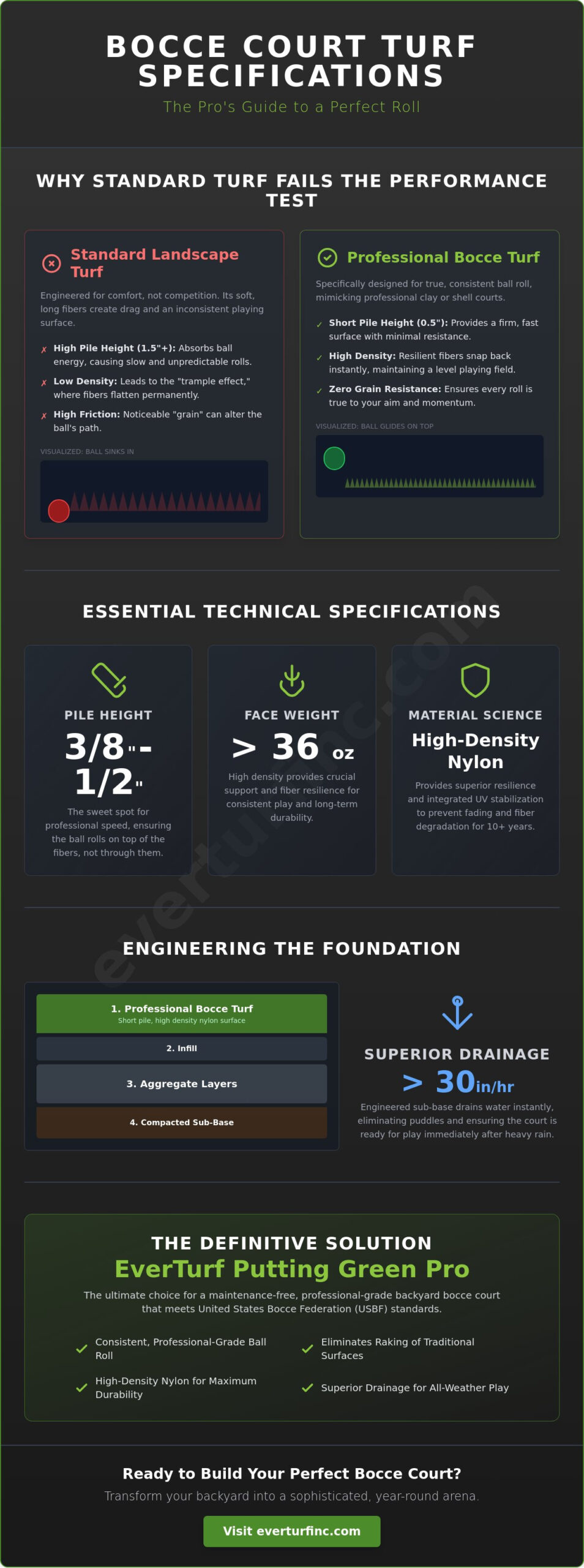
The difference is found in the numbers. A typical backyard turf often features a 1.5-inch pile height to provide that soft, deep-green look. In contrast, a professional court specification demands a much shorter 0.5-inch profile. This height reduction is paired with a significantly higher face weight, often exceeding 40 ounces for specialized sports surfaces, to create a dense, carpet-like mat. Stiction is the primary barrier to a professional bocce roll, representing the static friction that must be overcome to get the ball moving smoothly from a standstill. By choosing a surface with high-density nylon, you eliminate this resistance and ensure your backyard matches the quality of a professional club.
Essential Technical Specifications: Pile Height, Face Weight, and Material Science
Achieving a world-class roll depends on a precise combination of density and height. When reviewing bocce ball court turf specifications, the most critical number is the pile height. For a professional speed that mimics traditional Italian courts, you should look for a profile between 3/8″ and 1/2″. Any taller, and the ball encounters too much resistance; any shorter, and you lose the necessary grip for strategic bank shots. This height must be supported by a face weight in the 36 oz to 40 oz range. This specific density provides enough fiber support to keep the ball on top of the turf, ensuring that every toss remains true to your aim and momentum.
UV stabilization is the final piece of the material science puzzle. Without integrated UV inhibitors, the intense sun exposure on an open court will eventually break down the molecular bonds of the plastic. This lead to fading and brittle fibers that snap under the weight of play. Choosing a UV-stabilized product ensures your court remains a vibrant, deep green for a decade or more, regardless of the local climate. If you’re envisioning a court that stays pristine through every season, consider a professional artificial turf installation to ground your outdoor space with quality.
Material Comparison: Why Nylon Wins
Nylon is the undisputed champion for bocce applications. While polypropylene is common in general landscaping, it lacks the thermal stability required for a high-performance court. Nylon has a significantly higher melting point, which prevents the fibers from softening or deforming during the peak heat of summer. It also possesses superior memory, meaning the fibers spring back to their upright position after being compressed by heavy balls. This resilience prevents the unsightly matting that can plague cheaper installations. Additionally, nylon fibers are non-absorbent, making them naturally resistant to stains from spilled drinks during social gatherings.
The Role of Primary and Secondary Backing
The foundation of the turf itself, known as the backing, is vital for long-term satisfaction. A dual-layer primary and secondary backing system is required to prevent the turf from stretching or bubbling over time. Without this structural reinforcement, temperature fluctuations can cause the material to expand and contract, creating uneven surfaces that ruin the roll. High-quality specifications also demand a high pull-force rating to ensure individual fibers don’t shed during heavy use. Finally, ensure the backing is perforated. This allows for high-volume water drainage, keeping your court functional even after a sudden downpour.
Synthetic Turf vs. Traditional Surfaces: A Comparative Analysis
Choosing between heritage materials and modern innovation often comes down to how you value your time. While traditional clay or oyster shells offer a nostalgic appeal, they demand a level of dedication that most modern homeowners find exhausting. Adhering to professional bocce ball court turf specifications allows you to enjoy the game without the labor-intensive upkeep. Synthetic surfaces recover from rainstorms in minutes, whereas traditional courts might remain unusable for days due to standing water or mud. The aesthetic longevity is equally striking. Your court maintains a vibrant, evergreen hue year-round, avoiding the dull graying or staining common with weathered stone. Modern texturized turf is now engineered to mimic that classic “clack” of the balls and the subtle slide required for precision placement, ensuring the soul of the game remains intact.
Oyster Shells and Crushed Stone: The Old Guard
Traditionalists often point to oyster shells as the gold standard, but the reality involves a cycle of constant raking and leveling. Every year, these materials break down or wash away, requiring expensive replenishment to maintain a playable depth. Beyond the cost, there’s the practical frustration of tracking white dust and grit into your home or clubhouse. This material migration doesn’t just create a mess; it thins out the court surface. Without professional-grade leveling every season, natural courts develop “dead spots” where the ball’s energy is absorbed by loose material, ruining the competitive integrity of your match. These pockets of soft ground make consistent play nearly impossible for serious enthusiasts.
The ROI of Synthetic Bocce Turf
Investing in synthetic materials is as much about restoring your personal time as it is about property value. When you calculate the labor hours saved on weeding, raking, and rolling a natural surface, the long-term benefit becomes clear. While the initial artificial turf installation cost represents a premium investment, it functions as a permanent property asset that requires zero annual material top-offs. It’s a one-time solution that replaces a lifetime of chores with a lifetime of play. Most importantly, the rigid nature of professional bocce ball court turf specifications prevents the “pothole” effect common in clay courts, where repeated impact creates small craters that disrupt the ball’s path. You get a perfect roll, every single time, for the life of the installation, moving you away from the frustrations of maintenance toward the tranquility of your own private retreat.
Engineering the Foundation: Sub-Base and Drainage Specifications
A professional court is only as good as the ground it sits on. To meet the highest bocce ball court turf specifications, you must begin with a rigorous excavation process. Most projects require a depth of 4 to 6 inches, depending on your local soil composition and climate. In regions with heavy clay, deeper excavation ensures that the foundation won’t shift during freeze-thaw cycles. You’ll start with a robust layer of 3/4″ minus crushed stone to provide structural integrity. This is followed by a fine “screed” layer of decomposed granite or crusher fines, which allows for the microscopic leveling required for a tournament-grade surface.
Achieving 95% compaction is the critical threshold for success. A vibrating plate compactor or roller must be used to eliminate air pockets, ensuring the surface remains perfectly flat and non-shifting over years of heavy ball impact. Without this level of density, your court will eventually develop dips that ruin the roll. For drainage, you have two primary strategies: the “crown” and the “flat.” A slight crown helps water shed toward the perimeter, while a flat strategy relies entirely on vertical permeability through the sub-base. Both methods are effective when executed with precision, moving you away from the fear of court downtime and toward a reliable, year-round playing space.
Permeability and Vertical Drainage
High-performance turf must process over 30 inches of rain per hour to prevent water from pooling. This vertical drainage is supported by a layer of professional-grade landscape fabric, which blocks weed growth without clogging the aggregate pores. Your turf infill choice plays a surprising role here. The right infill maintains the vertical channels within the turf fibers, ensuring that water moves quickly into the sub-base. This engineering allows you to enjoy your outdoor space immediately after a storm, restoring your personal time and leisure.
Perimeter Framing and Anchoring
Framing keeps your court’s geometry crisp and permanent. Use concrete curbing or pressure-treated timber to create a rigid border that holds the court’s shape against the elements. This perimeter isn’t just for looks; it provides the vital anchoring point for the turf. Utilizing EverTurf Staples and Glue ensures the edges remain secure even when hit by high-velocity shots. Proper installation also requires stretching the turf during the layout phase. This tension prevents expansion wrinkles from forming during peak summer heat, keeping your playing surface as smooth as a billiard table. Ready to build a foundation that lasts? Explore our artificial turf installation options to ensure your court meets every professional standard.
EverTurf Putting Green Pro: The Definitive Bocce Surface Solution
Selecting a surface that balances professional performance with aesthetic beauty requires a specialized approach. While many homeowners look for a product labeled specifically for one sport, the most sophisticated bocce ball court turf specifications are often found in high-grade golf applications. EverTurf Putting Green Pro emerges as the premier solution for multi-sport backyard use, offering a surface that is as resilient as it is refined. This product isn’t just a covering; it’s a precision-engineered platform designed to provide the “true” bocce roll that enthusiasts crave. By utilizing high-density nylon construction, it eliminates the sluggishness of traditional landscape grass and replaces it with the fast, predictable response of a tournament court.
The aesthetic advantage of this professional-grade turf cannot be overstated. You’ll enjoy a lush, deep green that stays vibrant for decades, regardless of the local climate or frequency of play. This consistency provides a sense of relief, moving you away from the seasonal frustrations of reseeding or raking and toward the tranquility of a perfect outdoor space. Integrated drainage technology ensures the fibers and backing work in harmony to process moisture rapidly. Your court stays dry and ready for a match even after a summer storm, allowing you to focus on your game rather than your maintenance schedule.
Why EverTurf Putting Green Pro Excels at Bocce
The secret to its performance lies in the 100% Nylon fiber composition. Unlike cheaper alternatives, these fibers offer maximum durability and a superior “memory” that resists matting under the weight of heavy bocce balls. This material choice ensures your court maintains the exact speed required for competitive play over the long term. EverTurf Putting Green Pro is also fully compatible with EverTurf Infill, which allows you to customize the ball response. Whether you prefer a faster roll or a slightly “deadened” landing for strategic tosses, the right infill adjustment gives you total control. For those interested in how these professional standards apply across different sports, you can explore our EverTurf Putting Green guide for technical cross-over specs.
A Complete System Approach
Transforming your property into a luxury retreat requires more than just a playing surface. We recommend a complete system approach, utilizing EverTurf Pavers for the surrounding walkway to create a seamless, high-end look that connects your court to the rest of your landscape. This integrated design ensures your outdoor space feels organized and intentional. Our national distribution and professional support provide the peace of mind that your investment is backed by seasoned experts who value quality above all else. You aren’t just buying turf; you’re restoring your personal time and enhancing your lifestyle with a permanent solution. Contact EverTurf Inc for your professional bocce court specifications today.
Elevate Your Outdoor Lifestyle with Professional Precision
Transforming your property into a high-performance leisure destination begins with a commitment to quality. You now understand that the perfect roll isn’t accidental; it’s a result of adhering to strict bocce ball court turf specifications that prioritize density and drainage. By choosing a nylon-engineered surface, you eliminate the sluggish performance of standard grass and gain a court designed for professional speed. This investment isn’t just about the game. It’s about restoring your personal time and enjoying a pristine, evergreen environment that requires zero raking or leveling. Our permeable backing ensures your court is ready for all-weather play, even after the heaviest downpours.
With our national supply and distribution network, you have access to the seasoned expertise needed to make your vision a permanent reality. Don’t settle for a mediocre backyard when you can have a tournament-grade sanctuary. Take the first step toward a more beautiful, stress-free property and start your project today. Build Your Dream Court with EverTurf Professional Specifications and enjoy the lasting satisfaction of a perfect, year-round playing surface. Your ideal outdoor lifestyle is just one decision away.
Frequently Asked Questions
What is the official size of a bocce ball court according to the USBF?
The United States Bocce Federation (USBF) recognizes the international standard court size of 12 feet wide by 76 feet long for sanctioned tournament play. However, they also cite alternative official dimensions, including a 13.12-foot by 86.92-foot layout. For recreational backyard spaces, many homeowners scale these dimensions down to 10 feet by 60 feet to better fit their available landscape while maintaining a similar feel.
Do I need infill for an artificial turf bocce ball court?
Yes, using a high-quality infill is essential for achieving the professional ball response outlined in our guide. Infill provides the necessary weight to keep the turf mat flat and stable during heavy play. It also helps “deaden” the landing of the ball, allowing for the strategic tossing and placement that defines the sport. We recommend a product like EverTurf Infill to ensure your fibers remain upright and resilient.
Can I use standard backyard turf for my bocce court?
Standard landscape turf is generally too soft and plush for a professional bocce experience. The high pile height and low density of typical backyard grass absorb too much kinetic energy, which kills the ball’s roll and makes precision shots impossible. To meet professional bocce ball court turf specifications, you need a much shorter, denser pile that mimics the firm response of traditional clay or oyster shells.
How long does a synthetic turf bocce ball court last?
A professionally installed synthetic turf court typically lasts between 15 and 20 years. This lifespan is largely determined by the quality of the nylon fibers and the integrity of the sub-base construction. Choosing UV-stabilized materials ensures that your court remains a vibrant, deep green through decades of sun exposure, while a properly compacted foundation prevents the shifting or dipping that can ruin playability over time.
What is the best material for a bocce court sub-base?
The most reliable sub-base consists of a compacted layer of 3/4″ minus crushed stone topped with a fine “screed” layer of decomposed granite or crusher fines. This combination offers the structural stability needed for heavy ball impact while allowing for microscopic leveling. Achieving 95% compaction is vital to ensure your bocce ball court turf specifications result in a perfectly flat playing surface that doesn’t settle or shift with the seasons.
How do I clean my artificial turf bocce court?
Cleaning your court is a simple process that involves occasional rinsing with a garden hose to remove dust and fine debris. You can use a leaf blower to clear away organic matter like leaves or twigs that might disrupt the ball’s path. For areas that see heavy use, a light brushing with a synthetic-bristle broom will help keep the fibers upright and maintain the consistency of the roll across the entire surface.
Is nylon or polypropylene better for bocce ball roll?
Nylon is the superior material for bocce ball courts because it possesses a higher melting point and better fiber memory than polypropylene. These characteristics ensure the turf doesn’t soften in the summer heat or remain matted after repeated ball impacts. While polypropylene is a common choice for general landscaping, nylon provides the firm, fast surface and long-term durability required for a tournament-grade competitive environment.
How much does it cost to install a professional bocce ball court?
The total investment for a bocce court depends on the dimensions, site preparation needs, and the specific materials chosen for the project. Research suggests that basic DIY courts can start between $2,000 and $5,000, while mid-range professional installations often range from $5,000 to over $12,000. For high-end custom courts integrated into a larger luxury landscape, costs can exceed $15,000. You should check with a local specialist to get a precise quote tailored to your property’s unique requirements.