


Critical Fall Height for Playground Turf: The 2026 Safety & Compliance Guide
A playground’s aesthetic appeal means very little if the surface underneath fails during a child’s most vulnerable moment. Understanding the critical fall height for playground turf is the most vital step in transforming a potential hazard into a secure, year-round sanctuary. You likely envision a vibrant, inviting space where laughter is the only sound, yet the technical jargon of safety ratings and the fear of liability often cast a shadow over that vision. It’s frustrating to balance the desire for a beautiful, low-maintenance environment with the rigid demands of modern safety protocols.
This guide provides the clarity you need to navigate 2026 compliance standards with confidence, ensuring your play area offers maximum protection. We’ll examine how the integrated EverTurf Play system, combined with high-density shock pads and stable EverTurf Infill, creates a playground that is as secure as it is stunning. You’ll gain a clear path toward a permanent, worry-free solution that prioritizes both the well-being of every child and the long-term tranquility of your property.
Key Takeaways
- Decode the ASTM F1292 standards to ensure your playground meets the highest regulatory benchmarks for 2026.
- Master the technical metrics of critical fall height for playground turf to confidently choose a system that prevents life-threatening injuries.
- Explore how the combination of EverTurf Play and high-performance shock pads creates a superior safety system that outperforms traditional materials.
- Gain practical insights into mapping fall zones for specific equipment like swings and slides to ensure maximum coverage where it matters most.
- Learn how regular infill top-offs and surface care prevent the compaction that can compromise your playground’s safety over time.
What is Critical Fall Height? The Gold Standard for Playground Safety
A playground should be a sanctuary of joy, not a source of hidden anxiety. When we discuss the critical fall height for playground turf, we are defining the literal line between a minor tumble and a catastrophic event. It isn’t just a recommendation; it’s a technical performance standard that ensures the ground beneath a child’s feet is capable of absorbing life-altering energy. While many administrators focus on the height of the equipment, the real magic happens in the surfacing system’s ability to decelerate an impact. Safe enough is a phrase that has no place in playground design, especially when legal and ethical stakes are so high.
The Threshold of Protection
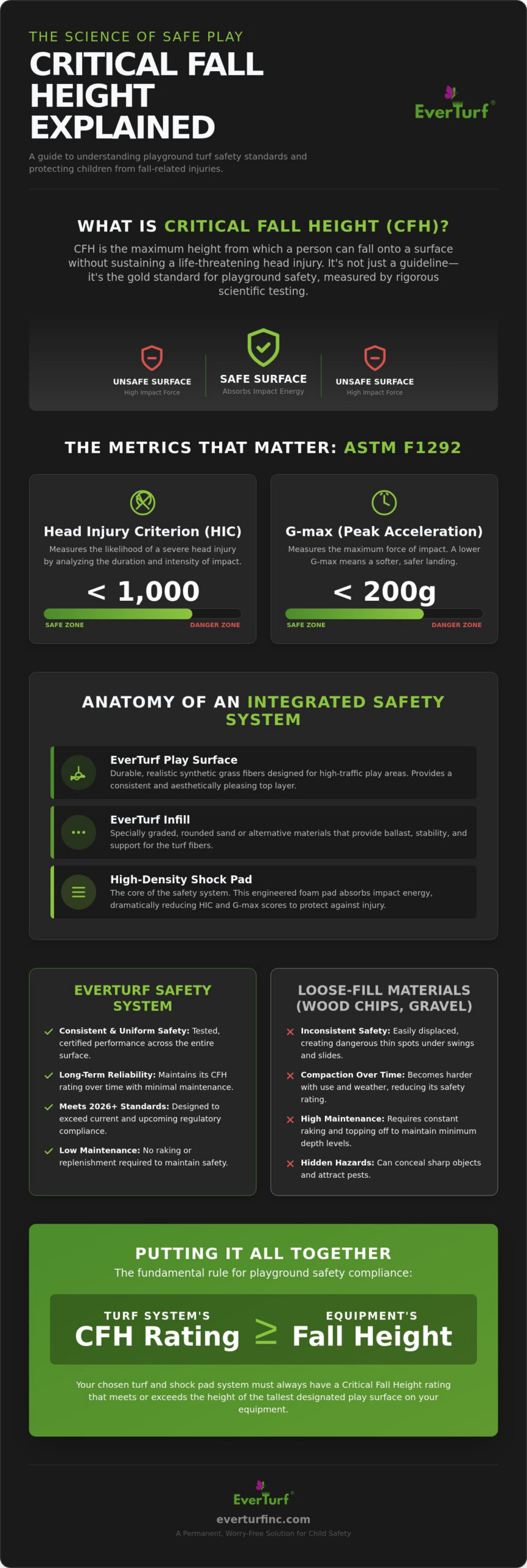
To understand safety, we must look at the physics of a fall through two primary metrics: Head Injury Criterion (HIC) and G-max. A HIC score of 1,000 represents the threshold where a life-threatening injury becomes significantly more likely. Similarly, a 200g limit on peak acceleration ensures the brain doesn’t experience forces that lead to permanent damage. Critical Fall Height is defined by ASTM F1292 as the maximum height from which a child can fall onto a surface without sustaining a life-threatening head injury. By adhering to these metrics, you create a buffer that protects children during those split-second accidents.
Regulatory Compliance in 2026
Modern Playground safety standards are becoming increasingly stringent as we move into 2026. There is a clear, industry-wide shift toward synthetic solutions because they offer a level of reliability that loose-fill materials cannot match. Traditional wood chips or gravel shift underfoot, creating thin spots that compromise safety exactly where children land most often. In contrast, high-performance artificial grass provides a uniform, tested surface that maintains its rating across the entire play area. This consistency is why the critical fall height for playground turf is now the gold standard for administrators who value long-term liability reduction and emotional peace of mind.
It is also vital to distinguish between the Specified Fall Height and the Critical Fall Height. The Specified Fall Height refers to the actual height of the equipment, while the CFH refers to the performance of the turf system. Your turf’s rating must always meet or exceed the equipment’s highest potential fall point. Choosing a permanent system like EverTurf Play restores your personal time by eliminating the constant need for raking and replenishment required by inferior materials, all while keeping your facility in perfect compliance.
The Science of Impact: How CFH Ratings are Measured and Tested
Visualizing safety requires looking beyond the vibrant green surface to the sophisticated instruments that validate it. Measuring the critical fall height for playground turf involves a rigorous procedure designed to mimic the physics of a human impact. Engineers use a specialized “headform” instrument, a sensor-packed metal hemisphere, to record exactly how much energy a surface absorbs during a fall. This data provides the logical evidence needed to ensure a play area isn’t just beautiful, but truly protective for every child who uses it.
The testing process centers on two critical metrics: G-max and HIC. While G-max measures the maximum acceleration or hardness of the surface, the Head Injury Criterion (HIC) calculates the duration of the impact. According to the CPSC Public Playground Safety Handbook, these combined measurements predict the likelihood of head trauma. By dropping the headform from incrementally higher points, technicians determine the exact threshold where the surface no longer meets safety requirements. It’s a precise science that replaces guesswork with certainty.
Laboratory Certification
Every premium system begins its journey in a controlled laboratory environment. Manufacturers drop headforms onto turf samples at various temperatures to establish a baseline performance rating. When you evaluate suppliers, always request their ASTM F1292 certification documents. These reports offer a snapshot of what the system can achieve under perfect conditions. They provide a foundation of trust before the first roll of turf even arrives at your property, ensuring the materials meet the high standards your project demands.
Field Validation and “Fall Zones”
Real-world protection happens on-site, where environmental factors like local humidity and sub-base compaction come into play. Field testing validates the critical fall height for playground turf after the installation is complete. It’s especially vital to test “fall zones”, the high-traffic areas under swings and at slide exits where impact risks are highest. Ensuring your artificial turf installation cost includes this post-install validation is a wise investment in long-term liability reduction. If you’re looking for a permanent solution, exploring the technical specs of EverTurf Play can help you envision a safer, more resilient environment.
The Anatomy of a Safety System: Turf, Shock Pads, and Infill
True safety isn’t found in a single component; it’s the result of a meticulously engineered system where every layer plays a vital role. Achieving the required critical fall height for playground turf demands a synergy between the visible surface and the hidden technology beneath it. When these elements work in harmony, they transform a hard sub-base into a resilient cushion that disperses energy and protects lives. This integrated approach is what separates a premium installation from a basic landscape project, offering the long-term satisfaction of a play area that stays safe year after year.
EverTurf Play serves as the high-density surface layer of this system. It’s engineered specifically for the rigors of high-traffic playground use, utilizing specialized fibers that resist friction and maintain their vibrant beauty under constant activity. While the turf provides the aesthetic appeal and initial durability, it’s the foundation beneath it that does the heavy lifting for impact attenuation. Adhering to the ASTM F1292 standard requires more than just a thick carpet; it requires a performance-driven infrastructure.
Shock Pad Density and Thickness
The shock pad is the true hero of impact protection. Choosing between a 1-inch and 2-inch pad depends entirely on your equipment’s highest fall point. A 1-inch pad might suffice for lower play structures, but taller climbing frames often demand the extra depth of a 2-inch system to prevent the dangerous “bottoming out” effect during a fall. We favor closed-cell technology for its superior resilience. Unlike open-cell alternatives, closed-cell pads don’t absorb moisture or collapse over time, ensuring the system maintains its life-saving cushion regardless of the local climate or usage levels.
The Critical Role of Infill
Infill is often misunderstood as mere weight to hold the turf down, but its role in safety is profound. Understanding the nuances of turf infill reveals how it keeps synthetic fibers upright, which assists in the initial stage of impact absorption. It also prevents “turf creep” and unsightly wrinkles that can easily become trip hazards for small, running feet. EverTurf Infill serves as the essential ballast that keeps the system’s geometry intact, ensuring the Head Injury Criterion (HIC) rating remains consistent despite years of energetic play. This stability allows you to enjoy the tranquility of a perfect outdoor space without the constant worry of shifting safety ratings or surfacing failures. By combining these layers, you create a critical fall height for playground turf that exceeds expectations and provides lasting peace of mind.
Mapping Your Playground: Equipment Heights vs. Turf Specifications
Mapping a playground requires more than a tape measure. It demands a visionary’s eye for how children actually move and play. Every piece of equipment has a different Specified Fall Height that dictates the critical fall height for playground turf requirements for that specific zone. By identifying the highest points of potential impact, you can design a surface that offers permanent protection and aesthetic harmony. This proactive planning transforms a standard play area into a secure sanctuary where safety is built into the landscape itself.
- Swings: Measure from the pivot point of the crossbar to the ground. This accounts for the highest potential arc a child might reach during active play.
- Slides: Consider both the highest platform and the exit region. While the platform is the highest point, the exit area experiences the most repetitive impact and requires consistent cushioning.
- Climbing Structures: Identify the highest point of intended foot support. If a child is meant to stand on a rung, rope, or platform, that elevation is your measurement benchmark.
- Fall Zone Perimeter: Determine the extension required beyond the equipment footprint. This ensures safety even during a diagonal or leaping fall away from the structure.
Standard Equipment Fall Heights
Equipment for toddlers, typically ages 2 to 5, generally has lower fall heights that often top out at 4 to 6 feet. School-age equipment for children ages 5 to 12 can reach heights of 8 to 10 feet or more. Your EverTurf Play system must be calibrated to these specific peaks to remain compliant. Composite structures, which combine slides and climbers, often have varying fall heights across a single footprint. We ensure your installation accounts for the highest possible risk point to provide a uniform safety net across the entire environment.
Calculating the Safety Perimeter
The Fall Zone is the area under and around equipment where a child is most likely to land after a tumble. Most stationary equipment follows a 6-foot rule, meaning the safety surfacing must extend at least 72 inches in all directions from the equipment’s edge. For swings, this zone extends twice the height of the pivot point both forward and backward to account for the momentum of the swing. Integrating EverTurf Pavers at the perimeter of your turf creates a seamless, safe transition from the play area to your surrounding walkways. This structural clarity mirrors the organized nature of a professional installation, making the transition to a worry-free space feel like an obvious choice.
Maintaining Safety Standards: Ensuring Long-Term CFH Compliance
Achieving the perfect critical fall height for playground turf is a significant milestone, but the true value of your investment lies in its permanence. Over time, even the most advanced systems face the subtle pressures of environmental exposure and heavy foot traffic. Ensuring your play area remains a secure sanctuary requires a proactive approach to maintenance that goes beyond simple cleaning. By addressing factors like surface compaction and infill migration, you protect both the children who play there and the long-term liability profile of your property. This commitment to excellence ensures the tranquility of your outdoor space remains undisturbed for years to come.
One of the most overlooked risks in playground management is surface compaction. In high-traffic zones, the repeated impact of running feet can gradually “harden” the surface, which potentially compromises the system’s shock-absorbing capacity. While EverTurf Play is engineered for exceptional high-traffic durability, an annual safety audit provides the professional validation needed to confirm your 2026 compliance remains intact. These inspections serve as essential logical evidence that your facility continues to meet the highest safety benchmarks, offering you the peace of mind that comes with a perfectly maintained environment.
The Maintenance Checklist
Proactive care is the key to preserving the life-saving cushion of your turf system. A consistent maintenance routine restores the aesthetic beauty of the grass while ensuring the critical fall height for playground turf stays within safe limits. Focus on these essential tasks to keep your system performing at its peak:
- Grooming Fibers: Use a synthetic-bristle brush to lift matted fibers, which helps the system maintain its ability to absorb impact.
- Seam Inspections: Check for any separation or trip hazards in high-use areas to ensure the surface remains a seamless, secure landscape.
- Infill Monitoring: Pay close attention to “impact spots” under swings and at slide exits. These areas experience the most displacement and often require regular infill top-offs to maintain the proper HIC rating.
Peace of Mind for the Long Term
The transition from high-maintenance loose-fill materials to an EverTurf Play system offers a significant return on investment. Traditional wood chips or mulch require expensive, back-breaking annual replenishment and constant raking to stay safe. In contrast, EverTurf Play is crafted from high-quality materials that resist UV degradation and fiber breakdown even in harsh climates. This resilience ensures that your playground remains a vibrant, low-maintenance asset that enhances both property value and community trust. By choosing a permanent solution, you prioritize the restoration of your personal time and the safety of the next generation. Ready to transform your environment? Consult with an EverTurf expert to design your safe play space today.
Secure a Legacy of Safe, Beautiful Play
Designing a playground that balances technical excellence with aesthetic beauty is a permanent investment in community well-being. By mastering the critical fall height for playground turf, you move beyond guesswork and into the realm of professional certainty. True protection arises from the synergy of ASTM-compliant safety systems, where high-performance synthetic grass and resilient shock pads work in tandem to absorb impact. This integrated approach ensures your facility remains a secure sanctuary while providing the lush, year-round green that modern homeowners and administrators desire.
Our national distribution and professional support teams are ready to help you navigate these 2026 standards with ease. Choosing a durable, high-performance system doesn’t just reduce liability; it restores your personal time by eliminating the frustrations of traditional maintenance. You deserve the peace of mind that comes from a sophisticated, everlasting result. Ready to elevate your environment? Explore EverTurf Play Systems for Your Next Project and envision the tranquility of a perfect, worry-free play space. Your vision for a safer, more beautiful property is well within reach.
Frequently Asked Questions
What is the typical critical fall height for playground turf?
Typical ratings for a critical fall height for playground turf system range from 4 to 12 feet. The exact number depends on the thickness and density of the shock pad installed beneath the EverTurf Play surface. While the turf provides durability, the pad does the heavy lifting for impact attenuation. You should always match the system’s certified rating to the highest point of your equipment to ensure full compliance with 2026 safety standards.
How do I know if my playground turf still meets its safety rating?
Field testing with specialized sensors is the only way to confirm your surface still meets its rating. These sensors measure G-max and HIC levels to simulate a real-world fall. You can also look for visual cues like matted fibers or visible thin spots in high-impact zones. If the surface feels significantly harder than when it was first installed, it’s time to schedule a professional audit to verify your critical fall height for playground turf performance.
Can I install playground turf without a shock pad?
You can install turf without a pad, but it won’t provide enough impact protection for play equipment. Without the resilient cushion of a shock pad, a standard turf installation typically only offers a fall rating of 1 to 2 feet. For any area with climbing structures, swings, or slides, a high-quality shock pad is essential to meet ASTM F1292 standards and prevent life-threatening head injuries during a tumble.
Is artificial turf safer for playgrounds than wood chips or rubber mulch?
Artificial turf offers superior safety because it provides a consistent, unshifting surface. Traditional materials like wood chips or rubber mulch are easily displaced by running feet, which creates dangerous thin spots exactly where children are most likely to fall. EverTurf Play systems maintain their thickness across every square inch. This reliability eliminates the constant maintenance of raking and replenishing, offering a more permanent and secure solution for modern play environments.
How often should I have my playground turf CFH rating tested?
Annual safety inspections are the industry standard for public and high-traffic private playgrounds. While high-quality synthetic grass is incredibly durable, environmental factors and heavy usage can lead to minor compaction over time. A yearly audit provides the logical evidence needed to protect your facility from liability. It also ensures that the restoration of your personal time isn’t interrupted by sudden safety failures or the need for emergency surface repairs.
Does the type of infill used affect the critical fall height rating?
The type and amount of infill used directly impact the system’s stability and shock absorption. EverTurf Infill acts as a vital ballast that keeps the synthetic fibers standing upright, which allows them to assist in the initial deceleration of a fall. Proper infill levels also prevent the turf from shifting or wrinkling. Without adequate infill, the system can lose its structural integrity, potentially leading to a decline in the Head Injury Criterion (HIC) rating.
What happens if my playground equipment is higher than my turf’s CFH rating?
If your equipment height exceeds your turf’s CFH rating, the playground is considered hazardous and non-compliant. This mismatch significantly increases the risk of severe injury and creates a major liability for the property owner. To resolve this, you must either lower the equipment’s fall height or upgrade the surfacing system with a thicker shock pad. Always ensure your surface’s critical fall height rating is higher than the tallest piece of equipment.
Is playground turf ADA accessible while maintaining its CFH rating?
Playground turf is an ideal solution for ADA accessibility because it provides a firm, stable surface for mobility devices. Unlike loose-fill materials that hinder wheelchairs and walkers, synthetic grass allows for easy movement across the entire play area. Because the safety cushion is built into the layers beneath the turf, you don’t have to sacrifice impact protection for accessibility. It’s a sophisticated solution that ensures every child can play safely and inclusively.