

Indoor Soccer Field Turf Requirements: The 2026 Professional Facility Guide
Did you know that the difference between an elite playing surface and a significant liability risk often comes down to a G-max rating between 90 and 115? It’s a narrow window of perfection that separates a world-class facility from one that causes unnecessary joint stress or painful turf burn. You likely want a field that attracts top-tier talent, yet the technical jargon surrounding indoor soccer field turf requirements can feel like a confusing obstacle rather than a helpful guide.
We understand the pressure of choosing a surface that must withstand a decade of heavy use while meeting strict 2026 fire and building codes. This guide provides the professional clarity you need to master the technical and safety specifications for your project. You’ll discover how to balance shock absorption with durability, ensuring your facility remains a safe, high-performance environment that players trust and owners rely on for long-term success. From pile height to the latest ASTM standards, we’ll help you build a space that prioritizes athlete safety and facility longevity.
Key Takeaways
- Learn why a pile height between 1.5 and 2.25 inches provides the ideal balance for authentic ball roll and long-term fiber resilience.
- Understand how to utilize shock pads and monitor G-Max ratings to safeguard athletes against impact injuries and joint stress.
- Navigate complex indoor soccer field turf requirements by mastering fire safety ratings and preparing a precision-leveled sub-base.
- Discover how face weight and density specifications impact the durability of your field under high-intensity, year-round traffic.
- Explore how professional-grade systems like EverTurf Sports Fields combine elite performance with the structural integrity required for modern facilities.
The Evolution of Indoor Soccer Surfaces: Why Turf Quality Matters
The landscape of indoor athletics has transformed since the early days of abrasive, carpet-style surfaces. Looking back at the history of artificial turf, it’s clear that the transition from hard courts to sophisticated synthetic grass systems has been driven by a demand for safety and technical realism. Modern facilities no longer settle for “good enough.” They seek surfaces that mirror the elite performance of natural grass, especially as global standards for indoor soccer field turf requirements become more rigorous in 2026. Understanding these specific indoor soccer field turf requirements is the first step toward creating a space that inspires confidence in every athlete.
Performance Benchmarks for Modern Play
Technical skill development relies on consistency. If a ball bounces unpredictably or rolls too fast, the quality of play suffers. Modern turf systems are engineered to provide a predictable ball roll that mimics high-quality natural sod. Safety is equally critical. We focus on a delicate balance of traction and torque. A surface with too much grip can lead to devastating ACL injuries, while too little causes slips. By optimizing energy return, your turf helps reduce player fatigue, allowing athletes to maintain their peak performance throughout the entire match.
The Long-Term Value of Premium Synthetic Turf
Investing in EverTurf Sports Fields represents a strategic commitment to your facility’s future. While budget-grade alternatives might seem tempting, they often lead to frequent maintenance downtime and premature replacement costs. Premium systems are designed to withstand the rigors of 2026 athletic standards, often lasting over a decade with proper care. Beyond durability, high-quality turf can positively influence your insurance premiums. Demonstrating compliance with safety benchmarks like the ASTM F1936 G-max test shows insurers that you are proactive about liability protection, ultimately providing peace of mind for both owners and athletes.
Technical Turf Specifications: Pile Height, Face Weight, and Density
Precision is the hallmark of a world-class facility. When you evaluate indoor soccer field turf requirements, you’re looking at a precision-engineered system where every millimeter matters. The specifications you choose today will dictate the speed of play, the safety of the athletes, and the frequency of your maintenance cycles for the next decade. Success begins with understanding how these technical variables interact to create a professional-grade environment.
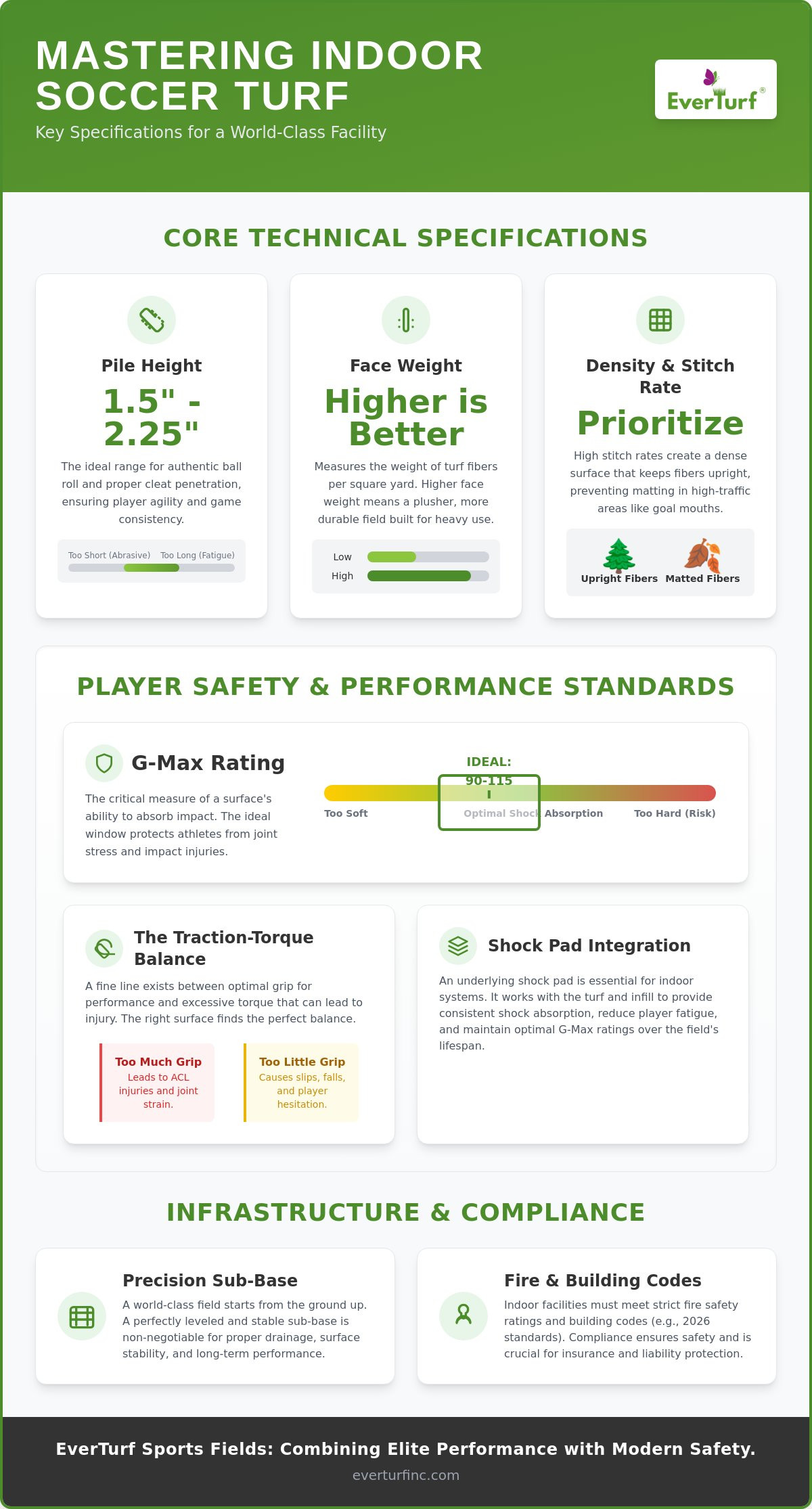
Pile height is perhaps the most visible specification. For indoor soccer, a height between 1.5 and 2.25 inches is widely considered the “sweet spot.” This range allows for proper cleat penetration, which is vital for quick lateral movements, while ensuring the ball doesn’t “sink” and lose its natural roll. If the pile is too short, the surface becomes too fast and abrasive; if it’s too long, it can lead to player fatigue and inconsistent ball physics. These physical dimensions directly influence the results of standardized G-Max testing, which measures how well the surface absorbs impact.
Face weight and density are the indicators of your field’s “meat.” Face weight refers to the weight of the synthetic fibers per square yard. A higher face weight generally translates to a plusher, more durable field that can withstand the grinding traffic of back-to-back league play. To prevent the “matting” effect often seen in high-traffic areas like the goal mouth or center circle, you must prioritize a high stitch rate and density. These factors keep the fibers standing upright, maintaining the aesthetic and functional integrity of the pitch.
Fiber Technology and Durability
Fiber shape is a critical choice for any visionary facility owner. Monofilament fibers are individually extruded to mimic the look and feel of natural grass blades, offering superior aesthetics and a soft touch. Conversely, slit-film technology uses wider fibers that “fringe” over time, creating a dense, incredibly durable mat. Slit-film is often the workhorse of high-use commercial facilities because of its exceptional abrasion resistance. Even in climate-controlled indoor spaces, UV stabilization remains a requirement. Skylights or high-intensity LED systems can degrade unstabilized fibers, leading to brittleness and premature shedding.
Understanding Infill Requirements
The fibers are only half of the story. A high-performance field relies on EverTurf Infill to provide the necessary ballast and cushioning. For a standard 2-inch pile, maintaining the correct infill depth ratio ensures that approximately 0.5 to 0.75 inches of the fiber remains exposed. This support system prevents the blades from laying flat and provides the energy return players need for endurance. If you’re designing a facility that demands elite performance, you can view our specialized artificial grass installation solutions to see how these technical specs come together in practice.
Player Safety Standards: Understanding Shock Pads and G-Max Ratings
Safety is the cornerstone of any elite sports facility. When you examine the essential indoor soccer field turf requirements, the G-max rating emerges as the most critical metric for long-term player health. G-max represents the measure of a surface’s impact attenuation. Essentially, it tells you how much shock the field absorbs versus how much energy is returned to the athlete’s body during a fall or a sprint. A hard field isn’t just uncomfortable; it’s a liability that can lead to concussions and chronic joint stress.
While standard regulations allow for a maximum G-max of 200, professional facility owners aim for a much safer threshold. Keeping your field below 165 Gs throughout its entire lifecycle ensures a premium experience that protects players of all ages. For reference, high-quality natural grass typically measures between 90 and 115 Gs. Achieving this level of performance indoors requires a strategic combination of turf thickness, specialized EverTurf Infill, and a high-performance underlayment. Without these layers, the synthetic system lacks the depth needed to mitigate high-energy impacts effectively.
The Role of Shock Pads in Indoor Facilities
Indoor soccer fields are almost exclusively installed over concrete or asphalt sub-bases. Because these materials offer zero natural compression, a shock pad is a non-negotiable requirement for player safety. You can choose from various materials, including Expanded Polypropylene (EPP), closed-cell foam, or recycled rubber. These pads do more than just cushion a fall; they act as a protective barrier for the turf itself. By absorbing the heavy impact of concentrated foot traffic, a shock pad prevents the synthetic fibers from being ground against the hard concrete. This preservation of fiber integrity significantly extends the life of your investment while maintaining a consistent feel across the entire pitch.
Preventing Turf Burn and Skin Abrasions
Player comfort extends beyond impact protection to the skin’s surface. Modern fiber technology has made massive strides in reducing “turf burn,” a common complaint in older indoor facilities. Selecting soft monofilament fibers and using specialized, non-abrasive infill can drastically reduce friction during sliding tackles. It’s also vital to consider temperature management. Even in climate-controlled environments, the friction of high-speed play can generate surface heat. A well-designed system utilizing breathable materials and proper infill density helps dissipate this energy, keeping the field cool and comfortable during the most intense matches. Prioritizing these details transforms a standard pitch into a sanctuary for technical play.
Infrastructure and Code Compliance: Sub-bases and Fire Safety
Constructing a premier facility is a multi-layered challenge. While we’ve discussed the technical fibers and player safety metrics, the foundation beneath your feet determines the ultimate success of the project. Adhering to professional indoor soccer field turf requirements means moving beyond the aesthetic and focusing on the rigid infrastructure and local building codes that govern indoor sports spaces. A visionary approach ensures that your facility isn’t just high-performing, but also fully compliant with the legal standards of 2026.
Precision leveling is non-negotiable for professional play. You must adhere to the “1/8 inch in 10 feet” rule across the entire sub-base. Any minor dip or ridge in the concrete or asphalt will be magnified once the turf is laid, leading to inconsistent ball roll and potential trip hazards. Sealing the concrete is another vital step. It prevents moisture from wicking into the turf backing, which can cause mold or adhesive failure over time. We also pay close attention to perimeter anchoring and existing floor drains to ensure a seamless, permanent fit that won’t shift under the force of high-speed technical play.
Indoor Sub-base Engineering
Success starts with a stable foundation. Whether you’re working with existing concrete or a new asphalt pour, the surface must be free of cracks and debris before installation begins. Sealing the sub-base is particularly important in regions with high humidity, as it creates a moisture barrier that protects the integrity of your EverTurf Staples and Glue. This attention to detail prevents the lifting or bubbling of the turf, ensuring a tranquil, worry-free environment for facility managers and athletes alike.
Regulatory Compliance and Fire Codes
Fire safety is where many facility owners find themselves unprepared. Indoor synthetic grass must contain specific fire-retardant additives to meet the ASTM E648 standard. This test measures the critical radiant flux of the flooring system, and most local fire marshals require a Class A or Class B rating for commercial sports complexes. You’ll need to provide documentation of these ratings, along with smoke density testing results, to pass your final building inspection. Choosing a system that prioritizes these safety markers gives you the peace of mind that your investment is fully compliant with modern life-safety codes. If you’re ready to ensure your project meets every local building code, schedule an artificial turf installation near me today.
Indoor health is a growing priority in 2026. High-quality turf systems are designed to be low-VOC, ensuring that the air quality remains safe for athletes during high-intensity training. Proper ventilation works in tandem with your turf choice to create a fresh, inviting environment that players will want to return to week after week. When you combine these infrastructure elements, you create a facility that is as durable as it is beautiful, standing as a testament to quality and long-term planning.
Selecting Your Turf System: The EverTurf Advantage
Choosing the right synthetic system is the final piece of the puzzle in meeting professional indoor soccer field turf requirements. While the technical specifications provide the blueprint, the execution determines whether your facility will thrive for the next decade. We believe in a consultative approach that transforms your vision into a high-performance reality. By selecting a system tailored to your specific usage rates and athlete profiles, you ensure that every square inch of your pitch contributes to a superior playing experience.
Customizing EverTurf Sports Fields allows you to align fiber density and shock absorption with your facility’s unique goals. Whether you’re hosting elite youth academies or high-intensity adult leagues, the structural integrity of the field remains paramount. This is why we emphasize the use of professional-grade installation accessories. Utilizing high-strength EverTurf Staples and Glue ensures that your field remains anchored and stable, even under the most aggressive lateral movements and technical maneuvers.
Longevity is a product of consistent care. A proactive maintenance schedule, including regular grooming and brushing, keeps the fibers standing upright and prevents infill compaction. Periodically topping off the infill levels preserves the cushioning properties you worked so hard to establish. This simple commitment to upkeep protects your warranty and ensures that your investment continues to provide a safe, beautiful environment for years to come.
The Installation Process for Indoor Fields
Precision during installation is what separates a good field from a legendary one. In high-stress areas like the penalty box and center circle, we recommend sewn seams over glued seams. Sewn connections offer superior tensile strength, preventing the separation that can occur over years of heavy use. For a truly professional look, inlaid lines and logos provide a permanent, crisp aesthetic that never fades or requires repainting. Once the installation is complete, we verify the results through post-installation testing, ensuring that the G-max ratings and ball roll physics meet the exact standards promised in your 2026 facility plan.
Maximizing ROI on Your Indoor Turf
A visionary facility is a versatile one. By choosing a high-density synthetic system, you unlock multi-sport potential. Your soccer field can easily transition to host lacrosse, flag football, or functional fitness training, significantly increasing your hourly revenue. Beyond the direct income, the transition to low-maintenance synthetic solutions offers substantial energy and labor savings. You’ll spend less time on traditional upkeep and more time growing your community. If you’re ready to build a facility that stands as a leader in the industry, Consult with an EverTurf Expert for your 2026 facility plan and take the first step toward a worry-free, high-performance future.
Elevate Your Facility with Professional Precision
Building a world-class sports complex requires a blend of technical mastery and visionary planning. You’ve seen how precise pile heights and G-max ratings safeguard your athletes, while strict fire code adherence protects your investment from regulatory hurdles. Mastering the specific indoor soccer field turf requirements for 2026 ensures your facility doesn’t just meet standards; it sets them for the entire region. This foresight transforms a simple building into a destination for elite play and community growth.
It’s time to move away from the stress of traditional maintenance and toward the tranquility of a perfect, year-round pitch. With our specialized EverTurf Sports Fields technology and national distribution, your large-scale project is supported by seasoned expertise at every stage. We’re here to help you achieve maintenance-free longevity that keeps players returning season after season. Choosing a system that balances technical performance with aesthetic beauty is a permanent investment in your facility’s future.
Design your professional-grade indoor soccer field with EverTurf today. Your vision of an elite, durable, and safe environment is well within reach. Let’s build something everlasting together.
Frequently Asked Questions
What is the best pile height for an indoor soccer field?
The ideal pile height for professional indoor soccer typically ranges between 1.5 and 2.25 inches. This specific height provides enough depth for proper cleat penetration and technical ball control without creating excessive drag. Choosing a height within this “sweet spot” ensures the surface mimics the playability of high-quality natural grass while remaining resilient under heavy daily use.
Do I need a shock pad if the turf is installed over concrete?
Yes, a shock pad is a non-negotiable requirement when installing synthetic systems over concrete or asphalt. Because hard sub-bases offer no natural compression, a 5mm to 15mm shock pad provides the necessary impact attenuation to protect players. This layer is essential for meeting modern indoor soccer field turf requirements and keeping the surface safe for high-intensity competition.
Are indoor soccer turf systems fire-resistant?
Professional indoor turf must be engineered with fire-retardant additives to meet strict commercial building codes. Most local regulations require a Class A or Class B rating according to ASTM E648 standards. It’s vital to verify these certifications during the planning phase to ensure your facility passes fire marshal inspections and provides a safe environment for athletes and spectators alike.
How long does professional indoor soccer turf typically last?
A high-quality indoor turf system typically lasts between 8 and 12 years, depending on the intensity of foot traffic and your maintenance routine. Because indoor fields don’t face the degrading effects of sun and rain, the fibers stay vibrant longer. However, the concentrated traffic of small-sided games means regular grooming is necessary to prevent the fibers from matting over time.
What is a G-max rating and why should I care?
A G-max rating measures the shock-absorbing capacity of your field by calculating how much energy is returned to a player upon impact. While the legal limit is 200 Gs, we recommend keeping your field below 165 Gs to maximize safety. Monitoring this rating is a core part of indoor soccer field turf requirements as it directly impacts your liability and the long-term joint health of your players.
Can I use outdoor soccer turf for an indoor facility?
You can use outdoor turf, but it must be vetted for indoor-specific safety standards like fire retardancy and smoke density. Outdoor systems are often designed for rapid drainage, which isn’t a priority indoors. The most critical factor is ensuring the product meets the National Fire Protection Association (NFPA) codes required for enclosed sports complexes before moving forward with installation.
How do you clean and maintain indoor synthetic soccer turf?
Maintenance involves regular brushing to keep fibers upright, removing surface debris, and periodic deep cleaning with specialized antimicrobial treatments. Since indoor fields don’t benefit from natural rainfall, you’ll need a consistent schedule to manage dust and hygiene. Keeping the infill levels consistent through periodic top-offs is also essential for maintaining the field’s original performance characteristics.
What is the difference between monofilament and slit-film turf fibers?
Monofilament fibers are individually extruded to look like natural grass blades, offering a softer feel and superior aesthetics. Slit-film fibers are wider and more durable, designed to “fringe” at the top to create a dense, resilient mat that holds infill in place. Slit-film is often the preferred choice for high-traffic commercial facilities because it withstands the heavy friction of pivot-heavy sports like soccer.