

What Is the Best Base for Artificial Grass? The Definitive 2026 Guide
The secret to a flawless, evergreen sanctuary isn’t the blades of grass you see, but the invisible foundation you don’t. When homeowners ask what is the best base for artificial grass, they’re often looking for a single miracle material. However, a truly professional result requires a precision-engineered system tailored to your specific environment. You deserve a backyard that offers total tranquility, not a project that buckles, wrinkles, or traps pet odors after the first season.
It’s natural to feel a bit lost when faced with technical terms like CMB or decomposed granite, especially with new 2026 water conservation regulations in states like Florida and Colorado changing the landscape of installation. We understand that you’re investing in more than just turf; you’re reclaiming your weekends and enhancing your home’s value. This definitive guide simplifies the technical details and reveals the installation secrets used to create high-performance foundations. You’ll discover how to achieve a perfectly level surface and superior drainage that keeps your EverTurf Artificial grass pristine for decades. We will walk you through the ideal material layers, lifestyle-specific solutions for pets, and the exact steps to ensure your investment remains a source of pride and relaxation.
Key Takeaways
- Understand why replacing unstable native soil with a structured sub-base is the only way to prevent unsightly surface buckling and shifting over time.
- Compare industry-standard materials like CMB and Decomposed Granite to determine exactly what is the best base for artificial grass for your specific landscape goals.
- Tailor your foundation to your unique lifestyle, focusing on specialized drainage techniques that keep pet areas fresh and odor-free.
- Learn the professional standards for excavation depth and geotextile application to ensure your lawn remains perfectly level and fast-draining for decades.
- Discover how a precision-engineered base serves as the critical first step in the EverTurf System for a truly stress-free and beautiful outdoor experience.
The Science of Stability: Why Your Artificial Grass Needs a Sub-Base
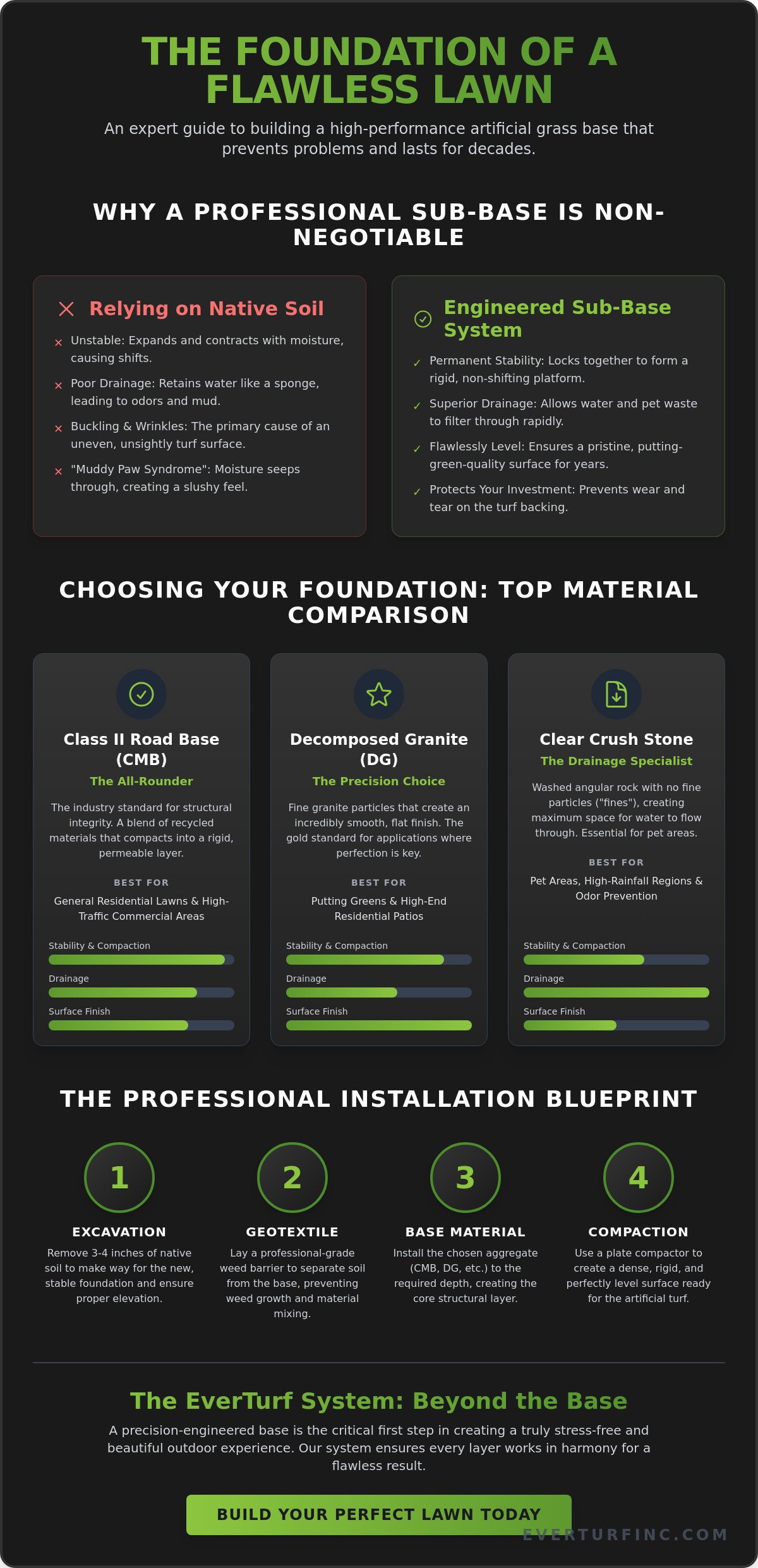
A truly evergreen lawn is more than just a surface; it’s a masterpiece of engineering hidden beneath the blades. When you ask what is the best base for artificial grass, you’re really asking how to ensure your investment lasts for two decades rather than two seasons. Our perspective as a reliable visionary in this industry is simple: we build for the long term. A professional sub-base isn’t just a layer of rock; it’s the structural replacement for unstable native soil that provides the tranquility of a perfectly flat yard for years to come.
The History of artificial turf shows us that early installations often failed because they ignored the ground’s natural movement. Raw dirt is a living entity that expands when wet and contracts when dry. This constant shifting creates a ripple effect that causes synthetic turf to buckle and lose its pristine appeal. To determine what is the best base for artificial grass for your specific property, we must first respect the physics of the ground itself. A high-quality base acts as a filtration system, facilitating rapid vertical drainage so that rainwater and pet waste move through the system quickly rather than lingering to cause odors.
The Problem with Native Soil
Native soil, particularly in regions with high clay or silt content, is the primary enemy of a flat lawn. These materials retain moisture like a sponge, turning your backyard into a soft, unstable mess. While natural grass survives in dirt by rooting into it, synthetic systems require a firm, non-organic foundation. Without a proper sub-base, you’ll deal with muddy paw syndrome, where moisture trapped beneath the turf seeps through the backing and creates a slushy surface. This defeats the entire purpose of moving toward a stress-free, low-maintenance outdoor space.
Structural Integrity and Load Bearing
Stability is about load-bearing capacity and even weight distribution. A solid base prevents footprinting in high-traffic zones or under heavy patio furniture. By excavating the soil and replacing it with a compacted stone layer, you protect the backing of your EverTurf Artificial grass from friction and wear. A depth of 3 to 4 inches is typically the standard for maintaining a surface that remains as level as a professional putting green. This structural clarity ensures your investment is protected by a foundation that won’t sag or shift as the seasons change.
Comparing Top Materials: CMB, Decomposed Granite, and Clear Crush
Selecting the right aggregate is the most critical decision in your landscaping journey. While homeowners often wonder what is the best base for artificial grass, the answer usually lies in a specific material’s ability to balance stability with drainage. In the professional world, we look at three primary contenders that turn a patch of dirt into a high-performance outdoor living space. Each material serves a distinct purpose in creating a foundation that remains firm and beautiful for decades.
Class II Road Base (CMB): The All-Rounder
Class II Road Base, often referred to as Crushed Miscellaneous Base (CMB), is the undisputed industry standard for structural integrity. This material is a sophisticated blend of recycled concrete and asphalt mixed with sand and gravel. Its unique composition allows it to compact more effectively than almost any other landscape material. When vibrated and rolled, the varying particle sizes lock together to create a rigid, permeable layer that won’t shift underfoot. It is the ideal choice for general residential lawns and expansive commercial landscapes where a firm, reliable foundation is required.
Decomposed Granite (DG): The Precision Choice
If your goal is a surface with zero imperfections, Decomposed Granite (DG) is the professional’s secret. DG consists of granite rock that has weathered into very small pieces and silts. It provides an incredibly smooth, flat finish that is essential for specialized applications. This material is the gold standard for EverTurf Putting Green Pro installations where even the slightest bump can ruin a roll. However, there is a trade-off; DG has lower permeability than coarser aggregates. To solve this, experts often use it as a thin finishing layer over a sturdier CMB base to capture the benefits of both materials.
Clear Crush for High-Drainage Zones
In regions where heavy rainfall is a seasonal reality, 3/4-inch Clear Crush stone becomes an essential part of the conversation. Unlike CMB, Clear Crush contains no fines or dust, leaving large voids between the stones. This structure allows water to move through the base at an accelerated rate, preventing puddles and surface saturation. While it doesn’t compact into a smooth surface as easily as DG, it’s the ultimate solution for vertical drainage. Many modern installations now utilize a hybrid approach, layering these materials to create a custom ecosystem tailored to the local climate. If you’re ready to transform your yard, our team can help you with artificial grass installation that perfectly matches your property’s needs.
Lifestyle-Specific Selection: Matching the Base to Your Needs
Your daily habits define the foundation of your outdoor sanctuary. While soil composition provides the starting point, your intended use ultimately determines what is the best base for artificial grass for your specific property. A family with several large dogs has vastly different requirements than a golf enthusiast seeking a professional-grade green. By aligning the sub-base with your lifestyle, you ensure a permanent solution that remains a source of pride rather than a maintenance burden. We focus on these nuances to provide the relief of a yard that truly serves your family’s needs.
The Best Base for Pet-Friendly Turf
Hygiene is the primary concern for pet owners. Standard bases often contain “fines,” which are tiny particles of dust that can trap pet urine and lead to persistent odors. For these projects, 3/4-inch clear crush stone is the superior choice. It creates an open-graded system with significant air gaps, allowing liquids to flush through instantly rather than lingering in the substrate. When you combine this high-drainage base with EverTurf Infill, you create an environment that resists bacteria and stays fresh. This setup ensures your lawn remains a safe, odor-free space for both pets and people.
Engineering for Putting Greens and Sports Fields
Precision defines the athlete’s experience. A professional golf roll or a safe soccer field requires more than just a single layer of rock. We typically utilize a dual-layer engineering approach to achieve these high-performance results. A stable foundation of Class II Road Base provides the structural strength, while a thin “screed” layer of Decomposed Granite (DG) creates a mirror-smooth finish. Our EverTurf Sports Fields systems rely on a rigorous 95% compaction rate to ensure the surface remains firm under heavy foot traffic. This level of detail prevents the shifting or footprinting that can ruin a game or a putting stroke.
Entertainers also benefit from this structural clarity. High-traffic social spaces require a base that can support heavy outdoor kitchens, fire pits, and seasonal furniture without sagging. A thick, well-compacted CMB layer prevents the turf from compressing or tearing under the weight of a crowd. Choosing a base that respects these loads means you can host gatherings with total confidence in your lawn’s resilience. It’s about moving away from the frustrations of a fragile yard toward the tranquility of a space built for life.
Precision Installation: How to Prepare and Compact Your Base
Transform your outdoor space by moving from theory to action. Even if you have identified what is the best base for artificial grass for your project, the installation quality determines whether that surface remains pristine for twenty years. Precision begins with excavation. You must remove the native soil to a depth of 3 to 4 inches to create enough volume for the structural aggregate. Once the area is clear, apply a professional-grade geotextile fabric. This barrier offers the relief of permanent weed prevention while keeping your base materials from sinking into the sub-grade.
Spreading your chosen material requires a careful touch to avoid aggregate segregation. When you dump large piles, the heavier stones often roll to the edges, leaving the fines in the center. This creates weak spots that lead to future sinking. Instead, spread the material in thin, even lifts. This methodical approach ensures the entire foundation carries weight equally, protecting your investment from shifting as the seasons change.
The Art of Compaction
Achieving a rock-hard finish is impossible without the right equipment. While a hand tamper might work for tiny repairs, a professional result requires a vibratory plate compactor. The secret lies in the moisture content. Follow the golden rule: the material should be damp enough to hold its shape when squeezed but not so wet that it turns to slurry. This precise balance allows the particles to lock together tightly. Aim for a 95% compaction standard. This level of density provides the firm, sophisticated feel underfoot that characterizes a premium installation.
Grading for Drainage
Water management is the final step in securing long-term satisfaction. Create a subtle 1% to 2% slope that directs rainfall away from your home’s foundation and toward existing drainage systems. Use a transit level or a long straight edge to identify any lingering low spots. Filling these depressions now prevents the puddles and odors that can plague a poorly installed yard. If you want a foundation that stands the test of time, consider a professional artificial turf installation near me to ensure every millimeter is perfectly graded.
The EverTurf System: Beyond the Base
Understanding what is the best base for artificial grass is only the first step in a larger journey toward outdoor perfection. We view every installation as a curated ecosystem where each component works in harmony to provide long-term satisfaction and relief. Once the foundation is set, integrating EverTurf Artificial grass provides the lush, vibrant finish that homeowners desire. This isn’t just about aesthetics; it’s about the logical progression from a high-maintenance burden to a stress-free sanctuary that enhances your daily life.
Securing this system requires precision tools that respect the engineering of the sub-base. EverTurf Staples and Glue are specifically designed to anchor into the compacted aggregates we’ve discussed, ensuring that the perimeter remains tight and the seams stay invisible. To finish the process, we use EverTurf Infill. This material acts as a ballast and a protective barrier, shielding the turf fibers from UV rays and ensuring the base remains undisturbed by heavy surface activity. By determining what is the best base for artificial grass and pairing it with these professional-grade finishes, you protect your investment for decades.
Why Quality Accessories Matter
Small details often determine the lifespan of a premium investment. Inferior staples can easily pull out of a well-compacted base during natural ground settling, leading to safety issues and surface wrinkles. By choosing professional-grade fasteners, you ensure the structural integrity of the entire system. For more complex designs, the synergy between EverTurf Pavers and synthetic turf allows for creative, multi-textured landscapes on roofs and decks. These specialized solutions ensure your property remains a beautiful, functional extension of your home that requires zero traditional maintenance.
Your Path to a Maintenance-Free Oasis
The restoration of your personal time is the ultimate reward for a job well done. Proper base preparation and the use of high-quality components prevent the sinking and drainage failures that lead to expensive repairs and frustrations. You’re no longer a slave to the lawn mower or the fertilizer spreader. Instead, you’re the owner of a permanent, year-round retreat that feels as firm and reliable as it looks. This investment pays dividends in both home value and daily tranquility. If you’re ready to move away from the stress of traditional lawn care, consult with an EverTurf expert today to finalize your project plans.
Step Into Your Everlasting Outdoor Retreat
Building a superior landscape starts from the ground up. You now understand that determining what is the best base for artificial grass depends on whether you prioritize the rapid drainage needed for pets or the mirror-smooth finish of our Putting Green Pro for an authentic golf roll. By matching professional-grade materials like CMB or clear crush with meticulous compaction, you eliminate the fear of wrinkles and odors before they ever begin. This precision engineering ensures your investment remains a source of pride rather than a maintenance burden.
We provide every element necessary for success, including specialized EverTurf Infill for advanced odor control and a national distribution network for all essential installation accessories. This structured approach moves you away from the endless cycle of traditional lawn care and into a world of year-round tranquility. Your property deserves a foundation as durable as the turf itself. Transform your landscape with EverTurf’s high-performance turf systems today. Reclaim your weekends and enjoy the lasting peace of mind that comes with a perfectly engineered outdoor oasis.
Expert Answers for Your Installation Questions
Can I use sand as a base for artificial grass?
Avoid using sand as a standalone base because it lacks the structural stability required for a long-term installation. Sand particles are rounded and shift easily under weight, which eventually leads to a lumpy and uneven lawn surface. For a result that remains perfectly flat, you need a crushed aggregate that locks together to create an unyielding foundation.
Do I really need to remove my existing grass and dirt?
Removing existing grass and several inches of topsoil is non-negotiable for a professional result. Organic matter like roots and blades eventually decays, leaving behind air pockets that cause your new turf to sink or buckle. Stripping the area allows you to install a stable, inorganic sub-base that provides the relief of a yard that won’t shift as the seasons change.
How deep should the base be for a residential lawn?
A standard residential project typically requires a base depth of 3 to 4 inches. This thickness provides the necessary load-bearing capacity for daily foot traffic and ensures superior vertical drainage. If your property has heavy clay soil, increasing the depth slightly helps prevent water from pooling beneath your EverTurf Artificial grass during heavy rain.
What is the difference between CMB and Decomposed Granite?
Class II Road Base (CMB) serves as the primary structural layer, while Decomposed Granite (DG) is used as a fine finishing material. CMB contains larger rocks that provide strength, whereas DG consists of tiny particles that fill in small gaps. Combining these materials is often what is the best base for artificial grass when your project requires both extreme durability and a mirror-smooth surface.
Should I use a weed barrier under the base or over it?
Place your professional-grade geotextile weed barrier directly on the native soil before you add any base material. This placement serves a dual purpose: it prevents dormant seeds from reaching the surface and stops your expensive rock base from sinking into the soft mud below. It acts as a critical stabilizer that keeps your layers separate and functional.
How do I prevent the base from washing away in heavy rain?
Prevent erosion by ensuring your base is compacted to at least a 95% density and contained by a solid perimeter. Using bender boards, EverTurf Pavers, or concrete curbing keeps the aggregate locked in place during storms. Proper grading also directs water flow toward drainage zones rather than allowing it to tunnel underneath your foundation.
Can I install artificial grass directly on concrete?
You can install synthetic turf on concrete if the area has a slight slope for water runoff. For these specific projects, we recommend our EverTurf Roof & Deck solution, which often utilizes specialized adhesives or padding. This setup ensures that moisture doesn’t get trapped between the turf backing and the hard surface, preventing mold and odors.
How much base material do I need to order for my project?
Calculate your needs by multiplying your square footage by your desired depth in feet, then dividing by 21.6 to find the required tonnage. For a 500-square-foot lawn at a 3-inch depth, you’ll need approximately 6 tons of aggregate. Always order about 10% extra to account for compaction and minor grading adjustments during the leveling process.