
What Voids an Artificial Grass Warranty? Protect Your EverTurf Investment in 2026
Could a simple window reflection or the wrong cleaning spray turn your premium lawn investment into an uncovered expense? You chose EverTurf to reclaim your weekends and enjoy a pristine, evergreen sanctuary; however, the peace of mind that comes with a 15 year warranty relies on more than just professional installation. Many homeowners feel a lingering anxiety when they read the fine print, wondering exactly what voids an artificial grass warranty and if a single mistake might leave them footing the bill for repairs. It’s natural to feel protective of your vibrant outdoor space, especially when you’ve traded the frustration of natural sod for a sophisticated, permanent solution.
We’re here to replace that uncertainty with the confidence of a seasoned expert. You’ll learn the specific environmental stressors and maintenance errors, from Low-E window heat magnification to improper infill care, that can cancel your coverage. We’ll break down the common 6.67% annual prorated reduction and explain why your two year installation warranty is just as critical as the manufacturer’s protection. This guide provides a clear checklist of actions to avoid so you can enjoy your lush, UV-stabilized lawn through 2026 and well into the next decade.
Key Takeaways
- Distinguish between manufacturer product coverage and installer labor guarantees to ensure every square foot of your property remains fully protected.
- Identify the specific household chemicals and mechanical tools that compromise fiber integrity and learn exactly what voids an artificial grass warranty.
- Recognize how professional base preparation prevents the common installation errors that frequently lead to denied manufacturer claims.
- Shield your vibrant lawn from environmental hazards like Low-E window reflections and heat-concentrating surfaces that cause permanent melting.
- Implement the EverTurf Way of proactive care, using maintenance logs and premium infill to preserve your lush sanctuary for decades.
The Two-Tiered Safety Net: Product vs. Installation Warranties
Protecting your outdoor sanctuary begins with understanding the paperwork behind the beauty. Your EverTurf lawn relies on a dual-layered protection system that separates the physical product from the labor used to install it. This distinction is vital because a failure in one area doesn’t always mean the other party is responsible. Knowing what voids an artificial grass warranty requires a clear distinction between the fibers you walk on and the hands that laid them. Your coverage is a partnership between the manufacturer’s quality and the installer’s precision.
What a Manufacturer Warranty Actually Covers
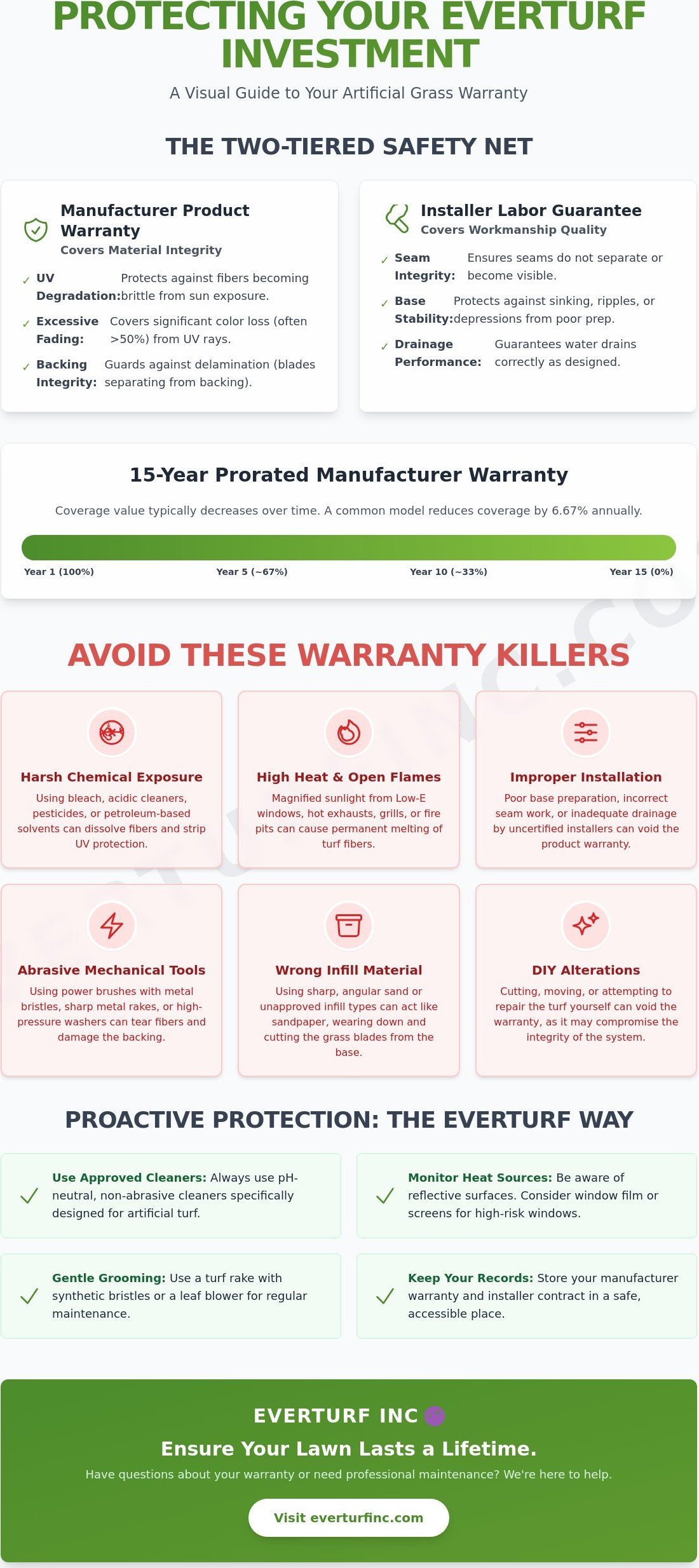
The manufacturer’s warranty focuses on the chemical and structural integrity of the material itself. High-quality Artificial turf is engineered to withstand intense sunlight and heavy foot traffic, but even the best products face environmental stressors. This coverage typically protects you against manufacturing defects that compromise the lawn’s longevity. Key protections include:
- UV degradation: Ensuring the synthetic fibers don’t become brittle or turn to dust under the sun.
- Excessive fading: Most warranties trigger if UV-induced fading exceeds 50% of the original vibrant color.
- Backing integrity: Protecting against delamination, which is when the grass blades pull away from the primary or secondary backing.
Most of these agreements are prorated over a 15 year lifespan. For instance, a common industry practice involves a 6.67% reduction in coverage value every year. If a claim arises in year ten, the manufacturer might only cover a portion of the replacement material cost rather than the full original value.
The Installer Guarantee: Your First Line of Defense
While the manufacturer stands behind the product, your local installation team stands behind the craftsmanship. This labor warranty is your primary shield during the first few years of ownership. It covers the physical assembly of your lawn, including the base preparation and the security of your seams. Common labor protections include coverage for seam separation, base stability to prevent sinking, and drainage performance.
Most professional labor warranties last between two and five years. Choosing a certified expert for your artificial grass installation is the most effective way to ensure your product warranty remains valid. If an uncertified contractor ignores proper base protocols, the manufacturer can rightfully claim that the product failure was actually a result of poor workmanship. This leaves you with an expensive, uncovered repair. Keep separate digital folders for your product certificate and your signed installation contract to ensure you’re prepared for any scenario.
Direct Actions That Void Your Artificial Turf Coverage
Your EverTurf lawn is designed to be a permanent sanctuary. While our synthetic fibers are incredibly durable, certain choices made during maintenance can inadvertently terminate your protection. Understanding what voids an artificial grass warranty is about more than just reading the fine print; it’s about protecting the molecular integrity of your vibrant outdoor space. Most warranty denials stem from preventable user errors rather than factory flaws. Stewardship of your investment ensures your lawn remains lush and evergreen for its entire intended lifespan.
Chemical Exposure: The Silent Fiber Killer
Synthetic turf is a sophisticated plastic product, typically made from high-grade polyethylene or polypropylene. These materials react poorly to harsh solvents. Using unapproved cleaning agents like bleach, highly acidic cleaners, or petroleum-based solvents can cause the fibers to become brittle or even dissolve. Many homeowners mistakenly use pesticides or herbicides intended for natural grass. These chemicals are unnecessary for synthetic lawns and often contain additives that strip the UV-stabilized coating from the blades. This leads to premature fading and fiber breakdown that manufacturers will not cover. To maintain a safe environment for your furry friends without risking your coverage, follow our expert advice on how to keep pet turf clean using only vetted, antimicrobial solutions.
High-Heat Hazards and Open Flames
Artificial grass is fire-resistant, meaning it won’t ignite into a blaze, but it’s not heat-proof. The fibers will begin to deform and melt at temperatures between 175 and 200 degrees Fahrenheit. This type of thermal trauma is a leading cause of warranty exclusion. Common culprits include portable BBQs, fire pits placed too close to the turf, and even discarded cigarettes. If you’re planning an outdoor kitchen or a cozy fire feature, ensure there’s a significant buffer zone or a protective paver surface between the heat source and your EverTurf. Accidental focal points, such as heat reflected from polished metal gutters or white vinyl fences, can also concentrate sunlight into “hot spots” that singe the grass. If you notice any area of your lawn looking flattened or fused, schedule a professional EverTurf consultation to assess the damage before attempting a DIY fix.
Mechanical Damage and Unauthorized Alterations
Physical trauma from sharp objects is another standard exclusion. While EverTurf is built for heavy foot traffic and play, it cannot withstand the slicing action of metal-edged snow shovels or the concentrated pressure of sharp furniture legs. Always use plastic shovels and place wide coasters under heavy patio furniture to distribute weight. Finally, avoid the urge to perform “patch jobs” or DIY alterations. Cutting into the turf to add a new flower bed or attempting to repair a seam yourself can compromise the entire installation. These unauthorized modifications typically kill the labor and product warranty instantly because they disrupt the tension and drainage balance of the system. Trust the experts to handle adjustments to keep your long-term satisfaction intact.
Why Improper Installation is the Leading Cause of Warranty Denial
Even the most premium EverTurf product can’t overcome a flawed foundation. Many homeowners assume that if their lawn begins to ripple or sink, the manufacturer is responsible for a replacement. In reality, these structural issues almost always point back to the installation phase. Understanding what voids an artificial grass warranty means recognizing that the manufacturer only covers the synthetic carpet, not the ground it sits on. If the sub-base isn’t excavated and compacted to professional standards, the resulting dips and valleys are classified as installation errors, leaving you without product coverage.
Structural integrity also depends on the quality of the bonding agents used to secure your sanctuary. Seams that lift or separate are often the result of using inferior adhesives or improper spacing during the layout. We recommend using EverTurf Staples and Glue to create a seamless, monolithic surface that withstands heavy foot traffic. When seams fail due to poor workmanship, the manufacturer views it as a service provider issue rather than a defect in the UV-stabilized fibers. This is why a documented, professional installation is your most valuable asset during a claim.
The Foundation: Sub-Base and Compaction
A successful lawn requires a meticulously engineered base to ensure long-term satisfaction. Using the wrong aggregate, like large river rocks instead of crushed stone or “fines,” creates uneven friction against the turf’s backing. Over time, this friction leads to premature wear or even tears in the backing material that won’t be covered under product defects. To keep your warranty valid, installers must adhere to the “1% Slope” rule. This ensures that heavy rainfall moves efficiently toward drainage points rather than pooling on the backing. Standing water is a major red flag for warranty adjusters; it often leads to mold or mildew exclusions that could’ve been avoided with a 90% compaction rate of the sub-base.
Infill Requirements: More Than Just Weight
Infill is the literal backbone of your synthetic lawn, providing the vertical support needed for a lush appearance. It’s tempting to save costs by using “free” sand or unwashed gravel, but this is a fast track to a denied claim. Raw sand contains jagged edges that act like microscopic saws, abrading the fibers from the inside out every time you walk on them. Manufacturers mandate specific volumes of high-quality EverTurf Infill to protect the delicate thatch layer and keep the blades standing upright. Without the correct infill density, the fibers will mat and tangle prematurely. This crushing is often dismissed as a maintenance failure rather than a product defect, making the right infill your best insurance policy for a worry-free lawn.
Environmental Hazards: From Reflective Melting to Chemical Runoff
Beyond your own maintenance habits, the environment surrounding your property plays a silent but significant role in your lawn’s longevity. While EverTurf products are engineered for the intense heat of the 2026 climate, external factors can create conditions that exceed any synthetic material’s design limits. Understanding what voids an artificial grass warranty requires looking upward at your windows and over the fence at your neighbor’s yard. Most manufacturers categorize environmental damage as “external influence,” meaning the responsibility for protection falls on the homeowner rather than the factory.
It’s also essential to understand the “Force Majeure” or “Act of God” clause found in nearly every warranty document. This clause excludes damage caused by natural disasters like hurricanes, lightning strikes, or extreme flooding. These events are typically handled through your homeowner’s insurance rather than a product claim. To ensure your sanctuary remains pristine, you must identify potential hazards before they cause permanent distortion to your lush, UV-stabilized fibers.
Managing Sun Magnification and Hot Spots
Modern energy-efficient glass, known as Low-E windows, is a double-edged sword for homeowners. While it keeps your home cool, the reflective coating can act as a parabolic mirror, concentrating sunlight into a beam that reaches temperatures well over 200 degrees Fahrenheit. This intensity far exceeds the 175 degree threshold where polyethylene fibers begin to soften and fuse. Because this is an environmental factor, “sun melting” is universally excluded from manufacturer warranties. You can identify these danger zones by looking for unusually bright, moving patches of light on your lawn during peak summer hours. Proactive solutions include installing exterior window screens, adding awnings, or using strategic landscaping to break the light’s path before it hits the turf.
Neighboring Landscapes and Cross-Contamination
Your lawn doesn’t exist in a vacuum. Runoff from a neighbor’s natural grass, often laden with high-nitrogen fertilizers or harsh herbicides, can pool along your perimeter and cause fiber discoloration. Similarly, pool splashes containing concentrated chlorine or salt can leave unsightly mineral deposits if not rinsed away promptly. Organic debris is another often-overlooked hazard. Allowing leaves, pine needles, or grass clippings from nearby mowing to rot on your surface can lead to organic staining and bacterial growth that isn’t covered under manufacturing defects. Ensuring your backyard turf is protected by proper edging and bender boards creates a vital barrier against these external contaminants.
Protecting your investment is a simple process once you know what to look for. If you’re concerned about reflective heat or neighboring runoff, contact the EverTurf team today for a professional site assessment to safeguard your evergreen oasis.
Proactive Protection: Ensuring Your EverTurf Lawn Lasts a Lifetime
Maintaining your EverTurf lawn is a simple commitment that yields decades of tranquility. While we have explored the common pitfalls of what voids an artificial grass warranty, the path to long-term satisfaction is paved with proactive stewardship. A warranty isn’t just a safety net; it’s a testament to the quality of your investment that requires occasional validation through proper care. By treating your lawn with the respect a premium asset deserves, you ensure your outdoor space remains a vibrant, stress-free escape. Your role as a homeowner is to act as the guardian of this evergreen sanctuary, ensuring that every fiber remains as pristine as the day it was installed.
The Importance of a Maintenance Paper Trail
Establishing a maintenance paper trail is the most effective way to safeguard your coverage. Manufacturers often require proof of “reasonable care” before approving a claim for fiber degradation or backing issues. If you cannot prove the lawn was regularly rinsed and brushed, a manufacturer might attribute fiber matting to neglect rather than a product defect. We suggest creating a digital folder to store your original contract, batch numbers, and high-resolution installation photos from day one. A documented history of professional cleaning can expedite claims by proving you’ve followed all recommended guidelines. This organized approach removes the stress of hunting for physical paperwork years down the line and provides clear evidence of your lawn’s history.
Choosing High-Performance Solutions
The “EverTurf Way” prioritizes the role of professional-grade infill as your lawn’s best insurance policy. Infill does more than just weigh the turf down; it supports the individual blades and prevents the thatch layer from collapsing under foot traffic. High-performance lines like EverTurf Putting Green Pro utilize specialized UV-stabilized fibers that resist the brittle texture common in lower-tier products. These advanced materials are specifically engineered to handle the intense Florida climate without losing their structural integrity. To keep these systems at peak performance, we recommend a professional “tune-up” every 24 months. During this visit, an expert will check seam tension and replenish infill levels to prevent the mechanical stress that often leads to denied claims.
The Step-by-Step Claim Process
If you ever need to file a claim, the process is straightforward but requires attention to detail. Start by taking clear, wide-angle and close-up photos of the affected area during midday light. Locate your original batch numbers, as these are essential for the manufacturer to track the specific production run and match dye lots for any necessary repairs. Most claims will involve a professional inspection to distinguish between manufacturing defects and external environmental factors. Having your maintenance log ready during this inspection demonstrates your commitment to the product’s longevity. Taking these proactive steps ensures you remain in total control of your property’s value and beauty. For more information on protecting your investment, contact EverTurf Inc for a consultation on high-durability synthetic solutions today.
Secure Your Everlasting Outdoor Sanctuary
You’ve invested in a sophisticated, low-maintenance lifestyle that replaces exhausting weekend chores with pure tranquility. Protecting that investment means staying vigilant against specific stressors like chemical cleaners and reflective window heat. Understanding what voids an artificial grass warranty is the final step in ensuring your lawn remains a lush, vibrant centerpiece of your home through 2026 and beyond. By choosing professional installation and maintaining a simple care log, you transform a standard product guarantee into a decades-long partnership of quality.
EverTurf offers the professional authority and technical superiority needed for total peace of mind. Our industry-leading UV-stabilization technology ensures your lawn resists the brittle texture of age; meanwhile, our national distribution of professional-grade installation accessories guarantees a secure foundation. We provide expert guidance on pet-friendly and athletic turf systems to ensure every square foot of your property serves your unique lifestyle. Secure your investment with EverTurf high-performance synthetic grass today and enjoy the relief of a permanent, pristine landscape. Your perfect lawn is waiting.
Frequently Asked Questions
Does dog urine void an artificial grass warranty?
Dog urine does not void your coverage when you choose an EverTurf system designed for superior drainage and pet-friendly performance. Our antimicrobial fibers are engineered to withstand the chemical composition of pet waste without degrading. However, allowing uric acid to crystallize without regular rinsing can lead to odors and hygiene issues that are classified as maintenance failures rather than product defects. Consistent rinsing ensures your sanctuary remains pristine and your warranty stays fully intact.
Will my warranty be voided if I install the turf myself?
Installing the turf yourself typically won’t void the manufacturer’s product warranty, but it does mean you lack a labor guarantee. If a DIY error like poor base compaction causes the backing to tear or seams to fail, the manufacturer will likely deny your claim because the fault lies in the workmanship. Most homeowners find that a professional installation is the best way to ensure every square foot is protected against technical denials and structural failures.
How do Low-E windows affect my artificial grass warranty?
Low-E windows can create a parabolic reflection that concentrates sunlight into a powerful beam exceeding 200 degrees Fahrenheit. Because this melting is caused by an external environmental factor rather than a manufacturing defect, it is a leading reason for denied claims. Identifying these hot spots early and using window screens or awnings is essential for anyone wondering what voids an artificial grass warranty in modern, energy-efficient residential settings. Protective measures are required to keep your fibers from fusing.
Can I use a power washer on my synthetic turf without voiding the warranty?
You can use a power washer on a low-pressure setting to refresh your lawn, but high-pressure or high-heat settings can permanently damage the fiber tufts. Directing a concentrated stream too close to the backing can dislodge your EverTurf Infill or compromise the tuft bind. We recommend keeping the nozzle at least 12 inches away from the surface and using a wide-angle spray pattern to maintain the structural integrity of the blades while removing stubborn debris.
Does the warranty cover the grass “matting” or flattening over time?
Standard warranties do not cover matting or flattening, as these are typically considered normal wear or maintenance issues. Keeping your fibers upright requires regular brushing and maintaining the correct levels of infill to support the thatch layer. If the pile height loss exceeds 50% due to a documented chemical defect in the resin, you may have a valid claim; otherwise, keeping the lawn lush and vertical is viewed as a stewardship responsibility for the homeowner.
What happens to my warranty if I sell my house?
Most artificial grass warranties are non-transferable and apply strictly to the original purchaser of the product at the time of installation. When you sell your home, the coverage typically expires for the new owner according to standard industry practices. While the warranty doesn’t transfer to the buyer, the presence of a pristine EverTurf lawn still provides a sophisticated, low-maintenance asset that can significantly enhance your property’s marketability and final sale price.
Are stains from organic debris like leaves covered under warranty?
Stains caused by rotting leaves, acorns, or other organic debris are not covered under manufacturer warranties as they are preventable maintenance issues. Allowing organic matter to decompose on the surface can lead to bacterial growth or tannin staining that penetrates the fibers. We recommend using a leaf blower or a plastic rake to keep your sanctuary clear. Regular removal of debris is a core requirement for maintaining the “reasonable care” standards required for a successful claim.
What is a “pro-rated” warranty and how does it affect my coverage?
A pro-rated warranty means the value of your coverage decreases annually over the life of the product. For a typical 15 year warranty, the value might drop by 6.67% each year from the date of installation. If you file a successful claim in year ten, the manufacturer may provide a credit for the remaining 33.3% of the turf material value rather than a full replacement of the entire lawn. This structure reflects the expected life cycle of the synthetic material.