
What to Do if You Regret Your Artificial Grass Choice: A Remediation Guide
What if your buyer’s remorse isn’t actually about the grass itself, but the invisible components hiding beneath the surface? Many homeowners feel trapped when their yard starts holding onto stubborn pet odors or becomes too hot for kids to play on during a typical afternoon. You might feel like you’ve wasted a significant investment, but understanding what to do if you regret your artificial grass choice starts with a simple truth: your turf isn’t a failure, it just needs the right system components to perform as promised.
At EverTurf Inc, we understand the frustration of watching a once-vibrant lawn become matted or lose its pristine appeal. You deserve the tranquility of a perfect, year-round outdoor space without the stress and expense of a total replacement. This guide will show you how to transform your current situation by focusing on targeted remediations rather than a total tear-out. We’ll explore how to eliminate odors with antimicrobial solutions and reduce surface temperatures using specialized cooling infills. By the end of this article, you’ll have a clear roadmap to restore that lush, evergreen aesthetic and finally reclaim your weekends in a yard you actually love.
Key Takeaways
- Categorize your buyer’s remorse into the four pillars of turf failure to identify a clear path toward a pristine, functional yard.
- Discover exactly what to do if you regret your artificial grass choice by utilizing an antimicrobial infill swap that eliminates pet odors and reduces heat.
- Revive matted fibers and a “fake” aesthetic through professional power brushing techniques that restore the lush, vibrant look of high-quality turf.
- Use our “Repair vs. Replace” framework to calculate whether a targeted remediation or a total system upgrade is the best investment for your property.
- Explore how EverTurf’s specialized systems provide a permanent solution that transforms your outdoor space into a tranquil, low-maintenance sanctuary.
Identify the Root Cause of Your Artificial Grass Regret
Feeling a sense of disappointment after a major home improvement project is more common than you might think. If your yard doesn’t feel like the sanctuary you envisioned, don’t panic. Understanding what to do if you regret your artificial grass choice begins with a focused diagnostic walk-through. Often, the frustration stems from a misalignment between your lifestyle needs and the specific system components installed. You aren’t necessarily stuck with a “bad” product; you might just have an incomplete solution.
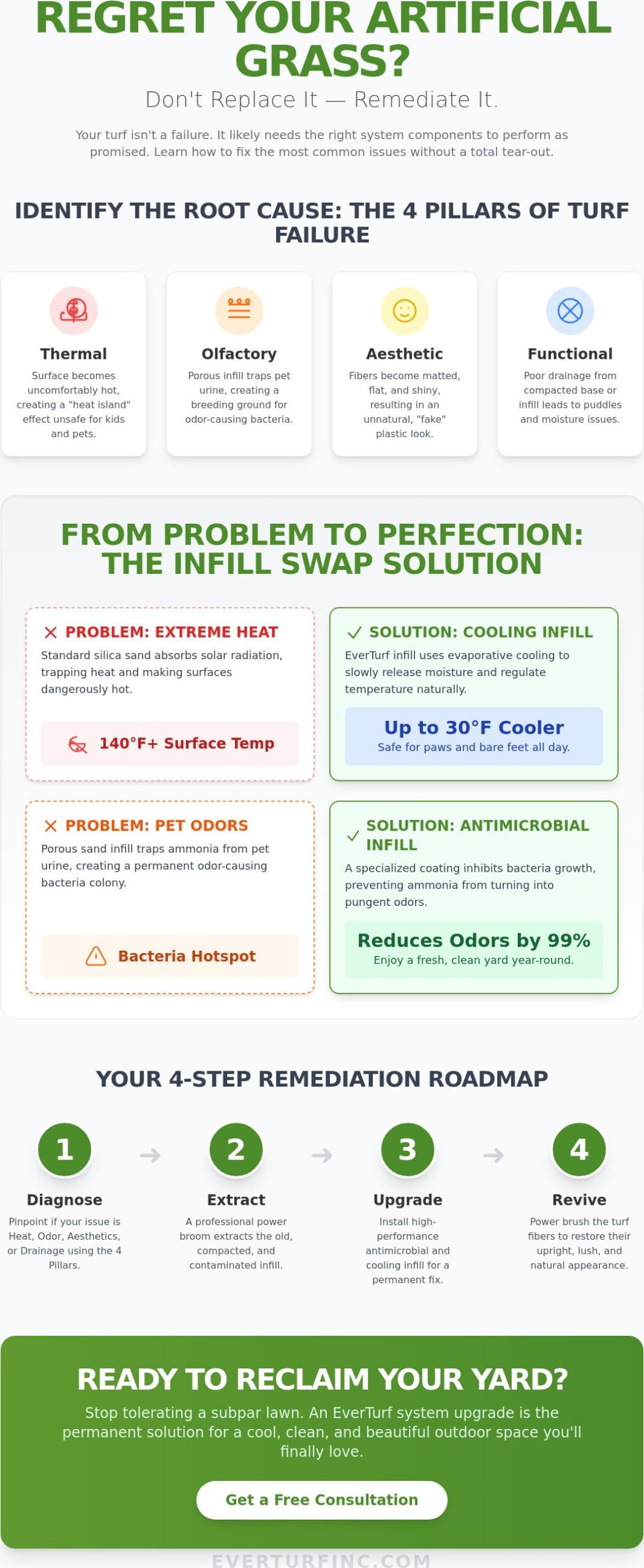
Most dissatisfaction falls into four distinct pillars: Thermal (excessive heat), Olfactory (lingering odors), Aesthetic (an unnatural look), and Functional (poor drainage). While some homeowners worry about broader environmental and health concerns of artificial turf, their immediate daily regret usually involves these practical performance failures. In many cases, the turf fibers themselves are high quality, but low-grade infill or improper base preparation creates a subpar experience. Take a moment to walk your lawn and pinpoint whether the issue is the texture of the fiber or the performance of the system beneath it.
Thermal Discomfort: Why Your Turf Feels Too Hot
High surface temperatures are frequently the number one regret for parents and pet owners. While premium UV-stabilized fibers are designed to reflect a portion of solar radiation, cheaper alternatives absorb it, leading to a “heat island effect.” This is particularly noticeable in small backyards with high walls where airflow is restricted. If your turf reaches uncomfortable levels by mid-morning, the culprit is likely a standard silica sand infill that acts as a heat sink. Upgrading this single component can lead to a significant cooling effect without requiring you to rip out the entire lawn.
The Olfactory Trap: Dealing with Persistent Pet Odors
If your yard has a lingering scent that won’t go away, you’re likely dealing with the “olfactory trap.” Standard sand infill is porous, meaning it allows ammonia from pet urine to get trapped deep within the system. This creates a breeding ground for bacteria that causes odors to intensify during the humid Florida afternoons. It’s vital to distinguish between surface-level dirt and this deep-seated bacterial growth. The speed of your lawn’s drainage directly impacts how long moisture and waste sit within the fibers, which is why superior drainage is the foundation of an odor-free environment.
Combating Heat and Pet Odors: Practical Remediation Steps
Reclaim your backyard sanctuary by addressing the two biggest sources of buyer’s remorse: heat and smell. If you’re wondering what to do if you regret your artificial grass choice, the most effective solution is often a comprehensive infill swap. Many homeowners mistakenly believe they must replace the entire lawn to solve these issues. In reality, substituting low-grade silica sand with high-performance materials from EverTurf Inc can transform your outdoor experience. This process targets the system’s foundation, providing a permanent fix that restores the tranquility of your space.
Modern antimicrobial infills are engineered with specialized coatings that prevent the breakdown of pet waste into odorous ammonia gases. Verified data shows that premium options like Envirofill can reduce ammonia odors by up to 99%. Simultaneously, evaporative cooling technologies act as a natural temperature regulator. These systems absorb moisture from dew or a quick rinse and release it slowly throughout the day. This process can reduce surface temperatures by up to 30 degrees Fahrenheit, making the yard safe for paws and bare feet even in the peak of summer.
Upgrading to High-Performance Infill
Start your remediation by removing the old, clogged sand that currently traps heat and bacteria. A professional power broom is the best tool for this job; it agitates the fibers and extracts the heavy, angular sand that restricts drainage. Once the backing is clear, introduce EverTurf Inc Infill to the system. Unlike standard silica, round-grain infill doesn’t compact over time. This shape creates consistent channels for moisture to flow through, ensuring superior drainage and a more resilient, upright blade structure. If you need assistance identifying the best materials for your specific layout, you can consult with a specialist at EverTurf Inc to ensure a professional-grade result.
Cooling Technologies and Hydration Strategies
Maximize the efficiency of your new system with a simple hydration protocol. During the hottest months, a brief two-minute rinse in the morning activates the cooling properties of the infill, providing relief for hours. This is significantly more effective than hosing down standard turf, which dries almost instantly. For a multi-layered approach, consider strategic landscaping. Adding a few well-placed trees or a stylish shade sail can complement your turf’s cooling technology by blocking direct UV rays during the most intense parts of the day. A consistent maintenance schedule, including a weekly light rinse and a monthly cross-brushing, will prevent debris buildup and keep your lawn looking pristine for years to come.
Fixing Aesthetic and Drainage Issues Without a Total Tear-Out
A lawn that looks like shiny plastic or feels flat underfoot is a common source of frustration for homeowners. When evaluating what to do if you regret your artificial grass choice, it’s helpful to realize that aesthetic issues are often a matter of maintenance and fiber physics rather than a permanent product failure. Flat fibers tend to reflect light in a way that creates an unnatural glare, while C-shaped or S-shaped fibers dissipate light more effectively, mimicking the matte finish of natural sod. If your lawn has lost its vibrant, upright look, the solution typically involves restoring the fiber memory that helps high-quality polyethylene turf bounce back after foot traffic.
Standing water is another significant concern that can make a yard feel swampy and unusable. Diagnosing the root cause is the first step toward a fix. If puddles form in the center of the lawn, the issue might be a clogged turf backing or a sub-base that wasn’t properly compacted. If you notice pooling near the edges, it’s often a minor grading issue that can be corrected with simple DIY adjustments to the perimeter. Addressing these functional hurdles ensures your investment provides the long-term outdoor satisfaction promised by EverTurf Inc. When deciding what to do if you regret your artificial grass choice, remember that visual and functional disappointment is often reversible with the right technical approach.
Restoring the ‘Lush’ Look Through Professional Grooming
Standard plastic rakes are fine for clearing leaves, but they lack the power to lift matted fibers. A motorized power broom uses high-speed rotating bristles to pull fibers into an upright position, instantly reviving the lawn’s texture. During this process, adding a top-off of premium infill provides the necessary lateral support to keep those fibers standing tall. High-quality polyethylene turf features built-in fiber memory, meaning once it’s groomed and supported by infill, it naturally resists flattening. This simple grooming session can make an older lawn look pristine and brand new in a single afternoon.
Correcting Drainage and Sub-Base Settling
Sub-base settling creates unsightly divots and potential trip hazards over time. You don’t always need to pull up the entire yard to fix these low spots. For minor depressions, professionals use an injection method, carefully lifting a small section of the turf to add more crushed stone base before re-securing the area with staples. This surgical approach preserves your existing installation while restoring a perfectly level surface. For a deeper understanding of what a high-quality foundation should look like, consult the Ultimate Guide to Artificial Grass to compare your current base layer standards. Proper base preparation is the secret to the superior drainage that defines a worry-free evergreen space from EverTurf Inc.
The ‘Repair vs. Replace’ Framework: Calculating Your Next Move
Deciding between a targeted fix and a total overhaul requires a clear-eyed look at your lawn’s structural integrity. If you’re weighing what to do if you regret your artificial grass choice, start by evaluating the scale of the failure. A high-quality remediation often costs a fraction of a full replacement. In 2026, the national average for professionally installed turf ranges between $12 and $15 per square foot for mid-range products. When you factor in removal costs of $1,500 to $3,000 for a 1,000-square-foot area, the financial incentive to repair rather than replace becomes quite compelling.
Empower yourself by learning the technical language of turf maintenance before speaking with a contractor. Ask specifically about “re-stretching” to eliminate unsightly wrinkles or “re-seaming” to fix gaps where sections have pulled apart. These surgical adjustments can often save a lawn that looks like it’s failing. For many homeowners, upgrading a high-traffic zone, such as a dedicated dog run, provides the highest return on investment while leaving the rest of the pristine landscape intact. This strategic approach allows you to address the root of your frustration without the disruption of a full-scale construction project.
Signs You Can Save Your Current Turf
Most fixable regrets fall under the category of “good turf with bad infill.” If your primary complaints are minor matting, temporary odors, or surface debris, your lawn is a prime candidate for a professional deep clean. This process extracts years of compacted dust and organic matter that standard hosing cannot reach. Once the fibers are clear, a fresh layer of high-performance infill can restore the upright, lush look you originally desired. If the backing is still intact and the fibers haven’t been physically damaged, a comprehensive grooming session is usually all it takes to revive your outdoor sanctuary.
When a Full Replacement is the Only Option
There are certain “Points of No Return” where remediation is no longer cost-effective. The most common unfixable issue is “turf melt,” which occurs when concentrated sunlight reflects off high-efficiency windows and physically deforms the polyethylene fibers. Once these fibers have fused together, they cannot be brushed back to life. Similarly, if you see widespread seam failure coupled with a base that is visibly shifting or collapsing, it indicates a total system breakdown. In these cases, it’s better to invest in a permanent solution. You can consult our Artificial Turf Installation Cost guide to help budget for a system that won’t let you down a second time.
Don’t settle for a yard that causes stress. If you’re ready to move from frustration to long-term satisfaction, schedule a professional turf assessment to determine if your lawn can be saved or if it’s time for a fresh start.
Choosing a Permanent Solution: How EverTurf Corrects Common Turf Failures
EverTurf operates as a Reliable Visionary in the outdoor living industry, specifically because we understand the technical reasons why previous installations often fall short. If you’re currently evaluating what to do if you regret your artificial grass choice, the solution lies in moving toward a system designed for permanence. Our brand name reflects this promise; the “Ever” prefix serves as a guarantee of a long-term, pristine environment that withstands the test of time and local climate challenges. We position ourselves as lifestyle enhancers who transform frustrating, high-maintenance yards into tranquil, evergreen sanctuaries.
Many homeowners arrive at a state of regret because they were sold a product rather than a complete, engineered system. When you partner with a seasoned expert, you gain access to localized knowledge regarding heat dissipation and heavy rainfall drainage. We don’t just offer a surface-level fix; we provide a sophisticated, permanent solution that addresses the root causes of thermal and olfactory discomfort. This consultative approach builds trust through transparency, ensuring you never have to revisit the frustrations of a failed lawn again.
The EverTurf Difference: Quality Over Convenience
Choosing a lifestyle enhancer means prioritizing high-performance specifications over the convenience of a “budget” install. Our systems utilize UV-stabilized, antimicrobial fibers that prevent the common regret cycle of fading, melting, and lingering bacteria. For families struggling with pet-related issues, EverTurf Artificial Grass for Dogs provides the ultimate solution for odor regret by integrating superior drainage with specialized polymers. We also supply professional-grade accessories, including EverTurf Staples and Glue and specialized EverTurf Pavers, to ensure every component of your outdoor space remains pristine and secure for years to come.
Reclaiming Your Weekends: A Final Invitation
Your original goal was simple: a maintenance-free, worry-free outdoor oasis where you could finally reclaim your weekends. A subpar installation shouldn’t stand in the way of that vision. We invite you to connect with us for a consultative session to diagnose your current lawn’s failures and explore what to do if you regret your artificial grass choice. Whether you need a high-performance DIY supply to fix a specific zone or a full professional assessment to start fresh, we offer a clear, low-pressure path forward. Experience the relief of a perfect lawn and the long-term satisfaction of a property that stays vibrant and lush regardless of the season. Reach out to us today to begin your transition toward a truly evergreen lifestyle.
Reclaim Your Outdoor Sanctuary Today
You’ve learned that your yard isn’t a lost cause. By diagnosing the root cause of your dissatisfaction through the four pillars of regret, you can often avoid the $1,500 to $3,000 expense typically required for a total tear-out. Whether it’s swapping out standard sand for professional-grade antimicrobial infill solutions or using motorized power brushing to restore fiber memory, most synthetic turf issues have practical, cost-effective solutions. Knowing exactly what to do if you regret your artificial grass choice means choosing targeted remediations that offer long-term relief and lasting beauty.
EverTurf provides the technical expertise and premium products needed to fix common failures and restore your peace of mind. Our systems utilize advanced fiber technology designed to reduce surface temperatures by up to 30 degrees Fahrenheit, ensuring your yard remains comfortable during the peak of summer. We specialize in installations for high-traffic pet and play areas that prioritize superior drainage and durability. Don’t settle for a lawn you regret—explore EverTurf’s high-performance solutions today. You deserve a beautiful, stress-free property that enhances your lifestyle and stays pristine for years to come.
Frequently Asked Questions
Can you fix artificial grass that has been matted down for years?
Yes, you can revive matted turf using a motorized power broom. This equipment uses high-speed rotating bristles to pull fibers back into an upright position. High-quality polyethylene turf features built-in fiber memory, which allows it to regain its original lush look even after years of heavy foot traffic. A fresh top-off of round-grain infill provides the lateral support needed to keep those fibers standing tall and vibrant.
Is it possible to change the infill of my turf after it’s already installed?
You can absolutely replace your infill without removing the turf fibers. This process, known as an infill swap, involves using a power broom to extract clogged or odorous silica sand. Once the backing is clear, you can introduce high-performance antimicrobial or cooling infills. This single change is often the best advice for what to do if you regret your artificial grass choice because it addresses heat and odor at the source.
Why does my artificial grass smell like dog urine even after I wash it?
Lingering odors usually occur because standard silica sand is porous and traps ammonia from pet waste. Simply washing the surface doesn’t reach the bacteria deep within the infill. To eliminate the scent permanently, you need to replace the standard sand with an antimicrobial infill. Verified data shows that premium infills reduce ammonia odors by up to 99% by preventing the chemical breakdown of urine into gas.
How can I lower the temperature of my fake grass on hot summer days?
Lowering surface temperatures is best achieved by upgrading to a cooling infill and following a hydration protocol. Specialized infills can reduce the heat of your lawn by up to 30 degrees Fahrenheit through evaporative cooling. A quick two-minute rinse in the morning activates these cooling properties, providing relief throughout the hottest part of the day. Strategic shade from trees or sails also helps prevent the heat island effect.
Can poor drainage under artificial turf be fixed without removing the grass?
Minor drainage issues can often be corrected without a total tear-out. If water pools near the edges, simple grading adjustments or cleaning the turf backing may solve the problem. For small low spots in the center, professionals use an injection method to add crushed stone base beneath the turf. However, if the entire sub-base has collapsed, a full replacement might be necessary to restore a level, functional surface.
What should I do if my artificial grass seams are coming apart?
Seam failures should be addressed immediately with professional-grade staples and glue to prevent tripping hazards. A technician can pull the sections back together and secure them to a seam tape foundation. This process, called re-seaming, restores the seamless, pristine appearance of your lawn. If you’re wondering what to do if you regret your artificial grass choice due to visible lines, a professional re-seaming can often make those joints disappear.
Is it worth trying to repair cheap turf, or should I just replace it?
The decision to repair or replace depends on the condition of the fibers. If the turf has physically melted from window reflections or the backing is disintegrating, a full replacement is the only permanent solution. However, if the issue is merely aesthetic or related to odors, a targeted remediation is often a smarter investment than a total replacement. Focus on the structural integrity of the polyethylene before deciding to start over.
How often should I professionally groom my synthetic lawn to prevent matting?
Aim for a professional grooming session once or twice every year to maintain a pristine, evergreen look. High-traffic areas, such as those used for pets or play, may require more frequent attention to prevent matting. Regular cross-brushing helps redistribute infill and keeps the fibers standing upright. This consistent maintenance schedule protects your investment and ensures your outdoor space remains a tranquil, worry-free sanctuary for its entire lifespan.