

Sports Field Turf Installation Cost Estimate: A 2026 Guide to Synthetic Surface Budgeting
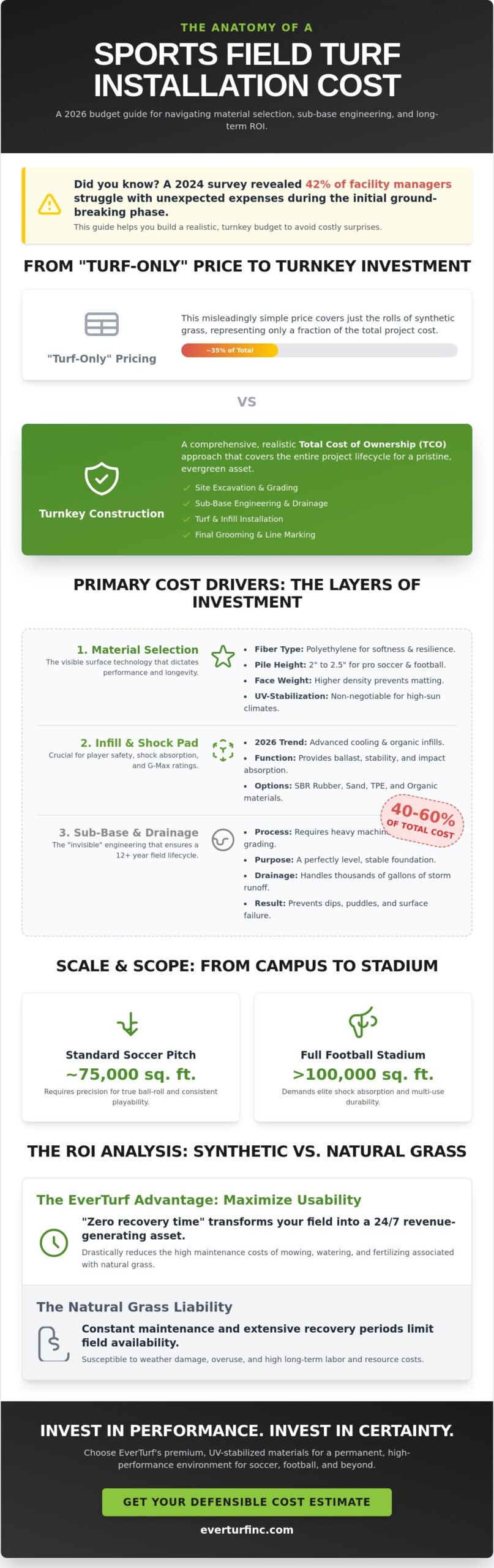
The Synthetic Turf Council reports that while the global market for synthetic grass is surging toward a $7 billion valuation by 2030, a 2024 industry survey revealed that 42% of facility managers struggle with unexpected expenses during the initial ground-breaking phase. You’ve likely felt that same frustration while staring at wildly different quotes, wondering why one contractor prioritizes sub-base engineering while another focuses solely on the lushness of the blades. It’s difficult to justify a premium investment when the technical details feel like a moving target.
We’re here to replace that uncertainty with a defensible sports field turf installation cost estimate that accounts for the high-performance demands of the 2026 athletic season. This guide provides a clear roadmap for navigating material selection, labor logistics, and the long-term ROI of UV-stabilized, professional-grade surfaces. You’ll learn exactly how to balance upfront capital with future maintenance savings to ensure your field remains a pristine, evergreen asset. We’ll explore the critical factors that influence your budget, from advanced drainage systems to the specific fiber technologies that define a world-class playing surface.
Key Takeaways
- Identify the critical differences between “turf-only” pricing and a comprehensive sports field turf installation cost estimate to build a realistic, turnkey budget.
- Discover how the “zero recovery time” of synthetic surfaces transforms your field into a 24/7 asset while drastically reducing the high maintenance costs of natural grass.
- Uncover the “invisible” budget drivers, from sub-base engineering to excavation pitfalls, that ensure your athletic surface remains pristine and high-performing for years.
- Learn how advanced fiber technology and material density influence both the upfront investment and the long-term durability of professional-grade fields.
- Explore the EverTurf advantage to see how premium, UV-stabilized materials create a permanent, high-performance environment for soccer, football, and beyond.
Breaking Down the Sports Field Turf Installation Cost Estimate
Investing in a premier athletic facility requires more than a simple price tag. A professional sports field turf installation cost estimate acts as a multi-layered financial projection. It accounts for site conditions, material technology, and long-term performance. You’ll often see “turf-only” prices, which cover just the rolls of synthetic grass. However, turnkey construction costs provide a more realistic picture. These comprehensive quotes include everything from initial excavation and base stabilization to the final infill and grooming. In 2026, high-performance athletic surfaces are shifting toward advanced cooling technologies and organic infills to meet stricter environmental standards. Adopting a Total Cost of Ownership (TCO) model is now the industry standard. This approach ensures you account for routine maintenance and eventual replacement, providing a transparent view of your long-term investment.
The Scope of Modern Synthetic Sports Surfaces
The sheer scale of an athletic project defines the initial budget. A standard soccer pitch covers roughly 75,000 square feet, while a full football stadium often exceeds 100,000 square feet. These massive footprints demand extreme precision during every phase of the build. Budgeting also depends heavily on the intended level of play. A K-12 field focuses on safety and versatility for physical education, while professional venues prioritize elite ball-roll and specific shock absorption metrics. For a comprehensive overview of artificial turf history and its diverse applications, understanding these distinctions is vital. Multi-sport usage adds another layer of complexity. It requires resilient, UV-stabilized fibers that can withstand the high-intensity traffic of both lacrosse and soccer without losing their vibrant, lush appearance.
Why Upfront Costs Differ from Residential Projects
Commercial sports projects aren’t just larger versions of a backyard lawn. They require heavy machinery like excavators, vibro-rollers, and laser-graders to ensure a perfectly level playing surface. Regulatory requirements are more stringent for public and private institutions. You’ll need environmental impact assessments and specific permits that don’t apply to residential zones. Professional engineering is mandatory for large-scale drainage systems. These systems must handle thousands of gallons of runoff during heavy storms. This is a factor our Florida-based experts know is critical for maintaining a pristine surface during the rainy season. A detailed sports field turf installation cost estimate will reflect these logistical realities, moving you away from the frustration of hidden fees and toward the tranquility of a project done right the first time.
Primary Drivers of Synthetic Sports Field Pricing
Calculating a sports field turf installation cost estimate requires looking far beneath the vibrant green surface. While the turf itself is the most visible component, a complex hierarchy of engineering decisions determines the final investment. In 2026, facility managers must balance immediate capital outlays against the 12 year lifecycle of the surface. From the density of the fibers to the logistical hurdles of moving tons of aggregate, every variable shifts the financial needle. We find that professional grade installations prioritize durability and player safety, ensuring the field remains a pristine asset rather than a maintenance liability.
Material Selection: Pile Height and Fiber Type
The choice of polymer dictates how the field performs under the stress of a 90 minute match. Polyethylene is the preferred choice for most modern sports fields due to its balance of softness and resilience. It’s less abrasive than polypropylene and more durable than nylon in outdoor settings. Higher pile heights, typically ranging from 2 to 2.5 inches for soccer and football, require more raw material and increase the price. You’ll also need to consider face weight; a denser carpet with a higher stitch rate prevents premature matting. For fields in high-UV environments like Florida, investing in advanced UV-stabilized fibers is a non-negotiable step to prevent the grass from becoming brittle after five years of intense sun exposure.
The Critical Role of Sub-Base Construction and Drainage
The “invisible” sub-base often accounts for 40% to 60% of your total sports field turf installation cost estimate. This foundation is where site-specific variables create the most budget volatility. If your soil analysis reveals high clay content, you’ll likely need lime stabilization or extra excavation to create a stable platform. Drainage engineering is equally vital. Vertical drainage systems allow water to flow through the turf backing into a dynamic stone base, while horizontal systems use specialized mats to direct water to perimeter drains. In regions prone to heavy tropical downpours, a robust drainage design ensures the field is playable within minutes of a storm ending, protecting your scheduling and revenue.
EverTurf Infill Options and Performance Requirements
Your choice of turf infill is the primary factor in meeting G-max safety standards, which measure the shock-attenuation properties of the surface. While traditional SBR crumb rubber is cost-effective, many 2026 projects are moving toward premium alternatives.
- Cooling Infills: Coated sands or organic materials like cork and coconut husks can reduce surface temperatures by up to 30 degrees.
- Shock Pads: Adding a dedicated shock pad layer beneath the turf increases the upfront cost but significantly improves player safety and extends the turf’s lifespan.
- Maintenance Planning: Budgeting for infill top-offs every 24 to 36 months is essential to maintain consistent playability and safety ratings.
Logistics also play a silent role in your budget. Freight costs for shipping 15,000-pound rolls of turf and the accessibility of your site for heavy machinery can impact the bottom line by several thousand dollars. If you’re ready to move away from the high costs of natural grass maintenance, you can explore our professional installation services to see how we transform athletic spaces into evergreen performance hubs.
Cost Per Hour: The ROI Analysis of Turf vs. Natural Grass
Smart facility managers look beyond the initial invoice to understand the true cost per hour of play. While natural grass carries a lower upfront price, it demands a recurring maintenance budget of $2.00 to $5.00 per square foot every year. When you calculate your sports field turf installation cost estimate, it’s essential to view the surface as a high-performance asset rather than a simple landscaping expense. Synthetic surfaces provide an evergreen solution that eliminates the 24-hour recovery periods required after heavy rain or intense matches, essentially doubling or tripling your field’s functional life.
Maintenance Expenses: Watering, Mowing, and Labor
Maintaining a pristine natural field is a relentless cycle of resource consumption. Data from the Sports Turf Managers Association indicates that a single natural grass football field can require between 500,000 and 1,000,000 gallons of water annually to remain safe and playable. Transitioning to synthetic fibers provides immediate relief from these utility costs. You also eliminate the need for a full-time groundskeeping crew to manage mowing, aeration, and the application of chemical pesticides or fertilizers. While synthetic fields require specialized grooming equipment to keep infill levels consistent and fibers upright, these tasks are periodic rather than daily. This shift allows your staff to focus on facility improvements rather than fighting the local climate to keep the grass alive.
Revenue Generation Through Increased Field Availability
The financial narrative of synthetic turf is defined by its “zero recovery time” capability. Natural grass fields are fragile; they often require 48 hours of rest for every hour of heavy use to avoid becoming a mud pit. EverTurf surfaces are engineered for 24/7 scheduling. This reliability is a game-changer for revenue generation. You can host back-to-back tournaments, midnight leagues, and off-season camps that were previously impossible due to surface degradation. In regions like Florida, where heavy afternoon downpours can cancel a week of scheduled play, the superior drainage of synthetic systems ensures the game goes on.
A 10-year financial comparison typically reveals a clear advantage for synthetic installations:
- Years 1-3: Higher initial capital investment focused on base preparation and premium turf.
- Years 4-6: The “break-even” point where saved maintenance costs and increased rental fees offset the initial sports field turf installation cost estimate.
- Years 7-10: Pure operational profit as maintenance remains low while utility stays at 100%.
High-use facilities frequently see a full payback on their investment within 5 to 7 years. By choosing a durable, UV-stabilized surface, you’re not just buying a field; you’re securing a decade of predictable, worry-free performance that serves the community every day of the year.
Planning Your Budget: From Site Prep to Final Seams
Creating a realistic sports field turf installation cost estimate requires a chronological perspective that spans from the initial site survey to the final grooming. You’ll begin with a topographical analysis and geotechnical report to ensure the ground is ready for transformation. Once the design is finalized, the project moves through excavation, base construction, turf laying, and precision seaming. Smart planners always set aside a contingency fund of 10% to 15% to protect the project from the unpredictable nature of large scale construction. This buffer ensures that your path to a pristine, evergreen surface remains stress free even if the unexpected occurs.
Hidden Costs in Site Excavation and Stabilization
The phase where most budgets face pressure is during the initial break of the ground. Encountering poor soil quality, unexpected rock outcroppings, or high water tables can quickly inflate costs. In Florida’s unique environment, managing heavy rainfall and sandy subgrades is a specialized task. Soil stabilization is the chemical or mechanical improvement of soil to support heavy turf systems. If the existing earth cannot be stabilized, you must account for the expense of hauling off site old materials and importing structural fill. Experience shows that remediation costs can vary by 20% depending on the proximity of disposal sites and current fuel surcharges in 2026.
Logistics, Labor, and Specialized Installation Equipment
Professional sports surfaces aren’t rolled out like carpet; they’re engineered landscapes that require specialized machinery. Your budget must account for the rental or operation of weighted turf rollers, industrial seam sewing machines, and precision infill spreaders. Shipping logistics also play a major role, as national freight rates for high volume turf and heavy infill bags fluctuate based on seasonal demand. Factoring these variables into your sports field turf installation cost estimate ensures no surprises during the delivery phase.
- Certified Expertise: Ensure labor quotes include technicians with industry specific certifications to guarantee the warranty remains valid.
- Precision Marking: Marking professional sports lines requires laser guided accuracy to meet league standards, whether for FIFA or high school athletics.
- Infill Uniformity: Specialized equipment ensures the infill is distributed at a consistent depth across all 75,000+ square feet of a standard field.
By focusing on these technical details early, you transition from the frustration of maintenance to the tranquility of a permanent, high performance solution. This organized approach reflects the reliable visionary spirit needed to complete a world class facility on time and within your financial goals.
Investing in Performance: The EverTurf Sports Field Advantage
Choosing a synthetic surface is a commitment to the future of your athletic program. At EverTurf, we transform high-traffic areas into pristine, professional-grade arenas that remain vibrant through every season. While your initial sports field turf installation cost estimate provides a baseline for your budget, the true value lies in the decades of playability we deliver. Our systems eliminate the mud, bald spots, and drainage failures that plague natural grass, ensuring your athletes always have a safe, high-performance stage. We don’t just install turf; we provide a permanent solution that stands up to the rigors of competitive play.
EverTurf Soccer and Football Field Solutions
Football requires a surface that can absorb heavy impacts while maintaining structural integrity. We engineer specific fiber configurations that resist matting under the weight of heavy equipment and intense foot traffic. For soccer, our turf meets rigorous FIFA-quality standards for ball-to-surface interaction. This ensures consistent ball roll and predictable bounce every time. We also offer customizable line tufting. By weaving yard lines and boundaries directly into the turf, we remove the recurring cost and labor of field painting. This keeps your facility game-ready 365 days a year without the need for constant touch-ups.
Professional-Grade Durability for Multi-Sport Facilities
Multi-sport complexes face the unique challenge of constant transitions. An EverTurf system handles the shift from high-speed lacrosse matches to grueling football practices without showing signs of wear. A critical component of this resilience is EverTurf Infill. This specialized layer supports the synthetic blades and provides the necessary shock absorption for player safety. It acts as the backbone of the system, keeping the surface stable and responsive.
When you finalize your sports field turf installation cost estimate, remember that an integrated system reduces long-term maintenance headaches. You won’t spend your weekends managing irrigation or reseeding dead patches. Instead, you get a lush, evergreen environment that serves your community year-round. Our Florida-specific expertise ensures your field handles heavy tropical rainfall with superior drainage technology. The result is a beautiful, stress-free facility that looks as good in year ten as it did on day one.
- UV-stabilized fibers to prevent fading in intense sun.
- Antimicrobial properties for a cleaner playing environment.
- Advanced drainage layers that allow for play immediately after heavy rain.
Ready to elevate your facility? Contact an EverTurf specialist today for a custom project estimate and take the first step toward a permanent, high-performance athletic environment.
Secure the Future of Your Athletic Facility
Building a world-class venue requires more than just a surface; it demands a strategic investment in durability and player safety. You now understand how meticulous site preparation and material selection define your sports field turf installation cost estimate. By 2026, industry standards will increasingly favor high-performance synthetic systems that offer 24/7 playability and handle over 3,000 hours of annual use without the downtime required by natural sod. EverTurf Inc delivers this reliability through specialized soccer and football turf systems engineered with antimicrobial and UV-stabilized fibers. These technical specifications ensure your field remains a lush, vibrant centerpiece for years while resisting the harsh effects of sun and heavy rainfall. Our national distribution of high-performance EverTurf Infill provides the necessary shock absorption and stability for elite competition. It’s time to move past the constant cycle of seeding and mowing to embrace a permanent, professional solution. Start your journey toward a pristine athletic environment today.
Get a Professional Sports Field Estimate from EverTurf Inc
We’re ready to help you transform your vision into an evergreen reality that supports your athletes and your community for a lifetime.
Frequently Asked Questions
How much does a full-size synthetic football field cost on average?
A full-size synthetic football field typically costs between $700,000 and $1,500,000 according to Synthetic Turf Council industry benchmarks. This total includes professional site excavation, base construction, and the high-performance turf layers. Your specific sports field turf installation cost estimate will fluctuate based on the choice of shock pads and the complexity of your local drainage requirements. Investing in a premium surface ensures your athletes enjoy a pristine, professional-grade environment for years.
What is the lifespan of a synthetic sports field before it needs resurfacing?
You can expect a high-quality synthetic sports field to last between 8 and 10 years before the carpet requires replacement. The structural base often lasts 20 to 25 years, meaning only the top turf layer needs refreshing during the second cycle. UV-stabilized fibers help maintain a vibrant, evergreen appearance even under the intense Florida sun. Regular grooming and proper infill management extend this lifespan to the upper limit of a decade.
Does a turf field really save money compared to natural grass over 10 years?
Yes, synthetic turf fields typically save owners between $200,000 and $500,000 in maintenance costs over a 10 year period. You eliminate the need for constant mowing, fertilizing, and thousands of gallons of irrigation water. These savings allow organizations to reclaim their budgets for other facility improvements. While the initial sports field turf installation cost estimate is higher, the reduction in daily labor and chemical treatments provides a clear financial advantage.
What are the most expensive components of a sports turf installation?
The stone base and drainage system represent the largest expense, often accounting for 40% to 50% of the total project budget. This critical foundation ensures superior drainage and a level playing surface during heavy tropical downpours. The synthetic turf carpet itself follows as the second most significant investment. High-quality shock pads also add to the cost but provide essential safety for players by absorbing impact during high-intensity games.
How does the type of infill affect the overall project cost?
Infill choice significantly impacts your budget, with premium organic or cooling options costing 5 to 10 times more than standard SBR crumb rubber. While crumb rubber is the most economical choice, many modern facilities opt for antimicrobial or heat-reducing infills to enhance player comfort. These advanced materials help lower surface temperatures by up to 30 degrees during peak summer months. Choosing a specialized infill ensures your field remains a lush and inviting space for all-day play.
What kind of maintenance is required for a synthetic sports field?
Maintenance involves regular brushing and grooming every 100 hours of use to keep fibers upright and infill evenly distributed. You’ll also need to perform annual deep cleaning and GMAX testing to ensure the surface remains safe and shock-absorbent. Unlike natural grass, you don’t have to worry about mud or bald patches after a storm. This streamlined routine helps you reclaim your weekends and focus on the game rather than tedious lawn chores.
Can we install synthetic turf over an existing natural grass field?
You can’t install synthetic turf directly on top of existing grass because the organic matter will rot and cause unstable sinking. Installers must first excavate 3 to 4 inches of natural soil and sod to create space for a compacted aggregate base. This professional preparation ensures your field stays perfectly level and drains efficiently through our specialized backing systems. A stable foundation is the secret to a permanent, beautiful outdoor environment that stands the test of time.
How long does the actual installation process take for a sports field?
A standard professional installation for a full-size field typically takes between 60 and 90 days from the start of excavation. This timeline accounts for site preparation, base stabilization, and the meticulous seaming of the turf panels. Weather conditions, particularly heavy rain, can occasionally shift the schedule by 5 to 10 days. Once finished, your facility transforms into a pristine, year-round venue that’s ready for immediate action without the wait for grass to grow.