


Mastering Artificial Grass Seam Tape: The Secret to Invisible, Professional Seams
Your backyard should be a sanctuary of seamless green, not a collection of visible patchwork pieces that reveal the “artificial” in artificial grass. It’s deeply frustrating to invest in high-quality turf only to have the entire aesthetic ruined by a prominent line or an edge that lifts after the first heavy rain. You deserve the tranquility of a perfect lawn without the constant reminder of how it was put together. The secret to achieving that professional, “grown-in” look lies in the precision of your artificial grass seam tape and the strength of the bond it creates.
We know that the fear of a messy installation or a seam that pulls apart can be a major hurdle for any homeowner. This guide is designed to move you past those frustrations toward long-term satisfaction. You’ll learn how to select the right materials, including why seasoned experts prefer high-performance options like EverTurf Staples and Glue over flimsy, peel-and-stick alternatives. We will explore the exact techniques required to create a bond that withstands the local climate and heavy foot traffic, ensuring your investment remains a beautiful, stress-free part of your property for years to come.
Key Takeaways
- Understand how artificial grass seam tape acts as the vital structural bridge that manages thermal expansion and prevents unsightly gaps in your lawn.
- Compare the convenience of self-adhesive tape against the superior durability of professional glue-down methods for high-traffic residential areas.
- Master the precise cutting techniques required to ensure your turf edges align perfectly for a flawless and invisible connection.
- Learn to identify and fix common installation errors like “Mohawking” to maintain a flat, professional-grade finish that lasts for years.
- Discover how to integrate high-performance accessories like EverTurf Staples and Glue to create a robust, permanent bond that withstands the elements.
Why Artificial Grass Seam Tape is the Backbone of Your Synthetic Lawn
Imagine your lawn as a high-performance tapestry. While the lush blades capture the eye, the true strength of a professional installation lies hidden beneath the surface of synthetic fibers. Artificial grass seam tape functions as the essential fabric bridge that unites separate rolls into a single, cohesive landscape. It isn’t just a placeholder; it’s the structural foundation that ensures your outdoor space remains tranquil and organized, even under the stress of daily life. By securing the edges of your turf, you move away from the frustration of shifting surfaces and toward a permanent, beautiful solution.
In the face of 2026 climate extremes, where temperature fluctuations can be drastic, this tape plays a critical role in managing thermal expansion and contraction. Synthetic materials naturally expand when heated and shrink as they cool. Without a robust seaming solution, these microscopic movements can lead to visible gaps or overlapping ridges. A secure seam also acts as a primary defense for your sub-base, preventing water from infiltrating the joints and washing away the carefully leveled foundation. This protection is what separates a temporary fix from an everlasting result that enhances your property’s value.
The Anatomy of a High-Quality Seam
Professional installers distinguish between standard materials and high-performance components. Most quality artificial grass seam tape is constructed from non-woven fabrics or specialized PET (polyethylene terephthalate) fibers designed to absorb adhesive without losing their shape. For residential projects, a 6-inch width is often sufficient, but high-traffic areas or sports applications typically require 12-inch tape to distribute load more effectively. This fabric must interact perfectly with the turf backing to create a bond that feels like a natural extension of the product itself.
Invisible Seams: The Ultimate Goal
Achieving a flawless finish requires more than just sticking two pieces together. It requires managing seam tension. If the tape is applied too tightly or without enough slack for the adhesive to settle, the rolls may “creep” or pull apart over months of use. This slow separation is the leading cause of visible lines that ruin the illusion of a natural lawn. By utilizing professional-grade accessories like EverTurf Staples and Glue in conjunction with your tape, you ensure the edges stay anchored exactly where you placed them. For a deeper look at how these components fit into your total property transformation, consult our Ultimate Guide to Artificial Grass. Proper seaming restores your personal time by eliminating the need for constant repairs, allowing you to simply enjoy your sanctuary.
Self-Adhesive vs. Glue-Down Tape: Which Should You Choose?
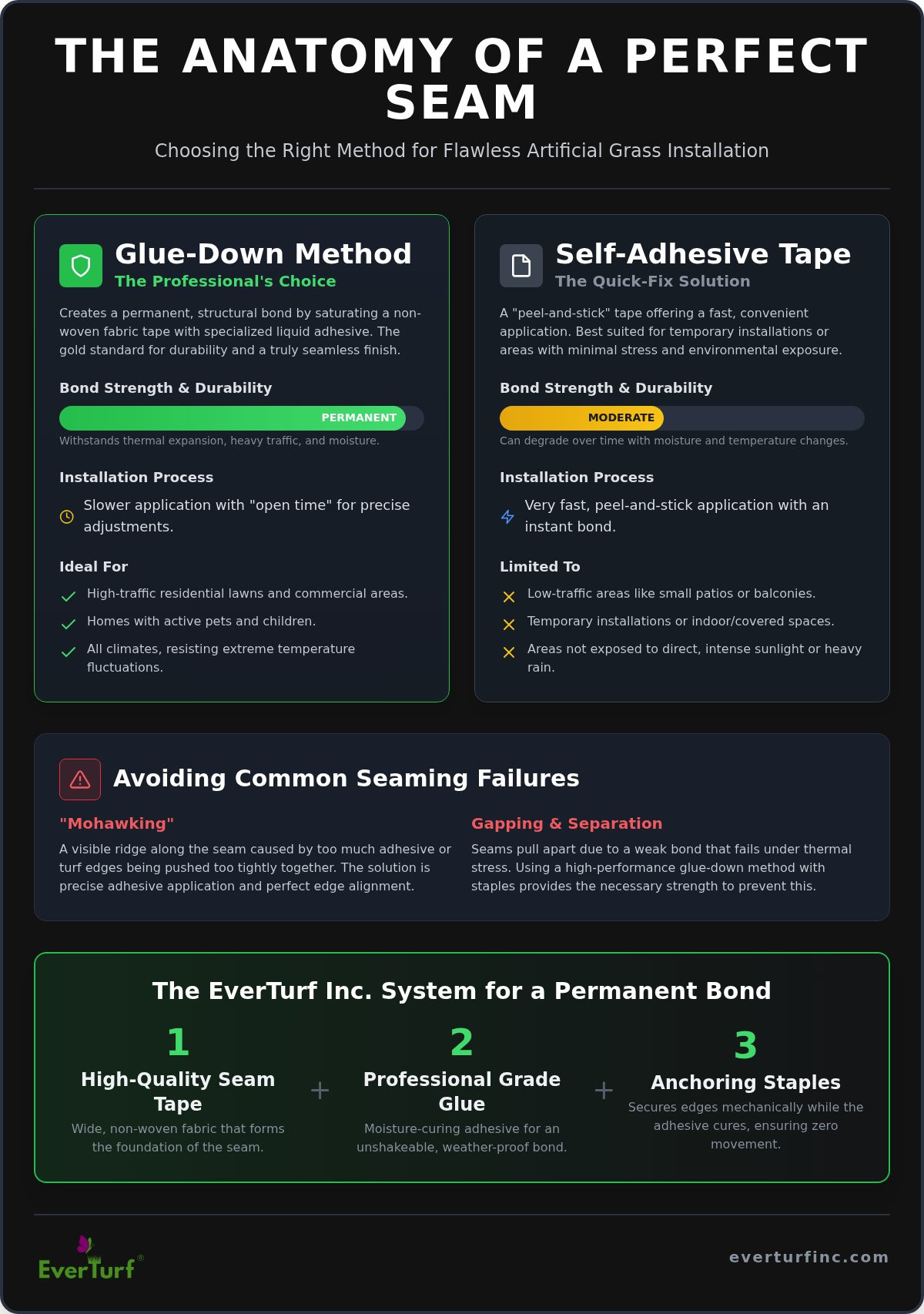
Choosing the right artificial grass seam tape is the defining factor between a lawn that looks flawless for a decade and one that begins to unravel after a single season. Homeowners often face a choice between the immediate convenience of self-adhesive tape and the long-term structural integrity of liquid adhesive systems. While peel-and-stick options offer a faster installation, they often lack the deep mechanical bond required to withstand environmental stressors. Liquid glue, when applied to high-quality seam cloth, saturates the fabric fibers. This creates a unified, hardened bridge that locks the turf rolls together, ensuring they move as one. This permanent connection moves you away from the frustration of constant repairs and toward the tranquility of a perfect outdoor space.
The Case for Professional Glue and Tape
For any permanent outdoor landscape, the professional “tape and glue” method is the gold standard. This approach uses specialized liquid adhesive, like EverTurf Staples and Glue, which is engineered to resist moisture and extreme temperature shifts. If you’re installing pet-friendly turf, this heavy-duty bond is non-negotiable. It prevents moisture and cleaning solutions from degrading the seam over time. One significant advantage is the “open time” that liquid glue provides. It allows you to make micro-adjustments to the turf edges before the bond sets, ensuring a perfectly flat finish. Using EverTurf Staples and Glue ensures your sanctuary remains pristine without the worry of shifting edges or visible gaps.
When to Use Peel-and-Stick Joining Tape
Self-adhesive tape has its place, but its utility is limited to specific scenarios. It’s an excellent choice for EverTurf Roof & Deck applications where applying liquid glue might be messy or unnecessary on a hard, flat surface. It also works well for temporary indoor mats or minor repairs in low-traffic areas. However, you should avoid using these products in high-heat or high-moisture environments. Competitors often claim peel-and-stick is a universal solution, but it frequently suffers from “edge lift” as the adhesive dries out or weakens under the sun. For a truly professional result that restores your personal time and provides long-term satisfaction, stick to professional-grade combinations for your main lawn areas. This logical choice provides the logical evidence needed to justify a premium investment in your home’s beauty.
How to Use Seam Tape for a Flawless, Professional Finish
Achieving a professional result requires moving beyond the “quick fix” mentality. Creating a seamless connection is a structured five-step process that demands both patience and precision. While some guides suggest simply pressing edges together, a true expert knows that the magic happens in the preparation. By following a benefit-forward workflow, you transform a standard installation into a masterpiece of landscape engineering. This methodical approach ensures your lawn remains a tranquil, flat surface that looks like a single, continuous carpet of green.
Step 1: Preparing the Edges and “Gauging” the Seam
Begin by meticulously trimming the “selvage,” which is the excess black backing found on the sides of your turf rolls. Use a sharp utility knife to perform a precise straight cut or a subtle “S-cut” between the stitch rows, ensuring you don’t clip the grass blades themselves. Once trimmed, align your rolls and check the grain of the grass. Grain direction refers to the consistent angle at which the turf blades lean, and aligning this across all rolls is the most critical factor for achieving complete seam invisibility. If the grains don’t match, the light will reflect differently on each side, making the seam obvious from every angle.
Step 2: Applying the Tape and EverTurf Glue
Fold back the edges of both turf rolls about 12 inches to keep the delicate blades far away from the adhesive. Position your artificial grass seam tape so it’s perfectly centered under the junction of the two rolls. Secure the ends of the tape with EverTurf Staples to prevent shifting during the glue application. Next, spread EverTurf Glue evenly across the tape using a notched trowel. Ensure the adhesive saturates the fabric fibers to create that essential mechanical bond. Be careful to avoid over-applying the glue; you want a consistent layer that won’t “bleed” up into the grass fibers when you close the gap.
Step 3: Closing and Weighting the Seam
Execute the “zipper” technique by slowly bringing the two turf edges together, working from one end of the seam to the other. It’s vital to follow the 1/8-inch rule: maintain a small gap between the backings to prevent them from bunching or overlapping. Once the edges are set, walk along the seam to press the backing firmly into the adhesive. Place heavy weights or sandbags along the length of the seam to ensure continuous contact while the bond cures. You must wait 24 hours before walking on the area or moving to the next phase, which we detail in our Essential Guide to Turf Infill. This period of rest is what guarantees a permanent and invisible result.
Troubleshooting Common Seaming Issues: From Gaps to “Mohawking”
Even with the highest quality materials, the transition from a construction project to a tranquil sanctuary can encounter minor hurdles. The most common fear for any homeowner is the sudden appearance of visible lines months after the project is finished. These imperfections often stem from subtle shifts in the environment or minor oversights during the bonding process. Understanding how to navigate these challenges ensures your lawn remains a source of pride rather than a maintenance headache. By mastering a few professional recovery techniques, you can maintain that “everlasting” look regardless of the terrain or climate.
One specific issue unique to synthetic turf is “Mohawking.” This occurs when the grass blades are accidentally trapped in the adhesive, causing them to stand up in a stiff, unnatural ridge that resembles a mohawk haircut. To fix this, you must gently comb the blades away from the seam using a stiff brush before the glue fully sets. For those working on sloped terrain or curved garden edges, gravity and tension are your primary opponents. On slopes, you should use additional EverTurf Staples to anchor the top of the roll, preventing it from sliding and pulling the artificial grass seam tape out of alignment. On curves, cutting the tape into smaller, overlapping segments allows it to follow the radius without bunching.
Why is my seam showing? Diagnosing the Gap
If a line becomes visible, you must first determine if you’re dealing with a physical gap or an optical one. A physical gap means the backings have actually moved apart, often because improper staple placement pulled the edges away from the center. An optical gap occurs when the turf grains aren’t perfectly aligned, creating a shadow that mimics a split. Temperature also plays a vital role; if you seam your turf during the peak heat of the day, the material is at its maximum expansion. As it cools at night, the rolls may shrink slightly, revealing a gap that wasn’t there during the installation hour. To ensure a permanent bond that resists these shifts, always rely on professional-grade installation accessories.
Fixing Adhesive Disasters
Accidents happen, but they don’t have to be permanent. If you notice glue on the tips of the grass blades, use a small amount of mineral spirits on a clean rag to dissolve the adhesive before it hardens. Avoid pouring the cleaner directly onto the turf, as it can damage the backing. If you discover “bubbles” or uneven sections beneath the surface, it usually indicates the tape wasn’t smoothed out or the adhesive was applied too thickly in one spot. Most seaming errors are reversible if caught before the glue cures. If a joint has already failed, follow this re-seaming checklist:
- Carefully pull up the failed edges and scrape away old, brittle adhesive.
- Clean the turf backing with a dry brush to remove debris.
- Trim a fraction of an inch off each edge to expose fresh, clean fibers.
- Lay down fresh artificial grass seam tape and re-apply adhesive.
Taking the time to correct these small details restores the professional-grade finish you envisioned for your property.
Beyond the Tape: Complete Installation Solutions for 2026
While mastering the application of artificial grass seam tape is a significant milestone, it’s essential to remember that seaming is just one component of a high-performance landscape. A truly successful project requires a holistic view of the entire Backyard Turf system. The synergy between your chosen turf, specialized EverTurf Staples and Glue, and premium infill creates a foundation that withstands the test of time. This integrated approach ensures your investment remains a tranquil, maintenance-free oasis for your family, moving you away from the stress of constant repairs toward long-term peace of mind.
Specialized projects require even greater attention to detail and higher-grade accessories. For example, creating an EverTurf Putting Green Pro requires superior seaming techniques to ensure a perfectly true ball roll. In these high-performance environments, the logical choice is to use tools engineered for the specific demands of the sport. Professional-grade accessories provide the logic needed to justify your investment, transforming a simple lawn into a functional lifestyle enhancer that adds tangible value to your property.
The EverTurf Advantage: Quality You Can Trust
Professional contractors across the country consistently prefer EverTurf Staples and Glue for commercial sports fields and residential projects alike. These accessories are engineered for high-performance bonding, offering a level of durability that standard retail products simply cannot match. By choosing a system designed for longevity, you adopt the mindset of a Reliable Visionary who values quality and personal time above all else. This commitment to excellence ensures that your outdoor space remains a beautiful, stress-free version of your property for years to come.
Next Steps for Your Project
To begin your transformation, you’ll need to accurately calculate the materials required for your specific layout. Measure the total linear feet of all seams to determine how much artificial grass seam tape you need, then factor in approximately one gallon of EverTurf Glue for every 30 to 40 feet of 6-inch tape. This precision planning prevents mid-project delays and keeps your installation organized. If you’re still in the budgeting phase, we invite you to view our Turf Installation Cost Guide for comprehensive pricing insights. When you’re ready to secure a permanent result, Explore EverTurf Installation Accessories to find the professional tools your project deserves.
Step Into Your Flawless Outdoor Future
Your journey toward a stress-free, beautiful outdoor space depends on the invisible details that hold it together. By mastering the selection and application of artificial grass seam tape, you’ve moved away from the frustration of visible lines toward a professional-grade finish. You now understand that the synergy of proper grain alignment and the robust “tape and glue” method creates a bond that lasts for years. This isn’t just about a lawn; it’s about reclaiming your personal time in a sanctuary that remains pristine regardless of the weather or foot traffic.
Achieving these results requires tools that match your high standards. Our accessories are trusted by professional sports field installers and provide weather-resistant bonding for all US climates. These products are specifically engineered for invisible seams, ensuring your property looks like a single, cohesive masterpiece. Don’t settle for temporary fixes when a permanent solution is within reach. Secure Your Lawn with Professional EverTurf Staples and Glue today. Embrace the tranquility of a perfectly executed landscape and enjoy the long-term satisfaction of a home transformed.
Frequently Asked Questions
Do I really need artificial grass seam tape, or can I just use staples?
You absolutely need seam tape to create a unified structural bridge between your turf rolls. While staples are excellent for anchoring the perimeter, they cannot prevent the edges of two rolls from shifting or gapping during seasonal temperature changes. Professional-grade artificial grass seam tape provides the wide surface area necessary for adhesive to create a permanent, mechanical bond. This combination ensures your lawn remains a flat, tranquil sanctuary rather than a collection of loose pieces.
How long does artificial grass seam tape last in extreme weather?
High-quality seam tape is designed to last the entire lifespan of your synthetic lawn, typically 15 to 20 years. Because professional tapes are constructed from non-woven PET fibers, they resist rot and degradation even in high-moisture or high-heat US climates. When paired with EverTurf Glue, the bond remains flexible enough to manage the natural expansion of the turf backing during summer peaks and winter freezes, ensuring your investment stays secure for the long term.
Can I use regular duct tape or outdoor carpet tape instead?
You should never use duct tape or standard outdoor carpet tape for a permanent turf installation. These household adhesives are not engineered to withstand the moisture, UV exposure, and soil chemistry found in an outdoor environment. Most residential carpet tapes are only a few inches wide, which provides insufficient surface area for a secure bond. Professional artificial grass seam tape is 6 to 12 inches wide, offering the structural integrity needed to prevent edges from lifting.
How much seam tape do I need for a standard 15×20 lawn?
For a standard 15×20 lawn, the amount of tape depends on the width of your turf rolls, which are typically 15 feet wide. If you lay two 15-foot sections side-by-side to cover the 20-foot width, you would need at least 20 linear feet of tape for that single longitudinal seam. We always recommend purchasing an extra 10 percent to account for trimming and edge adjustments, ensuring you have enough material to complete the project without interruption.
Is the tape waterproof, and will it affect drainage?
Professional seaming systems are completely waterproof once cured, protecting the bond from rain and irrigation. While the tape itself is a solid fabric bridge, it does not negatively affect the overall drainage of your lawn. Since seaming only occurs at the junctions of the rolls, the vast majority of your turf’s perforated backing remains open to the sub-base. This allows water to flow freely through the system, maintaining the tranquility and cleanliness of your space.
What happens if the seam tape gets wet before the glue dries?
If your seam tape or adhesive gets wet before the 24-hour curing process is complete, the bond integrity may be compromised. Moisture can cause the glue to foam or prevent it from properly saturating the fabric fibers, leading to a weak joint that may lift later. It’s vital to check the local weather forecast and ensure at least one full day of dry conditions. If rain is imminent, cover the seams with plastic sheeting to protect your work.
Can I use seam tape on concrete or wood surfaces for a roof deck?
You can certainly use seam tape on hard surfaces like concrete or wood, making it ideal for EverTurf Roof & Deck applications. In these scenarios, self-adhesive tapes are often preferred because they provide a clean, low-mess solution on stable, flat substrates where liquid glue might be difficult to manage. This allows you to transform balconies into lush, green escapes without the logistical challenges of a traditional ground-based installation, restoring your personal time and enhancing your lifestyle.
How do I hide the seam on a professional putting green?
Hiding seams on a professional putting green requires extreme precision and the use of the “S-cut” method. For specialized projects like EverTurf Putting Green Pro, ensure you trim the backing as close to the stitch row as possible without damaging the fibers. Using a wider 12-inch tape provides a more stable foundation, preventing the ball from “jumping” as it crosses the seam. This level of detail ensures a true roll and an aesthetic that rivals any country club.