
How to Spot Low-Quality Artificial Turf: The Homeowner’s 2026 Guide to Quality
What if the lush, green bargain you’re considering today is actually a toxic liability that will degrade into a matted mess in less than three years? It’s natural to feel a sense of hesitation when faced with a sea of synthetic grass samples that all look identical on the surface. You want a tranquil, year-round sanctuary for your family, yet the fear of wasting thousands on a product that traps heat or emits chemical odors is a significant concern. Learning how to spot low-quality artificial turf is no longer just about the “feel” of the blades; it’s about understanding the engineering that ensures your investment remains beautiful well into the 2040s.
We agree that your home deserves a solution that restores your personal time rather than adding to your chores. This guide promises to strip away the marketing jargon to reveal the specific physical red flags and technical metrics that separate EverTurf professional-grade solutions from cheap imitations. We’ll explore the critical new ASTM F3782-26 PFAS testing standards, explain why polyurethane backing is the non-negotiable gold standard for our local climate, and provide a clear framework to evaluate samples with total confidence. You’re about to discover how to choose a landscape that offers long-term relief and lasting aesthetic grace.
Key Takeaways
- Identify the “false economy” of bargain synthetic grass where initial savings frequently lead to a costly total replacement in just a few short years.
- Learn how to spot low-quality artificial turf by inspecting yarn shapes and backing fusion to ensure your lawn maintains its upright, lush appearance.
- Decode technical metrics like face weight and stitch density to accurately measure the volume and durability of the synthetic fibers in your samples.
- Master two quick at-home tests to reveal hidden manufacturing weaknesses, giving you the confidence to choose a product built for a 15-year lifespan.
- Understand why professional-grade EverTurf Artificial grass outlasts retail alternatives by prioritizing molecular engineering and UV resistance.
The Hidden Risks of Bargain Synthetic Grass
Low-quality turf often masquerades as a bargain, but it frequently lacks the essential UV stabilizers and structural integrity required to withstand the local climate. When you investigate how to spot low-quality artificial turf, the first sign is often a lack of fiber memory. This leads to “matting,” where the blades stay flat and lifeless after minimal foot traffic. Instead of a vibrant landscape, you are left with a dull, plastic sheet that fails to replicate the natural beauty of a living lawn.
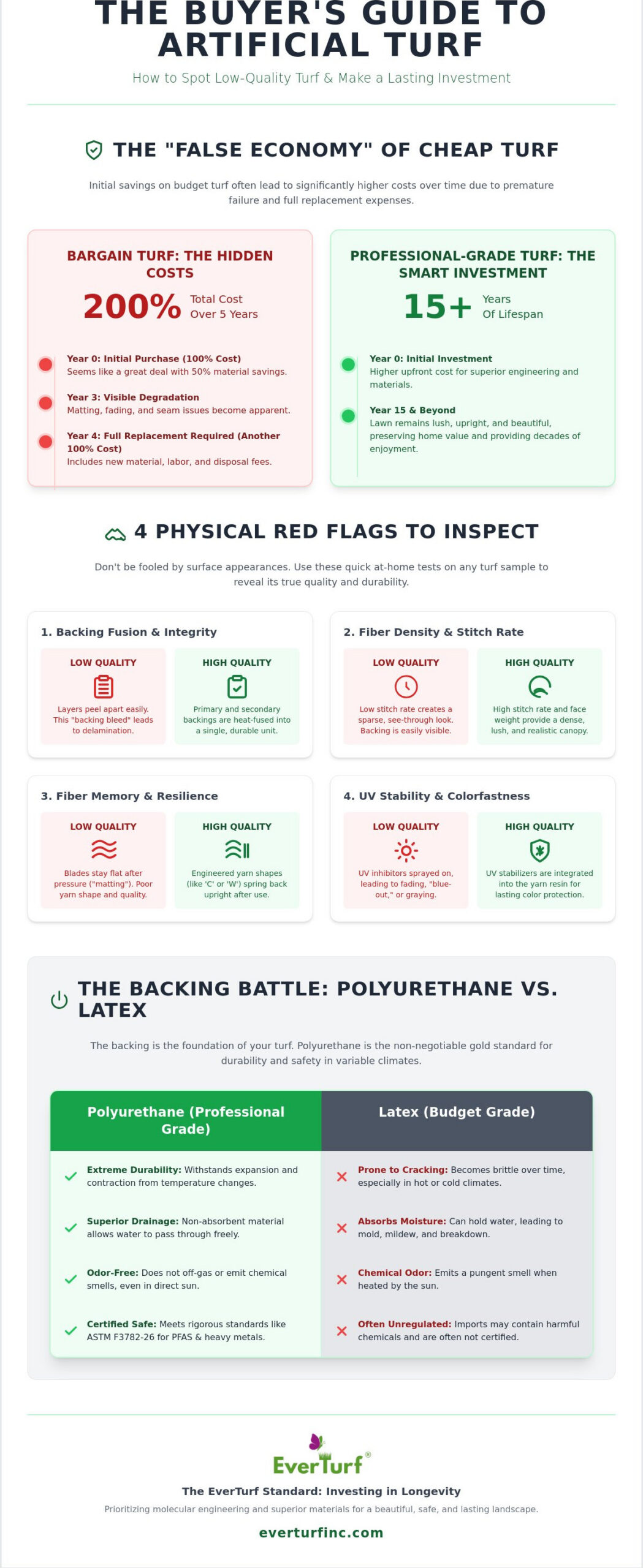
Many homeowners fall into the “False Economy” trap. They see a 50% savings on material and assume they’ve found a deal. However, when a product fails in four years instead of twenty, the total replacement cost often reaches 200% of the original quote. This includes the price of new materials, secondary labor costs, and disposal fees for the old material. Artificial turf is a significant property investment; choosing a product that breaks down into microplastics within a few seasons compromises both your backyard tranquility and the environment. High-performance engineering is what ensures your lawn remains an asset rather than a liability.
Why “Cheap” Often Costs More in the Long Run
Installation is a labor-intensive process. You are paying for professional excavation, base preparation, and precision seam work. If the turf fails, you pay for that labor all over again. Understanding cheap artificial turf risks helps you protect your property’s resale value. A matted, faded lawn is an eyesore that potential buyers view as a renovation project rather than a luxury feature. Premium products ensure your outdoor space remains a stress-free sanctuary for decades, preserving both your time and your home’s equity.
Health and Safety Concerns with Unregulated Imports
Safety is paramount for families and pets. Low-end imports may contain heavy metals or PFAS, which are “forever chemicals” that pose long-term health risks. As of May 2026, the new ASTM F3782-26 standard provides a method for testing these substances, yet many discount retailers still stock non-certified products. Beyond chemical composition, cheap latex backings often “off-gas” in the sun. This creates a pungent, chemical odor that ruins the experience of your outdoor living area. High-standard, certified products ensure your lawn is safe for play and free from the unpleasant scents of industrial manufacturing. Knowing how to spot low-quality artificial turf means looking past the green surface to the chemical safety of the components underneath.
Four Physical Red Flags: Inspecting the Yarn and Backing
Understanding how to spot low-quality artificial turf starts with a physical inspection of the sample in your hand. While many products look identical from a distance, manufacturing shortcuts become obvious once you look closer at the structural components. High-quality synthetic grass is a feat of engineering, whereas budget alternatives often rely on outdated techniques that compromise the lifespan of your landscape.
Check for what industry experts call “backing bleed.” Professional-grade turf features a primary and secondary backing that are fused together through a rigorous heating process. If you can easily peel the layers apart or see adhesive dripping unevenly, the product is prone to failure. Quality is often invisible, particularly regarding UV stabilization. UV inhibitors must be integrated into the resin during the extrusion process rather than sprayed on afterward. This prevents the “blue-out” effect or premature graying that plagues cheap imports. Following the Synthetic Turf Council Performance Guidelines ensures the product has undergone standardized testing for colorfastness and weathering.
Examine the back of the turf to count the stitches. A low stitch rate creates a sparse, carpet-like appearance because there aren’t enough fibers to cover the backing. Professional-grade turf uses a high stitch rate to provide a dense, lush canopy that mimics the complexity of natural sod. Learning how to spot low-quality artificial turf involves recognizing that density is a primary driver of both aesthetics and long-term resilience.
The Backing Battle: Latex vs. Polyurethane
Latex was once the industry standard, but it’s prone to crumbling and moisture absorption. In areas with high humidity or extreme temperature swings, latex backings often suffer from delamination. Delamination is the separation of turf fibers from the backing material due to adhesive failure. Transitioning to a polyurethane backing offers superior drainage and long-term durability. It remains flexible and intact regardless of the weather. If you want a lawn that stands the test of time, you can explore our high-performance turf options that prioritize these advanced materials.
Yarn Integrity and “Fiber Memory”
The choice of plastic matters. Polypropylene is a brittle, inexpensive polymer often used in low-end products. It lacks “fiber memory,” meaning it stays flat once stepped on. Premium EverTurf Artificial grass utilizes Polyethylene, which is soft to the touch yet remarkably resilient. Look for specific blade shapes. Flat fibers are cheap to manufacture but offer zero structural support. Advanced “W,” “C,” or “S” shaped fibers act like tiny springs, helping the blades bounce back after use. This integrity is further supported by the “thatch,” which are the curly tan or green fibers nestled at the base. Thatch isn’t just for realism; it provides a supportive cushion that keeps the primary blades standing upright.
Decoding Performance Metrics: Face Weight vs. Density
Relying solely on visual appeal can be a costly mistake when evaluating synthetic grass samples. To master how to spot low-quality artificial turf, you must look past the surface and analyze the technical specifications provided by the manufacturer. Two of the most misunderstood metrics are face weight and density. Face weight refers to the total weight of the yarn per square yard, excluding the weight of the backing material. While a higher face weight often suggests a premium product, it is only half of the story.
Density measures how closely the individual fibers are stitched together. Some manufacturers “cheat” the system by using exceptionally thick, heavy blades while maintaining a low stitch count. This allows them to market a high face weight while producing a sparse, “see-through” lawn that lacks structural integrity. A truly high-quality lawn balances a substantial face weight with high density, ensuring the blades support one another and maintain a lush, upright appearance over decades of use. Don’t be fooled by the “Hand-Feel” fallacy; while extreme softness is pleasant to the touch, it often indicates a thin yarn that lacks the resilience needed for high-traffic areas. Durable fibers require a specific molecular thickness to resist flattening.
Drainage Rates and Permeability
Drainage is arguably the most critical performance factor for pet owners and those in high-rainfall regions. Low-quality turf often utilizes “hole-punched” latex backing, which relies on small, spaced-out perforations to let water pass through. These holes can easily clog with debris or pet waste, leading to ammonia buildup and unpleasant odors. Modern, professional-grade systems utilize 100% permeable backings that allow water to flow through every square inch of the material. This rapid drainage is further enhanced by your choice of components; you can learn more about why your synthetic lawn needs it in our guide to high-quality infill systems. Proper drainage ensures your outdoor space remains fresh and usable immediately after a storm.
The Role of Denier and Dtex
To understand the longevity of your investment, you must evaluate the Dtex or Denier of the yarn. These textile terms measure the linear mass of the fibers, essentially telling you how thick and robust each individual blade is. A higher Dtex is non-negotiable for high-impact applications like EverTurf Sports Fields, where the yarn must withstand constant friction and pressure. Low-quality fibers with a low Dtex are prone to “fibrillation,” a process where the yarn ends prematurely split and fray, giving the grass a fuzzy, worn-out appearance within just a few years. Consulting the Synthetic Turf Council’s installation guidelines can help you verify that your chosen product meets the rigorous standards required for your specific lifestyle needs. Investing in superior yarn thickness is the only way to guarantee a permanent, stress-free landscape.
The 5-Minute Quality Test: Evaluating Samples at Home
Technical data sheets provide a logical foundation, but physical evidence remains the most reliable way to verify a product’s integrity. You don’t need a laboratory to identify how to spot low-quality artificial turf; you just need five minutes and a critical eye. By performing these simple DIY tests on your samples, you can bypass marketing claims and see exactly how the material will perform in your backyard over the next decade.
- The Pull Test: Grip a single blade of grass and give it a firm tug. If the fiber slides out of the backing with minimal effort, the tuft bind is insufficient. This indicates a high risk of shedding and premature thinning in high-traffic areas.
- The Fold Test: Bend the sample in half with the grass side facing out. If you can easily see the black or gray backing through the yarn, the stitch density is too low. A quality product remains lush and opaque even when flexed.
- The Scuff Test: Use your thumb to vigorously rub the tips of the fibers back and forth. Low-quality yarn will start to fray or “fuzz” almost immediately. Premium fibers remain smooth and intact despite friction.
- The Sun Test: Place your sample on a dark surface in direct sunlight for an hour. Check for excessive heat retention or a strong chemical smell. High-performance turf is engineered to remain virtually odorless and manage surface temperatures effectively.
- The Water Test: Pour a cup of water directly onto the backing. If the water beads up or takes more than a few seconds to penetrate, the drainage system is inadequate for pets or heavy rain.
Taking the time to physically challenge your samples ensures you won’t be surprised by a failing lawn three years from now. If you want to see the difference for yourself, you can request a premium sample kit and compare our high-integrity materials against any retail alternative.
Visual Inspection: Color and Sheen
Authentic beauty is found in the details. Cheap synthetic grass often has a distinct, mirror-like shine that makes the lawn look like green plastic wrap. This occurs when manufacturers use low-grade resins that reflect too much light. High-quality monofilament yarn features a researcher-grade matte finish and multi-tonal blades that incorporate various shades of green and tan. This complexity mimics the natural imperfections of real sod, providing a sophisticated aesthetic that enhances your property’s curb appeal rather than detracting from it. For those looking to maximize their home’s market value, Elam Real Estate notes that premium landscaping is a key factor in attracting discerning buyers.
The Odor and Texture Check
The sensory experience of your lawn should be one of comfort and tranquility. Low-end products often have a high “prickle factor,” meaning the blades feel abrasive or scratchy against the skin. This is a common trait of Polypropylene. In contrast, premium Polyethylene is soft enough for bare feet and paws. A high-quality turf sample should return to its original shape immediately after being compressed by a heavy object. This resilience ensures your landscape maintains its inviting, manicured look without the need for constant grooming or maintenance.
Investing in Longevity: The EverTurf Standard
EverTurf Inc doesn’t just sell products; we curate environments designed for long-term satisfaction. While learning how to spot low-quality artificial turf helps you avoid immediate disasters, choosing a professional-grade partner ensures your vision becomes a permanent reality. Big Box retailers often prioritize volume over value, stocking generic products that fail to address the specific environmental stresses of our local climate. In contrast, EverTurf Artificial grass is selected based on rigorous engineering standards that exceed retail expectations for UV resistance and structural memory.
Our commitment to your family’s well-being means every product in our catalog is 100% lead-free and non-toxic. We understand that a beautiful lawn is only successful if it’s also a safe sanctuary. This dedication to quality extends to the invisible components of your installation. Using premium EverTurf Infill and high-strength, weather-resistant adhesives ensures your turf stays secure and drains efficiently for the next two decades. When you understand how to spot low-quality artificial turf, you realize that the system is only as strong as its weakest component, from the staples to the glue.
Engineered for Specific Lifestyles
Every property has a unique rhythm, and your turf should reflect that. For the golf enthusiast, EverTurf Putting Green Pro delivers a professional-grade ball roll that rivals the most exclusive courses. Families with active children often choose EverTurf Play, which is specifically engineered to meet playground safety standards and provide a soft landing for every adventure. Pet owners find lasting relief with our specialized artificial grass for dogs, featuring antimicrobial properties and rapid-flow drainage that eliminates the frustrations of traditional pet areas.
The Reliable Visionary Approach
We believe the transition to a low-maintenance lifestyle should be an inspiring and stress-free journey. Our team acts as a Reliable Visionary, guiding you through a consultative process that focuses on your daily needs rather than just a price point. We help you understand why a premium investment provides a superior long-term ROI, and our comprehensive warranty serves as a testament to the durability of our molecular engineering. When you know the technical red flags of cheap imports, the superiority of a professionally installed system becomes obvious. It’s time to reclaim your weekends and enjoy the tranquility of a perfect, year-round outdoor space.
Explore our full range of high-performance turf solutions and discover the difference that quality makes for your home.
Secure Your Forever Landscape
Choosing the right synthetic grass is an investment in your home’s beauty and your own peace of mind. By prioritizing polyurethane backings and resilient yarn shapes over cheap, flat fibers, you ensure your outdoor sanctuary remains lush for decades. You’ve learned that true quality is found in the molecular engineering of the blades and the permeability of the backing system rather than just the initial price tag. Understanding how to spot low-quality artificial turf empowers you to reject the “false economy” of bargain imports and choose a solution that restores your personal time.
As a national leader in high-performance synthetic solutions, EverTurf Inc provides everything from professional-grade EverTurf Putting Green Pro to specialized non-toxic, pet-friendly turf systems. We believe every homeowner deserves a stress-free, year-round lawn that is safe for the whole family. Upgrade to Professional-Grade Turf Today and take the first step toward a more beautiful version of your property. Your perfect, maintenance-free environment is closer than you think.
Frequently Asked Questions
Is cheap artificial turf safe for pets and children?
Cheap turf often poses health risks because it lacks the rigorous testing required for modern safety standards. Many unregulated imports contain lead or PFAS, which are “forever chemicals” that shouldn’t be near your family. Professional-grade solutions are certified non-toxic and lead-free. Choosing a high-standard product ensures your lawn remains a healthy, stress-free sanctuary for your children and pets to enjoy for years.
How long does low-quality artificial grass actually last?
Low-quality synthetic grass typically begins to fail within three to five years. You’ll notice the fibers becoming brittle and the color fading into a dull gray or blue. In contrast, premium systems are engineered to maintain their structural integrity for 15 to 20 years. Investing in quality today prevents the frustration and expense of a total yard replacement just a few seasons down the road.
Why does some artificial turf smell like chemicals in the sun?
That chemical odor is often the result of “off-gassing” from inexpensive latex backings and low-grade resins. When these materials heat up in the sun, they release volatile organic compounds that create a pungent scent. Understanding how to spot low-quality artificial turf means looking for polyurethane backings. These superior materials are virtually odorless and remain stable even during the hottest summer afternoons, protecting your outdoor tranquility.
What is the most important metric to look for on a turf spec sheet?
Density is the most critical metric because it determines the lushness and resilience of the lawn. While many focus on face weight, a high weight with low density results in a sparse, carpet-like look. You want a high stitch rate that allows the fibers to support each other. This balance ensures your landscape looks natural and resists flattening under foot traffic, providing a better long-term return on your investment.
Can I install low-quality turf myself to save money?
You can attempt a DIY installation, but pairing low-quality material with amateur labor often leads to a “false economy.” The base preparation and seam work are identical regardless of the turf quality. If the material fails in three years, you’ve wasted your time and the cost of the base materials. It’s more efficient to install a high-performance product once and enjoy a permanent, worry-free result.
Does high-quality artificial turf get as hot as cheap turf?
High-quality turf remains noticeably cooler due to advanced cooling technology and blade geometry. Premium fibers often incorporate heat-reflective pigments that lower surface temperatures compared to standard green plastic. Additionally, shapes like “W” or “S” blades allow for better airflow and less direct surface contact. This engineering makes your outdoor space much more comfortable for bare feet and paws even during peak daylight hours in the summer.
How can I tell if a turf company is selling me a low-end product?
A company selling low-end products often hides behind vague marketing terms rather than providing technical spec sheets. Ask for their ASTM F3782-26 certification for PFAS testing and check the backing material. If they can’t confirm a polyurethane backing or explain the “tuft bind” rating, they’re likely offering a budget import. Knowing how to spot low-quality artificial turf helps you demand the transparency you deserve before making a premium investment.
What is the “tuft bind” and why does it matter for quality?
Tuft bind refers to the amount of force needed to pull a single grass blade out of the backing material. It’s a vital measure of durability and manufacturing excellence. A weak tuft bind leads to shedding, especially if you have active dogs or high foot traffic. High-quality turf uses a robust secondary backing to lock fibers in place, ensuring your lawn stays thick and full for its entire 15-year lifespan.