


How to Lay Imitation Grass: The 2026 Professional Installation Guide
What if you could reclaim the 70 hours a year the average homeowner spends on lawn maintenance and spend them enjoying a pristine, evergreen sanctuary instead? Mastering how to lay imitation grass is about more than just aesthetics; it’s about creating a permanent, high-performance space that withstands the 50 inches of annual rainfall common in regions like Florida. You likely want a vibrant yard but worry that visible seams or poor drainage might ruin the investment. It’s a common concern, especially when the variety of base materials feels confusing and overwhelming.
We agree that your outdoor space should be a source of tranquility, not a list of chores or a muddy path for paws. This 2026 professional guide promises to help you achieve a perfectly flat, lush result with professional-looking invisible seams. We’ll walk through the exact step-by-step process, from preparing a superior drainage foundation to the final brush that brings your evergreen vision to life. Get ready to transform your property into a worry-free masterpiece where you can finally relax and enjoy your weekends.
Key Takeaways
- Treat your installation as a sophisticated multi-layered system to build a stable foundation that prevents sinking and ripples for years to come.
- Master the technical nuances of how to lay imitation grass by optimizing sub-base drainage and calculating the perfect aggregate volume for your specific site.
- Discover the “Resting Period” rule and professional positioning techniques that ensure your vibrant, UV-stabilized turf looks flawlessly natural from the moment it’s secured.
- Eliminate visible seams using the advanced “S-Cut” method to create a smooth, evergreen expanse that remains indistinguishable from natural grass.
- Learn why specialized infill acts as the essential ballast for your lawn, maintaining structural integrity while finally allowing you to reclaim your weekends for relaxation.
Preparing for Your Installation: Tools and Site Assessment
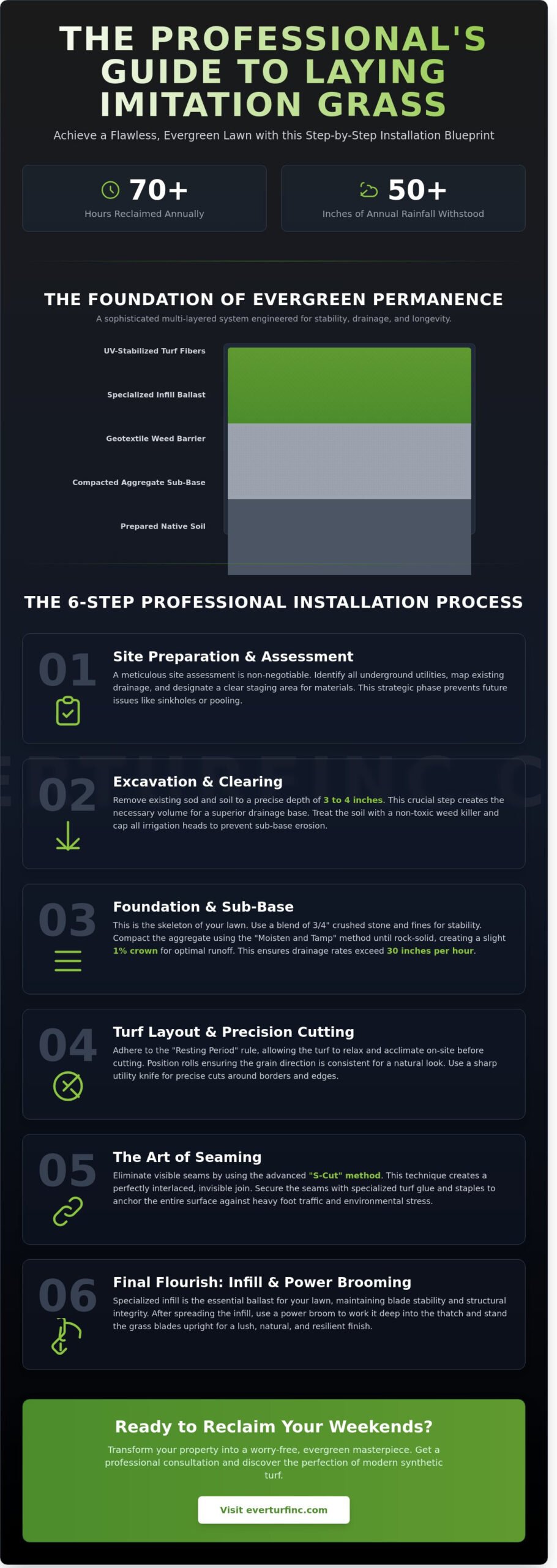
Achieving a pristine, year-round lawn starts with shifting your perspective. Learning how to lay imitation grass isn’t just about covering a surface; it’s about engineering a multi-layered landscape system designed for “Evergreen Permanence.” This approach ensures your investment withstands the 50-plus inches of annual rainfall common in Florida while maintaining its lush, vibrant aesthetic. Before moving the first shovel of dirt, consult a comprehensive overview of artificial turf to understand the technology behind modern fibers and drainage backings.
Success depends on a meticulous site assessment. You must identify underground utilities and map out existing drainage patterns to prevent future sinkholes or pooling. Reclaiming your weekends starts with this strategic planning phase. By designating a clear staging area for materials and selecting a turf variety specifically tailored to your lifestyle, whether it’s antimicrobial for pets or high-density for play areas, you set the stage for a stress-free transformation.
The Professional Installer’s Toolkit
Professional results require professional hardware. You’ll need a motorized turf cutter to remove old sod cleanly and a vibrating plate compactor to create a rock-solid sub-base. A sharp utility knife with a box of fresh blades is essential for precision trimming around curved borders. For the structural integrity of the seams, utilize specialized EverTurf Staples and Glue. These accessories ensure your lawn remains anchored against heavy foot traffic and tropical winds. Finally, the power broom is the secret weapon of the trade; it stands the blades upright and works the infill deep into the thatch for a natural, healthy appearance.
Excavation and Clearing the Canvas
Creating a stable foundation is the most labor-intensive part of learning how to lay imitation grass. You must remove existing grass and soil to a precise depth of 3 to 4 inches. This creates the necessary volume for the crushed stone base that facilitates superior drainage. Once the area is clear, treat the exposed soil with a non-toxic weed killer to stop stubborn growth from compromising the backing. Don’t forget to address your irrigation system. Cap off or relocate existing sprinkler heads to prevent moisture from building up under the turf layers, which can lead to odors or sub-base erosion over time.
Building the Foundation: Sub-Base and Drainage Optimization
Think of your sub-base as the skeleton of your landscape. Without a rigid, well-engineered frame, even the highest-quality turf will eventually succumb to unsightly ripples or localized sinking. When you’re learning how to lay imitation grass, the preparation phase dictates whether your investment lasts 5 years or 25 years. A solid foundation ensures your fake lawn remains pristine and level, even under heavy foot traffic or the intense tropical downpours common in Florida.
To achieve a stable 3-inch base, you’ll need to calculate your aggregate volume precisely. Multiply your total square footage by 0.25 (the decimal equivalent of 3 inches) and divide by 27 to find the required cubic yards. For a standard 800-square-foot area, this equates to roughly 7.4 cubic yards of material. Superior drainage is equally vital; a porous sub-base allows water to migrate away from the surface at a rate exceeding 30 inches per hour. This speed effectively eliminates standing water and neutralizes pet odors by flushing away uric acid before it can settle.
Aggregate Selection and Compaction
Skip the common mistake of using just sand or dirt. A professional-grade base requires a blend of 3/4″ crushed stone for structural stability and “fines,” such as decomposed granite, to fill the microscopic voids. Once you’ve spread the stone, use the “Moisten and Tamp” method. Lightly spray the aggregate with water and run a plate compactor in overlapping passes until the surface is rock-hard. For the best results, create a 1% “crown” or a very slight rise in the center of the lawn. This subtle grading directs natural runoff toward your perimeter drains rather than letting it pool.
Weed Suppression and Geotextile Layers
Protection starts from the ground up. In regions with aggressive native grasses or nutgrass, place a heavy-duty geotextile weed barrier directly over the excavated soil before you add your aggregate. If you’re following step-by-step instructions for laying turf, you’ll know that overlapping seams by at least 6 inches is non-negotiable to prevent breakthrough. Secure the fabric with 6-inch landscape staples every 3 feet. This layer must stay taut so it doesn’t shift or bunch when you’re finalizing how to lay imitation grass on top. If you’re ready to reclaim your weekends from the endless cycle of weeding and mowing, connect with our specialists to plan your permanent sanctuary.
Mastering the Layout: Positioning and Precision Cutting
Transitioning from the foundational work to the aesthetic phase is the most rewarding part of learning how to lay imitation grass. You’ve spent hours perfecting the sub-base; now you must protect that investment. Turf rolls are deceptively heavy, often weighing up to 0.8 pounds per square foot. Never drag these rolls across your leveled aggregate. Doing so creates ruts and depressions that will show through the final surface. Instead, use a carpet dolly or a team of three people to lift and place the material exactly where it needs to be. This precision preserves the integrity of your hard work.
Once the rolls are positioned, you must observe the “Resting Period” rule. Synthetic fibers are compressed under high pressure during shipping and storage. Before you secure anything, let the turf for grass sit in the sun for 2 to 4 hours. This window allows the backing to become pliable and the blades to stand upright. It also lets the material expand and contract to its natural state. If you skip this step, you risk the lawn buckling or shifting weeks after the installation is complete.
Visualize the final result from every corner of your yard. Walk to your patio, your kitchen window, and your side gate. You want the landscape to look natural from every vantage point. Professional installers follow a strict “measure twice, cut once” philosophy. Mistakes in cutting can lead to a 15% increase in material waste, which is an expensive error to correct. Take your time to ensure the fit is snug but not forced.
The Golden Rule of Pile Direction
Every roll of synthetic turf has a “grain” or “pile” where the fibers lean in a specific direction. Identifying this is the secret to a professional finish. You should always face the pile toward the primary viewpoint of the property, which is typically the back patio or the main house windows. When the pile leans toward the viewer, the grass looks lush, deep, and vibrant. If it leans away, the surface can appear shiny or reflective. Ensure every roll on your project faces the same way. A single roll facing the wrong direction creates a permanent “patchwork” look that no amount of brushing can fix.
Precision Trimming and Perimeter Fitting
Clean edges separate a DIY project from a professional masterpiece. Use the “Finger-Gap” technique by leaving a 5mm gap between the edge of the turf and your hardscape or border. This small space allows you to tuck the turf edge down into the perimeter for a clean, hidden finish. When you start how to lay imitation grass projects, always cut from the back of the turf. Cutting through the black latex grid ensures you don’t shear the grass blades, which keeps the edges looking full and natural.
- Use a fresh utility blade every 10 to 12 feet to maintain a sharp, clean slice.
- Follow the stitch rows on the back of the carpet to keep your straight lines perfect.
- For complex obstacles like trees or EverTurf Pavers, make small relief cuts from the center outward to help the backing conform to the curve.
Precision here ensures your lawn remains a maintenance-free sanctuary for years. By focusing on these technical details, you reclaim your weekends and enjoy a pristine view every single day.
The Art of Seaming: Securing for a Seamless Finish
The most common fear among homeowners is the “seam line,” that telltale mark where two rolls of turf meet. A flawless lawn should look like a single, continuous carpet of verdant growth. When mastering how to lay imitation grass, achieving this requires moving beyond basic alignment. Professional installers utilize the “S-Cut” or “Zig-Zag” method to break up straight visual lines. By cutting the edges in a gentle wave rather than a straight line, you disrupt the eye’s ability to track the joint. This creates an organic transition that mimics natural sod and prevents the unsightly “mohawk” effect where blades lean against each other.
Environmental factors play a massive role in the success of your installation. When you are learning how to lay imitation grass in high-humidity regions, you must account for moisture levels. Adhesives require specific temperature windows, typically between 60 and 90 degrees Fahrenheit, to cure correctly. If the humidity exceeds 85%, the glue may fail to bond deeply into the turf backing. This technical precision is a hallmark of the standards set by a leading artificial grass company, ensuring your investment doesn’t shift or lift during the first heavy summer rain.
Invisible Seams: Tape and Adhesive Application
Once your edges are trimmed, fold them back about 12 inches to reveal the sub-base. Lay your seam tape centered between the two pieces. Apply EverTurf adhesive in a “serpentine” or S-shaped pattern across the tape to ensure total coverage. As you lay the turf back down, use the “Comb-Over” technique. Gently pull the grass blades away from the seam with your fingers to ensure no fibers get trapped in the glue. Finally, run a 75-pound weighted roller over the seam to fuse the backing to the tape. This ensures a permanent bond that remains flat even under heavy foot traffic or pet play.
Anchoring the Perimeter
Stability starts at the edges. Secure the perimeter by driving EverTurf Staples every 6 inches along the outer boundary and every 12 inches throughout the center to prevent “turf creep” over time. Don’t drive the staples straight down. Instead, hammer them at a 45-degree angle pointing away from the seam. This technique allows the staple to “catch” the mesh backing more effectively while hiding the green-coated head beneath the lush blades. For transitions to hardscapes like concrete or bender board, use a specialized masonry adhesive or tuck the turf into a 1-inch deep trench for a clean, tucked finish that looks integrated into your landscape.
Ready to transform your lawn into a maintenance-free sanctuary and reclaim your weekends? Contact EverTurf today to start your project with the experts.
The Final Flourish: Infill and Long-Term Maintenance
Many homeowners believe the hard work ends once the turf is rolled out. However, the most misunderstood stage of how to lay imitation grass involves the infill. This isn’t just a finishing touch; it functions as the structural ballast of your lawn. Without proper infill, your turf behaves like a loose carpet, shifting and wrinkling as temperatures fluctuate. In the intense Florida sun, synthetic fibers can expand and contract. Infill provides the necessary weight to keep the backing pinned securely to the aggregate base. Beyond stability, these tiny granules act as a support system, holding each individual blade upright to ensure your lawn retains its lush, vibrant aesthetic for years to come.
Why EverTurf Infill is Non-Negotiable
Choosing a high-performance product like EverTurf Infill transforms a standard installation into a professional-grade sanctuary. This specific infill features advanced cooling technology that can reduce surface temperatures by up to 20 percent, a critical factor during July heatwaves. Its antimicrobial properties also prevent the growth of bacteria and mold. To apply it correctly, use a drop spreader to achieve a uniform distribution of 1.5 to 2 lbs per square foot. Finish the process with a power brush, working against the grain to lock the granules at the base of the fibers. This technique ensures the blades stand tall and the infill remains invisible.
Reclaiming Your Weekends: Routine Maintenance
The true beauty of a synthetic lawn lies in the time you get back. You’ve mastered how to lay imitation grass, and now you can enjoy the results with minimal effort. A quick weekly rinse removes dust and pollen, keeping the colors pristine. Once a month, use a stiff synthetic broom to cross-brush high-traffic areas, which prevents the fibers from matting down. For households with pets, artificial grass for dogs requires a slightly more focused approach. Applying enzyme-based cleaners once every two weeks neutralizes odors and maintains a sanitary environment for your family.
Before you declare the project complete, perform a final walkthrough using this professional checklist:
- Soft Spots: Walk the entire perimeter to ensure the base hasn’t shifted or created depressions underfoot.
- Loose Edges: Check every six inches along the border to confirm the turf is securely fastened to the framing or ground.
- Seam Visibility: Inspect the joins from multiple angles in direct sunlight; they should be completely invisible to the eye.
- Infill Depth: Ensure the infill is consistent across the yard, with no areas appearing sparse or overfilled.
By following these final steps, you ensure your investment remains evergreen. You aren’t just installing a product; you’re curating a permanent outdoor lifestyle that values your time and your property’s aesthetic appeal.
Step Into Your Everlasting Green Oasis
Transforming your landscape is a journey that starts from the ground up. By focusing on a meticulously engineered sub-base and mastering the nuances of how to lay imitation grass, you’ve secured a foundation that resists heavy rainfall and daily wear. Your commitment to precision cutting and seamless joining ensures a pristine finish that remains vibrant year after year. This 2026 guide provides the roadmap to move past the endless cycle of mowing and watering, replacing frustration with the tranquility of a lush, evergreen lawn.
EverTurf products feature advanced UV-stabilized fibers designed to withstand the intense sun of 2026 and beyond. Our pet-safe antimicrobial technology keeps your environment healthy for the whole family while our national distribution network provides pro-grade support for every project. It’s time to stop laboring over your lawn and start enjoying its beauty. Explore the EverTurf Collection and reclaim your weekends today!
Your dream yard isn’t a distant goal; it’s a permanent reality waiting to be enjoyed. Take pride in a landscape that stays perfect through every season.
Frequently Asked Questions
Can I lay imitation grass directly on top of existing soil or dirt?
You should never install imitation grass directly onto raw soil because natural ground shifts and expands over time. To ensure a pristine and level finish, you must excavate 3 to 4 inches of earth and replace it with a compacted aggregate base. This layer provides the structural integrity needed for a permanent landscape. Proper preparation prevents the 20 percent dip in surface evenness often seen in DIY projects without a sub-base.
How long does it take for the artificial grass to “settle” after installation?
Your new lawn typically settles within 48 to 72 hours as the infill weights down the fibers and the backing adjusts to local temperatures. While the space is ready for use immediately, the blades reach their optimal upright position after 14 days of foot traffic and sunlight exposure. This brief waiting period ensures your investment looks lush and vibrant for years. It’s the final step in learning how to lay imitation grass for a professional result.
Is it possible to install imitation grass on a sloped yard?
You can successfully install synthetic turf on slopes with gradients up to 35 degrees to transform difficult hillsides into evergreen vistas. Sloped installations require additional timber edging or specialized landscape staples every 6 inches to prevent the turf from creeping downward. This technique manages erosion 100 percent more effectively than natural sod. You’ll finally reclaim your weekends by eliminating the danger of mowing steep, slippery inclines.
What is the best way to prevent weeds from growing through my artificial turf?
Installing a heavy duty geotextile weed barrier between the sub-base and the turf is the most effective way to stop 99 percent of growth. This fabric allows water to pass through while blocking sunlight from reaching any dormant seeds in the soil. For added protection, apply a non-toxic weed killer to the area 14 days before you begin the excavation process. It’s a simple step that guarantees a stress-free, pristine lawn.
Do I really need a plate compactor, or can I use a hand tamper?
You need a powered plate compactor to achieve the 95 percent compaction rate required for a stable, long-term surface. Hand tampers often leave air pockets that lead to unsightly undulations within 6 months of installation. Using professional grade equipment ensures your base remains rock solid even during Florida’s heavy rainfall. This level of precision is what separates a DIY attempt from a sophisticated EverTurf transformation.
How do I hide the seams if I have a very large area to cover?
Hiding seams requires aligning the pile direction of every roll toward the main viewpoint, such as your back patio. Secure the edges using 12 inch wide joining tape and professional grade adhesive to create a seamless, evergreen carpet. When you master how to lay imitation grass this way, the joints become invisible to the naked eye. Most professional installers allow a 2 millimeter gap between rolls to prevent overlapping or visible ridges.
What happens to rain or pet urine once the turf is installed?
Liquids flow directly through the perforated backing at a rate of 30 inches per hour, which is faster than most natural lawns. Our antimicrobial infill and superior drainage systems work together to neutralize odors and flush away moisture instantly. This design is perfect for the 45 inches of annual rainfall common in coastal regions. Your yard stays dry and usable just minutes after a heavy tropical downpour, ensuring an EverGreen experience.
Can I install imitation grass over an old concrete patio?
You can install synthetic turf over concrete if the surface is level and features a 1 percent slope for water runoff. Use a 10 millimeter shock pad underlay to provide a soft, cushioned feel and to hide any minor cracks in the masonry. This conversion turns a cold, gray slab into a vibrant outdoor lounge. It’s a sophisticated way to enhance your lifestyle without the need for a full demolition.