

How to Install Artificial Grass for Dogs: 2026 Guide
What if the secret to a pristine, odor-free backyard isn’t the grass you see, but the sophisticated engineering hidden beneath your pet’s paws? Most homeowners transition to synthetic turf to escape the mud and constant maintenance, yet they often find themselves battling lingering ammonia smells or drainage issues that turn a luxury investment into a daily headache. You deserve an outdoor space that stays beautiful through every season while providing a safe, durable environment for your four-legged family members.
Mastering how to install artificial grass for dogs requires a shift in focus from mere aesthetics to high-performance “barkitecture.” In this 2026 guide, you’ll learn the professional techniques for creating a sanctuary that handles over 60 inches of drainage per hour and resists even the most determined diggers. We’ll walk through the essential steps of site preparation, the selection of pet-specific materials like EverTurf Infill, and the technical secrets to ensuring a cool, comfortable surface. By the end of this article, you’ll have the roadmap to a long-lasting, mud-free landscape that restores your personal time and enhances your property’s value.
Key Takeaways
- Understand why a high-performance pet sanctuary relies on a multi-layered system rather than just a surface-level product.
- Master the technical steps of how to install artificial grass for dogs to ensure rapid drainage and a secure, dig-proof foundation.
- Discover the essential “grain direction” rule for laying turf that looks lush and natural from your home’s primary viewing areas.
- Identify the critical role of EverTurf Infill in neutralizing ammonia and maintaining the structural integrity of your lawn’s fibers.
- Develop a streamlined maintenance routine that prevents odors and keeps your outdoor space pristine for years of worry-free use.
Understanding the Foundation of Pet-Friendly Turf Installation
Imagine your backyard as a high-performance machine. When you research how to install artificial grass for dogs, it’s easy to get caught up in the lush green aesthetics. However, true success lies in the engineering you’ll never see. A pet-friendly installation isn’t just a surface; it’s a sophisticated drainage system designed to handle the unique demands of active pets. While the history and development of artificial turf began with athletic fields, modern residential systems have evolved to prioritize hygiene and odor control.
Standard turf often fails pet owners because it treats drainage as a secondary feature. When learning how to install artificial grass for dogs, you must plan for the invisible layers that manage liquid waste. In contrast, EverTurf Artificial grass pets is built from the ground up to ensure your sanctuary remains fresh and inviting. This visionary approach moves beyond simple lawn replacement and focuses on creating a permanent, stress-free environment for your family.
The Science of Drainage Rates
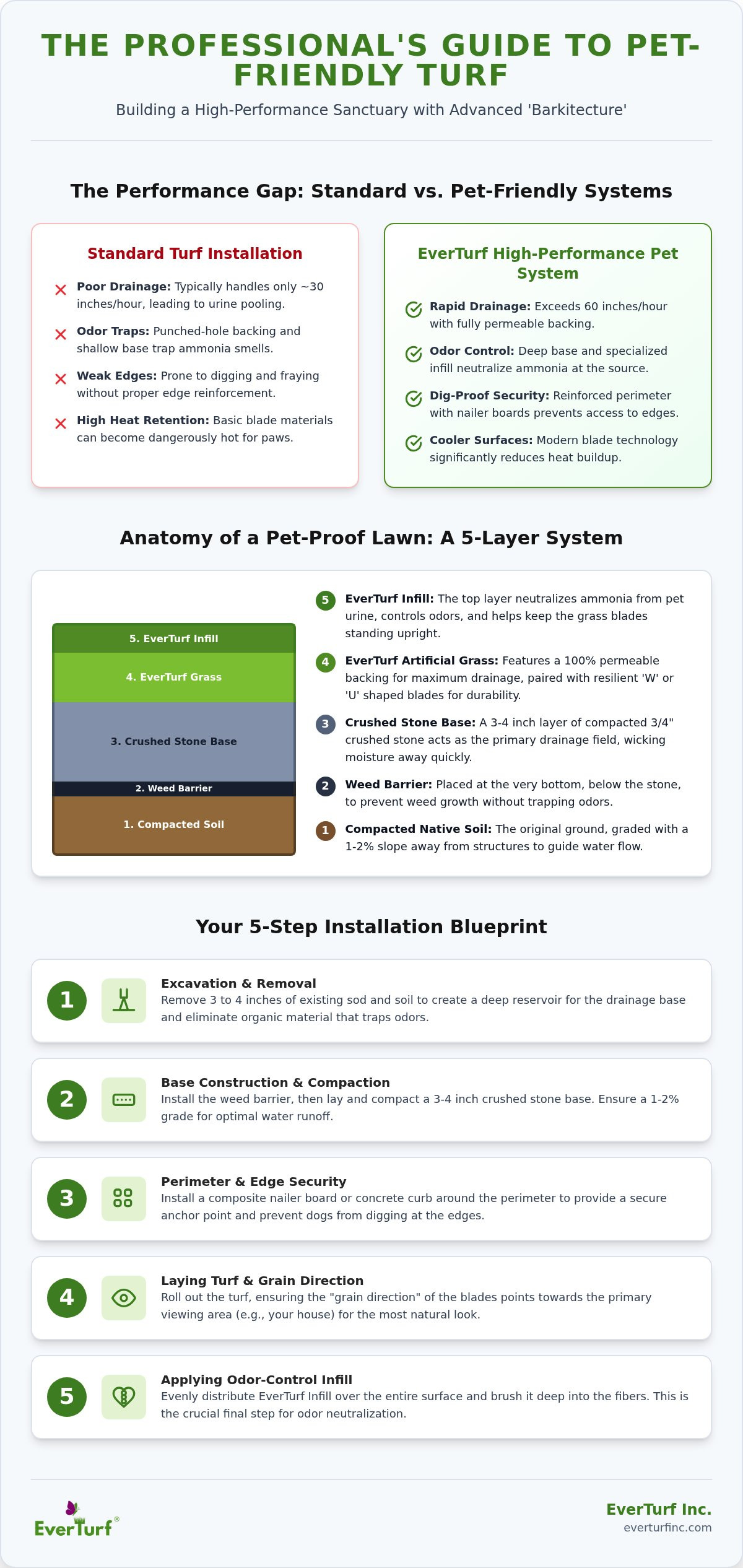
Drainage is the single most important factor in a pet-focused backyard. Standard turf typically offers a drainage rate of about 30 inches per hour through small, punched holes. For a household with dogs, this is often insufficient. High-performance systems like EverTurf Artificial grass pets utilize fully permeable backing that allows for rates exceeding 60 inches per hour. This rapid flow prevents urine from pooling and ensures that moisture moves quickly into the sub-base before odors can develop. You can learn more about these technical specifications in our complete guide to artificial grass for dogs.
Selecting the Right EverTurf Materials
A durable installation requires a curated selection of professional-grade components. You’ll need more than just the grass itself; the system includes EverTurf Infill, high-strength EverTurf Staples and Glue, and a properly graded base. Blade shape plays a vital role in longevity. We recommend “W” or “U” shaped blades because they bounce back after heavy paw traffic, maintaining a lush appearance. Additionally, 2026 technology focuses on cooler blade surfaces. This is critical for protecting sensitive paws from heat retention during peak summer months. By choosing materials designed for the local climate and your dog’s activity level, you ensure a permanent solution that adds value to your property and restores your personal time.
Preparing the Ground for Maximum Drainage and Stability
The first step in mastering how to install artificial grass for dogs is recognizing that your yard’s beauty is only as stable as the ground beneath it. Standard installations often skimp on excavation, but pet-specific projects require a more rigorous approach. You must remove between 3 and 4 inches of existing sod and soil. This deeper cut isn’t just for stability; it creates a vital reservoir for a thick layer of permeable stone that acts as a primary filter for pet waste. By removing more organic material, you eliminate the risk of trapped odors fermenting in the dirt below your new lawn.
While you prepare the area, consider the placement of your weed barrier. A common mistake is placing the fabric directly under the turf, which can trap urine and lead to lingering smells. Instead, secure your weed barrier at the very bottom of the excavated area, beneath the crushed stone. This allows liquids to pass through the stone base and into the soil without obstruction. Additionally, plan for a slight grade of approximately 1% to 2% away from your home’s foundation. This subtle slope ensures that heavy rainfall and rinse water flow efficiently toward your property’s drainage points, keeping your yard dry and mud-free.
Building the Crushed Stone Base
A stable foundation requires a specific blend of 3/4-inch crushed stone mixed with fines or decomposed granite. This combination provides the structural integrity needed to withstand high-energy zoomies while remaining porous enough for rapid drainage. Use a mechanical plate compactor to press the base into a solid, level surface. For households with large dog breeds or multiple pets, a minimum base depth of 4 inches is essential to prevent shifting and ensure maximum odor neutralization.
Perimeter Planning and Edge Security
The edges of your lawn are often the most enticing spots for dogs who love to dig. To counter this, you should install a composite nailer board or a concrete curb around the entire perimeter before you begin the final layout. These sturdy anchors provide a solid point for fastening your turf with EverTurf Staples and Glue, making it nearly impossible for curious paws to pull up the edges. As you map out these structural elements, it’s helpful to review the artificial turf installation cost factors to ensure your budget accounts for these high-quality perimeter reinforcements.
If you’re ready to transform your backyard into a stress-free sanctuary, exploring the professional-grade options from EverTurf is the logical next step for a lasting result.
Laying and Securing EverTurf Artificial Grass for High-Energy Pets
Once your foundation is perfectly graded and compacted, the visual transformation begins. Unroll your EverTurf Artificial grass pets across the prepared area and allow it to “relax” in the sun for at least 60 to 90 minutes. This step is a vital part of how to install artificial grass for dogs because the warmth makes the specialized backing more pliable, allowing any ripples from the roll to flatten naturally. Skipping this pause can lead to expansion wrinkles later, which create trip hazards for both you and your pets.
While the turf rests, pay close attention to the grain direction. Every roll of synthetic grass has a natural “lean” where the blades tilt slightly in one direction. For the most beautiful and professional result, ensure the grain faces your primary viewing area, such as your back patio or living room windows. This orientation reduces glare and gives the lawn a deeper, lusher green appearance. If your project requires multiple rolls, they must all face the exact same direction to avoid a mismatched, checkerboard look that detracts from your property’s value.
Professional Seaming Techniques
Large dog runs often require joining two pieces of turf, and the seam is the most common point of failure under heavy “zoomies.” Instead of a standard straight cut, professionals often utilize an “S-cut” pattern to break up the visual line and provide more surface area for the bond. Apply a consistent bead of EverTurf Glue to the seaming tape, ensuring it’s spread evenly but not so thick that it oozes through the backing. Carefully join the edges, making sure no individual grass fibers are trapped in the adhesive. This creates a monolithic surface that stands up to high-speed turns and sudden stops.
Securing Against Diggers and Runners
The lateral force of a running dog can easily shift unsecured turf, so your fastening strategy must be robust. Drive EverTurf Staples every 4 to 6 inches along the entire perimeter to lock the edges against determined diggers. For the interior of the lawn, use a staggered pinning pattern with staples spaced every 2 to 3 feet to prevent the center from lifting or “bubbling” during play. To hide the staples completely, simply part the grass blades with your fingers, drive the staple flush against the backing, and then brush the fibers back over the top to keep the hardware invisible and safe for sensitive paws.
By focusing on these structural details, you transform a simple lawn into a high-performance sanctuary that restores your personal time and provides a stress-free environment for your pets to thrive.
The Secret to Odor Control: Applying EverTurf Infill
You’ve successfully laid your turf and secured the perimeter against high-energy play. Now, you must address the most critical component for long-term satisfaction: odor management. Many homeowners mistakenly believe that the grass blades alone define the quality of the installation. In reality, the “secret” to a fresh, long-lasting backyard is the infill. When learning how to install artificial grass for dogs, you must view infill as your primary defense against ammonia buildup. It’s the invisible filter that keeps your sanctuary smelling like a fresh morning breeze rather than a kennel.
EverTurf Infill serves a dual purpose. Mechanically, it provides the necessary weight to keep the turf from shifting and acts as a cushion to protect the backing from heavy paw traffic. It also keeps the synthetic fibers standing upright, mimicking the resilient feel of natural grass. To ensure professional-grade performance, calculate your requirements carefully. For pet-specific areas, we recommend applying between 1.5 and 2 lbs of infill per square foot. This density is essential for adequate liquid filtration and fiber support. You can find a deeper dive into these requirements in our essential guide to turf infill.
Why EverTurf Infill is Mandatory for Pet Owners
Standard silica sand is a common choice for general landscaping, but it’s a poor fit for households with dogs. Silica is porous; it absorbs urine and traps bacteria, leading to persistent odors that are nearly impossible to wash away. EverTurf Infill is specifically engineered to neutralize the ammonia found in pet urea. This antimicrobial solution breaks down the odor-causing components before they can settle into the sub-base. Beyond scent control, this specialized infill is non-toxic and dust-free. It protects your pet’s respiratory health and prevents them from tracking messy residue back into your home.
Application and Power Brushing
Achieving an even distribution is vital for both aesthetics and performance. Use a standard drop spreader to apply the infill in several light passes rather than one heavy layer. This prevents the infill from clumping and ensures it reaches the very base of the turf fibers. Once the material is spread, you’ll need to “work” it into the lawn. While a stiff push broom can work for small areas, a power brush is the tool of choice for the aspirational “Reliable Visionary” look. The rotating bristles drive the infill deep into the thatch while simultaneously grooming the blades into a lush, upright position. This final touch transforms the project into a professional-grade sanctuary.
If you’re ready to ensure your backyard stays fresh and beautiful for years to come, explore our high-performance EverTurf Infill options today.
Long-Term Maintenance for a Pristine Pet Sanctuary
Completing your project is a significant milestone, but true tranquility comes from the consistent stewardship of your new outdoor space. While you’ve mastered how to install artificial grass for dogs to create a durable foundation, the longevity of your investment depends on a simple, proactive maintenance routine. Unlike the relentless cycle of mowing and fertilizing natural sod, caring for EverTurf Artificial grass pets is designed to restore your personal time while keeping your property looking sophisticated and pristine year-round.
The key to an “everlasting” result is managing the areas where your pets frequently congregate. Even with high-performance drainage, certain “hot spots” may require more frequent attention. Solid waste should be removed promptly to prevent it from being pressed into the fibers, which can lead to matting. Once the waste is cleared, a quick spot-clean ensures that no residue interferes with the antimicrobial properties of your EverTurf Infill. By treating your lawn with this level of care, you move away from the frustrations of traditional yard work and toward the long-term satisfaction of a worry-free environment.
The Weekly Rinsing Protocol
A routine rinsing schedule is your best defense against dust and microscopic residue. For households with a single dog, a quick weekly rinse is typically sufficient. However, if you have multiple high-energy pets, you might increase this to twice a week. It’s important to use a light spray rather than a deep soak; a quick rinse effectively moves liquids through the permeable backing without over-saturating the sub-base. Periodically, you can incorporate pet-safe enzymatic cleaners to deep-clean the fibers and refresh the scent. This protocol also allows you to inspect the surface and identify any potential drainage clogs, such as organic debris or leaves, before they impact the system’s performance.
Rejuvenating the Surface
Over time, heavy traffic can cause even the most resilient blades to lean. To maintain the lush, upright aesthetic of a professional installation, practice “cross-brushing” every few months. Using a synthetic-bristled brush, move against the grain of the fibers to lift them and redistribute the infill. This simple action prevents permanent traffic patterns from forming in high-use “zoomie zones.” Additionally, plan for an annual infill top-off. Adding a small amount of EverTurf Infill once a year ensures that your lawn maintains its odor-neutralizing power and structural support. For more ideas on creating a functional and beautiful pet-friendly space, explore our backyard turf guide for design inspiration.
Transform Your Backyard into a Stress-Free Sanctuary
You now possess the professional blueprint for a landscape that balances technical excellence with daily tranquility. By focusing on high-frequency drainage and secure perimeter anchoring, you’ve moved beyond the common pitfalls of standard lawn replacement. Real success relies on the invisible layers; specifically the excavated sub-base and the odor-neutralizing power of specialized infill. Mastering how to install artificial grass for dogs is ultimately about reclaiming your personal time and providing a safe, mud-free environment where your pets can thrive through every season.
Ready to turn this vision into an everlasting reality? We provide everything you need to succeed, from turf specifically engineered for rapid drainage to our industry-leading EverTurf Infill. With national shipping on all professional installation accessories, your dream backyard is closer than you think. Upgrade your backyard with EverTurf Artificial grass for pets today and enjoy the peace of mind that comes with a high-performance, beautiful outdoor space. Your pets will love the new terrain, and you’ll love the effortless elegance of a year-round green lawn.
Frequently Asked Questions
How do I stop dog urine from smelling on artificial grass?
Use an antimicrobial infill like EverTurf Infill to neutralize ammonia at the source. This specialized material breaks down urea before it can permeate the sub-base and cause persistent smells. Combined with a high-flow backing that drains over 60 inches per hour, liquid waste moves through the system too quickly to linger. Regular rinsing further ensures your sanctuary remains fresh and inviting for your family.
Can dogs dig through EverTurf artificial grass?
No, dogs cannot typically dig through the heavy-duty backing when it’s properly secured. The key to a dig-proof yard is the perimeter security. By using EverTurf Staples and Glue along a composite nailer board, you lock the edges down tight. This prevents even the most determined pets from finding a loose edge to pull or tear, ensuring your lawn stays pristine and your pets stay safe.
Is artificial turf too hot for dog paws in the summer?
Modern synthetic grass utilizes advanced cooling technology to stay comfortable even in direct sunlight. EverTurf Artificial grass pets features multi-tone, W-shaped blades that reflect UV rays and reduce heat absorption. On exceptionally hot days, a quick 30-second rinse with a garden hose can drop the surface temperature significantly. This keeps the environment safe and pleasant for sensitive paws during peak summer months.
What is the best base material for pet turf drainage?
A mixture of 3/4-inch crushed stone and fines provides the ideal balance of stability and porosity. This combination creates a firm foundation that won’t shift under paw traffic while allowing urine to filter through rapidly. Avoid using standard sand or soil as a base, as these materials trap moisture and odors. A professional-grade stone base is the foundation of a long-lasting, odor-free installation that adds property value.
Do I need a weed barrier if I have dogs?
Yes, but the placement is critical for effective drainage and hygiene. You should install the weed barrier at the very bottom of your excavated area, beneath your crushed stone base. This prevents weeds from growing up through your lawn while ensuring that pet waste doesn’t get trapped against the turf backing. Placing it directly under the grass can lead to ammonia buildup and drainage clogs over time.
How often should I clean my pet turf?
Establish a routine based on the number of pets using the space. A quick weekly rinse with water is usually enough to keep the fibers clean and move residue through the drainage system. For solid waste, remove it as soon as possible to prevent fiber matting. An annual grooming with a power brush and an EverTurf Infill top-off will keep your sanctuary looking and smelling like new for years.
Can I install artificial grass for dogs over dirt?
No, you should never install synthetic turf directly over dirt. When you research how to install artificial grass for dogs, you’ll find that proper excavation is mandatory. Dirt turns into mud when wet and traps pet urine, creating a permanent odor problem. Excavating 3 to 4 inches and replacing the soil with a crushed stone base is the only way to ensure proper drainage and stability.
What is the difference between pet turf and regular turf?
Pet turf is engineered specifically for high-frequency drainage and extreme durability. While regular turf might only drain 30 inches per hour, EverTurf Artificial grass pets is designed to handle over 60 inches per hour. It also features more resilient blade shapes, like “W” or “U” profiles, that bounce back after heavy play. These technical specifications ensure the lawn survives high-energy pets while maintaining its lush, green appearance.