



How to Choose a Putting Green Stimp Speed for Your Backyard
The fastest putting green isn’t necessarily the best one for your backyard. When you’re deciding how to choose a putting green stimp speed, consider what you want to practise, the shape and size of your green, and the pace you’ll enjoy playing on regularly.
It’s natural to focus on the Stimp number when comparing green speeds. But that reading is useful only when you understand what it measures and how turf, infill, installation, and surface conditions affect the roll. A consistent, realistic pace can make practice more rewarding than simply aiming for the highest number.
This guide explains what Stimp speed means, how to measure and compare readings consistently, and how to choose a target that suits your practice goals and available space. You’ll also learn why the complete turf system matters to a backyard green’s feel, and how EverTurf Putting Green Pro can fit into your planning once you’ve defined the pace you want.
Key Takeaways
- Understand what a Stimp reading tells you about ball roll, and why it can’t describe the feel of a green on its own.
- Learn how to compare test rolls consistently so your speed readings are more useful from one session to the next.
- Use your practice goals, typical play, and available green space to guide how to choose a putting green stimp speed that feels right for you.
- Assess pace during regular practice as well as through measurements, then use what you learn to fine-tune your target.
- Consider the complete turf system and intended use when exploring EverTurf Putting Green Pro for your backyard green.
What Does Putting Green Stimp Speed Measure, and Why Does It Matter?
Should a backyard green feel familiar and forgiving, or quick enough to demand delicate touch? The answer starts with pace, but a Stimp reading is only one part of how a putt will play.
Stimp speed measures how far a golf ball rolls across a putting green when released from a standardized Stimpmeter. The result is a distance, typically expressed in feet. The standard method averages rolls in opposite directions to reduce the effect of a slight slope. The Stimpmeter is a grooved measuring tool that releases a ball in a repeatable way, helping golfers and course staff compare green pace more consistently.
What does a Stimp reading tell a golfer?
A higher reading indicates a faster roll, so a putt travels farther with the same stroke. A lower reading indicates a slower roll. That difference affects distance control and touch, and a speed that feels comfortable on one green may take adjustment on another.
The reading describes pace, not the full putting experience. It doesn’t measure slope, surface firmness, or how consistently the ball rolls across the entire green. A sharply breaking putt, for example, can be difficult on a moderate-paced surface, while bumps or an uneven roll can make distance control unpredictable. These are separate features to consider.
Is there one ideal Stimp speed for every putting green?
No. The right target depends on your experience, the greens you usually play, and what you want to practise. A familiar pace can help you rehearse everyday distance control. A deliberately quicker, more demanding pace may suit focused practice, but it can feel less representative of your regular rounds.
Green design matters, too. On a compact layout, a fast pace can send a missed putt farther from the cup, leaving less room for recovery. Contours, slopes, and the putting distances available all affect how a given reading feels in play. That’s why how to choose a putting green stimp speed is about matching the measurement to your intended practice, not chasing a number. Think about the putts you want to make, then use Stimp speed as one useful reference rather than a verdict on green quality.
How Is Putting Green Stimp Speed Measured Consistently?
A Stimpmeter turns the impression that a green feels “quick” or “slow” into a repeatable measurement. The standard tool is a 36-inch aluminum bar with a V-shaped groove. Raise it to about a 20-degree angle, then release a golf ball from a notch so it rolls onto the green. The measured distance provides a pace reading, not a complete assessment of how the surface will play.
Meaningful comparisons require consistent test conditions. Use the same type of ball, test area, direction, and release procedure each time. A gentle slope, scattered debris, moisture, or surface irregularities can change the roll, so readings taken under different conditions may not reveal a real change in pace. Penn State Extension’s Factors Affecting Green Speed explains how surface qualities such as smoothness and firmness can influence green speed.
What equipment and conditions affect the reading?
Choose a smooth, unobstructed lane with enough room for the ball to roll freely, and avoid a pronounced slope when comparing pace. Remove loose debris and note whether the surface is dry or damp. These steps help reduce variables, but a backyard test is a practical comparison, not a certified course rating.
A putt during ordinary practice can tell you how the green feels, but it isn’t a controlled measurement. The Stimpmeter standard provides a repeatable release; an informal roll by hand does not.
How can you compare readings without overinterpreting them?
Keep a simple record of the test location, direction, surface condition, and method. Repeat the test in the same area and under similar conditions before concluding that the pace has changed. If you test another section, record that location as well, since even nearby areas may roll differently.
- Prepare: Select a smooth test lane and note the surface condition.
- Set up: Position the Stimpmeter in the same way for each release.
- Roll: In the standardized procedure, release three balls in one direction and three in the opposite direction. For a valid test, the three balls in each direction must finish within eight inches of one another.
- Record and compare: Measure the rolls, average the distances from the two directions, and compare results only with tests taken using a sufficiently similar setup.
Consistency matters more than collecting isolated numbers. Use repeatable readings to inform how to choose a putting green stimp speed, then judge the pace during ordinary practice, too. To compare putting-green turf options with your target pace, visit EverTurf putting-green options.
How to Choose a Putting Green Stimp Speed for Your Practice
The fastest possible surface isn’t automatically the best choice for a backyard green. A demanding pace can sharpen touch, but if it feels unlike the greens you usually play, it may be less useful for everyday practice. Start with your goals, experience, and available layout, then choose a pace that supports the putts you want to rehearse.
Which green speed suits your practice goals?
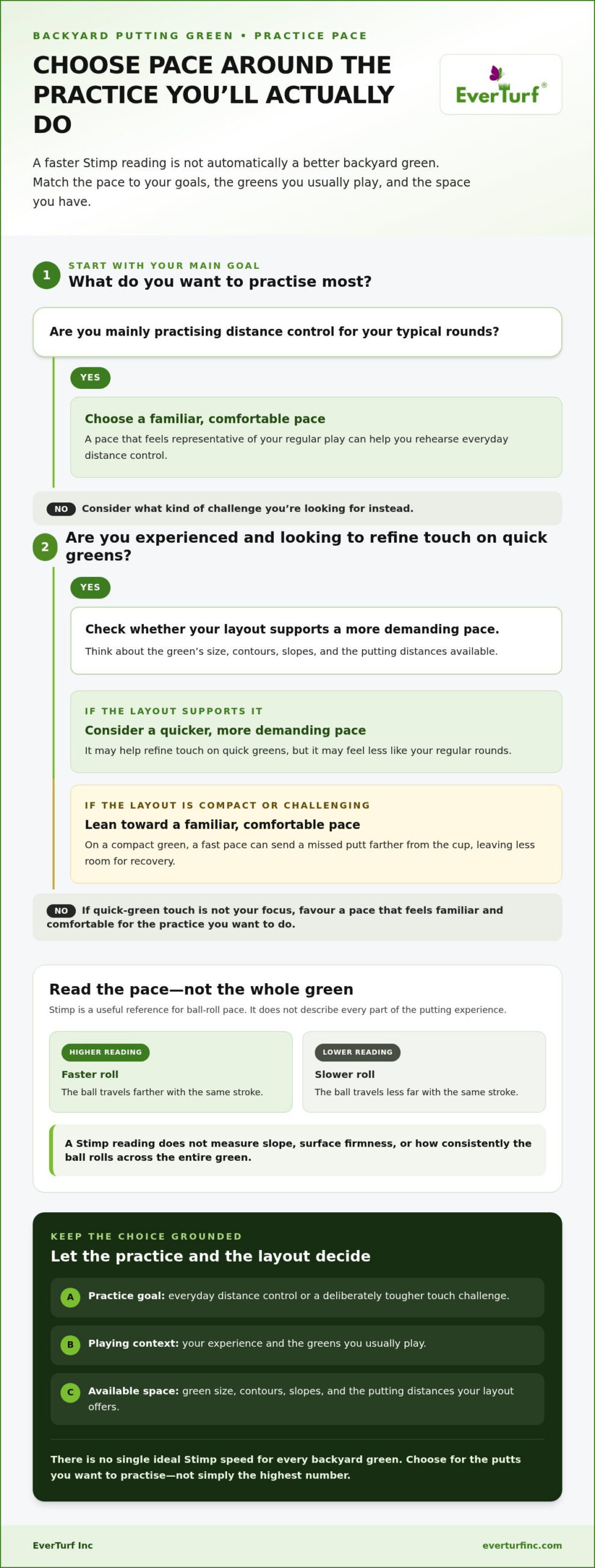
Think about the practice you’ll do most often. If you want to build reliable distance control for typical rounds, a familiar, comfortable pace may serve you better than an extreme challenge. If you’re an experienced golfer seeking to refine touch on quick greens, a more demanding pace could be useful, provided your green’s design supports it.
Use this comparison to narrow your preference before settling on a target:
| Practice priority | Desired feel | Design considerations | Questions to resolve |
|---|---|---|---|
| Everyday distance control | Comfortable and familiar | Room for varied putt lengths and straightforward practice lines | Does this pace resemble the greens I usually play? |
| Touch on quicker greens | More demanding and sensitive to stroke length | Enough space to manage longer roll-outs and missed putts | Will I use this challenge regularly, or only occasionally? |
| Shared family or casual use | Approachable for different skill levels | Contours and layout that keep practice enjoyable and playable | Will other golfers use the green, and what pace will feel comfortable to them? |
Your experience matters, but so does the golf you want to prepare for. Consider the pace and conditions you encounter in regular play, along with the practice routines you’ll actually repeat. A specialized challenge can be valuable, but it shouldn’t come at the expense of a green you enjoy using.
How do turf and green design influence the result?
Your target pace depends on the complete surface system, not just the turf choice. Turf characteristics and infill can affect how the ball rolls, while base preparation influences the smoothness and consistency of the finished surface. Contours, slopes, and the length of available putting lanes also shape how fast a green feels in play.
That’s why how to choose a putting green stimp speed starts with both the golfer and the planned design. Define your practice priorities, consider who will use the green, and think about the available space before deciding on a pace. Then evaluate turf, infill, base, and contours as parts of one system, rather than expecting a Stimp target alone to determine the experience.
How to Test and Fine-Tune a Backyard Green’s Pace
Once your green is in place, assess its pace using repeatable measurements and the putts you make during ordinary practice. A single reading is a snapshot, not a complete picture of how the surface performs across different lines and distances. For broader planning considerations, explore this EverTurf putting-green guide.
What should you record during a backyard speed test?
Choose a smooth, unobstructed test area and use the same measurement method each time. Keep notes so you can distinguish a change in the surface from a difference in test conditions.
- Test location and direction: Record where you tested and which way the balls rolled.
- Surface condition: Note moisture, debris, and anything else that could affect the roll.
- Method and result: Use the same tool and procedure, and record the measurement rather than relying on memory.
- Roll consistency and feel: Note whether balls travel similarly, then try short, medium, and longer putts during a normal session.
Repeat the test under comparable conditions before drawing conclusions. A different reading after a change in moisture, test location, or procedure doesn’t necessarily mean the green’s underlying pace has changed. Pay attention to how the surface feels in play, too: short putts reveal touch, while longer putts make distance control easier to judge.
How do maintenance and infill fit into speed consistency?
Loose debris and changes in surface condition can affect playability. Infill is part of the complete turf system, so understand its role alongside the turf and its care requirements. For more context on how infill functions in synthetic turf, read the turf infill guide.
Follow the care instructions for your specific turf system rather than adding, removing, or redistributing infill as an assumed way to change speed. If practice suggests the pace feels inconsistent, repeat your test in the same location and check the surface condition first. Then compare your notes with the green’s feel during ordinary putting.
Regular review helps you decide whether the green still matches your goals, rather than encouraging you to chase small reading changes. If you’re planning a putting green or considering turf options, explore EverTurf putting-green products as you refine your target pace.
Choosing EverTurf Putting Green Pro for Your Target Playing Pace
A satisfying backyard green starts with the golfer, not a speed claim. Define what you want to practise, decide what pace feels realistic for your regular play, then consider how the full green system and layout can support that experience. A Stimp target can guide your decisions, but it shouldn’t be treated as a guaranteed product outcome.
What should you decide before selecting putting-green turf?
Picture how the green will fit into your routine and outdoor space. Consider who will use it, whether practice will focus on short-putt touch or longer distance control, and how much room is available for useful putting lines. Contours matter, too: slopes can add variety, but they change how putts behave independently of the surface’s measured pace. For broader context on synthetic turf, see the artificial grass guide.
Once those priorities are clear, EverTurf Putting Green Pro is EverTurf’s dedicated putting-green product to consider. Choose turf in the context of your intended play and the complete green system, including infill and the planned surface design. Don’t assume a particular Stimp reading based on a product name alone.
How can the finished green support a satisfying practice routine?
A useful practice surface combines a roll that feels consistent across the areas you use with a pace suited to your goals. After the green is ready, test comparable areas using the same method and conditions, then putt from short, medium, and longer distances during ordinary sessions. Measurements help you compare; regular play reveals whether the pace feels right.
If the experience doesn’t match your expectations, review your notes and the care guidance for the installed turf system before considering changes. Avoid adjusting infill or the surface based on a single test or general speed assumption. Keep product decisions grounded in published specifications and assess the result as a complete system, rather than expecting one feature to determine every putt.
With your practice goals, layout, and pace preference in view, you can make a considered choice without chasing the fastest possible surface. Explore EverTurf putting-green solutions as you plan a green designed around the way you want to play.
Build a Backyard Green Around the Way You Play
The right pace isn’t necessarily the fastest one. It’s the pace that supports the practice you’ll return to, feels relevant to the greens you play, and works with your green’s layout. To decide how to choose a putting green stimp speed, combine a clear practice goal with repeatable measurements and the feel of short, medium, and longer putts during regular use.
Keep the whole system in view, too. Turf, infill, surface preparation, and contours all contribute to the finished experience, so a Stimp reading alone can’t promise how every putt will feel. EverTurf offers EverTurf Putting Green Pro as a dedicated putting-green product, along with turf infill and installation accessories to consider as part of your planning.
Start with the play experience you want, then explore the options that fit your vision. Explore EverTurf putting-green solutions and take the next step toward a backyard space that makes practice inviting and easy to return to.
Frequently Asked Questions
What is a good Stimp speed for a backyard putting green?
A good Stimp speed suits your practice goals and feels playable in your space. If you mainly want to rehearse the distance control you use on familiar courses, choose a pace that feels similar to those greens. A quicker target may add a challenge, but it isn’t automatically more useful. Consider the layout, slopes, and putting distances, too, since they affect how the green plays.
How do you measure the Stimp speed of a putting green?
Use a Stimpmeter on a smooth, unobstructed area, following the same procedure for each test. In the standardized method, release three balls in each of two opposite directions; the balls in each set must finish within eight inches of one another for a valid test. Measure their roll distances and average the results from both directions. Record the location and surface conditions so you can make fair comparisons later.
Is a faster putting green always better for practice?
No. Faster greens demand a lighter touch and can help you practise distance control on quick surfaces, but they’re not right for every golfer or routine. If the pace differs greatly from the greens you usually play, practice may feel less representative. Choose a speed that challenges you without making the green frustrating to use. The best target supports the shots you want to practise and keeps you coming back.
Can you adjust the Stimp speed of artificial turf?
Artificial turf speed depends on the complete surface system, including turf characteristics, infill, and installation. Don’t assume that adding or removing infill will produce a predictable speed change. First consult the care guidance for your specific turf system, then assess playability with consistent tests and regular putting. If you’re planning a synthetic putting green, EverTurf offers EverTurf Putting Green Pro and turf infill as components to consider together.
What affects putting green Stimp speed?
On a natural green, moisture, surface smoothness, firmness, and maintenance can affect how far the ball rolls. On an artificial green, turf material and pile characteristics, infill, base preparation, and surface condition also influence ball roll. Slope can affect a test and change the way a putt feels, even though it isn’t the same as measured pace. Keep these factors in mind when comparing readings or evaluating play.
Does a backyard putting green need a Stimpmeter?
No. A Stimpmeter can help you compare pace using a repeatable procedure, but it isn’t essential for enjoying or practising on a backyard green. Pay attention to short, medium, and longer putts during ordinary sessions, and note whether distance control feels consistent. If you use a Stimpmeter, repeat the same method in comparable conditions. Treat informal backyard readings as useful comparisons, not certified course ratings.
How do I choose a putting green speed for my skill level?
Match the pace to your experience, the greens you typically play, and the skills you want to develop. If you’re building fundamentals, start with a comfortable pace that lets you practise direction and distance without constant recovery putts. Experienced golfers may prefer a more demanding challenge if it reflects their goals and the green’s design. To decide how to choose a putting green stimp speed, focus on useful practice, not the highest possible reading.