


EverTurf Staples and Glue: The Professional Guide to Securing Your Synthetic Lawn
What if the secret to a flawless, year-round landscape isn’t actually the grass you choose, but the invisible architecture holding it in place? Most homeowners focus on the blades, yet the true difference between a DIY project and a professional masterpiece lies in how the turf is anchored. When you’re investing in a beautiful outdoor space, you want the peace of mind that comes with a perfectly flat, immovable surface. Using EverTurf Staples and Glue correctly is the essential insurance policy that prevents shifting and ensures your lawn looks like a single, continuous piece of natural grass.
We understand the anxiety of worrying about visible seams or edges that might lift and create tripping hazards. You deserve a sanctuary that withstands the energy of playful pets and the unpredictability of the climate without losing its pristine shape. This guide promises to transform your installation process by teaching you the expert techniques for securing your synthetic lawn for a lifetime of enjoyment. We will break down the specific uses for 6-inch galvanized steel staples and high-tensile adhesives, giving you a clear roadmap to a safe, stunning, and stress-free environment.
Key Takeaways
- Understand why professional anchoring serves as an essential insurance policy against unsightly ripples and shifting turf.
- Learn the “Perimeter Rule” for deploying 6-inch galvanized steel staples to create a deep, rust-resistant mechanical foundation.
- Discover how to achieve invisible seams using EverTurf Staples and Glue for a permanent bond that handles high-traffic pets and play.
- Tailor your installation approach based on subgrade analysis and your specific soil type to ensure long-term stability.
- Implement the hybrid strategy of using both mechanical and chemical fasteners to guarantee a perfectly flat, lifelong finish.
Beyond the Surface: Why Securing Your Turf is a Critical Investment
The beauty of a modern synthetic lawn is its ability to remain evergreen regardless of the season. However, achieving that tranquil, stress-free outdoor space requires more than just rolling out the grass. While the history of artificial turf shows how materials have evolved for better realism, the installation methods remain the true differentiator of quality. Securing your turf is a critical investment in your home’s safety, longevity, and overall curb appeal. It’s about more than just holding the material down; it’s about creating a permanent foundation for your lifestyle.
When turf isn’t anchored correctly, it reacts to the environment in ways that can ruin your investment. Temperature fluctuations cause the backing material to expand and contract. Without the structural integrity provided by EverTurf Staples and Glue, these thermal shifts result in unsightly ripples or waves that disrupt the perfectly flat surface you envisioned. By using a sophisticated combination of mechanical and chemical fasteners, you create a monolithic surface that behaves like natural sod, staying taut and beautiful through every season.
The Aesthetic Impact of Professional Seaming
Visible seams are often the first sign of an installation that didn’t prioritize fastening. If the edges aren’t bonded correctly, they can pull apart or overlap, creating a shadow line that breaks the illusion of a single piece of grass. Proper anchoring also ensures that the grain or direction of the blades remains perfectly aligned across the entire yard. This stability is essential for the performance of EverTurf Infill. Without a secure base, the infill can migrate or settle unevenly, leading to patches that look flat or worn over time.
Safety and Liability in High-Traffic Areas
A beautiful lawn should be a place of relief, not a source of anxiety. Unsecured edges are the primary cause of tripping hazards, especially in high-activity zones where children and pets play. Turf creep occurs when heavy foot traffic or athletic movements slowly push the turf out of position. Professional-grade, 6-inch galvanized steel staples are designed to penetrate deep into the sub-base, providing a grip that resists both physical force and wind-lift during severe storms. These pro-grade accessories won’t rust or break underground, ensuring your family’s safety remains a permanent fixture of your home.
EverTurf Staples: The Mechanical Foundation for Landscape Anchoring
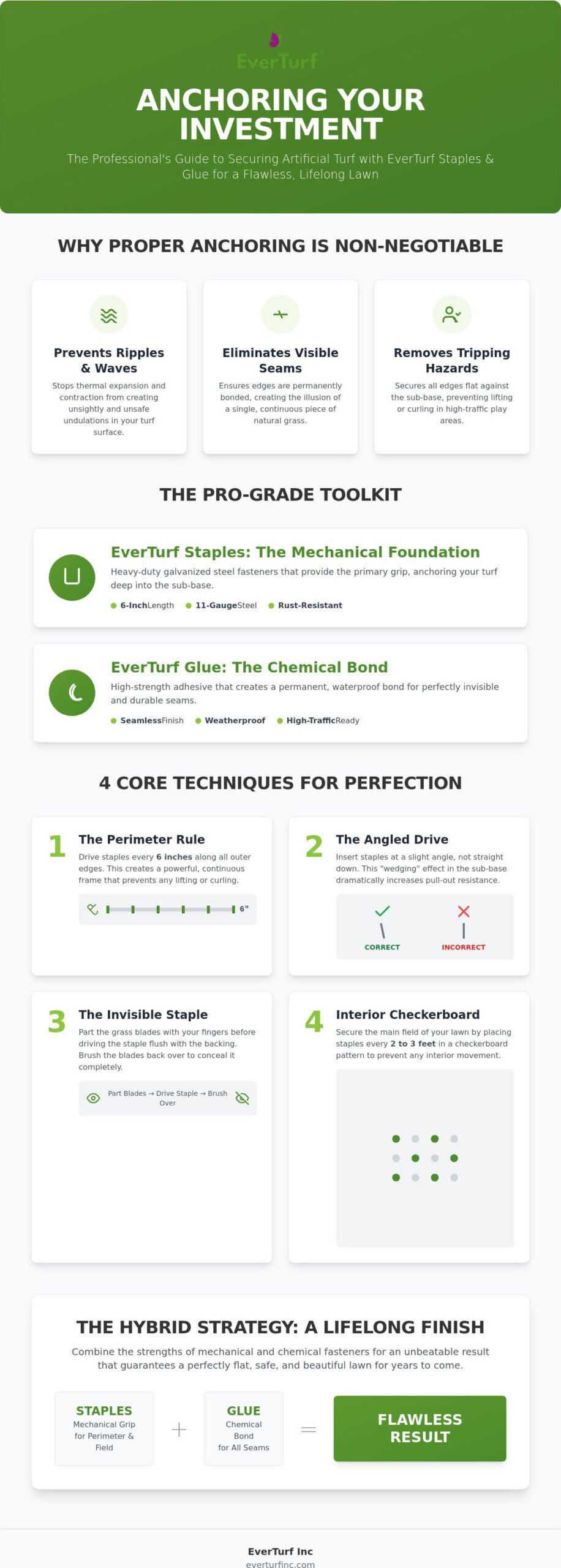
EverTurf Staples provide the heavy-duty mechanical grip required to anchor your lawn firmly into the earth. Crafted from 6-inch, 11-gauge galvanized steel, these fasteners are engineered to penetrate deep into the sub-base without bending or corroding. Choosing the right EverTurf Staples and Glue combination is the first step toward a professional-grade result. This robust construction is particularly effective in soft-to-medium subgrades, such as loam or well-compacted sand, where the long prongs can bite into the soil for maximum hold. To ensure your installation meets professional standards, we recommend following the STC installation guidelines, which emphasize the importance of structural integrity in residential landscapes.
One of the most vital techniques for a stable lawn is the “Perimeter Rule.” This involves driving staples every 6 inches along all outer edges of your turf. This high-density anchoring prevents the edges from lifting or curling, especially in breezy areas. For a truly professional finish, always drive your staples at a slight angle rather than straight down. This creates a “wedging” effect in the sub-base, significantly increasing the pull-out resistance against pets or heavy play. When you use EverTurf Staples and Glue together, you’re building a foundation that won’t budge.
The “Invisible Staple” Technique
A common mistake in DIY projects is leaving visible “crowns” or trapped blades under the staple head. To achieve a seamless look, use your fingers to pull back the grass blades before driving the staple home. Once the staple is flush with the backing, brush the blades back over the area to hide the metal completely. While the perimeter needs frequent anchoring, the interior of your lawn should follow a checkerboard pattern. Securing the center every 2 to 3 feet ensures the turf remains flat without creating unsightly dimples.
When to Choose Staples Over Glue
Staples are often the faster and more cost-effective choice for large-scale residential projects. They’re ideal for areas where you might need future access to the sub-base or for temporary installations. Many homeowners prefer staples when working with landscape edging and bender boards to create clean, defined borders. If you’re ready to start your transformation, you can find the right installation accessories for your project today.
High-Strength Turf Glue: Creating Seamless Chemical Bonds
While staples provide the mechanical grip needed to anchor your lawn into the soil, professional-grade adhesive creates a permanent fusion where two pieces of grass meet. EverTurf Glue is specifically formulated to create high-tensile chemical bonds that act as the backbone of high-stress seams. It isn’t just about sticking things together; it’s about ensuring the transition between rolls is invisible and indestructible. By using the right combination of EverTurf Staples and Glue, you’re building a landscape that resists the natural urge to pull apart during intense summer heat or winter freezes.
To achieve a truly waterproof result, the adhesive works in tandem with non-adhesive seam tape. This “Seam Tape Synergy” creates a durable, flexible backing that keeps moisture from undermining the bond. Because EverTurf adhesives are engineered for extreme weather resistance, they won’t become brittle in the cold or liquefy in the sun. This reliability is why professionals rely on these chemical bonds for complex EverTurf Roof & Deck installations where mechanical fasteners aren’t an option.
Seaming Like a Pro: The Glue and Tape Method
Apply the glue in a “serpentine” or S-shaped pattern across the seam tape. This technique maximizes the surface area covered, ensuring every square inch of the turf backing has a firm grip. Timing is everything. You must respect the “tack time,” which is the brief window when the glue is sticky enough to grab but hasn’t yet begun to cure. Pressing the turf into the adhesive at this exact moment ensures a flush, flat finish. This level of precision is non-negotiable for professional-grade putting greens, where even a millimeter of lift can ruin a perfect putt.
Glue for Non-Traditional Surfaces
Many modern homeowners are transforming concrete patios, wooden decks, or apartment balconies into lush retreats. Since staples cannot penetrate these hard materials, high-strength glue becomes the primary fastening agent. Success on these surfaces starts with meticulous preparation. The base must be bone-dry and free of oils or dust to allow the chemical bond to take hold. Additionally, you must manage drainage carefully. Instead of a solid sheet of glue, apply it in broken patterns to ensure water can still flow freely beneath the turf, preventing pooling and protecting the underlying structure.
The Selection Framework: Choosing the Right Fastening Method
Selecting the correct fastening method is the final step in transitioning from a simple yard project to a sophisticated landscape. It isn’t just about choosing between a mechanical or chemical bond; it’s about matching your hardware to the specific DNA of your property. By analyzing your soil, traffic patterns, and local climate, you can deploy EverTurf Staples and Glue with surgical precision. This strategic approach ensures your lawn remains a flat, tranquil sanctuary that looks as perfect in five years as it does on day one.
Project scope also plays a major role in your decision. A small patio “rug” installation on concrete relies entirely on adhesive, while a full backyard transformation typically requires a diverse toolkit. Climate factors shouldn’t be ignored either. If you live in a high-wind region or an area prone to heavy seasonal rainfall, your fastening strategy acts as the primary defense against wind-lift and sub-base erosion. Making the right choice now restores your personal time later by eliminating the need for constant repairs or adjustments.
The Soil Type Decision Matrix
If you have ever tried to drive a stake into sun-baked clay or caliche, you know that “hard dirt” is an understatement. In these dense, rock-bound environments, traditional staples often bend before they can penetrate the surface. For these challenging subgrades, a glue-and-tape system is often the superior choice for creating a stable seam. Conversely, soft soils like loam or compacted sand don’t offer much resistance to pull-out forces. In loose earth, the 6-inch depth of a staple is mandatory to find the deep grip that glue simply cannot provide. Additionally, if your property has high groundwater intrusion, using professional-grade glue ensures your seams remain waterproof and won’t shift during subsurface flow.
Traffic and Usage Considerations
The way you intend to use your space dictates the strength of the bond you need. High-activity zones, such as artificial grass for dogs, often require a hybrid approach to withstand the lateral force of running pets. While staples secure the perimeter, high-strength glue is essential for seams in “swing-off” areas or under playground slides where impact is frequent. This professional-grade durability is the same standard used for soccer turf and sports fields, where safety and performance are non-negotiable. Ready to secure your sanctuary with the right materials? Explore our full range of professional installation accessories to ensure your project stands the test of time.
The Hybrid Strategy: Professional Secrets for an Everlasting Result
The secret to a lawn that remains a permanent masterpiece isn’t choosing between mechanical or chemical fastening. It’s the hybrid strategy. Professionals use EverTurf Staples and Glue together to create a fail-safe system that handles the unique stresses of your local environment. While some sources present these as separate options, combining them is the only way to guarantee a truly seamless, lifelong finish that withstands pets, weather, and time. This integrated approach provides the structural integrity needed to transform your yard into a stress-free sanctuary.
The process begins with patience. Step 1 is laying your turf and allowing it to acclimate in the sun. This allows the backing to relax and reach its natural state before you apply any tension, preventing ripples later. Step 2 involves executing the chemical seam bond first. By focusing on the grass-to-grass fit with high-tensile glue and seam tape, you ensure the most visible parts of the lawn are locked together invisibly. Only after the seams are perfect do you move to Step 3: perimeter stapling. This final mechanical stage locks the entire system into the landscape, providing the heavy-duty anchor that prevents lateral movement or wind-lift.
A final inspection is the mark of a reliable visionary. Walk the entire perimeter to ensure every staple is hidden and every seam edge sits flush against its neighbor. This attention to detail ensures your installation looks like a single, continuous piece of grass, restoring your personal time by eliminating future maintenance headaches.
Common Mistakes to Avoid
Over-gluing is a frequent DIY pitfall. More is not better; excessive adhesive can bleed through the backing and create messy, visible residue on the grass blades. Under-stapling is equally risky, often leading to edge-curl within the first six months of installation. Finally, never fasten too soon. If you don’t let the turf relax in the sun, you risk trapping tension that will eventually cause the material to shift or buckle as temperatures change.
The EverTurf Advantage
Choosing matched EverTurf Staples and Glue ensures total chemical compatibility with your turf backing. Using mismatched products can sometimes lead to backing degradation or bond failure over time. By selecting our professional-grade accessories, you also gain the ability to connect with our national network of pro partners for help with complex installations. You can explore the full range of EverTurf Installation Accessories to find the professional-grade tools needed to secure your investment for an everlasting result.
Secure Your Vision for a Lifetime of Tranquility
Transforming your property into a lush, maintenance-free oasis is about more than just the grass you see. It’s about the precision and quality of the invisible architecture beneath the surface. By mastering the hybrid approach of using both mechanical anchors and chemical bonds, you ensure your lawn remains perfectly flat and safe for pets, kids, and every weather event. You’ve now seen how the right EverTurf Staples and Glue act as the ultimate insurance policy for your investment.
Professional-grade 6-inch galvanized staples and high-tensile, weather-resistant adhesives are the tools trusted by pro installers across the United States to deliver a seamless finish. Don’t leave your dream landscape to chance with subpar fasteners that rust or lift over time. It’s time to reclaim your personal time and enjoy the peace of mind that comes with a permanent solution. Order Your EverTurf Staples and Glue for a Professional Finish today and take the first step toward a flawless, everlasting result. You’re ready to create an outdoor space that looks stunning for years to come.
Frequently Asked Questions
Can I install artificial grass with only staples?
Yes, you can install artificial grass using only staples for standard landscape areas with soft soil, but it isn’t recommended for high-traffic zones or seams. Staples provide a mechanical hold that works well for perimeters, yet they can’t create the waterproof, invisible bond that glue offers. For a professional finish that lasts decades, a hybrid approach is the superior choice for your property.
How long does EverTurf Glue take to fully cure?
EverTurf Glue typically reaches its initial set within 1 to 2 hours, though it requires a full 24 hours to cure completely. Environmental factors like high humidity or cold temperatures can extend this timeline. Avoid walking on the turf or exposing the seams to moisture during this critical 24-hour window to ensure the chemical bond reaches its maximum tensile strength.
Will galvanized staples rust and ruin my turf over time?
No, professional-grade 6-inch galvanized steel staples will not rust or ruin your turf over time. The specialized zinc coating protects the metal from moisture and oxygen in the soil, preventing the corrosion that often plagues standard garden stakes. This durability ensures the structural integrity of your lawn remains intact for its entire lifespan without staining the backing or the fibers.
How many staples do I need per square foot of turf?
You should plan for one staple for every square foot of the interior, while the perimeter requires a much higher density. Following the professional 6-inch spacing rule for all outer edges, a standard 500-square-foot lawn usually requires approximately 300 to 500 individual fasteners. Using the right quantity of EverTurf Staples and Glue prevents the material from shifting under heavy foot traffic or high winds.
Is turf glue safe for pets and children once it has dried?
Yes, turf glue is completely safe and non-toxic for pets and children once it has fully dried and cured. The adhesive becomes an inert, high-strength bond that doesn’t off-gas or leach harmful chemicals into your yard. It’s specifically engineered to withstand the daily activities of a modern household while maintaining a pristine, worry-free sanctuary for your family to enjoy year-round.
What should I do if glue gets on the grass blades during installation?
You should act immediately by using a clean rag and a small amount of mineral spirits or denatured alcohol to wipe the adhesive away. Don’t allow the glue to dry, as it becomes significantly harder to remove without damaging the synthetic grass fibers. Once you have cleared the residue, rinse the area thoroughly with water to remove any remaining cleaning solvents from the blades.
Can I use staples on a concrete patio installation?
No, you cannot use staples on a concrete patio because they aren’t designed to penetrate hard, non-porous surfaces. For these projects, you must rely exclusively on high-strength adhesive to secure the turf to the base. Using EverTurf Staples and Glue effectively means understanding that staples are reserved for soil-based subgrades where they can find a deep mechanical grip to anchor the lawn.
Do I need a special tool to drive EverTurf staples?
You don’t need any specialized machinery or expensive equipment to drive EverTurf staples into the ground. A standard hammer or a rubber mallet is perfectly sufficient for most residential projects. Many professionals prefer a rubber mallet because it’s less likely to damage the galvanized coating or accidentally crush the turf blades if you miss the staple head during the final drive.