

DIY vs. Professional Artificial Grass Installation: Making the Right Choice in 2026
The weekend you spend excavating your yard might seem like a smart investment, but the most expensive lawn is often the one you have to install twice. When weighing the merits of DIY vs professional artificial grass installation, many homeowners assume the primary difference is simply the cost of labor. However, the true value lies in the structural integrity of the foundation and the precision of the finish. You deserve a landscape that remains a pristine, low-maintenance sanctuary, not a source of anxiety over visible seams or “bubbles” in the turf.
It’s understandable to feel overwhelmed by the physical labor of base excavation or the technical nuances of pet-friendly drainage. We’ll help you navigate these choices by revealing the critical differences between amateur and expert methods. You’ll discover which specialized materials, like high-performance EverTurf Infill, are non-negotiable for a lush, flat result that can save up to 55,000 gallons of water annually. This guide explores how to secure a 15 to 25-year lifespan for your investment while avoiding the costly mistakes that void product warranties. Let’s transform your outdoor space into the year-round, stress-free retreat you’ve envisioned.
Key Takeaways
- Master the science of drainage to ensure your lawn remains a fresh, odor-free environment by focusing on the often-overlooked foundation layers.
- Navigate the financial reality of DIY vs professional artificial grass installation by uncovering hidden expenses like heavy equipment rentals and sod disposal fees.
- Assess whether your landscape’s unique contours and traffic patterns require the specialized precision and bonded guarantees of a professional installation crew.
- Protect your long-term investment by learning which professional-grade materials, such as EverTurf Infill, are essential for maintaining blade resilience and temperature control.
- Gain the confidence to choose the right path for your property, ensuring a perfectly flat, evergreen result that enhances your lifestyle for decades.
Evaluating the DIY Appeal vs. Professional Precision
Deciding between DIY vs professional artificial grass installation is more than a financial calculation; it’s a choice about the future of your home’s sanctuary. Since the history and development of artificial turf began, the materials have transitioned from simple plastic mats to sophisticated, multi-tonal systems that require expert handling. In 2026, installing turf is no longer a “carpet-laying” task. It’s a complex engineering project that demands a shift in mindset. You’re not just finishing a weekend chore; you’re installing a permanent property asset designed to provide tranquility for decades.
The DIY Pros and Cons for Modern Homeowners
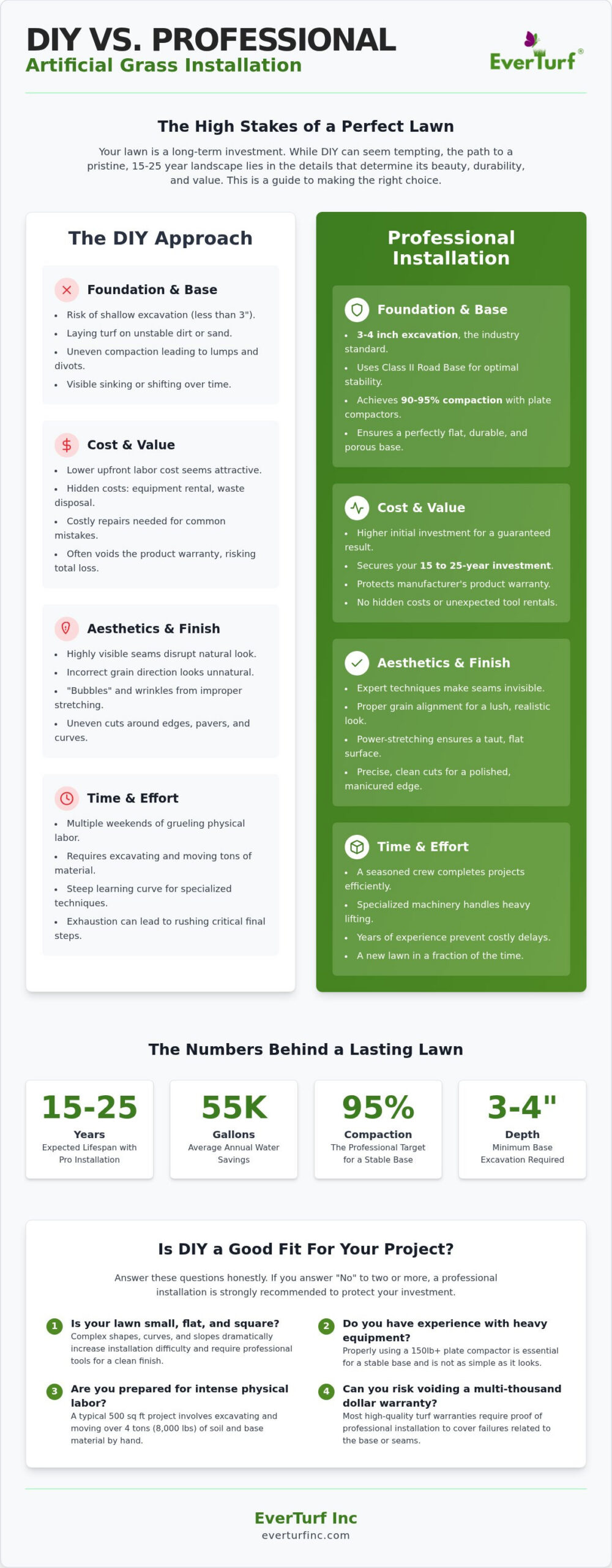
Taking the DIY route offers an immediate financial allure. By eliminating professional labor fees, which typically account for 50% to 60% of the total project cost, you can significantly reduce the initial artificial turf installation cost. Homeowners also enjoy absolute creative control over the timeline, working at a pace that fits their personal schedule. However, this path is often paved with hidden challenges. Common “rookie mistakes” include misaligning the grain direction or leaving visible seams that disrupt the lush, natural look of the lawn. The physical toll is also substantial. Excavating hundreds of pounds of soil and base rock often leads to exhaustion, which can tempt even the most dedicated homeowner to rush the critical final stages of base preparation.
Why Professional Installation is the Industry Benchmark
Professional teams bring a level of precision that’s difficult to replicate with rented equipment. While a DIYer might struggle with a hand-held rake, pros utilize industrial-grade power brooms and high-impact plate compactors to ensure a flawless, ultra-flat finish. This expertise is vital when fitting turf around curved garden beds or intricate stone pavers. When considering DIY vs professional artificial grass installation, remember that expertise equals efficiency. A seasoned crew can complete in a day what might take a homeowner three weekends of grueling labor.
Beyond the aesthetic, choosing a professional crew often secures your investment through warranty protection. Many high-end turf warranties in 2026 require proof of professional installation to remain valid against structural failures. If you’re envisioning a high-performance feature like an EverTurf Putting Green, the technical demands for base compaction and surface smoothness make professional intervention the gold standard. This specialized approach ensures your landscape remains a stress-free environment rather than a source of future repairs.
The Hidden Complexity of Synthetic Turf Foundation and Drainage
A flawless lawn is only as good as the ground beneath it. While the vibrant green blades capture the eye, the invisible layers determine whether your investment lasts two years or twenty. When evaluating DIY vs professional artificial grass installation, the sub-base is where most amateur projects falter. Skipping these foundational steps leads to shifting, sinking, and poor drainage that eventually ruins the aesthetic and functional value of the turf. You aren’t just laying a carpet; you’re building a multi-layered drainage system.
Mastering the Excavation and Sub-Base
Success begins with a commitment to depth. In 2026, industry standards dictate a minimum of 3-4 inches of excavation. This depth is non-negotiable for ensuring a stable surface that resists the natural expansion and contraction of the soil. Many DIYers make the mistake of laying turf over simple dirt or sand. This is the fastest way to a failed installation as these materials wash away or settle unevenly over time, creating a lumpy and unattractive surface.
Professionals typically utilize Class II Road Base or Decomposed Granite depending on the specific drainage needs of your local climate. Achieving 90-95% compaction is the critical secret to preventing future divots or sinking. This level of density requires a heavy plate compactor and a seasoned eye to ensure the surface is perfectly smooth yet porous enough to breathe. Protecting this foundation with high-quality weed barriers and gopher wire adds another layer of security, keeping your sanctuary pristine from the bottom up.
Ensuring Long-Term Drainage Performance
Proper drainage is the difference between a fresh outdoor space and a swampy mess. This is especially vital when installing artificial grass for dogs, where vertical drainage rates must be high enough to flush away pet waste and prevent odors. A professional installation includes a precise 1-2% grade to move water away from your home’s foundation, avoiding the dreaded “bathtub effect” often seen in heavy clay soils.
Specialized sub-surface drainage systems may be necessary in areas with poor natural percolation to ensure year-round tranquility. For those seeking a permanent solution, browsing the EverTurf accessory line provides the technical edge needed for a professional-grade result. Understanding these engineering nuances is a core part of the DIY vs professional artificial grass installation debate, as the foundation is truly the heart of the system. Without a professional touch, even the most expensive turf can fail if the water has nowhere to go.
Analyzing the Long-Term Cost: Upfront Savings vs. Lifetime Value
When homeowners evaluate DIY vs professional artificial grass installation, they often focus solely on the quote for labor. While skipping professional fees offers an immediate reduction in the artificial turf installation cost, this calculation frequently ignores the “hidden taxes” of a self-managed project. From the logistics of hauling tons of base rock to the specialized tools required for a seamless finish, the true expense of a DIY project accumulates quickly. Choosing a professional path isn’t just an expense; it’s a strategy to protect your property’s resale value and ensure your personal time remains yours.
The DIY Budget Checklist: What You Will Actually Spend
A successful installation requires more than just rolls of turf. To achieve a result that doesn’t look like a weekend experiment, you must account for several critical expenses that often surprise first-time installers:
- Equipment Rental: You’ll need a sod cutter to remove existing grass, a dump trailer for debris disposal, and a heavy plate compactor for the sub-base. A power broom is also essential for brushing the blades upright after the EverTurf Infill is applied.
- Professional Consumables: High-performance results depend on high-performance materials. You’ll need professional-grade EverTurf Staples and Glue, bender boards for crisp edges, and industrial-strength seam tape.
- Opportunity Cost: Most 1,000-square-foot projects demand between 40 and 60 hours of grueling physical labor. When you calculate the value of three lost weekends, the “savings” of DIY often evaporate.
The ROI of Professional Expertise
Professional installers operate with a level of material efficiency that’s difficult for most amateurs to replicate. Through precision layout planning and expert cutting, a seasoned crew minimizes waste, ensuring you only pay for the turf you actually use. This precision also helps you avoid the “repair tax,” which is the high cost of hiring a pro to fix buckling seams or drainage failures six months after a DIY attempt.
Decision Framework: Is Your Project a Candidate for DIY?
Choosing between DIY vs professional artificial grass installation requires a realistic audit of your property’s topography and your personal logistical capabilities. While a small, flat patio might be a weekend win, a tiered backyard with multiple drainage points presents an entirely different set of engineering challenges. This is especially true when integrating multiple surface types, such as combining a new lawn with the durable elegance of Deluxe Resin Services, where professional coordination ensures a seamless transition. Before you commit to a path, you must pass the “Seam Test.” Are you comfortable using industrial adhesives and specialized turf staples to join two heavy rolls of grass without leaving a visible scar? If the thought of a permanent mistake on a premium product causes hesitation, professional intervention is likely the wiser choice.
Logistics also play a massive role in this decision. A standard roll of high-performance turf can weigh over 500 lbs, and a typical backyard project requires several tons of crushed rock for the base. Without a heavy-duty truck and a team of helpers, simply moving materials to the site can become a multi-day hurdle. You must decide if your goal is a simple aesthetic upgrade or a high-performance feature like an EverTurf Putting Green. The latter requires a level of surface precision that even seasoned DIYers find difficult to achieve.
When DIY is a Viable Option
Taking the lead on your own installation is often successful in small, confined areas with straight edges. Dog runs, balconies, and narrow side yards are excellent candidates for a self-managed project because they require minimal seaming and straightforward excavation. If you have previous landscaping experience and access to the necessary equipment, you can achieve a beautiful result for a low-traffic aesthetic lawn. These projects allow you to enjoy the process of transformation without the high-stakes pressure of complex geometry or heavy drainage requirements.
When Professional Installation is Mandatory
Certain projects demand a level of expertise that only a bonded crew can provide. For instance, the installation of EverTurf Putting Green Pro is an art form. It requires expert-level undulation and stimp-speed control to ensure the ball rolls true. Professionals are also essential if your property faces significant soil expansion issues or requires specialized sub-surface drainage to prevent water pooling.
Commercial applications and sports fields fall into this category as well. In these environments, safety standards and liability are paramount. A professional team ensures the turf is anchored to meet rigorous usage demands, protecting both the users and your investment. If your vision involves complex multi-level landscapes or high-performance athletic surfaces, the specialized precision of a professional crew is the only way to guarantee a stress-free, permanent result. To ensure you have the right materials for any path you choose, explore our professional-grade turf catalog today.
Achieving Professional Standards with EverTurf High-Performance Materials
The debate between DIY vs professional artificial grass installation often focuses on the “who,” but the “what” is equally critical. Even the most skilled contractor cannot overcome substandard materials, just as a dedicated homeowner cannot achieve a pristine result with entry-level supplies. To bridge the gap between an amateur project and an industry-standard sanctuary, you must prioritize the quality of your components. Utilizing professional-grade supplies is the secret to ensuring your landscape remains a resilient, low-maintenance retreat for years to come. It’s the most effective way to protect your investment from the wear and tear of daily life.
The Essential EverTurf Accessory Kit
A “Pro-DIYer” approach involves using the same high-performance materials that elite crews rely on. This starts with EverTurf Infill. While older standards often relied on basic silica sand, 2026 luxury installations demand antimicrobial and cooling infills. This specialized material is the hidden engine of your lawn. It keeps blades standing upright, manages surface temperatures during peak summer, and neutralizes pet odors at the source. Without it, your turf risks becoming flat, hot, and uninviting.
- EverTurf Staples and Glue: Securing the perimeter is vital for preventing trip hazards and unsightly lifting. These industrial-strength adhesives ensure your lawn stays flat and secure through all four seasons, regardless of foot traffic or weather shifts.
- EverTurf Pavers: Elevate the aesthetic by integrating durable pavers into your design. This creates a sophisticated, multi-textured landscape that feels intentional and high-end.
Final Finishing: The Professional Touch
The final stage of any installation determines whether the result looks like a roll of carpet or a living, breathing backyard turf oasis. Power brushing is a non-negotiable step. This process uses mechanical force to lift the fibers and distribute infill evenly, transforming a flat, matted roll into a lush environment. Professionals excel here, but a homeowner with the right equipment can replicate this vibrancy by following a disciplined finishing routine.
Seam integration is the ultimate test of any DIY vs professional artificial grass installation. Making two distinct pieces of turf appear as one continuous lawn requires patience and the right adhesive bond. Once the installation is complete, the EverTurf system simplifies your life through its innate durability. Ongoing maintenance becomes a matter of occasional rinsing and light brushing rather than the endless cycle of mowing and fertilizing. For homeowners interested in further automating their outdoor maintenance, kultgarden.hu provides comprehensive insights into irrigation systems that complement a low-maintenance lifestyle. By choosing professional-grade materials, you restore your personal time and secure a stress-free version of your property that remains beautiful year-round.
The Path to an Everlasting Landscape
EverTurf Inc supports your vision with a premium national distribution of high-performance turf systems and specialized accessories designed for professional-grade results. Our expert-approved systems for pets, play, and sports provide the durability needed for a permanent, year-round retreat. Take the next step toward a more beautiful, stress-free version of your property and Explore the EverTurf High-Performance Catalog today. You’re just one choice away from the tranquility of a perfect lawn.
Frequently Asked Questions
Is it cheaper to install artificial grass yourself?
A professional crew typically completes a 1,000-square-foot project in roughly two days. This efficiency is a hallmark of an expert team using industrial power brooms and plate compactors. Homeowners attempting the same project often spend three or more weekends on the grueling physical labor of excavation and base prep. Choosing a professional path offers the relief of a rapid transformation, moving you quickly toward the tranquility of a maintenance-free outdoor space.
Can I lay artificial grass directly on dirt?
No, you shouldn’t lay turf directly on dirt because it lacks the stability and drainage required for a long-term result. Soil shifts with the weather, causing the turf to buckle or sink over time. A professional-grade installation requires a compacted sub-base of crushed rock or decomposed granite. This layer ensures your lawn remains perfectly flat and porous, preventing the standing water and odors that can ruin a low-maintenance sanctuary.
What are the most common mistakes in DIY turf installation?
The most frequent mistakes include poor base compaction and visible seams that disrupt the lawn’s natural look. Amateurs often struggle to reach the 90-95% compaction rate needed to prevent future divots. Other common errors include:
- Misaligning the turf grain direction.
- Using inadequate perimeter anchors.
- Rushing the drainage graduation.
These issues can lead to “bubbles” or pet odors, undermining the long-term satisfaction of your property investment.
Do I need a special machine to install artificial grass?
Yes, achieving a professional standard requires several heavy machines that homeowners rarely own. You’ll need a sod cutter for excavation, a plate compactor for the base, and a power broom to brush the blades upright. While these are available for rent, professional crews use industrial-grade versions that ensure a superior finish. This equipment is a critical factor when weighing DIY vs professional artificial grass installation for a high-performance result.
How much does professional artificial turf installation cost in 2026?
Professional installation costs are influenced by the size of your lawn, the complexity of the contours, and any necessary drainage upgrades. While labor is a primary factor, the total investment reflects the specialized expertise and industrial equipment required for a permanent result. Readers should check with local providers for current market rates, as a high-performance system like an EverTurf Putting Green requires more technical precision than a standard aesthetic lawn.
Will DIY installation void my artificial grass warranty?
It’s a significant risk; many high-end turf warranties in 2026 are contingent on professional installation. Manufacturers often specify that failures resulting from improper sub-base preparation or poor seaming aren’t covered. If you’re investing in a premium product designed to last over 15 years, professional intervention provides the logical evidence needed to protect that warranty. It’s an essential step for ensuring long-term peace of mind and property value.
What is the best infill to use for a DIY project?
EverTurf Infill is the superior choice for those wanting to bridge the gap between DIY and professional quality. Unlike basic sand, this specialized material features antimicrobial properties and cooling technology to manage surface temperatures. It’s essential for keeping blades upright and neutralizing pet odors. Choosing a high-performance infill ensures your project meets modern durability standards, providing a sophisticated, permanent solution that stays fresh and beautiful regardless of your traffic levels.