


Artificial Grass for Rooftops & Decks: 2026 Design Guide
Your rooftop or deck has the potential to be the most beautiful space on your property. So why does it look like a forgotten concrete slab or a weathered wood platform that nobody wants to spend time on? If you’ve been staring at that bare, heat-radiating surface and wondering whether there’s a better solution, the answer is a confident yes. Artificial grass for rooftops and decks has evolved far beyond a simple cosmetic upgrade; it’s now a precision-engineered system designed specifically to handle the unique demands of elevated surfaces.
You already know the frustration. The scorching surface temperatures on a summer afternoon, the creeping worry about moisture trapped beneath a surface causing rot or mold, the failed attempts to keep potted plants alive without a proper irrigation setup. Those are real problems, and they deserve a real solution rather than another seasonal workaround.
This 2026 design guide walks you through everything you need to know to transform an elevated hardscape into a lush, cool, and genuinely low-maintenance retreat, from understanding how specialized drainage systems protect your structure to choosing the right EverTurf system components for a result that looks stunning year-round.
Key Takeaways
- Artificial grass for rooftops and decks is a precision-engineered system—not a standard landscape product—designed specifically to handle drainage, heat, and structural demands of elevated surfaces.
- The right installation starts with your roof’s dead load rating; understanding weight-bearing capacity is the single most important step before any surface transformation begins.
- EverTurf Roof & Deck outperforms traditional decking materials like pressure-treated wood and composite boards in heat retention, slip resistance, and long-term maintenance costs.
- A complete EverTurf system—combining turf, infill, and accessories like EverTurf Pavers and EverTurf Staples and Glue—delivers seamless, design-forward results that a turf-only approach simply cannot match.
- This guide reveals the multi-layer anatomy of a professional rooftop turf installation and shows you exactly how to design an urban oasis that looks stunning and performs reliably year-round.
Elevating Your Outdoor Living: Why Artificial Grass is the Ultimate Rooftop Upgrade
A rooftop or deck isn’t just a structural surface. It’s potential square footage waiting to be claimed. Unlike standard landscaping products designed for soil-based ground applications, artificial grass for rooftops and decks is a purpose-built synthetic system engineered to perform on non-porous, elevated surfaces where drainage, weight distribution, and structural integrity are non-negotiable considerations. Understanding that distinction is the first step toward making a genuinely informed upgrade decision.
The modern home has shifted dramatically in how it defines usable living space. Flat roofs and exposed decks that once served purely functional roles, housing HVAC units or simply existing as maintenance access points, are now being reimagined as lifestyle amenities. Urban homeowners and developers alike are recognizing that an elevated terrace with lush green surfacing communicates something that bare concrete simply cannot: intention, quality, and a commitment to how a space actually feels to inhabit.
There’s also a thermal comfort argument worth making. Hard surfaces like concrete and composite decking absorb and radiate heat, contributing to what urban planners call the urban heat island effect. A synthetic grass surface, particularly one paired with a quality infill system like EverTurf Infill, reflects and dissipates heat differently than dense hardscape materials, creating a noticeably cooler microclimate underfoot. That’s not a minor detail on a rooftop in peak summer. It’s the difference between a space you avoid and one you actually use.
The Aesthetic and Financial ROI of Rooftop Turf
Green elevated terraces consistently rank among the most marketable features in urban real estate. The visual contrast of vibrant, manicured turf against a city skyline carries genuine curb appeal, even when that “curb” is six stories up. Beyond aesthetics, replacing a traditional rooftop garden, with its irrigation demands, seasonal plantings, and ongoing upkeep, with a professionally installed synthetic surface dramatically reduces long-term maintenance costs. No watering schedules. No replanting. No seasonal die-off.
Artificial turf has evolved considerably since its early stadium applications, and today’s rooftop-grade systems are engineered with drainage rates, UV stabilization, and load weight in mind from the ground up.
Reclaiming Unused Square Footage
Think about what a flat roof or underused deck actually represents: finished, weather-exposed square footage that most homeowners simply abandon. Transforming that surface into a lounge area, a children’s play zone, or a compact entertaining terrace isn’t a luxury project. It’s a practical reclamation of space you’re already paying for. Research in environmental psychology consistently supports what most people intuitively feel: access to green spaces, even simulated ones, measurably reduces stress and improves mood in dense urban environments. Discover how this same philosophy applies at ground level in our guide to the benefits of a maintenance-free outdoor oasis.
The Engineering of EverTurf Roof & Deck Systems: Drainage and Durability
Pull back the surface of any professional rooftop turf installation and you’ll find a carefully sequenced system, not just a roll of green material laid down on concrete. That distinction matters enormously. Standard landscape turf, the kind designed for soil-based ground applications, lacks the backing permeability and structural compatibility required for elevated surfaces. Without proper drainage architecture beneath it, water pools, pressure builds, and the membrane protecting your roof from moisture intrusion faces real, compounding risk. That’s the engineering problem that EverTurf Roof & Deck is purpose-built to solve.
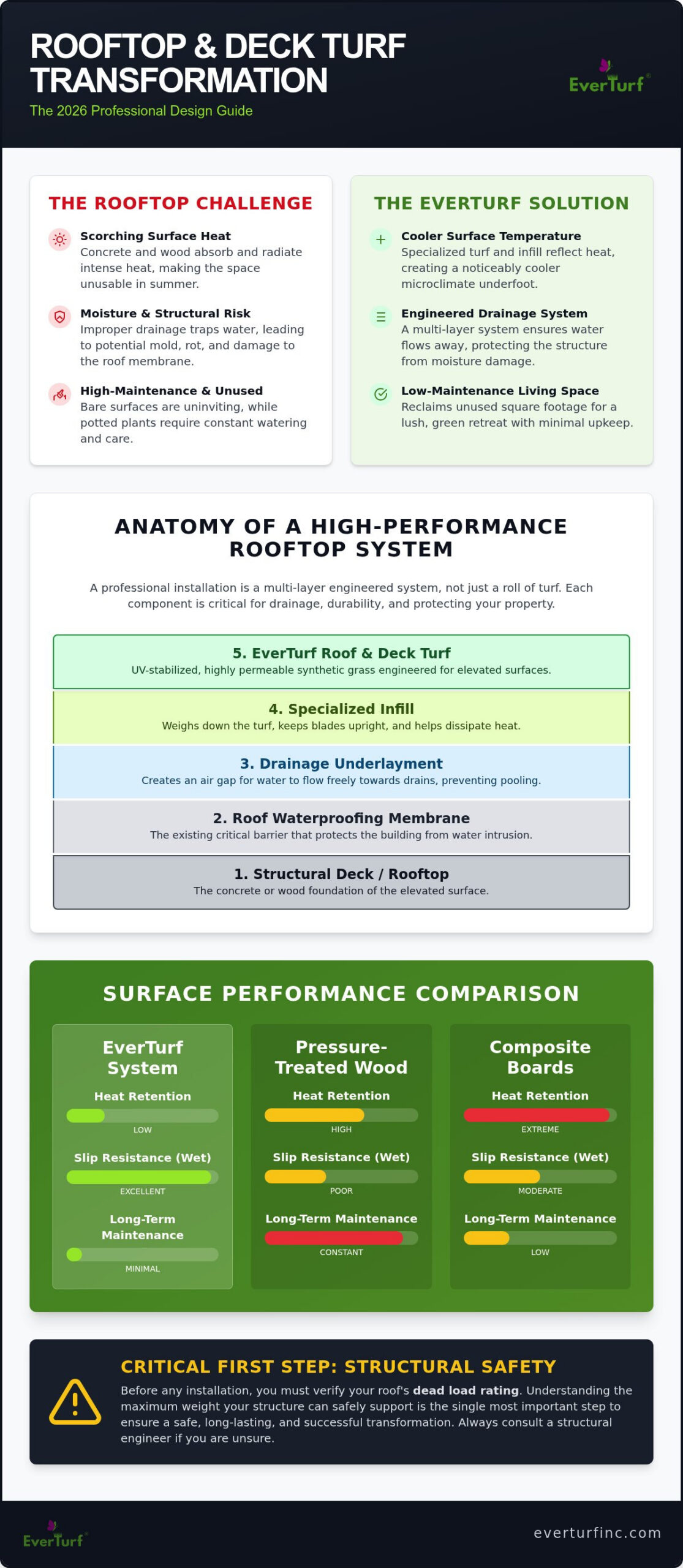
Rooftop-grade artificial grass for rooftops and decks requires a multi-layer approach. From the structural deck upward, a professional installation typically sequences through a root barrier or waterproof membrane, a drainage layer, the turf backing itself, and then infill. Each layer performs a distinct function. Remove one, and the system’s integrity degrades. This is why the “just lay turf on the deck” approach fails over time, regardless of how premium the turf itself might be.
UV degradation is the other hidden threat on exposed rooftops. Elevated surfaces receive unfiltered solar radiation for longer periods than shaded ground-level lawns. Without high-grade UV stabilizers woven into the fiber chemistry, turf fibers break down, fade, and become brittle within a few seasons. EverTurf Roof & Deck is engineered with UV stabilization designed for full-exposure environments, which is what separates a rooftop-grade product from a standard landscape roll dressed up with a premium price tag.
Advanced Drainage Solutions: Tiles vs. Perforated Backing
Drainage tiles create a raised void space beneath the turf, functioning like a perched water table that channels rainfall laterally toward existing gutters and scuppers rather than allowing it to saturate and stagnate. Perforated backings alone can move water vertically, but without that lateral flow channel, you’re still relying entirely on your roof’s slope to do the work. Permeability rate, in this context, refers to how quickly water passes through the turf system per square foot per hour, and on a rooftop, an inadequate rate creates hydrostatic pressure that can compromise waterproofing layers over time. Routing drainage correctly to existing scuppers and gutters isn’t optional; it’s the structural foundation of the entire installation. The EPA guidance on rooftop surface solutions and urban heat reduction reinforces why managing both water flow and surface temperature simultaneously is central to any responsible elevated surface design.
The Role of EverTurf Infill in Elevated Systems
Infill does something that surprises many homeowners: it acts as ballast. On high-rise decks and exposed rooftops, wind uplift is a genuine structural concern. Without sufficient weight distributed across the turf backing, edges lift, seams separate, and the entire surface can shift. EverTurf Infill adds the distributed mass that keeps the system anchored without requiring excessive mechanical fastening that could compromise a waterproof membrane. It also plays a meaningful role in heat dissipation, moderating surface temperatures on sunny decks by reducing the heat buildup that dense, infill-free turf can trap at the fiber base. For a deeper look at how infill selection shapes the long-term performance of any synthetic surface, the essential guide to turf infill breaks down the science in practical, actionable terms.
Choosing the right infill type for an elevated installation isn’t a minor detail. It’s one of the highest-leverage decisions in the entire project. Explore the full EverTurf system to understand how turf, infill, and drainage accessories work together as a unified, high-performance solution.
Comparing Surface Options: Why Synthetic Turf Outperforms Traditional Decking
Pressure-treated wood has a reputation problem that time keeps making worse. The initial cost looks reasonable, but the ongoing relationship with that surface is one of continuous maintenance: annual sealing, sanding down splinters that emerge after the first few seasons, replacing boards that warp or rot from moisture cycling. On an elevated deck where water has nowhere to drain naturally into soil, that degradation accelerates. And then there’s the barefoot experience, which, on a sun-baked dark-stained wood deck in July, borders on painful.
Composite decking solved the rot problem but introduced its own set of compromises. Dense composite boards absorb and retain heat at a rate that makes them genuinely uncomfortable on hot afternoons. Their smooth, hard surface also becomes dangerously slippery when wet, a real safety concern on any elevated surface. Neither material offers what artificial grass for rooftops and decks delivers as a baseline: a surface that stays cooler underfoot, provides natural slip resistance through its fiber texture, and requires no seasonal maintenance whatsoever.
The “soft fall” factor deserves serious consideration for families. Synthetic turf provides a cushioned surface that composite boards and wood simply cannot replicate. For households with young children playing on a rooftop or deck, or pets navigating a hard elevated platform, the difference between a fiber-cushioned surface and a rigid board underfoot is meaningful from both a comfort and an injury-prevention standpoint.
- Pressure-treated wood: Requires annual sealing, prone to splinter and warp, surface temperatures spike in direct sun
- Composite decking: Heat-retentive, slippery when wet, hard underfoot with no impact absorption
- Synthetic turf: Cooler surface temperature, slip-resistant fiber texture, cushioned underfoot, zero seasonal maintenance
Acoustic Benefits: Sound Dampening for Urban Peace
Composite decks have a distinctive hollow resonance. Every footstep announces itself, and in multi-story buildings, that impact noise transfers downward in ways that frustrate neighbors and undermine any sense of private retreat. Synthetic turf absorbs both ambient city noise and the percussive impact of foot traffic through its layered fiber and backing structure. The result is a noticeably quieter surface, one that muffles rather than amplifies, which is a lifestyle benefit that urban dwellers rarely anticipate but quickly come to value. It’s a quiet that composite boards simply cannot manufacture.
Pet-Friendly Rooftops: A Clean Sanctuary
Elevated pet spaces present a sanitation challenge that hard decking handles poorly. Waste sits on the surface, odor compounds, and cleaning requires real effort. A properly installed turf system routes liquid waste through the drainage layer and toward existing scuppers, which means odor doesn’t accumulate the way it does on wood or composite. Solid waste lifts cleanly from the fiber surface. Drainage is genuinely the single most important factor in keeping a pet deck odor-free long-term. For a complete look at how synthetic surfaces handle the full range of pet-specific demands, the complete guide to artificial grass for dogs covers everything from fiber selection to hygiene maintenance in practical detail.
Choosing artificial grass for rooftops and decks over traditional decking materials isn’t just an aesthetic decision. It’s a durability decision, a comfort decision, and for many urban households, a quality-of-life decision that pays dividends every single day the space is used.
Safe Installation: Protecting Your Structure and Ensuring Longevity
Before a single roll of artificial grass for rooftops and decks is laid, one question overrides every aesthetic decision: can your structure actually support the system? This isn’t a bureaucratic formality. It’s the foundational safety check that separates a successful long-term installation from a costly structural failure. Every rooftop has a dead load rating, which is the maximum static weight per square foot the structure can safely bear continuously. A complete turf system, including turf, infill, drainage layers, and any accessory components, adds distributed weight across the entire surface. Verifying that rating with a structural engineer before installation isn’t optional; it’s the responsible first step that protects your investment and everyone who uses the space.
Protecting the waterproof membrane beneath your installation deserves equal attention. Rooftop membranes are the invisible barrier between your living space and serious water damage, and they’re surprisingly vulnerable to punctures from mechanical fasteners. A professional installation routes any required fastening away from membrane layers and uses adhesive systems like EverTurf Staples and Glue strategically, keeping penetrations to a minimum and preserving the integrity of the waterproofing beneath.
Installing Turf on Wooden Decks: Preventing Rot
Wooden decks introduce a specific challenge that most installation guides gloss over entirely: breathability. Laying turf directly onto wood creates a sealed microclimate where moisture becomes trapped, and trapped moisture accelerates rot, mold, and structural decay far faster than an exposed deck ever would. The solution is a specialized underlay that creates an air gap between the turf backing and the wood surface, allowing moisture to move laterally and evaporate rather than saturate. When securing the turf to wooden decks, fasteners should anchor into framing members rather than decking boards alone, distributing load without weakening the structural connections the deck depends on.
Fire Safety and Building Codes
Rooftop installations face fire safety scrutiny that ground-level applications don’t. A Class A fire rating is the highest classification available for surface materials and indicates that a product resists flame spread and combustion under rigorous standardized testing. For commercial rooftops and many residential buildings, this certification isn’t a preference; it’s increasingly a code requirement that local building departments enforce at the permit stage. EverTurf Roof & Deck is engineered to meet demanding fire safety standards, giving homeowners and developers the documentation they need to move through the permitting process with confidence rather than uncertainty.
Getting the structural and safety fundamentals right from the start is what makes everything else, the design choices, the aesthetics, the long-term performance, actually work. Explore EverTurf’s complete rooftop system to understand how each component is designed to protect your structure while delivering a surface that performs beautifully for years.
Designing Your Urban Oasis with EverTurf Accessories
A rooftop covered in a single unbroken field of green is beautiful. A rooftop that combines synthetic turf with integrated pavers, defined zones, and thoughtful texture contrast is genuinely extraordinary. That’s the design gap most installation guides never address, and it’s exactly where EverTurf Pavers change the conversation entirely.
EverTurf Pavers are purpose-built to sit flush alongside EverTurf Roof & Deck turf, creating the kind of hardscape-softscape integration you’d expect from a high-end landscape architect. For professionals looking to master the visualization of such sophisticated projects, 3D STUDIOART offers specialized training in advanced architectural rendering.
Integrated Paver and Turf Designs
Laying EverTurf Pavers alongside synthetic turf requires one non-negotiable priority: level transitions. A height discrepancy between paver surface and turf pile creates a trip hazard and disrupts the visual continuity that makes mixed-material designs so compelling. The sequencing logic is straightforward: establish your paver grid first, confirm all units are level with each other, then fit turf panels to the remaining field. This approach lets you trim turf edges cleanly against the paver borders rather than cutting around an uneven reference point. Steppable turf paths, where pavers are set at intervals through a turf field, work particularly well on rooftops that serve both as lounge areas and as access routes to mechanical equipment or planters.
Finishing Touches and Maintenance
Seaming between turf panels and paver edges is where EverTurf Staples and Glue earns its role in the system. Adhesive application along paver borders locks turf edges in place without mechanical fasteners that could compromise the membrane beneath. The result is a seamless visual transition that holds through wind, foot traffic, and seasonal temperature swings.
Integrating planters and outdoor furniture into a turf-covered rooftop completes the softscape-hardscape balance. For seasonal events or festive transformations, Twilight Trees provides high-quality artificial trees that offer a lush, maintenance-free aesthetic without the weight or mess of real greenery. Position heavy furniture on paver sections where possible to avoid long-term fiber compression in the turf. Where furniture must sit on the turf itself, use wide-base feet to distribute weight and rotate placement periodically to prevent permanent matting.
Maintenance on artificial grass for rooftops and decks is refreshingly minimal. A stiff-bristle brush run against the grain every few weeks keeps fibers upright and looking lush. A light rinse clears dust and debris from the drainage layer. That’s genuinely the full routine for most installations.
- Brushing: Use a stiff-bristle or power broom against the grain every few weeks to maintain fiber resilience
- Rinsing: A light hose-down clears particulate buildup and keeps the drainage layer flowing freely
- Furniture placement: Prioritize paver zones for heavy pieces; use wide-base furniture feet on turf sections and rotate placement seasonally
Before committing to a full design plan, it’s worth understanding the complete investment picture. The 2026 buyer’s guide for installation costs breaks down synthetic grass pricing in practical, transparent terms so you can budget with confidence rather than guesswork. A well-designed rooftop doesn’t happen by accident; it happens when every component, turf, pavers, infill, and adhesive, is selected as part of a unified system. That’s the EverTurf approach, and it’s what separates a finished space from a finished surface.
Your Rooftop Retreat Is Ready to Be Built
The gap between a forgotten concrete slab and a genuine outdoor living space comes down to one decision: choosing a system engineered specifically for where it’s going to live. Artificial grass for rooftops and decks isn’t a workaround; it’s a precision solution backed by real engineering, from high-drainage backing that protects your membrane to Class A fire-rated options that satisfy building code requirements with confidence.
The EverTurf system approach matters here. Combining EverTurf Roof & Deck turf with EverTurf Infill for ballast and temperature regulation, then integrating EverTurf Pavers for defined hardscape zones, delivers a result that a turf-only installation simply can’t replicate. Every component earns its place in the design.
You’ve already spent enough time looking at a surface that isn’t working for you. The knowledge is here. The system exists. The next step is yours to take. Transform your rooftop with EverTurf Roof & Deck solutions today and start using every square foot of the space you already own.
Frequently Asked Questions About Artificial Grass for Rooftops and Decks
Is artificial grass too heavy for a standard roof or deck?
A complete turf system, including turf, infill, and drainage components, adds meaningful distributed weight to your structure, so verifying your roof’s dead load rating with a structural engineer before installation is essential. That rating tells you exactly how many pounds per square foot your structure can safely bear on a continuous basis. EverTurf Roof & Deck is engineered to minimize unnecessary bulk, but no installation should proceed without that structural confirmation first.
How does water drain through artificial grass on a flat roof?
Water moves through the perforated backing of the turf and into a drainage layer beneath it, which channels rainfall laterally toward existing scuppers and gutters rather than allowing it to pool or stagnate. The drainage layer creates a void space that keeps water moving even on a nearly flat surface. Routing that flow correctly to your roof’s existing drainage points is what protects the waterproof membrane beneath the entire system from hydrostatic pressure buildup over time.
Can I install artificial grass directly on a wooden deck?
Laying turf directly onto wood without an intermediate layer is one of the most common installation mistakes, and it accelerates rot significantly. Sealing turf against wood creates a trapped moisture environment where decay sets in far faster than it would on an exposed deck. A breathable underlay that creates an air gap between the turf backing and the wood surface allows moisture to move and evaporate rather than saturate. Fasteners should also anchor into framing members, not just surface boards, to distribute load properly.
Does artificial turf on a rooftop get hot in the summer?
Synthetic turf does absorb heat in direct sunlight, but it performs noticeably better than dense hardscape materials like composite decking or bare concrete, which radiate stored heat long after the sun moves. EverTurf Infill plays a meaningful role here by moderating surface temperatures at the fiber base rather than allowing heat to concentrate at ground level. Choosing lighter-colored turf and ensuring adequate infill distribution both help keep surface temperatures in a comfortable range on peak summer days.
Is artificial grass fire-resistant for rooftop use?
Fire safety is a legitimate concern for any rooftop surface material, and building codes in many jurisdictions now require a Class A fire rating for elevated installations. A Class A rating is the highest available classification and indicates the material resists flame spread under rigorous standardized testing. EverTurf Roof & Deck is engineered to meet demanding fire safety standards, which gives homeowners and developers the documentation needed to move through the permitting process confidently. Always confirm current local code requirements before finalizing your installation plan.
How do you clean dog urine from turf on a balcony or deck?
A properly installed turf system routes liquid waste through the drainage layer and toward existing scuppers, so routine urination doesn’t accumulate the way it does on wood or composite surfaces. For regular maintenance, a light rinse with water is typically sufficient to flush residual waste through the drainage layer. For odor control, a diluted enzyme-based cleaner applied periodically breaks down organic matter at the fiber level without damaging the turf backing. Solid waste lifts cleanly from the fiber surface and should be removed promptly before rinsing the area.
Will artificial grass damage my roof’s waterproof membrane?
The membrane itself is safe when installation is handled correctly. The primary risk comes from mechanical fasteners that penetrate the membrane surface, creating entry points for moisture. A professional installation using EverTurf Staples and Glue minimizes the need for membrane-penetrating fasteners by securing turf edges and seams with adhesive systems designed specifically for elevated applications. Any required mechanical anchoring should be planned carefully to avoid compromising the waterproofing layer that protects your entire structure.
How long does synthetic turf last on an exposed rooftop?
Rooftop-grade synthetic turf engineered with high-grade UV stabilizers typically lasts considerably longer than standard landscape turf placed in full-exposure conditions, where unfiltered solar radiation accelerates fiber breakdown and color fade. EverTurf Roof & Deck is built with UV stabilization designed specifically for full-exposure environments rather than partially shaded ground-level applications. Actual lifespan depends on installation quality, infill maintenance, and foot traffic levels, but a well-maintained system on a properly prepared surface is a long-term investment rather than a seasonal solution.