

How to Stop Dogs From Tracking Mud Inside: The Definitive Guide to a Mud-Free Home in 2026
What if you could finally retire the soggy towel by the back door and stop viewing a heavy rainstorm as a direct threat to your pristine hardwood floors? You love your dog’s spirit, but you likely don’t love the $200 professional grooming bills or the endless cycle of scrubbing dark stains out of your rugs. It’s a frustrating, time-consuming chore that steals your peace of mind and can even lead to irritated paw pads for your pet. Learning how to stop dogs from tracking mud inside shouldn’t feel like a losing battle against the elements.
You deserve a home that stays clean and a backyard that remains lush and vibrant regardless of the weather. This guide will show you how to eliminate the muddy paw cycle forever by combining immediate hygiene tactics with permanent, high-performance landscaping solutions. We’ll explore everything from the efficacy of $16 protective booties to why modern homeowners are investing an average of $5,778 in synthetic turf to reclaim their weekends and their sanity. Discover how to transform your property into a mud-free sanctuary where your pet can roam freely and your interior remains effortlessly flawless.
Key Takeaways
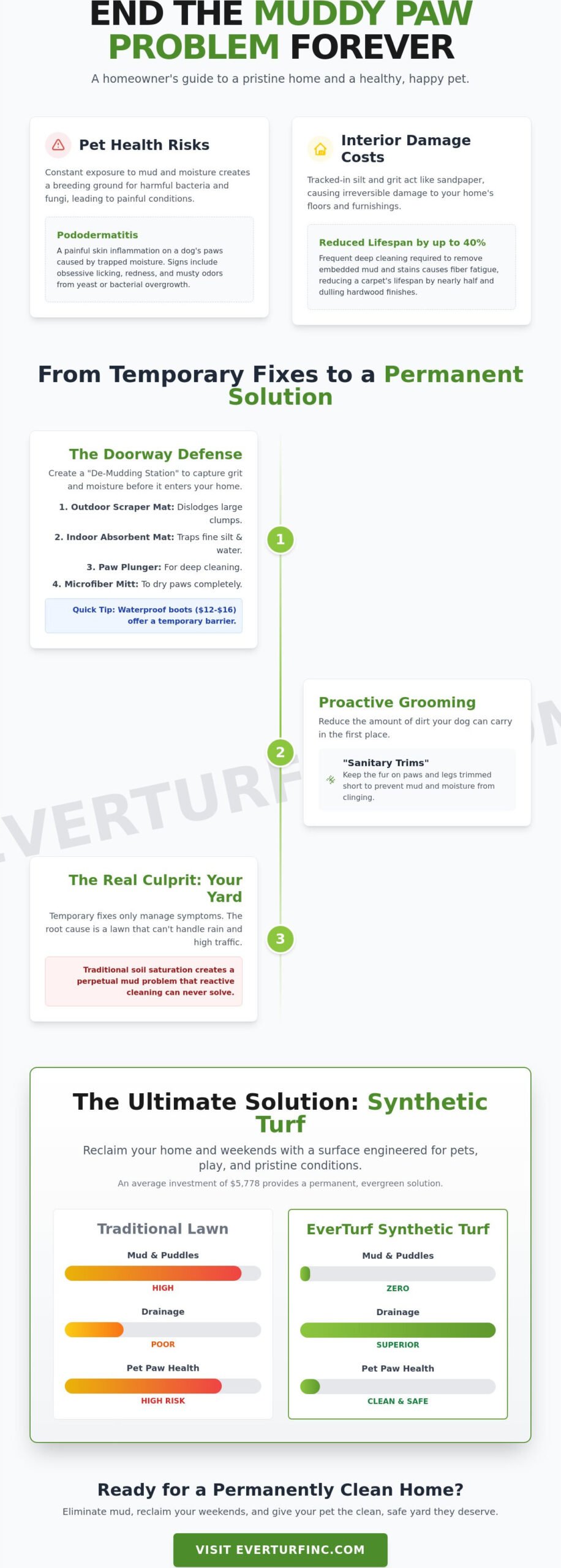
- Identify the hidden health risks of muddy paws, such as pododermatitis, and learn how to maintain a drier, healthier environment for your pet.
- Master the tiered mat system to create a professional-grade entry station that captures debris before it touches your hardwood or carpet.
- Discover how to stop dogs from tracking mud inside by using “Sanitary Trims” to reduce the amount of fur that traps moisture and dirt.
- Understand why traditional landscaping fails in high-traffic zones and how soil saturation creates a perpetual mud problem in your yard.
- Explore how antimicrobial synthetic turf with superior drainage provides a permanent, evergreen solution for active pet owners who value a pristine home.
The Muddy Paw Problem: Health Risks and Household Impact
Homeowners in 2026 recognize that a muddy entryway is more than a minor inconvenience; it’s a persistent threat to both family health and property value. With 94 million U.S. households now owning at least one pet, the struggle to maintain a pristine interior has reached a tipping point. When heavy rainfall saturates traditional soil, it creates a slurry of bacteria and fungi that hitches a ride on your pet’s paws directly into your living room. Understanding how to stop dogs from tracking mud inside is no longer just about aesthetics. It’s about breaking a cycle that degrades your home’s air quality and compromises your pet’s well-being.
The reality of reactive cleaning is that it’s a losing battle. By the time you reach for the towel, the damage is often already done. Silt and grit have already settled into floor crevices, and moisture has begun to seep into the delicate skin between your dog’s pads. This constant exposure to damp, contaminated earth creates a breeding ground for invisible threats that no amount of vacuuming can fully resolve.
Understanding Pododermatitis and Paw Hygiene
Pododermatitis is a common but painful inflammatory condition that affects the skin of a dog’s feet. You might notice your dog obsessively licking their paws, or you may detect a distinct, musty odor. These are often signs of yeast or bacterial overgrowth triggered by trapped moisture and soil. When mud remains lodged between the toes, it keeps the skin in a state of chronic dampness, weakening the natural barrier and inviting infection. Adhering to dog grooming best practices helps mitigate these risks, but the source of the moisture remains the primary enemy. In environments with persistent dampness or high humidity, this moisture rarely has a chance to evaporate, leading to persistent irritation for your pet.
The True Cost of Interior Mud Damage
The financial impact of tracked-in mud extends far beyond the price of a bottle of floor cleaner. Silt is essentially a collection of tiny, sharp minerals. When these particles are ground into hardwood floors by the weight of a running dog, they act like high-grit sandpaper, stripping away protective finishes and dulling the wood’s natural luster. Carpets fare even worse; frequent deep cleaning to remove deep-seated mud can reduce a carpet’s lifespan by as much as 40 percent due to fiber fatigue and backing degradation. The ‘mud cycle’ is a failure of yard drainage and surface integrity. Until you address the saturated ground outside, your interior will remain at the mercy of the next rainstorm.
Immediate Strategies for Managing Muddy Paws at the Doorway
Creating a seamless transition from the outdoors to your living room requires more than a simple towel. It demands a high-efficiency “De-Mudding Station” designed to intercept grit and moisture at the threshold. While the long-term goal is to re-engineer your landscape, managing the daily reality of wet weather starts with a structured protocol. By implementing a tiered entry system, you can significantly reduce the time spent scrubbing floors and protect your interior finishes from abrasive silt. Learning how to stop dogs from tracking mud inside effectively starts with capturing the debris before it ever crosses your floorboards.
Designing a Proactive Paw-Washing Station
A successful station follows a logical four-step process to ensure no mud bypasses the doorway. First, place a heavy-duty rubber scraper mat outside. This initial layer dislodges large clumps of mud and debris. Second, position a high-absorbency microfiber “noodle” mat immediately inside the threshold. These mats are engineered to trap moisture and fine silt that scrapers miss. Third, keep a silicone paw plunger filled with warm water and a drop of pet-safe shampoo ready for deeper cleaning. Finally, use a dedicated microfiber mitt to dry the paws thoroughly. This step is critical; leaving paws damp contributes to the moisture-related skin issues discussed in the previous section. Investing in a 12-pack of waterproof rubber boots, which typically retails between $12 and $16, can also serve as a temporary barrier during particularly swampy weeks.
The Best Materials for Indoor Mud Trapping
Not all mats are created equal. Microfiber is the gold standard for pet owners because it can absorb up to seven times its weight in water, far outperforming traditional cotton or synthetic fibers. For high-energy breeds that tend to bolt inside, “double matting” is essential. This involves using an extra-long runner to ensure the dog takes at least four full strides on absorbent material before reaching your hardwood or carpet. To maintain effectiveness, wash these mats weekly. Over-saturated fibers eventually stop absorbing and become secondary sources of dirt themselves. If you are tired of the constant maintenance required by these entry stations, considering a more permanent solution like artificial grass installation near me can resolve the issue before it reaches your door.
To prevent your dog from bypassing the station entirely, train them to “wait” at the door. Use a high-value treat to reward a calm sit on the mat while you perform the cleaning ritual. This behavioral boundary ensures you have the time to use tools like waterless shampoo or silicone plungers effectively. With the pet accessories market projected to grow by $9.2 billion by the end of 2025, there are more specialized tools than ever to help you master the art of the clean entry without turning your mudroom into a disaster zone.
Grooming and Training: Reducing Mud Retention on the Dog
While an efficient entryway station captures debris at the threshold, your dog’s physical coat often determines how much mud actually makes it to the door. Certain “mud-magnet” breeds with long leg feathers or dense undercoats can carry several cups of saturated soil within their fur. Addressing your dog’s grooming and behavior is a proactive step in how to stop dogs from tracking mud inside. By modifying the way your pet interacts with the outdoors, you reduce the sheer volume of debris they bring home and protect your living space from the ground up.
Strategic Trimming for Mud Prevention
A “Sanitary Trim” is one of the most effective ways to minimize mud retention. This involves keeping the hair between the paw pads flush with the pads themselves. Long hair in this area acts like a sponge, trapping grit and moisture that eventually leads to the skin irritations discussed earlier. Professional grooming services for an extra-large dog can cost $200 or more as of April 2026, but basic paw maintenance is manageable at home with the right tools. Use safety shears or a small electric trimmer to clear the “feathers” around the lower legs. Keeping nails short is equally vital; long nails encourage deeper digging into soft soil, which packs more mud into the paw structure. Recent data shows 76% of pet owners are now actively seeking wellness-focused products to improve their pets’ health, and maintaining short, clean paws is a cornerstone of that care.
Behavioral Fixes for Entryway Order
Training your dog to cooperate at the door transforms a chaotic struggle into a refined routine. Teach a solid “Wait” command so your pet remains on the absorbent matting while you prepare your cleaning tools. You can also train your dog to “Give Paw,” allowing you to clean each limb without a wrestling match. Create a positive association by offering a small treat once the cleaning is finished. This establishes a “settle” zone where your dog understands that the transition from the yard to the home requires a moment of stillness. Mastering these habits is a key part of how to stop dogs from tracking mud inside without causing stress for your pet. For those especially rainy afternoons, more durable individual dog booties made from 1000 Denier Cordura, priced at approximately $3.70 per bootie, can provide an impenetrable barrier. When you combine these behavioral habits with strategic grooming, you significantly lower the maintenance burden on your home’s interior.
Landscaping Solutions: Fixing the Mud at the Source
While entryway stations and grooming routines mitigate the mess, the most effective way to address how to stop dogs from tracking mud inside is to eliminate the mud at its origin. High-traffic zones, specifically the areas along fence lines or near back doors where dogs frequently run, are the first places where natural grass fails. Once the turf is gone, the exposed soil becomes a permanent mud factory every time it rains. Re-engineering these spaces requires a shift from reactive cleaning to proactive property management, focusing on surface integrity and advanced drainage.
Homeowners often struggle with soil saturation because repeated pet traffic compacts the earth, pressing soil particles together until they become as dense as concrete. This compaction prevents water from soaking into the ground, leading to stagnant pools that can sit for days. Stagnant water creates the anaerobic conditions that lead to smelly mud. If your yard fails a simple percolation test, where water sits in a dug hole for more than four hours, your landscape is essentially a swamp waiting to happen.
Comparing Ground Cover Options for Pet Areas
Many homeowners turn to traditional ground covers to mask muddy spots, but these often introduce new frustrations. Dark bark mulch, priced at approximately $47.00 per yard as of 2026, is a common choice, yet it frequently tracks into the house on fur and can cause painful splinters in paw pads. Pea gravel, which averages $58.00 per yard, offers superior drainage but tends to scatter into the lawn and can be uncomfortably hot for pets in the Florida sun. Flagstone and EverTurf Pavers provide a more permanent solution, though natural stone can become dangerously slippery when wet. While these materials are better than open dirt, they rarely offer the seamless, low-maintenance beauty of a fully engineered surface.
Addressing Drainage and Soil Compaction
To truly fix a muddy yard, you must address the grading and sub-surface water flow. Installing French drains or adjusting the slope of your yard can direct heavy rainfall away from pet zones, but these projects can be labor-intensive and expensive. The average cost of professional landscaping in 2026 ranges from $3,300 to $13,200, depending on the complexity of the drainage issues. If you’re tired of the constant cycle of digging and filling, it’s time to consider a surface that doesn’t rely on fragile natural grass. Transitioning to a high-performance artificial grass installation ensures that your yard remains pristine and permeable, regardless of how many laps your dog runs. By removing the soil from the equation entirely, you solve the mystery of how to stop dogs from tracking mud inside once and for all.
The Permanent Fix: Why Synthetic Turf is the Ultimate Solution
While entryway stations and grooming routines offer temporary relief, they don’t solve the core issue: the presence of exposed, saturated soil. To truly master how to stop dogs from tracking mud inside, you must replace the source of the problem with a surface engineered for high performance. Synthetic turf doesn’t just cover the dirt; it eliminates the possibility of mud by creating a sophisticated barrier that remains permeable and pristine regardless of rainfall. In regions like Florida, where heavy downpours are a weekly occurrence, the science of drainage becomes the most critical factor in maintaining a clean home. The “Ever” in our name isn’t just a prefix; it’s a promise of a permanent, evergreen sanctuary.
EverTurf’s systems are designed with a high-flow permeable backing that allows water to move through the surface at a rate far exceeding natural soil’s percolation capacity. While natural grass often fails in high-traffic pet zones, leading to the anaerobic, smelly conditions mentioned earlier, synthetic options maintain their structural integrity. This drainage science is the reason why your yard stays dry while your neighbor’s natural lawn remains a swamp for days after a storm.
Engineered for Dogs: EverTurf’s Specialized Solutions
The secret to a successful pet installation lies in the details of the assembly. EverTurf Infill is a vital component of this system, providing the necessary stability and antimicrobial protection to manage odors and keep the blades upright. Unlike traditional sod, which turns into a slurry under the pressure of running paws, artificial grass for dogs offers a durable, vibrant sanctuary. It resists digging and remains lush even in the face of heavy use and intense UV rays. This specialized engineering ensures your pet stays clean, dry, and healthy, significantly reducing the risk of the moisture-related skin issues discussed in previous sections.
Transitioning to a Mud-Free Lifestyle
Choosing backyard turf is the most effective way to stop tracking mud inside because it breaks the cycle of dirt and moisture at the threshold. Beyond the immediate hygiene benefits, the return on investment is substantial. Consider the long-term savings on floor repairs, professional carpet cleaning, and those $200 grooming bills. Most importantly, you reclaim your weekends. Instead of scrubbing paws and mopping floors, you can finally enjoy a lush, maintenance-free outdoor oasis with your family. The transition to a synthetic lawn is a lifestyle enhancement that pays dividends in peace of mind and property value. You’ll no longer dread the rain or panic when your dog runs for the door. Request a quote from EverTurf Inc to transform your muddy yard today and experience the tranquility of a truly permanent, mud-free solution.
Reclaim Your Pristine Home and Everlasting Green Space
Mastering how to stop dogs from tracking mud inside involves more than just keeping a towel by the door; it’s about re-engineering your lifestyle for permanent tranquility. You’ve learned that while high-efficiency entry stations and strategic grooming are effective immediate steps, they don’t address the root cause of saturated soil and poor drainage. By choosing a surface that remains lush and mud-free, you protect your home’s interior and your pet’s health simultaneously. The days of scrubbing silt out of your hardwood floors are finally over.
Imagine a yard that stays vibrant through every storm and an entryway that remains effortlessly clean. EverTurf provides advanced drainage technology designed for heavy rainfall and utilizes antimicrobial EverTurf Infill to ensure a safe, odor-free environment for your dog. With a 15+ year lifespan, this investment offers a sophisticated return that natural sod simply can’t match. Transform your muddy backyard into an evergreen sanctuary with EverTurf Inc. and enjoy the lasting beauty of a stress-free property. Your journey toward a pristine, mud-free home starts with a single, rewarding choice.
Frequently Asked Questions
What is the best ground cover for a muddy dog run?
High-performance synthetic turf is the premier choice for muddy dog runs because it eliminates soil contact entirely. While traditional options like mulch or gravel require constant replenishment and can track debris, artificial grass provides a stable, evergreen surface. It features superior drainage that handles heavy rainfall, ensuring your pet stays clean even after a Florida downpour. This permanent solution transforms a high-traffic eyesore into a pristine, low-maintenance asset for your home.
Can certain dog breeds be more prone to tracking mud than others?
Long-haired breeds and those with dense undercoats are significantly more prone to becoming “mud-magnets” during wet weather. Dogs like Golden Retrievers or Spaniels have long “feathers” on their legs that trap saturated soil, while breeds with thick hair between their paw pads carry moisture deep into the house. Understanding how to stop dogs from tracking mud inside often involves targeted grooming to reduce this surface area, preventing your pet from acting as a sponge for outdoor debris.
How do I stop my dog from digging in the mud?
The most effective way to stop a dog from digging in the mud is to remove their access to exposed soil. Dogs are often drawn to soft, damp earth for cooling or instinctual behavior; however, once you install a durable synthetic surface, the temptation vanishes. High-quality turf stands up to active paws and prevents the creation of holes that trap stagnant water. This structural integrity keeps your landscape level and your pet’s paws free from the grime of excavated dirt.
Is artificial grass safe for dogs to use as a bathroom?
Artificial grass is perfectly safe and highly efficient for pet bathroom use when equipped with antimicrobial infill and a permeable backing. These systems allow liquid waste to drain instantly through the turf into the sub-base, preventing puddles and odors from lingering on the surface. Unlike natural grass, which develops yellow “burn” spots from nitrogen, synthetic turf remains vibrant and lush. Regular rinsing with a hose is all that’s required to maintain a fresh, hygienic outdoor environment.
How much does it cost to fix a muddy backyard permanently?
Fixing a muddy backyard permanently through professional artificial grass installation costs an average of $5,778 as of April 2026. Most homeowners pay between $1,300 and $15,000, with the price per square foot typically ranging from $5.45 to $20 according to industry data from Lawn Love. This investment covers the necessary excavation, drainage preparation, and high-quality materials required to eliminate mud forever. While the upfront cost is higher than temporary fixes, the long-term ROI comes from reclaiming your weekends.
What happens if my dog’s muddy paws aren’t cleaned properly?
Neglecting to clean muddy paws properly can lead to painful pododermatitis and chronic fungal infections between the toes. Trapped moisture weakens the skin’s natural barrier, allowing bacteria from saturated soil to cause inflammation and odor. Beyond health risks, uncleaned paws track abrasive silt into your home. This grit acts like sandpaper on hardwood finishes and can reduce the lifespan of your carpets by 40 percent due to fiber degradation and deep-seated staining.
Do dog boots actually help with mud prevention?
Dog boots are an excellent temporary tool for mud prevention, especially during the wettest months of the year. A 12-pack of waterproof rubber boots typically has an MSRP between $12 and $16, providing an affordable barrier for daily walks. For more active dogs, individual booties made from 1000 Denier Cordura offer increased durability at approximately $3.70 each. These accessories are a great secondary defense while you plan more permanent landscaping solutions to address how to stop dogs from tracking mud inside.
How often should I clean my dog’s paw-washing station?
You should clean the components of your paw-washing station at least once a week to ensure they remain effective. Microfiber mats can absorb seven times their weight in water, but once they reach saturation, they become a source of mud themselves rather than a trap. If you use a silicone paw plunger, change the water after every use to prevent bacterial growth. Regular maintenance ensures your entryway station remains a hygienic barrier rather than a contributor to the very problem you’re trying to solve.