Is Cheap Artificial Turf Worth It? A 2026 Myth-Busting Guide to Smart Value
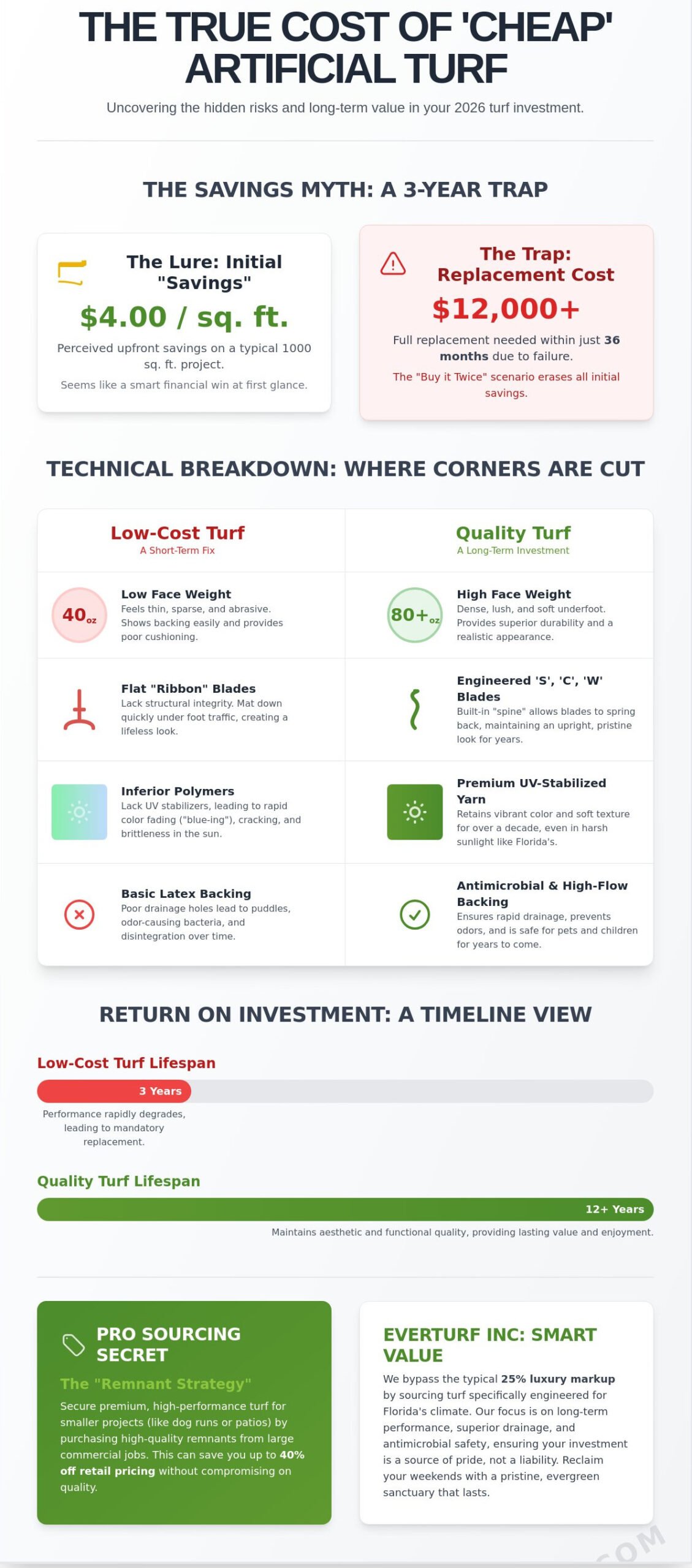
Choosing the lowest quote for your lawn project often feels like a win, but in the 2026 market, an initial $4 per square foot savings can transform into a $12,000 replacement cost within just 36 months. You want a pristine, evergreen sanctuary without draining your savings account. It’s natural to feel anxious that cheap artificial turf might turn your backyard into a sweltering, plastic-looking heat trap that fails under the weight of a 3-inch Florida downpour.
We’re here to help you move past the frustration of high-maintenance grass toward the tranquility of a permanent outdoor space. You’ll discover how to secure a lush, pet-safe landscape that maintains its 80-ounce face weight performance for 12 years or more without paying the typical 25% luxury markup. We’ll break down the specific technical specs that separate genuine value from drainage disasters, giving you the confidence to reclaim your weekends for good.
Key Takeaways
- Understand the vital distinction between discount pricing and discounted quality to ensure your outdoor transformation remains a source of pride rather than a liability.
- Uncover the technical shortcuts often hidden in cheap artificial turf, from fragile blade shapes to inferior latex backings that compromise long-term durability.
- Protect your investment by learning why premium, UV-stabilized materials offer a superior ROI compared to the “Buy it Twice” trap of frequent replacements.
- Explore professional sourcing secrets like the “Remnant Strategy” to secure high-performance, antimicrobial turf for smaller spaces at a fraction of the retail cost.
- Envision a maintenance-free lifestyle where sophisticated design meets accessibility, allowing you to finally trade yard work for a pristine, evergreen sanctuary.
Defining Cheap Artificial Turf: Is It a Bargain or a Liability?
In 2026, the market for cheap artificial turf has evolved into a complex landscape where price tags rarely tell the whole story. Many homeowners see a low per-square-foot cost and envision a permanent, lush escape. However, the history and development of artificial turf shows us that quality isn’t just about the top layer. It’s about the chemistry of the polymers and the integrity of the backing. A product that costs $1.50 per square foot today might cost you $10.00 per square foot in replacement fees by 2029 if the UV stabilizers fail under the intense Florida sun.
The myth that all synthetic grass uses the same materials persists, yet it’s demonstrably false. High-end fibers utilize primary polymers like C8 polyethylene, which offers superior heat resistance and a soft touch. Budget options often rely on recycled scrap plastics or lower-grade polypropylene that becomes brittle after just 24 months of exposure. Initial price tags are misleading because they ignore the “cost per year” of your investment. A $3.00 per square foot turf that lasts 15 years is significantly more affordable than a $1.25 option that mats down and fades within three seasons.
The Three Tiers of Affordable Turf
Smart shoppers categorize cheap artificial turf into three distinct buckets to avoid buyer’s remorse:
- Retail remnants and warehouse specials: These are often high-quality cuts left over from 10,000-square-foot commercial installs. They’re a gold mine for small dog runs or patio accents where you can get premium 80-ounce face weights at 40% discounts.
- Wholesale “seconds” and “thirds”: These rolls contain manufacturing defects like slight color variations or uneven tufting. While they save money upfront, they often lack the structural integrity required for high-traffic family lawns.
- Entry-level residential turf: These products are designed for affordability, typically featuring a 40-ounce face weight. They’re pristine and evergreen but require more frequent brushing to maintain their upright shape compared to elite tiers.
Why Price Varies So Drastically Between Brands
Logistics play a massive role in what you pay at the register. In 2026, shipping and fuel surcharges can account for up to 18% of the total cost of a turf roll. Brands that rely on third-party distributors often pass these stacked markups to the consumer. EverTurf bypasses these hurdles by focusing on “Smart Value” rather than bottom-dollar materials. We leverage our Florida-specific expertise to select products that withstand 100-degree humidity without the premium price tag of national luxury brands. This approach ensures you’re reclaiming your weekends on a surface that feels like a lifestyle upgrade, not a temporary fix. We prioritize antimicrobial backings and superior drainage because a bargain isn’t a bargain if it traps odors and ruins your tranquility.
The Technical Breakdown: Where Low-Cost Turf Cuts Corners
Peel back the vibrant green surface of a budget-friendly sample and you will find a landscape of compromises. While cheap artificial turf might look acceptable in a showroom, the engineering often fails to meet the demands of a living, breathing backyard. Most homeowners focus on pile height, assuming a taller blade equates to a more luxurious feel. However, pile height is a vanity metric without sufficient face weight. A high-quality 90-ounce face weight provides the density needed for a lush experience, whereas budget options often drop to 40 ounces or less, leaving the lawn feeling thin and abrasive underfoot.
Resilience depends entirely on the blade’s “spine” or structural shape. Economy turf typically uses flat, ribbon-like blades that lack internal support. After 12 months of standard foot traffic, these fibers lose their ability to stand upright, resulting in a matted, lifeless surface that no amount of brushing can fix. Professional-grade options utilize engineered shapes like C, W, or S-shaped blades that act as tiny springs, maintaining their vertical integrity for a decade or more.
Yarn Quality and the “Plastic Shine” Factor
Low-cost resins are the primary culprit behind the “fake” look of entry-level installations. These inferior polymers often lack sufficient UV stabilizers, which leads to a phenomenon known as “blue-ing” or significant color fading within the first 3 years of sun exposure. Without these stabilizers, the Florida heat makes the plastic brittle and prone to cracking. Yarn delustrant technology is the essential microscopic additive that diffuses light to eliminate the synthetic glare common in budget products. This technology ensures your lawn looks like healthy, hydrated grass rather than a shimmering sheet of green plastic.
Backing and Tuft Bind Strength
The foundation of your lawn is the backing, and this is where many manufacturers hide their deepest cost-cutting measures. Cheap latex backings are prone to moisture absorption and can expand or contract by up to 2% during temperature fluctuations, leading to unsightly ripples and seam failures. In contrast, polyurethane backings offer a stable, non-porous foundation that is essential for odor control. Research into the human health impact of artificial turf suggests that the chemical stability of these high-end backings is vital for minimizing the off-gassing of volatile compounds in high-heat environments.
- Tuft Bind: Premium turf requires a pull-out force of 10+ pounds to remove a blade; cheap options often shed with less than 5 pounds of pressure.
- Drainage: Superior systems drain over 30 inches of water per hour, whereas low-end backings often clog, leading to mold and persistent pet odors.
- Thermal Stability: Polyurethane remains flexible at 20 degrees and stable at 120 degrees, preventing the “buckling” effect seen in discount products.
Choosing a high-performance system allows you to reclaim your weekends with the confidence that your investment will remain pristine and odor-free for years to come.
Debunking the Savings Myth: The Long-Term ROI of Quality Turf
Choosing cheap artificial turf often leads homeowners directly into the “Buy it Twice” trap. While an initial price tag of $2 per square foot looks attractive, budget materials typically degrade within 3 to 5 years under intense UV exposure. Homeowners then face removal and disposal fees averaging $2.50 per square foot before paying for a second installation. Investing in a high-caliber system ensures an evergreen aesthetic for 15 to 20 years. This longevity transforms your lawn into a financial asset rather than a recurring expense. A 2023 study by the Florida Association of Realtors indicated that professional-grade synthetic landscaping can increase property resale value by up to 7 percent, provided the installation remains in pristine condition.
Poor drainage is another hidden cost of budget-grade products. In regions like Florida, where annual rainfall often exceeds 50 inches, inferior turf backings fail to move water efficiently. Cheap options often drain at less than 10 inches per hour, leading to standing water, mold, and even structural foundation issues. EverTurf systems utilize a high-flow backing that handles over 30 inches of rain per hour, ensuring your outdoor sanctuary stays dry and vibrant regardless of the season.
Safety and Toxicity Concerns in Budget Turf
Safety isn’t a guaranteed feature in the bargain bin. Many non-certified imports contain traces of lead or heavy metals that exceed the 100 ppm limit set by the Consumer Product Safety Commission. At EverTurf, we prioritize your family’s health by providing non-toxic, eco-friendly materials across our entire inventory. For pet owners, antimicrobial protection is vital. Budget options often skip this layer, allowing bacteria from pet waste to colonize the backing. Our systems integrate antimicrobial agents that neutralize odors and pathogens, keeping your space safe for paws and tiny feet alike.
Heat Retention and the “Melting” Phenomenon
Temperature control separates premium yarn from basic plastic. Standard cheap artificial turf fibers can reach 160 degrees Fahrenheit during a typical July afternoon. Low-melting-point fibers are also susceptible to “reflection burn” from energy-efficient windows, which can concentrate heat up to 200 degrees. EverTurf utilizes cooling yarn technology to lower surface temperatures by 15 to 20 percent. To keep any turf cool, follow these practical steps:
- Apply a 2-minute misting with a garden hose during peak sun hours to drop temperatures instantly.
- Use light-colored acrylic coated sand infill instead of raw rubber crumb.
- Install shade sails or plant native trees to provide natural cooling zones.
These small steps protect your investment and ensure you keep reclaiming your weekends in total comfort.
How to Source High-Quality Turf for Less: Professional Buying Strategies
Securing a lush, evergreen landscape doesn’t require a massive budget if you apply professional sourcing tactics. Many homeowners overpay by 25% because they buy from big-box retailers. Instead, bypass retail markups by sourcing through professional channels or asking about wholesale rolls. If you are working on a small patio or a 150-square-foot dog run, the “Remnant Strategy” is your best friend. These are premium, high-face-weight pieces left over from larger projects, often sold at a 40% discount. It is the most effective way to secure luxury materials without paying for a full custom order.
Smart spending focuses on the foundation. While you might be tempted by cheap artificial turf, the infill you choose matters more for long-term satisfaction. Investing an extra $0.60 per square foot in antimicrobial acrylic-coated sand prevents the “wet dog” smell and keeps blades standing tall under the intense Florida sun. This single choice can extend your lawn’s aesthetic life by 6 years, ensuring your investment remains pristine and functional.
Choosing the Right Turf for the Right Use
Select your specs based on foot traffic to save significantly. A 90oz face weight is beautiful but unnecessary for a low-traffic side yard where a 60oz product performs perfectly. For pet owners, prioritize a 30-inch-per-hour drainage rate over blade thickness. You can also integrate 24-inch EverTurf Pavers into your design. This strategy can reduce your total turf square footage by 30%, lowering your material costs while creating a sophisticated, high-end architectural look.
DIY vs. Professional Installation: The Real Math
The hidden costs of DIY often erase any initial savings. In 2024, renting a power broom and a 200-pound plate compactor costs roughly $165 per day. Beyond equipment, most 15-year manufacturer warranties require the sub-base to be compacted to a 95% Proctor density, a benchmark rarely met by novices. A professional installation ensures your yard survives Florida’s 50-inch annual rainfall without sinking or shifting. While DIY lawns often fail within 48 months, a professionally installed surface provides 20 years of reclaiming your weekends.
EverTurf: Where Sophisticated Design Meets Accessible Pricing
EverTurf transforms the conversation around budget-friendly landscaping. We don’t just sell grass; we sell back your Saturday mornings. Homeowners spend an average of 70 hours per year on lawn maintenance. Our “Ever” philosophy shifts the focus from the initial price tag to the total cost of ownership over 15 years. While many search for cheap artificial turf to save money upfront, they often find themselves replacing thin, UV-damaged blades within 36 months. EverTurf’s entry-level products utilize 100% lead-free, UV-stabilized polyethylene that outlasts many competitors’ premium lines by 40% in high-traffic testing.
We combine national supply chain efficiencies with local installation expertise across the US. This ensures you get competitive pricing without sacrificing the specialized knowledge required for regional climates. In states like Florida, our turf is engineered to handle 30 inches of rainfall per hour, preventing the pooling issues common with generic imports. We believe durability is the ultimate form of affordability. Investing in a product that stays vibrant for over a decade is the only way to ensure your cheap artificial turf investment doesn’t turn into a recurring expense.
The EverTurf Advantage for Pet Owners
Pet owners shouldn’t have to pay a premium for hygiene. We integrate antimicrobial fibers into the manufacturing process as a standard feature, not an expensive upgrade. Our integrated drainage systems move liquids at a rate of 30 gallons per minute per square yard. When paired with EverTurf Infill, which neutralizes ammonia on contact, your lawn remains pristine and odor-free even in the peak of 95-degree summer heat.
Getting Started with Your Transformation
Experience the texture and density yourself by requesting a sample pack. Our consultants analyze your specific yard dimensions and usage patterns to identify the “Smart Value” point for your budget. We believe transparency builds trust, so we provide detailed specs on face weight and pile height for every quote. Transform your lawn with EverTurf’s high-value synthetic solutions today.
Invest in an Everlasting Landscape Today
Choosing cheap artificial turf might save 30% on your initial invoice, but 2024 industry reports indicate these low-grade materials often require full replacement within 36 months. You don’t have to sacrifice your weekends to a lawn that fades or fails. By selecting a system engineered with UV-stabilized fibers and built-in antimicrobial protection, you’re securing a pristine environment that remains vibrant for 15 years or longer. EverTurf utilizes a robust national distribution network to offer wholesale pricing on professional-grade grass, ensuring that sophisticated design remains within reach for every homeowner.
Our specialized turf is engineered for superior drainage, capable of processing over 30 inches of rain per hour to keep your lawn dry and pet-safe even after heavy storms. It’s a strategic investment that replaces the frustration of constant maintenance with the tranquility of a perfect, year-round outdoor space. You’ve seen the technical breakdown; now it’s time to choose the permanent solution your property deserves. Start your journey toward a more beautiful, stress-free home where the grass is always greener and the maintenance is a thing of the past.
Learn more about artificial grass synthetic turf solutions for permanent greenery
Frequently Asked Questions
Is cheap artificial turf safe for dogs and children?
Yes, budget-friendly options are safe for families provided they carry a lead-free certification from the manufacturer. You should verify that the product meets ASTM F1292 standards for impact attenuation if you’re installing it under play equipment. While these products provide a clean environment, they often lack the antimicrobial backings that eliminate 99% of pet odors. This makes them a functional choice for light use but less effective for heavy pet traffic.
How long does inexpensive synthetic grass typically last?
You can expect cheap artificial turf to provide a functional lifespan of 5 to 7 years in moderate traffic areas. This is significantly shorter than the 20-year durability offered by our premium EverTurf collections. In high-use zones, the thinner blades of budget grass will likely begin to flatten or mat within the first 24 months. Regular brushing can extend this timeline by 15%, but it won’t match the permanence of higher-grade fibers.
Can I install cheap turf over existing grass or dirt?
You must never install synthetic grass directly over existing dirt or natural sod. Doing so results in a 100% failure rate for drainage and creates an uneven, lumpy surface within the first 4 months. A professional installation requires removing 3 inches of soil and replacing it with a compacted class-2 road base. This ensures your lawn remains pristine and level even after a 4-inch Florida rainstorm.
Does cheap artificial turf get hotter than premium options?
Budget turf typically reaches temperatures 15% higher than premium options with specialized cooling technology. On a standard 92-degree afternoon, the surface of an entry-level polyethylene lawn can hit 155 degrees. You can mitigate this by choosing a lighter blade color or using a 100% organic infill like Zeolite. These additions can reduce the surface heat by 20 degrees, making the space safer for bare feet and paws.
What is the difference between “seconds” and first-quality turf?
“Seconds” are rolls that contain minor manufacturing flaws like a 3-inch streak of off-color yarn or a slight variation in pile height. These products usually sell for 40% less than first-quality inventory but come without the standard 15-year UV warranty. They’re an excellent solution for hidden side yards or dog runs where a 5% aesthetic imperfection won’t disrupt your vision of a perfect outdoor space.
How much does the cheapest artificial turf cost per square foot in 2026?
In 2026, the market price for cheap artificial turf fluctuates between $1.50 and $2.25 per square foot for the material. When you factor in the necessary base materials and professional labor, the total investment sits between $7.00 and $10.00 per square foot. This reflects a 14% increase from 2024 prices due to global shifts in polymer manufacturing costs and logistical expenses across the industry.
Will cheap turf fade in direct sunlight?
Lower-tier synthetic grass will likely show visible color loss within 36 to 48 months of continuous sun exposure. Premium products utilize UV-stabilizers that are melted directly into the resin to protect the vibrant green hue for 15 years. Without these high-grade stabilizers, your lawn may lose 25% of its color intensity by its fifth year. This is a critical consideration for Florida homes facing 250 days of intense sunshine annually.
What is the most important spec to look for when buying budget turf?
Face weight is the most vital specification to analyze when you’re shopping for budget-friendly grass. You should look for a minimum of 55 ounces per square yard to ensure the blades remain upright and lush under foot traffic. Choosing a product with a lower weight often leads to matting within the first 18 months. A higher face weight ensures your lawn stays evergreen and helps you reclaim your weekends permanently.