
Artificial Grass vs. Real Grass Pros and Cons: The 2026 Homeowner’s Guide
What if your weekend didn’t start with a loud lawnmower and end with muddy paw prints tracked across your hardwood floors? For many homeowners, the dream of a lush lawn has become a “time tax” that demands constant weeding, feeding, and high summer water bills. When weighing artificial grass vs real grass pros and cons, it’s easy to feel torn between the classic appeal of sod and the modern efficiency of synthetic turf. You likely want a beautiful space for your family, but the reality of Stage 2 water restrictions and brown patches makes traditional maintenance feel like a losing battle.
This guide evaluates the true cost, lifestyle impact, and performance of EverTurf artificial grass versus natural sod to help you choose the best foundation for your home. We’ll look at why homeowners typically see their investment pay for itself within five to seven years through reduced utility costs and near-zero maintenance. From the latest cooling technologies to the hyper-realistic textures of 2026, you’ll discover how a sophisticated landscape can restore your personal time while providing a pristine, year-round green sanctuary for your family and pets.
Key Takeaways
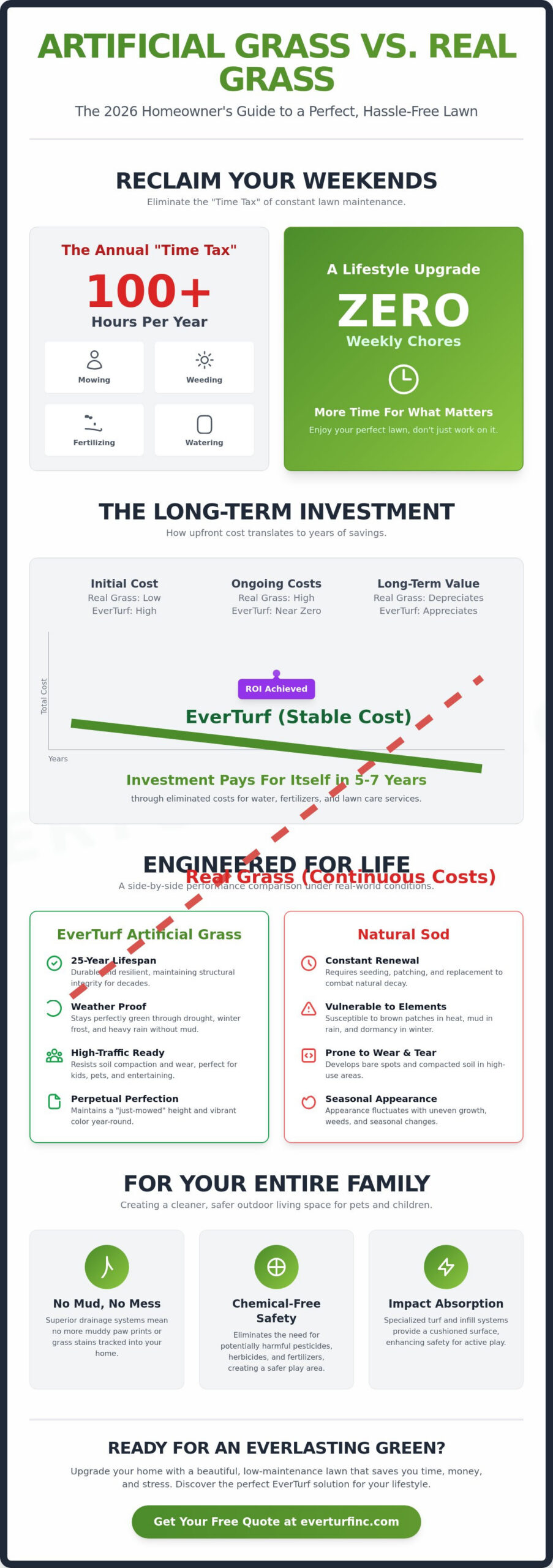
- Reclaim your weekends by eliminating the 100-hour annual “Time Tax” spent on maintenance, turning your yard into a true outdoor sanctuary.
- Evaluate the artificial grass vs real grass pros and cons to understand how synthetic turf stays pristine even during severe water restrictions.
- Analyze the five-to-seven-year economic ROI that comes from eliminating irrigation, chemical fertilizers, and professional lawn care services.
- Explore specialized EverTurf Play and Pet solutions designed for superior drainage, hygiene, and impact safety for your whole family.
- Identify the technical benchmarks for durability and permeability that ensure your landscape remains beautiful and functional for up to 25 years.
The Philosophy of the 2026 American Lawn: Real vs. Synthetic
The American lawn is undergoing a fundamental transformation. In 2026, we no longer view our yards as mere decorative patches meant to be admired from a distance. Instead, homeowners see their outdoor areas as functional living spaces; they are essentially outdoor rooms where life happens. This shift in perspective makes the artificial grass vs real grass pros and cons debate more relevant than ever. While natural sod represents an “Aspirational Green” that looks beautiful in professional photos, it often falls short of the “Everlasting Green” required by modern, active families.
Maintaining a traditional lawn requires an average of over 100 hours of labor every year. We call this the “Time Tax.” It is a recurring debt paid in Saturday mornings lost to mowing and Sunday afternoons spent weeding. By contrasting these two options, we can evaluate which foundation best supports your lifestyle, your budget, and your local environment. This guide sets the stage for a side-by-side comparison that looks past the surface to analyze the long-term economics and ecological impact of your landscape choice.
The Hidden Costs of Natural Sod
Natural sod is a demanding tenant. Beyond the initial installation, the resource drain is relentless. You are constantly purchasing specialized fertilizers, herbicides, and gasoline for noisy equipment. Seasonal volatility adds another layer of frustration. One summer heatwave can turn a lush yard into a field of brittle brown patches. A week of rain transforms it into a muddy mess that ruins your interior flooring and leaves your pets covered in grime. It is a maintenance cycle that never truly ends because living grass is always in a state of growth or decay. This instability forces homeowners into a reactive lifestyle, always fixing the next problem rather than enjoying the space.
The Synthetic Paradigm Shift
Today’s artificial grass represents a complete paradigm shift. It is a permanent architectural foundation, not just a surface cover. For busy professionals, this means moving toward a low-maintenance lifestyle where the yard is always ready for guests. The history and development of artificial turf shows a massive leap from the abrasive products of the mid-20th century. Modern synthetic fibers offer multi-tonal realism and integrated thatch layers. When evaluating artificial grass vs real grass pros and cons, the aesthetic consistency of synthetic turf is a major victory. It provides a lush, vibrant environment that remains unchanged by drought or winter frost, allowing you to reclaim your weekends for the things that truly matter.
Performance Metrics: A Side-by-Side Comparison
When you step onto your lawn, you expect resilience. Whether it is a Saturday morning soccer game or a heavy summer downpour, the surface must hold up. Analyzing artificial grass vs real grass pros and cons requires looking at how these materials perform under pressure. Natural sod often fails when foot traffic increases; the soil compacts, roots suffocate, and bare patches emerge. In contrast, EverTurf products are engineered for high-performance durability. They maintain their structural integrity even in high-traffic zones, ensuring your yard remains a functional asset rather than a fragile display.
A common concern with synthetic surfaces is heat retention. However, 2026 cooling technology has revolutionized this aspect. Modern heat-resistant turf can stay up to 30 degrees cooler than older synthetic products by using IR-reflective fibers. When paired with specialized turf infill, which provides evaporative cooling, the surface remains comfortable for bare feet and paws alike. This infill also acts as the “ballast” of your lawn, keeping blades upright and resilient against crushing. It’s a technical solution that addresses the physical demands of a modern outdoor lifestyle.
Aesthetics and Year-Round Appeal
Natural grass is subject to the whims of the calendar. During winter dormancy, even the best-maintained lawns turn a dull, straw-like brown. EverTurf offers a “Perpetual Spring” that ignores the seasons. Using multi-tonal blade technology, these systems mimic the subtle color variations of local grass species, providing a lush look that feels authentic. Because synthetic turf doesn’t grow, it maintains a perfect, “just-mowed” height every hour of the day. You don’t have to worry about the uneven growth or shaggy edges that often plague real sod between mowings.
Durability and Drainage Tech
Drainage is where professional engineering truly shines. While natural soil can become saturated and turn into a muddy swamp, high-quality synthetic systems utilize a sophisticated “Grid” backing. This allows for superior water permeability, often outperforming natural earth in heavy rain. It’s a vital distinction because poor drainage leads to odors and mold in low-quality installs. While we must consider the broader environmental impact of artificial lawns regarding microplastics, the reduction in chemical runoff from fertilizers provides a significant trade-off for many homeowners.
Achieving this level of performance depends entirely on the foundation. Professional artificial grass installation ensures that seams are invisible and the base is perfectly leveled. This precision eliminates the puddling and compaction issues that typically ruin the longevity of a natural lawn. By choosing a high-performance architectural foundation, you are investing in a space that works as hard as you do, regardless of the weather or the season.
Environmental Stewardship and Economic ROI
Choosing between a living landscape and a synthetic one involves more than just picking a shade of green. It requires a balanced look at artificial grass vs real grass pros and cons through the lens of long-term sustainability. While critics often focus on the material composition of synthetic turf, a sophisticated analysis must include the massive resource consumption required to keep natural sod alive. Modern homeowners are increasingly adopting the concept of “Responsible Synthetic Landscaping.” This approach recognizes that in an era of permanent water restrictions, a high-performance foundation can actually be the more ecologically sound choice for many properties.
Beyond the environmental impact, the economic reality of lawn ownership has shifted. The days of “cheap” natural grass are gone; they’ve been replaced by rising utility rates and the high cost of professional maintenance. When we evaluate the financial trajectory over a 15-year period, the “front-loaded” nature of synthetic turf begins to look like a wise capital improvement rather than a mere expense. By eliminating the recurring “slow-bleed” costs of traditional landscaping, you create a predictable financial future for your property.
Water Conservation and Chemical Runoff
The environmental math for natural grass is becoming difficult to justify in drought-prone regions. A typical 1,000-square-foot residential lawn requires between 30,000 and 40,000 gallons of water every year to stay healthy. Considering that outdoor irrigation accounts for 30% to 60% of residential water use in many areas, switching to EverTurf provides immediate relief to the local grid. This transition also allows you to retire gas-powered lawn equipment, significantly reducing your household’s carbon footprint.
Perhaps most importantly, synthetic turf eliminates the need for the chemical cocktail required by sod. You no longer have to worry about pesticides, herbicides, or synthetic fertilizers leaching into local groundwater. A study published by MDPI regarding environmental effects and health risks highlights the complex trade-offs between different surfacing materials, but for many, the removal of nitrogen runoff and chemical exposure is a decisive victory for family safety and local ecology.
The 15-Year Financial Breakdown
Understanding the true artificial grass vs real grass pros and cons requires a look at your bank statement. While the initial artificial turf installation cost is higher than laying sod, the maintenance gap widens every year. Maintaining natural grass professionally can cost between $2,400 and $5,000 annually when you factor in fertilization, aeration, and irrigation repairs. In contrast, synthetic turf maintenance typically stays between $150 and $350 per year.
Landscape ROI is the specific financial milestone where the accumulated savings from eliminated water bills and maintenance fees equal your initial investment. For most homeowners, this break-even point occurs within five to seven years. Beyond that window, your lawn essentially pays you back every month. Additionally, a pristine, low-maintenance yard often increases property value, as modern buyers prioritize “turn-key” outdoor spaces that don’t come with a mandatory weekend work schedule.
Lifestyle Impact: Pets, Play, and Family Safety
The daily lived experience of your yard is where technical specifications meet reality. When evaluating artificial grass vs real grass pros and cons, the most immediate impact is often felt by those who share the space with pets and children. Natural sod, while traditional, often serves as a breeding ground for allergens, pests, and the inevitable mud that finds its way into your home. Synthetic surfaces provide a clean, indoor-quality foundation that extends your living space outside, regardless of the weather or the activity level of your family. It’s a fundamental shift from a yard you have to manage to a yard you can actually use.
The Pet-Friendly Yard Revolution
For many, the biggest hurdle in switching to synthetic turf is the concern over hygiene and odors. Traditional natural grass holds onto moisture and waste, leading to bacteria buildup and patchy, yellowed areas that are impossible to repair. High-performance artificial grass for dogs solves this through a combination of antimicrobial infills and rapid-flow drainage. These infills work to neutralize odors at the source rather than simply masking them with fragrances.
Maintenance becomes a simple “rinse-and-go” routine. You no longer have to spend your weekends patching holes from aggressive diggers or scrubbing mud out of the carpet after a rainstorm. EverTurf systems are built to withstand the most active pets, providing a durable sanctuary that stays green and pristine. This level of cleanliness is a major relief for homeowners who are tired of the constant battle against brown spots and muddy paw prints.
Safe Play Zones for Children
The safety of our youngest family members is paramount. Playground-grade synthetic turf utilizes “Soft-Landing” technology, which provides a fall-height-rated surface that is much more forgiving than compacted soil or dry, dormant grass. This engineering eliminates hidden dangers like deep holes, sharp rocks, or pests like fire ants and ticks that often thrive in natural lawns. It creates a predictable, level surface that reduces the risk of trips and falls during active play.
Beyond physical safety, synthetic surfaces are naturally allergen-free. There is no grass pollen to trigger hay fever and no risk of grass stings or itchy skin after an afternoon of tumbling. You’re creating a controlled environment where children can explore without the usual baggage of a natural yard. This transformation turns your property into a high-performance play zone that is as safe as it is beautiful, allowing for year-round outdoor activity without the mess.
If you’re ready to upgrade your family’s outdoor experience, explore our professional artificial grass installation near me to find a solution tailored to your specific lifestyle needs.
Choosing Your Path: Real Sod or EverTurf?
Deciding on the foundation of your property is a pivotal choice that shapes how you’ll spend your weekends for the next two decades. As we’ve explored the artificial grass vs real grass pros and cons, it becomes clear that the “best” option depends on your hierarchy of needs. For many, the transition to backyard turf is more than a landscaping project; it’s a strategic move to reclaim time and eliminate the recurring stress of a failing lawn. By evaluating your lifestyle through the lens of time, budget, and long-term utility, you can determine which path leads to a more tranquil home environment.
To help finalize your decision, consider this final checklist for your property:
- Maintenance Appetite: Do you find genuine joy in the physical labor of lawn care, or does mowing feel like an exhausting chore?
- Climate Resilience: Are you prepared to manage brown, dormant patches during the inevitable summer droughts and water restrictions?
- Indoor Cleanliness: How much value do you place on eliminating the mud, pests, and allergens that pets and children track inside?
- Long-Term Value: Is your priority the lowest possible upfront cost, or are you looking for a capital improvement that pays for itself over time?
When Real Grass Makes Sense
While synthetic solutions offer unmatched efficiency, natural sod still holds a place for specific homeowners. If you are a hobbyist gardener who finds genuine joy in the science of soil health, fertilization, and seasonal planting, the labor might feel like an investment rather than a burden. There is an undeniable emotional connection to the smell of freshly cut grass and the tactile nature of living landscapes for some. For those who view their lawn as an active, evolving project rather than a finished living space, natural grass remains the traditional choice. We encourage homeowners to be honest about how much labor they are truly willing to provide over the next decade before committing to a living yard.
The EverTurf Advantage
For those who value a sophisticated, permanent solution, EverTurf Inc provides a high-performance transition. From the professional-grade texture of EverTurf Putting Green Pro to our specialized residential lines, we focus on quality that lasts. A common pitfall in the artificial grass vs real grass pros and cons debate is the assumption that all synthetic turf is created equal. High-quality fibers and professional installation are the keys to ensuring your yard looks like a lush sanctuary rather than a plastic substitute. Poorly executed DIY projects often lead to visible seams and drainage failures that undermine the beauty of the product.
We position ourselves as your partner in this transformation, helping you create a stress-free environment that looks perfect 365 days a year. If you’re ready to restore your personal time and enjoy a pristine outdoor space, connect with EverTurf to evaluate your landscape transformation and take the first step toward an everlasting green.
Design an Everlasting Foundation for Your Home
Choosing the right foundation for your property is about more than just surface aesthetics; it is about reclaiming your personal time and investing in a stress-free future. We have seen how the shift toward high-performance synthetic turf addresses the modern challenges of water scarcity, the “time tax” of maintenance, and the daily mess of muddy paws. When you evaluate the artificial grass vs real grass pros and cons, the choice becomes clear for those who prioritize a pristine, year-round environment that works as hard as they do. Whether you are looking for specialized Pet and Play systems or pro-grade putting green solutions, the transition to a low-maintenance landscape offers a sense of relief that traditional sod simply cannot match.
EverTurf Inc provides the expertise and national distribution and installation support needed to ensure your property reaches its full potential. You don’t have to settle for brown patches or seasonal mud when a permanent, beautiful solution is within reach. It is time to stop managing your yard and start living in it. Reclaim your weekends with EverTurf’s high-performance synthetic solutions. We look forward to helping you envision a more beautiful and worry-free version of your outdoor space.
Frequently Asked Questions
Is artificial grass better for the environment than real grass?
The environmental impact of your lawn depends on your regional priorities. While synthetic turf is a petroleum-based product, it eliminates the need for 30,000 to 40,000 gallons of water per year for a typical 1,000-square-foot yard. It also prevents chemical pesticides and nitrogen-heavy fertilizers from leaching into local groundwater. For homeowners in drought-stricken areas, removing the demand for constant irrigation and gas-powered mowing often outweighs the footprint of the material itself.
Does artificial turf get too hot for dogs and children in the summer?
Modern synthetic surfaces remain manageable even in high temperatures through advanced cooling technologies. New IR-reflective fibers can keep surfaces up to 30 degrees cooler than older turf products. When you use specialized evaporative cooling infills, the system retains moisture to lower the surface temperature through a natural process similar to sweating. This ensures the yard remains a comfortable space for bare feet and paws during peak summer months.
How long does artificial grass last compared to a natural lawn?
Quality residential synthetic turf typically provides a lifespan of 15 to 25 years. While a natural lawn can technically live indefinitely, it requires constant renovation, reseeding, and seasonal repairs to maintain its health. Synthetic turf offers a fixed lifecycle of consistent beauty without the risk of disease or total die-off. This longevity makes it a permanent architectural foundation for your property rather than a temporary botanical display.
Does artificial turf require any maintenance at all?
Synthetic turf requires minimal but consistent care to keep the fibers upright and the surface clean. You’ll need to occasionally brush the blades with a power broom to prevent matting in high-traffic zones. Removing organic debris like leaves and rinsing pet areas with water helps maintain the drainage system’s efficiency. This routine takes a fraction of the time required for mowing and weeding; it restores your weekends while keeping the yard pristine.
Can I install artificial grass over my existing real grass?
No; you cannot install synthetic turf directly over living grass or organic soil. A successful installation requires removing the existing sod and excavating several inches to make room for a compacted crushed stone base. This stable foundation is essential for proper drainage and prevents the surface from shifting or wrinkling over time. Skipping this step leads to mold growth and an uneven surface that undermines the durability of your investment.
What is the best type of infill for a pet-friendly synthetic lawn?
Antimicrobial acrylic-coated sand or volcanic minerals like Zeolite are the superior choices for pet owners. These materials are specifically engineered to capture and neutralize the ammonia in pet urine, preventing odors from building up in the turf backing. Unlike standard silica sand, these specialized infills don’t absorb moisture or harbor bacteria. This creates a hygienic environment that stays fresh even with multiple pets using the yard daily.
Does synthetic turf increase the resale value of my home?
A professionally installed lawn often boosts home resale value by significantly enhancing curb appeal and offering “turn-key” convenience. Modern buyers prioritize low-maintenance outdoor spaces that don’t require a large water budget or a weekend work schedule. In regions with strict water conservation laws, a yard that stays green year-round is a high-value asset. It positions your property as a sophisticated, worry-free option compared to homes with dormant or struggling natural grass.
How does the cost of artificial turf compare to sod over 10 years?
The long-term artificial grass vs real grass pros and cons clearly favor synthetic turf when you analyze the 10-year financial trajectory. While natural sod is cheaper to install, the accumulated costs of professional mowing, fertilization, and irrigation can reach $50,000 over a decade. Synthetic turf typically pays for itself within five to seven years through utility savings. Beyond that break-even point, your landscape essentially becomes a cost-saving feature for your household budget.