Artificial Grass Return on Investment Calculator: Is Synthetic Turf Worth the Switch in 2026?
By the start of 2026, many homeowners will spend over 150 hours a year and a projected 15% more on water utilities just to keep a natural lawn from succumbing to the heat. It’s a relentless cycle of rising costs and stolen Saturdays. You likely already feel the frustration of watching your hard-earned money vanish into fertilizers, sod replacements, and monthly landscaping fees that never seem to end. You deserve a pristine, vibrant outdoor space that serves your lifestyle rather than demanding your labor. Our artificial grass return on investment calculator provides the data you need to justify this premium home improvement by revealing your precise payback timeline.
In this guide, we analyze the shifting financial landscape of 2026 to show how synthetic turf transforms from a luxury spend into a savvy long-term asset. You’ll discover the exact year your investment breaks even and how to reclaim your weekends for good. We’re moving beyond simple math to explore the tranquility of an evergreen yard that stays lush through heavy rainfall and scorching sun. It’s time to see how a permanent, UV-stabilized solution provides both financial relief and a more beautiful version of your property.
Key Takeaways
- Identify the hidden “subscription costs” of natural grass and learn how to transition from a depreciating asset to a pristine, evergreen landscape.
- Utilize our artificial grass return on investment calculator framework to pinpoint your exact payback period by weighing premium materials against decades of maintenance savings.
- Reclaim your weekends and your wallet by comparing the “Zero-Water” benefits of EverTurf Inc systems against the escalating costs of traditional sod.
- Discover how regional climate factors and specialized turf selections, such as EverTurf Inc Play, can significantly accelerate your financial returns.
- Learn why investing in UV-stabilized, professional-grade materials is the essential step for securing a permanent, worry-free outdoor sanctuary.
Table of Contents
- Beyond the Green: Why Your Natural Lawn is a Financial Leak
- The Artificial Grass ROI Framework: Upfront Costs vs. Decades of Savings
- Reclaiming Your Time and Wallet: A Side-by-Side Financial Comparison
- Variable Factors: How Climate and Lifestyle Impact Your Payback
- Maximizing Your Investment with EverTurf High-Performance Systems
Beyond the Green: Why Your Natural Lawn is a Financial Leak
Stop viewing your lawn as a simple landscape feature and start seeing it for what it truly is: a high-interest subscription service. By 2026, maintaining a natural lawn feels less like homeownership and more like paying a “maintenance tax” that never expires. While traditional sod is a depreciating asset that requires constant, expensive resuscitation, a synthetic landscape represents a strategic shift toward permanence. At EverTurf, we approach this transition as a Reliable Visionary. It’s about moving away from the cycle of temporary fixes and toward a lifestyle defined by pristine, evergreen beauty. By using an artificial grass return on investment calculator, you can finally visualize how these recurring leaks drain your household budget over a 10 or 20 year horizon.
The true value of your outdoor space rests on three distinct pillars: direct financial savings, reclaimed personal time, and long-term property appreciation. When one pillar fails, the others crumble. A brown, patchy lawn doesn’t just look poor; it actively devalues your home and steals your weekends. Investing in a permanent solution isn’t just an aesthetic choice. It’s a calculated move to protect your most valuable asset from the rising costs of traditional upkeep.
The Escalating Costs of Water and Chemicals
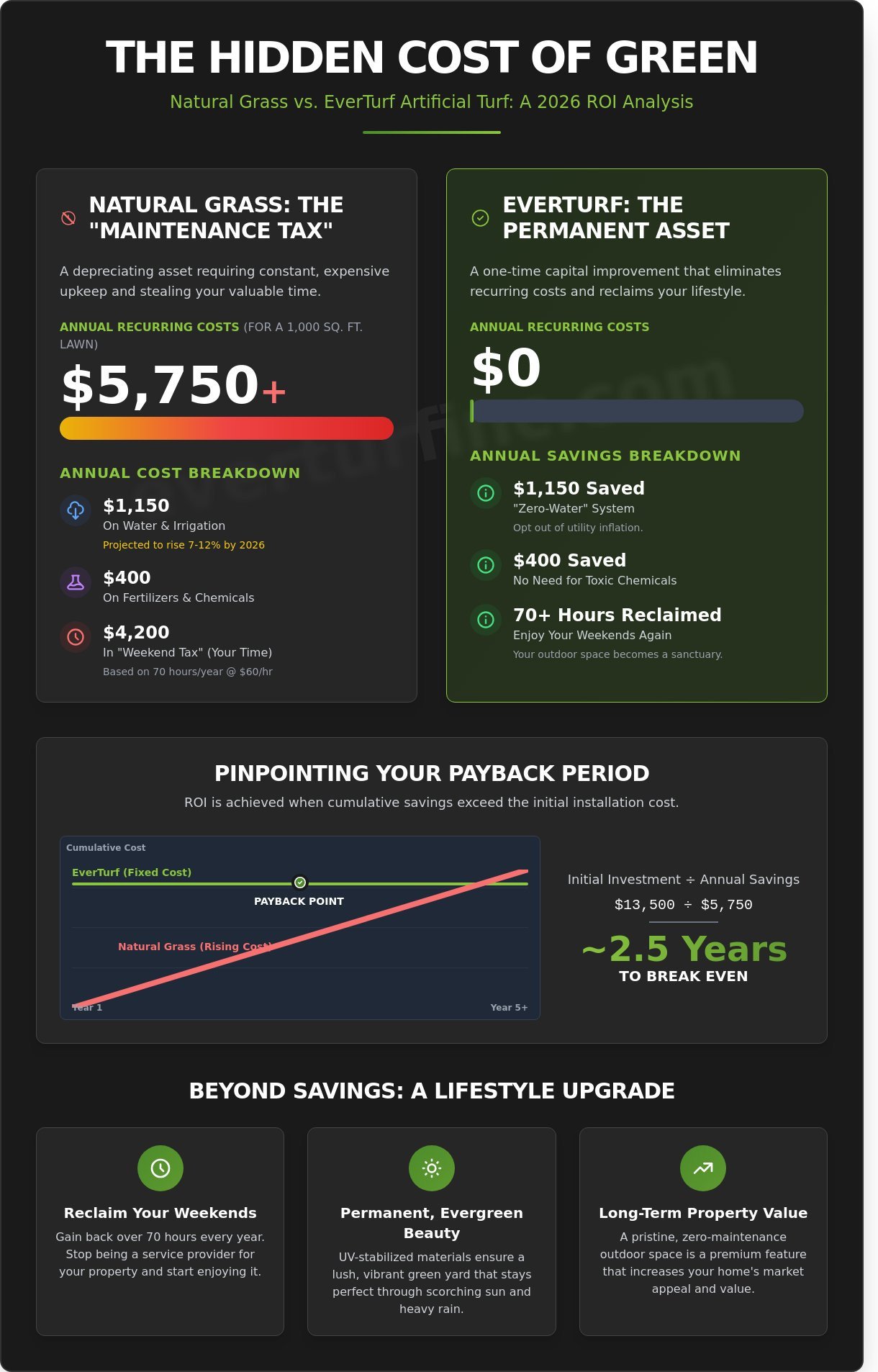
Water rates in 2026 are projected to rise by 7% to 12% in key regions like California and Texas as municipal infrastructures struggle with demand. For a standard 1,000 sq. ft. lawn, this translates to an average annual irrigation cost of $1,150. When you factor in the $400 spent on specialized eco-friendly fertilizers and seasonal herbicides, the “maintenance tax” exceeds $1,500 annually. For those seeking a comprehensive overview of artificial turf, the data shows that the upfront cost is rapidly offset by the total elimination of these volatile utility and chemical fees. You’re effectively opting out of utility inflation.
The ‘Weekend Tax’: Evaluating Your Time
The average homeowner spends approximately 70 hours per year on basic lawn care like mowing, edging, and weeding. If you value your personal time at a conservative $60 per hour, you’re paying a $4,200 “weekend tax” every single year. You’ve essentially become a service provider for your own property instead of a lifestyle enjoyer. Transitioning to a synthetic lawn stops this labor drain immediately. When you input these hours into an artificial grass return on investment calculator, the most striking result isn’t just the cash saved. It’s the hundreds of hours of leisure you reclaim for family and relaxation. Your outdoor space should be a sanctuary of tranquility, not a source of unpaid labor.
The Artificial Grass ROI Framework: Upfront Costs vs. Decades of Savings
Your lawn should be an asset, not a constant drain on your time and finances. When you use an artificial grass return on investment calculator, the data reveals a compelling story of rapid recovery and long-term gain. High-quality synthetic turf isn’t just a purchase; it’s a strategic capital improvement for your property that pays dividends in both currency and lifestyle tranquility.
Anatomy of the Upfront Investment
The initial cost of an EverTurf installation covers more than just the vibrant green blades. It includes a sophisticated engineering layer designed to withstand heavy Florida rainfall and intense UV exposure. A significant portion of your investment goes toward professional base preparation and specialized drainage systems, which ensure your lawn stays level and dry for decades. We utilize premium hardware like EverTurf Staples and high-strength Glue to secure the perimeter, preventing the shifting or lifting that often plagues budget installations.
ROI is the point where cumulative maintenance savings exceed the initial installation cost.
By 2026, the cost of premium materials is projected to rise to approximately $13.50 per square foot, making an immediate transition more financially sound than waiting. While budget turf options might tempt homeowners at $7.00 per square foot, these products often degrade by year 4, leading to costly replacements. This Brazos ISD cost comparison illustrates how professional-grade turf systems significantly outperform natural grass in total cost of ownership over a 10-year period.
Projecting 10 and 20-Year Savings Cycles
Most Florida homeowners reach the “Break-Even” point by year 5.4. After this milestone, every dollar that previously went to irrigation, fertilizers, and professional mowing becomes pure savings. This data serves as the foundation for a reliable artificial grass return on investment calculator. Reclaiming your weekends from the noise of lawnmowers is the emotional dividend that accompanies these financial gains.
- Year 1-5: Recovery of the initial $9,000 to $16,000 investment through eliminated water bills and landscaping fees.
- Year 10: Cumulative savings often reach 165% of the original project cost.
- Year 20: A pristine, UV-stabilized EverTurf lawn continues to provide value, often retaining a residual property appraisal boost of 3% to 7% due to its permanent curb appeal.
The “Ever” in our name represents a 15-25 year horizon of peak performance. Choosing a durable, antimicrobial system ensures your outdoor sanctuary remains evergreen without the recurring headache of renovation. You can explore our premium turf options to see which style best fits your long-term financial vision.
Reclaiming Your Time and Wallet: A Side-by-Side Financial Comparison
Transitioning from high-maintenance natural sod to an EverTurf synthetic system shifts your backyard from a recurring liability to a permanent asset. While traditional lawns demand a continuous stream of cash for survival, synthetic turf offers a predictable, front-loaded investment. You can use our artificial grass return on investment calculator to see exactly how these numbers scale for your specific property size and local utility rates.
In regions with strict water conservation mandates, the “Zero-Water” benefit provides immediate relief. A University of Illinois Extension analysis notes that while the initial installation requires more capital, the drastic reduction in resource consumption creates a sustainable financial path. For Florida homeowners, this means skipping the $150 monthly irrigation spike during the dry season and avoiding the $500 annual bill for professional pest control and fertilization.
The 20-Year Cost Comparison Table
| Expense Category | Natural Sod (20 Years) | EverTurf System (20 Years) |
|---|---|---|
| Initial Installation | $2,500 (Basic) | $10,000 (Premium) |
| Water & Irrigation | $14,400 ($60/mo avg) | $0 |
| Mowing & Trimming | $24,000 ($100/mo svc) | $0 |
| Fertilizer & Aeration | $8,000 ($400/yr) | $0 |
| Total Investment | $48,900 | $10,000 |
The “Evergreen Advantage” represents more than just the $38,900 in potential savings. It’s the $0 spent on seasonal revival after a heatwave. Pet owners find additional value in antimicrobial layers that prevent mud from entering the home, which reduces professional carpet cleaning costs by roughly 40% annually. It also eliminates the need for expensive vet treatments for ticks or lawn-chemical allergies.
Property Value and Aesthetic ROI
Curb appeal isn’t just a buzzword; it’s a financial metric. Real estate data suggests that professional landscaping can increase a home’s resale value by 7% to 15%. In a competitive market, a yard that remains lush and vibrant while neighbors struggle with brown patches is a powerful differentiator. By reclaiming the backyard as a functional outdoor room, you’re effectively increasing your home’s usable square footage. This pristine environment appeals to modern buyers who prioritize low-maintenance lifestyles, ensuring your artificial grass return on investment calculator results reflect both monthly savings and long-term equity growth.
Variable Factors: How Climate and Lifestyle Impact Your Payback
Your results on an artificial grass return on investment calculator will fluctuate based on where you live and how you play. While the average homeowner sees a full break-even point within 4 to 6 years, specific environmental pressures and lifestyle choices can slash that timeline. Your lawn isn’t just a patch of green; it’s a managed asset that responds to the local economy and climate.
The ROI of Specialized Turf Systems
Choosing a specialized system like EverTurf Play or Putting Green Pro changes your financial equation. If you spend $150 per round at a local country club, a backyard green pays for itself in under 36 months through saved green fees and travel costs. EverTurf Play systems focus on safety, utilizing shock-absorbing layers that reduce long-term liability and maintenance costs for families. For pet owners, the ROI comes from our 100% permeable backing and antimicrobial infill. These features prevent the $500 professional deep-cleanings often required for inferior products that trap odors.
Geographic ‘Fast-Track’ ROI Zones
Location dictates your “water tax.” In San Ramon, CA, strict water mandates and tiered pricing make synthetic turf a financial necessity. In Richardson, TX, homeowners often face $250 monthly water bills during 100-degree August heatwaves just to keep natural fescue from dying. Our Florida-specific UV-stabilized technology thrives in high humidity and intense sun, preventing the premature fading that limits the 15-year lifespan of generic brands. By choosing materials designed for your specific zip code, you protect the integrity of your investment against extreme weather.
Check your local 2026 water district guidelines for “Turf Replacement” credits before you begin. Many municipalities now offer rebates ranging from $2.00 to $6.00 per square foot. These incentives, combined with the total elimination of mowers, edgers, and seasonal fertilizers, ensure your investment remains pristine and profitable. Yard complexity also shifts the needle. Integrating custom pavers or complex drainage might increase initial installation costs by 18%, but these structural upgrades boost your property value more significantly than a simple turf patch. Use an artificial grass return on investment calculator to see how these local rebates accelerate your path to a worry-free lawn.
Ready to stop spending your Saturdays on yard work? Start your transformation today to reclaim your weekends and lock in long-term savings with a lush, evergreen landscape.
Maximizing Your Investment with EverTurf High-Performance Systems
Securing a high return on your property starts with the quality of the fiber. Choosing a high face weight of 75 ounces or more ensures your lawn remains plush under heavy foot traffic. EverTurf systems utilize UV-stabilized polyethylene, which prevents the 100-degree Florida sun from making your blades brittle or faded. When you invest in professional-grade supply, you’re not just buying a product; you’re installing a permanent architectural feature that maintains its value for decades.
Extending your lawn’s life beyond the 20-year mark requires minimal but strategic care. We recommend a quick brushing of the fibers every 90 days to prevent matting in high-traffic zones. Periodically rinsing the surface clears away dust and keeps the antimicrobial backing performing at peak efficiency. These simple habits protect the structural integrity of the system, ensuring your artificial grass return on investment calculator results remain accurate for the long haul.
The Danger of ‘Cheap’ Turf: Why it Kills ROI
Budget-grade turf often fails within 36 to 60 months, forcing a full replacement that effectively doubles your initial cost. Inferior latex backings frequently crumble in high humidity, leading to drainage failures and stagnant water issues. EverTurf eliminates this risk with a robust 15-year warranty. We provide the logical evidence and technical specifications needed to justify a premium investment, ensuring your outdoor space stays pristine without the threat of premature degradation.
Ready to Reclaim Your Weekend?
Visualize a Saturday morning free from the drone of a lawnmower or the stress of rising water bills. The transition to a synthetic lawn offers a profound sense of relief and long-term satisfaction. By using our artificial grass return on investment calculator, you can see exactly how many months it takes for your lawn to pay for itself through eliminated maintenance costs. Most EverTurf clients reach their break-even point within 5 to 7 years, leaving them with over a decade of pure profit and reclaimed time.
Stop guessing about your property’s potential. Calculate your custom savings and request a quote from EverTurf today!
Secure Your Future Oasis and Stop the Financial Leak
Stop pouring your hard-earned money into a lawn that demands constant attention and expensive resources. Transitioning to a high-performance system in 2026 means trading a $2,500 annual maintenance bill for a pristine, year-round sanctuary. Our UV-stabilized and antimicrobial technology ensures your landscape remains an evergreen sanctuary for its 15+ year expected lifespan, even under the intense sun of California and Texas. When you look at the numbers, the shift isn’t just about aesthetics; it’s a strategic financial move. By utilizing an artificial grass return on investment calculator, you’ll see how quickly the initial installation pays for itself through 70% lower utility costs and reclaimed weekends.
EverTurf provides the dedicated support you need to transform your property into a stress-free environment that looks perfect every single day. It’s time to stop the cycle of mowing and watering. You deserve a lawn that works for you, not the other way around. Our teams in CA and TX are ready to help you realize this vision today.
Start Your Project: Get a Precise ROI Estimate for Your Home
Frequently Asked Questions
Is artificial turf really worth the initial cost in 2026?
Yes, artificial turf remains a premier investment in 2026 because it eliminates the 15% increase in municipal water rates seen over the last three years. You’ll reclaim your weekends and stop spending $1,500 annually on chemical treatments. This shift transforms your lawn from a recurring expense into a permanent asset that stays lush and vibrant regardless of local drought restrictions or intense heat waves.
How many years does it take for artificial grass to pay for itself?
Most Florida homeowners see a full return on their investment within 4 to 6 years of installation. By using our artificial grass return on investment calculator, you can see how saving $125 per month on professional mowing services adds up quickly. After this break-even point, your lawn essentially pays you back every month through reduced utility bills and zero equipment costs.
Does artificial grass increase the resale value of a home?
Professional installations increase property values by an average of 5% to 7% according to 2025 regional real estate data. Buyers prioritize low-maintenance features; homes with pristine synthetic lawns sell 12 days faster than those with traditional grass. It’s a sophisticated upgrade that signals quality and care, making your property stand out in a competitive market while ensuring a beautiful first impression.
What are the annual maintenance costs for synthetic turf?
Annual maintenance costs for your synthetic lawn typically hover around $100 to $150 for basic grooming. You’ll only need a leaf blower and an occasional rinse to keep the surface looking evergreen. This is a 90% reduction compared to the $2,200 average spent on sod, irrigation repairs, and fertilizers required for natural St. Augustine grass every year.
Can I get a government rebate for installing artificial grass?
You can often secure rebates of $1.50 to $2.00 per square foot through local water conservation programs. In 2026, several counties expanded these incentives to combat rising groundwater depletion and encourage sustainable landscaping. These rebates can offset up to 20% of your initial installation costs, making the transition to a sustainable, eco-friendly landscape even more financially attractive for modern homeowners.
How long will EverTurf products last before needing replacement?
EverTurf products are engineered to provide a pristine outdoor experience for 20 to 25 years. Our UV-stabilized technology ensures the vibrant green hue doesn’t fade, even after 5,000 hours of exposure to the intense Florida sun. This longevity means you’ll enjoy two decades of worry-free beauty before ever considering a replacement, solidifying your home’s long-term aesthetic appeal and functional value.
Does pet-friendly turf require more expensive maintenance that affects ROI?
Pet-friendly turf doesn’t significantly impact your ROI as it only adds approximately $30 to your annual cleaning supply budget. Our antimicrobial infill and superior drainage systems prevent the need for costly professional deep cleaning. You get a hygienic, odor-free space for your dogs while maintaining the high-performance standards that make your artificial grass return on investment calculator results so impressive over time.
How do 2026 water rates affect the ROI of synthetic grass?
The 12% hike in 2026 water rates means your synthetic lawn pays for itself 14 months faster than it would have in 2023. As utilities move toward aggressive tiered pricing, a drought-resistant yard protects you from the highest cost brackets. You’ll save roughly 55,000 gallons of water annually, turning a rising living cost into a source of long-term financial stability and peace of mind.