


The 2026 Guide to EverTurf Artificial Grass Football Fields: Performance, Safety, and ROI
Did you know a natural grass pitch can only withstand about 25 hours of play per week before it needs a recovery period, while a professional synthetic surface handles over 1,500 hours of action every year? You’ve likely felt the frustration of canceling a game due to a muddy mid-field or worried about the mounting costs of specialized lawn care that never seems to yield a perfect result. It’s exhausting to manage a facility that feels like it’s constantly under repair. Investing in an EverTurf Artificial grass football field transforms your facility from a high-maintenance burden into a 24/7 revenue-generating asset that prioritizes athlete safety and professional performance.
We believe a professional field is a sophisticated, engineered system where sub-base stability and infill technology are as critical as the grass fibers themselves. This guide provides a clear path toward the restoration of your time and the satisfaction of a perfect, year-round playing surface. You’ll discover the latest 2026 safety standards, the impact of shock pad technology on player longevity, and how modern cooling infills create a comfortable environment. We’ll break down the technical specifications you need to justify a premium investment that finally puts an end to field downtime and provides a permanent solution for your facility.
Key Takeaways
- Learn why shifting to synthetic turf eliminates field downtime and helps you manage the rising labor and water costs expected in 2026.
- Explore the sophisticated engineering of an EverTurf Artificial grass football field, focusing on how a stable sub-base and UV-stabilized fibers ensure lasting durability.
- Understand the technical differences in traction and ball roll required to create a high-performance facility that serves both football and soccer athletes.
- Calculate your long-term return on investment by comparing upfront capital with a decade of operational savings on painting, mowing, and irrigation.
- Discover how a consultative installation process tailors the turf system to your local climate, ensuring a safe and professional playing environment for years to come.
Why Synthetic Turf is Replacing Natural Grass in 2026
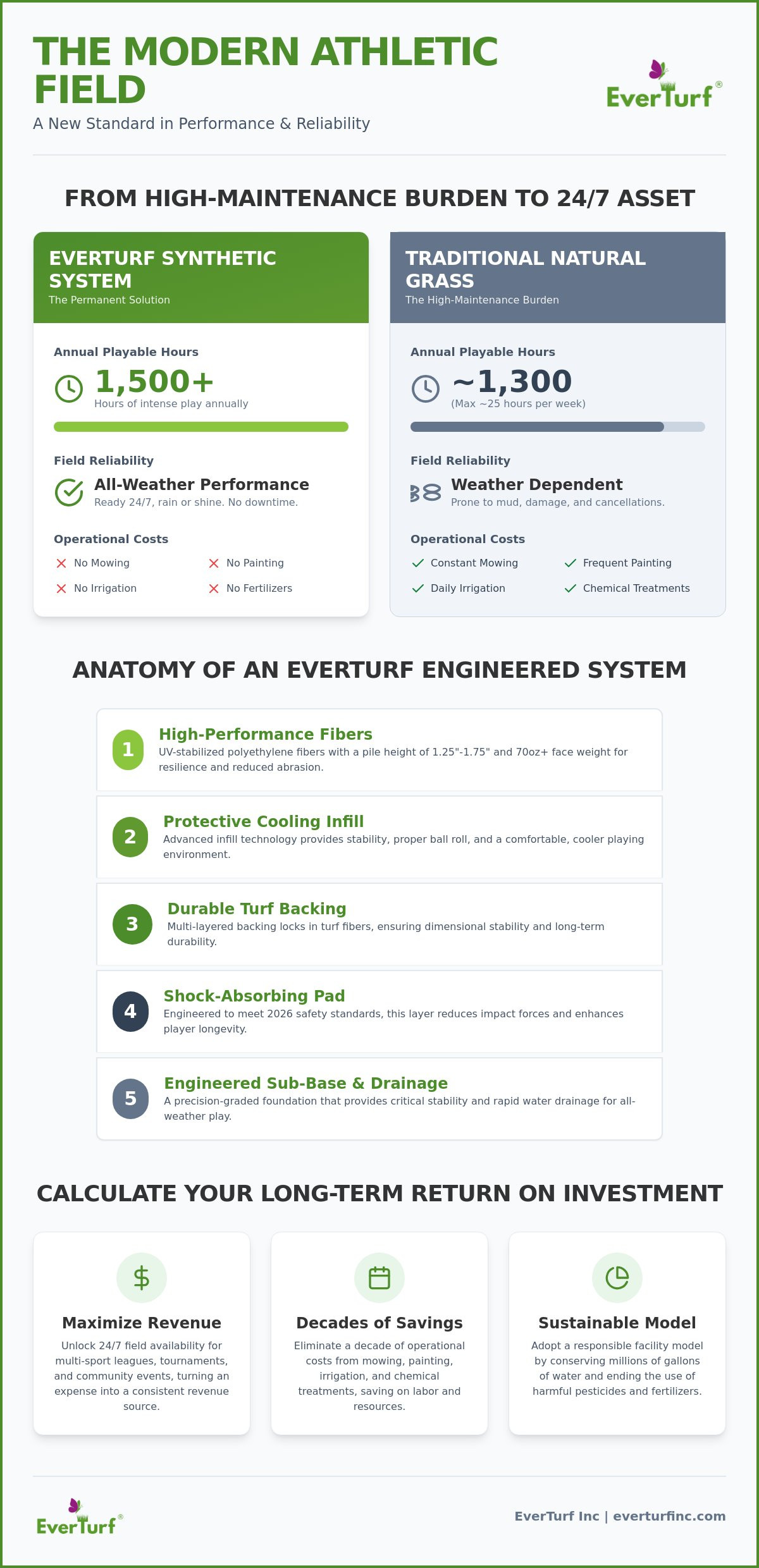
The landscape of athletic facility management has shifted dramatically. In 2026, the demand for 24/7 field availability has made natural sod a logistical liability for most organizations across the United States. Traditional grass requires extensive recovery periods, often limiting use to just 20 to 25 hours per week before the surface begins to fail. By contrast, an EverTurf Artificial grass football field can endure over 1,500 hours of intense play annually. This allows multi-sport facilities to maximize their revenue and community impact without the constant fear of wearing out the turf. It’s a fundamental change in how we view athletic space, turning a fragile patch of land into a durable, year-round asset.
Rising maintenance labor costs in 2026 have forced many American organizations to reconsider their budgets. Keeping a natural pitch in playing condition involves constant mowing, painting, and irrigation, along with the heavy use of chemical fertilizers. These chemicals are increasingly restricted by local environmental regulations, making the “perfect” grass field harder and more expensive to achieve. A professional-grade EverTurf Artificial grass football field offers a permanent solution. It eliminates the need for these recurring expenses while conserving millions of gallons of water. This isn’t just about saving money; it’s about adopting a sustainable model that meets the demands of modern athletics.
The Problem with Natural Grass Reliability
The “recovery time” bottleneck is the primary enemy of a busy athletic schedule. When a field is out of commission for days to let the grass heal, you lose money and momentum. Weather-related cancellations add another layer of frustration. A single heavy rain can turn a championship game into a mud bowl, damaging the soil structure for the rest of the season. High-profile domestic venues like MetLife Stadium and SoFi Stadium have demonstrated that synthetic surfaces provide the consistency and durability needed for elite competition. They’ve shown that reliability is the ultimate competitive advantage, ensuring that the game goes on regardless of the forecast.
The Lifestyle Value: Reclaiming Facility Time
Transitioning to synthetic turf represents a fundamental shift from a maintenance-heavy mindset to a performance-focused one. Much like the principles outlined in our guide to backyard turf, large-scale athletic facilities benefit from the same emotional relief of a space that’s always ready. Facility managers can finally stop worrying about the forecast and start focusing on player development and event scheduling. Understanding the Anatomy of an EverTurf Artificial Grass Football Field reveals why these systems are so resilient. It’s about more than just the top layer; it’s a sophisticated engineering feat that restores your time and provides long-term satisfaction.
Anatomy of an EverTurf Artificial Grass Football Field
Think of your field as a high-performance machine. An EverTurf Artificial grass football field isn’t simply a roll of carpet laid over dirt; it’s a multi-layered system designed to withstand decades of punishment while keeping athletes safe. This hierarchy begins with a precision-engineered sub-base and drainage layer, moving upward through a shock-absorbing pad, the turf backing, and finally the UV-stabilized polyethylene fibers. Each layer plays a specific role in ensuring the field remains a 24/7 asset rather than a maintenance liability. When these components work in harmony, they provide a consistent playing surface that feels natural underfoot.
High-Performance Fiber Technology
Football requires a specific type of resilience. For high-traffic athletic environments in 2026, we recommend a pile height between 1.25 and 1.75 inches combined with a face weight of 70 ounces or more. These fibers are designed with unique blade shapes that stay upright under heavy pressure. Abrasive resistance is another critical factor. Advanced fibers reduce the friction that causes “turf burn” during slides or tackles, which is a major concern for player safety and performance. Because these fibers are UV-stabilized, you can expect the vibrant green color and structural integrity to remain intact through 2030 and beyond, regardless of the local climate.
The Science of Infill and Shock Pads
While the fibers get all the attention, the real magic happens beneath the surface. Using the right turf infill is vital because it mimics the energy return of natural soil. In 2026, G-Max testing has become more stringent for high school and professional fields alike. A G-Max rating measures the shock-absorption of the surface. The lower the number, the better the impact attenuation for concussion prevention. Adding a shock pad beneath the turf can lower these values significantly and extend the life of your investment by up to four years.
Drainage efficiency is the final piece of the puzzle. A professional EverTurf Artificial grass football field can manage heavy rainfall without surface ponding, ensuring the game continues even in a downpour. This invisible engineering prevents the “mud bowl” scenarios common with natural grass. If you’re ready to see how these layers work together for your specific facility, consulting with a field designer can help you visualize the perfect, low-maintenance solution for your athletes.
Football vs. Soccer: Designing for Multi-Sport Excellence
Modern athletic facilities are rarely dedicated to a single sport. To maximize the utility of a community or school complex, the surface must perform at an elite level for both the explosive, high-impact nature of football and the fluid, ball-centric dynamics of soccer. An EverTurf Artificial grass football field provides the structural integrity needed for heavy lineman play while maintaining the precise ball roll required for a technical soccer match. Achieving this balance requires a deep understanding of how different athletes interact with the turf. It’s about creating a space where every player, regardless of their sport, feels they have a competitive home field advantage.
The primary technical challenge lies in the “cleat-to-surface” interaction. Football players rely on high traction to support sudden stops and powerful lateral cuts. In contrast, soccer players need a surface that allows for a predictable ball bounce and a consistent roll speed. If the turf is too soft, the soccer ball “chokes,” slowing down play and frustrating athletes. If it’s too firm, football players risk increased joint strain. By utilizing a specialized fiber shape and a calibrated infill depth, we create a hybrid environment that satisfies the traction requirements of a wide receiver and the ball-handling needs of a midfielder.
Marking systems also play a vital role in multi-sport versatility. Many facilities choose permanent tufted lines for their primary sport, such as the yard markers for a football game, while using high-quality temporary paint for soccer or lacrosse seasons. This flexibility allows you to host back-to-back tournaments without compromising the professional appearance of the field. Designing for the 2026 athletic season means viewing your field as a versatile platform for community engagement and athletic growth.
Traction and Rotational Resistance
Football players require a surface with enough “bite” to facilitate explosive movements without causing the foot to become trapped. This balance is known as rotational resistance. If the grip is too high, the risk of lower-extremity injuries increases. EverTurf Sports Fields are engineered to hit the “sweet spot” of safety and performance. Soccer boots have different stud patterns than football cleats, yet our systems provide a consistent interface for both. This ensures that a slide tackle in soccer feels just as controlled as a sprint to the end zone in football.
Optimizing for Multi-Sport Revenue
Versatility is the most significant driver of a field’s financial success. When Calculating ROI: The True Cost of a Synthetic Field, facility owners must account for the added value of multi-sport rental hours. A field that can host football on Friday night and a soccer tournament all day Saturday generates significantly more revenue than one requiring a “recovery day.” Transitioning between seasons becomes a seamless process rather than a maintenance headache. This high-durability approach ensures your complex remains a vibrant, active hub for athletes throughout the entire year.
Calculating ROI: The True Cost of a Synthetic Field
Evaluating the financial impact of an EverTurf Artificial grass football field requires shifting your perspective from initial expenditure to long-term asset performance. While the upfront capital for a professional system is significant, the 10-year operational savings often outweigh the initial price tag. By choosing a high-performance surface, you’re investing in a permanent solution that eliminates the recurring financial drain of traditional field management. This transition provides a sense of relief for facility directors who are tired of balancing shrinking budgets against rising maintenance demands. It’s a strategic move that prioritizes quality and predictable results over the constant firefighting of natural grass care.
Maintenance Savings Analysis
The “hidden costs” of natural grass are where athletic budgets truly bleed. In 2026, annual maintenance for a synthetic field typically ranges between $15,000 and $25,000, which is a fraction of what’s required for professional sod care. Labor reduction is the most immediate benefit. Instead of daily mowing, fertilizing, and line painting, your team shifts to light, monthly grooming. Eliminating massive water bills and expensive chemical treatments is also a major factor, especially as resource conservation becomes a national priority. For a broader look at budget frameworks and regional pricing factors, reviewing our guide on artificial turf installation cost helps set realistic expectations for your project.
Revenue Generation and Availability
Longevity planning is the final pillar of a smart ROI strategy. Quality materials extend the replacement cycle, which is vital for long-term fiscal health. While a standard turf carpet might last 8 years, a premium system is designed to perform at an elite level for up to 12 years before the carpet needs replacement. This extra four-year window significantly lowers the total cost of ownership and delays future capital expenditures. By investing in UV-stabilized fibers and a superior sub-base now, you avoid the premature replacement costs that plague lower-quality installations. If you’re ready to transform your athletic complex into a revenue-generating powerhouse, request a custom ROI analysis to see how much your facility can save over the next decade.
The EverTurf Advantage: Professional Installation and Support
Selecting the right materials is a significant first step, but the true EverTurf advantage lies in the precision of the build. An EverTurf Artificial grass football field requires more than just a skilled crew; it demands a consultative approach that tailors the entire system to your specific sport and local climate. We don’t believe in one-size-fits-all solutions. Instead, we act as a Reliable Visionary, guiding you through a design process that prioritizes sub-base engineering. This foundation is our hallmark. It ensures that your field remains flat, stable, and perfectly drained through decades of use. Moving from a high-maintenance past to a high-performance future starts with a partner who values your time as much as you do.
Precision Installation Accessories
The integrity of an athletic field is often determined by the smallest details. We utilize EverTurf Staples and Glue to guarantee seam security across the entire 57,600 square feet of a regulation field. Heavy-duty staples and industrial-grade adhesives are essential for preventing trips and ensuring a seamless playing surface. These professional tools are non-negotiable for athletic-grade installations. Without them, even the highest-quality fibers can shift or pull apart under the stress of heavy lineman play or intense soccer sprints. Secure seams mean a safer environment for every athlete who steps onto the pitch, providing the everlasting results your community deserves.
Partnering with a Reliable Visionary
Transparent communication is the heartbeat of our process. From the initial measurement to the final infill grooming, you’ll receive clear updates and expert guidance. We provide ongoing support and specialized maintenance guidance for field managers, moving you away from the stress of traditional maintenance toward a worry-free, permanent solution. This collaborative relationship ensures that your facility doesn’t just look professional on opening day but stays that way through 2030 and beyond. It is a confident and inviting transition that allows you to envision a more beautiful and stress-free version of your property. It’s time to reclaim your schedule and enjoy the tranquility of a field that’s always game-ready.
Secure the Future of Your Athletic Facility
Transitioning to an EverTurf Artificial grass football field is more than a simple facility upgrade; it’s a strategic commitment to athletic excellence and long-term fiscal health. You’ve discovered how engineered sub-base systems and UV-stabilized performance fibers create a surface that defies the limitations of natural grass. By reclaiming the thousands of hours previously lost to maintenance and weather recovery, you’re opening your doors to a 24/7 schedule that serves your community with professional-grade safety standards.
Our national distribution and support network ensures that your investment remains a vibrant, high-performing centerpiece for your organization through 2030 and beyond. It’s time to leave behind the mud bowls and the rising labor costs of the past. Envision a field that’s always ready for the big game and a budget that finally works in your favor. When you’re ready to move from a high-maintenance situation to a worry-free one, we’re here to help you lead the way. Request Your Professional Sports Field Consultation and take the first step toward a permanent, high-performance solution today.
Frequently Asked Questions
How long does an EverTurf artificial grass football field last?
A professional-grade synthetic field typically provides an elite playing surface for 8 to 12 years before the turf carpet requires replacement. This lifespan depends on the intensity of use and your commitment to a regular grooming schedule. By utilizing high-performance, UV-stabilized fibers, we ensure your facility maintains its structural integrity and vibrant color well into the next decade, even in challenging local climates.
Is synthetic turf safe for football players regarding concussions?
Modern synthetic systems prioritize athlete safety by incorporating specialized shock pads beneath the turf to improve impact attenuation. These pads are specifically designed to lower G-max values, which measures the shock-absorption of the surface to help prevent concussions and other impact-related injuries. When combined with calibrated infill, the system mimics the natural energy return of high-quality soil to protect players during intense contact.
How does the drainage system work for an artificial football field?
The drainage system utilizes a perforated backing on the turf and a precision-engineered stone sub-base that allows water to flow vertically through the surface at a rapid rate. This advanced engineering ensures that your EverTurf Artificial grass football field remains playable even during heavy downpours without the risk of surface ponding or mud. It provides a permanent solution to the weather-related cancellations that often disrupt schedules on natural grass pitches.
Can soccer be played on an artificial grass football field?
Yes, soccer can be played on these fields, provided the system is designed to balance the high-traction needs of football with the consistent ball roll required for soccer. Many facilities maximize their revenue potential by utilizing multi-sport line markings to host both sports on a single, durable surface. This versatility allows you to transition between seasons seamlessly without the need for extensive field recovery periods or surface repairs.
Does synthetic turf get too hot for summer football practice?
While synthetic surfaces can absorb heat, 2026 cooling infill technologies like coated sands or organic materials like cork significantly reduce surface temperatures compared to older turf models. These specialized materials help manage the microclimate of the field, ensuring that summer practices remain comfortable for athletes. Selecting the right infill is a vital part of our consultative design process to ensure your field is a year-round asset.
How much maintenance does an EverTurf sports field actually require?
Synthetic fields require a fraction of the labor needed for natural grass, shifting your team from daily mowing and painting to light, monthly grooming. This maintenance typically involves brushing the fibers to keep them upright and occasionally topping off the infill to ensure consistent performance. By eliminating the need for irrigation and fertilizers, you reclaim significant facility time and reduce long-term operational headaches for your staff.
What is a G-Max rating and why does it matter for my field?
A G-Max rating measures the shock-absorption capacity of an athletic surface by recording how much force is returned to an athlete upon impact. For high school and professional organizations, maintaining a safe G-Max score is a vital safety requirement to protect players from serious injuries. Regular testing of your EverTurf Artificial grass football field ensures that the system continues to meet professional safety standards throughout its entire operational life.
Can we use existing natural grass sub-base for a new turf field?
You generally cannot use a standard natural grass sub-base because synthetic fields require a specific engineered stone foundation to ensure proper stability and vertical drainage. A professional installation involves excavating the existing soil and replacing it with a multi-layered stone system that supports the weight of the turf and athletes. However, if you are replacing an older synthetic field, we can often reuse the existing stone base if the drainage remains functional.