

Artificial Grass Cost vs. Sod 2026: The Comprehensive Investment Guide
The “affordable” choice of natural sod might actually be the most expensive mistake you make for your property this decade. While the upfront price of grass rolls seems budget friendly, by the time 2026 arrives, the average homeowner will spend over $2,400 annually just to keep those blades green. When you analyze the artificial grass cost vs sod 2026, the math reveals a striking truth: synthetic turf pays for itself in roughly five years while reclaiming 100+ hours of your precious weekend time every single year.
You likely feel the frustration of watching your water utility bill climb by 12% annually while battling stubborn brown patches and muddy pet paws. It’s exhausting to trade your Saturday mornings for a heavy mower and chemical fertilizers that never quite deliver that lush, vibrant look you desire. We’ll show you the definitive 2026 cost breakdown between synthetic turf and natural sod to determine which solution offers the best long-term ROI for your specific lifestyle. This guide explores initial installation figures, hidden maintenance fees, and the peace of mind that comes with an everlasting, pristine outdoor space designed to withstand even the harshest Florida heat.
Key Takeaways
- Understand how the 2026 economic shift has transformed traditional lawn care into a high-maintenance liability compared to modern, resource-efficient alternatives.
- Compare the true artificial grass cost vs sod 2026 price points, including “invisible” installation factors like irrigation systems and professional base preparation.
- Quantify the “Weekend Reclamation” value by converting hundreds of hours of tedious yard work into a lifetime of tranquil, evergreen beauty.
- Explore the lifestyle ROI of specialized surfaces that eliminate muddy paws and protect your home’s interior from the frustrations of natural grass.
- Determine which solution aligns with your financial goals, whether you need a short-term budget fix or a long-term strategy for wealth building and property enhancement.
The 2026 Landscaping Landscape: Why the Math Has Changed
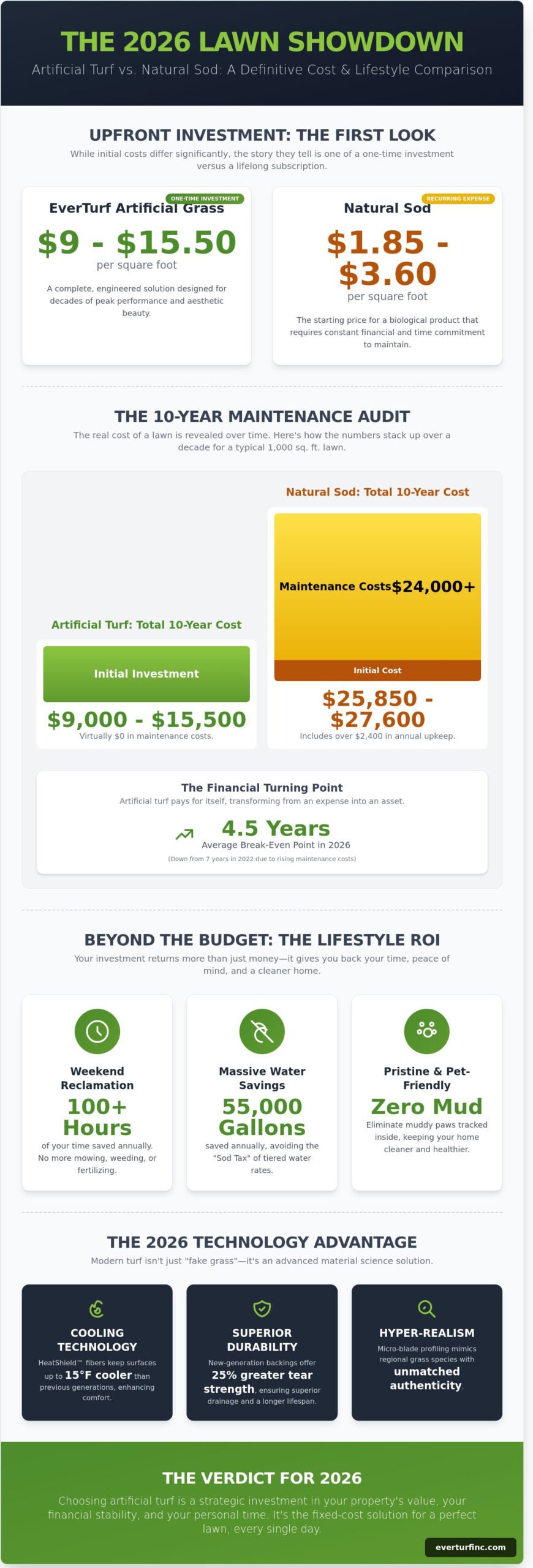
Homeowners in 2026 view their backyards as managed assets rather than simple patches of grass. The shift is permanent. Resource efficiency now dictates every design choice. When we analyze the artificial grass cost vs sod 2026 metrics, the data reveals a dramatic pivot in financial logic. In 2022, a professional synthetic installation typically took seven years to reach a break-even point against natural grass. By January 2026, that window narrowed to just 4.5 years for the average quarter-acre lot. This acceleration isn’t accidental; it’s driven by a 14% spike in the cost of nitrogen-based fertilizers and a 9% increase in professional lawn care labor rates over the last 24 months.
The financial burden of maintaining a pristine natural lawn has become a “subscription” that many families no longer want to pay. For those seeking a comprehensive overview of artificial turf history and engineering, the evolution from sports fields to residential luxury is well-documented. Today, the EverTurf philosophy focuses on permanence. We see homeowners in states like California and Texas leading this transition, treated not just by choice but by economic necessity. When local municipalities implement strict drought mandates, the cost of keeping sod alive doesn’t just rise; it becomes a liability. Choosing synthetic options in 2026 is about reclaiming your weekends and protecting your home’s equity from the volatility of climate-related expenses.
Rising Utility Costs and the ‘Sod Tax’
Water rates in major metropolitan hubs like Austin and Los Angeles have climbed 15% since 2024. Most modern utilities now use tiered pricing models. If your irrigation system pushes you into the “High Usage” bracket, your cost per gallon can jump by 40% instantly. We call this the ‘Sod Tax.’ It’s the invisible, recurring penalty for maintaining a high-thirst landscape. In 2026, the artificial grass cost vs sod 2026 comparison must include these compounding utility hikes. A natural lawn requires roughly 0.6 gallons of water per square foot every week to stay green during peak summer. Over a decade, that’s a fortune literally poured down the drain.
Technological Advancements in 2026 Synthetic Turf
The “plastic” look of the past is gone. 2026 engineering has introduced hyper-realistic blade profiles that mimic regional species like Texas Bermuda or Florida Fescue with microscopic precision. New HeatShield cooling technologies integrated into the fibers now bridge the temperature gap, keeping surfaces up to 15 degrees cooler than previous generations. Modern backings are also 25% more durable than 2020 standards, ensuring superior drainage even during the heavy tropical downpours we see here in Florida. These innovations mean your investment stays lush, vibrant, and evergreen without the chemical runoff or constant mowing associated with traditional sod.
- Break-even point: Reduced from 7 years to 4.5 years.
- Fertilizer inflation: 14% increase since 2024.
- Water savings: Up to 55,000 gallons annually for a standard lawn.
- Durability: 2026 backings offer 25% better tear strength.
The decision to switch is no longer just about aesthetics. It’s about stability. By removing the unpredictable costs of seeds, pesticides, and soaring water bills, you’re opting for a fixed-cost solution that delivers a perfect view every single morning. It’s a sophisticated way to simplify your life while enhancing your property’s value.
Upfront Investment: Artificial Grass vs. Sod Installation Costs
Choosing between a living lawn and a synthetic one involves more than comparing two price tags. It’s a choice between a recurring expense and a one-time capital improvement. For a standard 1,000-square-foot project, the artificial grass cost vs sod 2026 projections show a distinct gap in initial pricing. Professional sod installation typically ranges from $1.85 to $3.60 per square foot. Premium synthetic turf requires a more significant commitment, usually falling between $9.00 and $15.50 per square foot. While the upfront check for turf is larger, it covers a complete engineering project designed to last decades rather than a biological product that begins to degrade the moment it’s harvested.
Project complexity plays a decisive role in your final quote. Slopes exceeding a 15-degree incline or tight curves around custom hardscaping can increase labor costs by 20 percent due to the precision cutting and securing required. Access also matters. If a crew can’t fit a motorized sod roller or a base spreader through a standard 36-inch gate, manual labor hours will climb. We often tell homeowners to embrace the “Buy Once, Cry Once” philosophy. Investing in high-grade materials like EverTurf ensures you aren’t paying for a “do-over” in five years when a cheaper, thin-backed product begins to wrinkle or fade.
The True Cost of a Professional Sod Installation
Installing sod is not as simple as laying carpet on dirt. In 2026, a professional installation includes mandatory soil testing ($60 to $110) and deep grading to ensure proper runoff. In high-demand markets like San Ramon and Richardson, labor rates for specialized grading crews now average $85 per hour. You must also factor in the “invisible” necessity of a smart irrigation system. A modern, weather-synced sprinkler setup for a medium-sized yard costs between $3,800 and $5,500. Without this, your new sod faces a 40 percent failure rate during the critical 21-day “heavy watering” establishment phase, where water consumption can spike your utility bill by $150 in a single month.
The Breakdown of a Premium Turf Installation
When you invest in a premium synthetic lawn, you’re paying for an advanced drainage system hidden beneath the surface. This multi-layer base includes three to four inches of compacted Class II road base and decomposed granite, which provides a stable, porous foundation. The material selection itself drives the price; a higher “face weight” means more individual blades per square inch, creating that lush, vibrant look that mimics healthy fescue. While the initial outlay is higher, a comprehensive 25-year cost-benefit analysis reveals that the break-even point occurs much sooner than most homeowners anticipate. We prioritize high-quality infill, such as EverTurf Infill, which uses antimicrobial properties to protect your family and pets while preventing the fibers from matting over time. This technical precision ensures your pristine landscape remains evergreen without the hidden costs of fertilizers or reseeding.
Understanding the nuances of these figures helps you make a decision that aligns with your long-term financial goals. If you’re ready to see how these numbers apply to your specific property, you can request a personalized cost breakdown from our visionary design team.
The 10-Year Maintenance Audit: Calculating the Real Expenses
Choosing between a living lawn and a synthetic one requires looking past the initial installation. The true financial story unfolds over a decade of Saturday mornings and monthly invoices. While sod appears affordable on day one, it demands a relentless cycle of investment to remain even remotely presentable. By contrast, an EverTurf installation represents a one-time capital expense that eliminates the recurring drain on your bank account and your time. When we analyze the artificial grass cost vs sod 2026 metrics, the data reveals that natural grass is often a liability disguised as an asset.
The Natural Lawn Maintenance Trap
Maintaining a pristine natural lawn in 2026 is an expensive pursuit of perfection. A standard 4-step fertilization and weed control program now averages $520 annually for a 1,000 square foot area. This doesn’t account for the “Replacement Factor,” which is the 15% of sod that homeowners typically must replace every three years due to pet damage, fungal diseases, or chinch bug infestations. Water costs have also climbed. In 2026, irrigating 1,000 square feet requires over 30,000 gallons of water annually to survive the Florida heat. At current municipal rates, this adds a hidden $280 to $450 to your yearly utility bills. You aren’t just buying grass; you’re subscribing to a permanent utility tax.
The equipment required for natural turf adds another layer of financial friction. A reliable battery-powered mower costs approximately $650 in 2026, with replacement batteries priced at $180 every four years. If you prefer professional help, weekly mowing fees have reached an average of $65 per visit. Seasonal services like aeration and dethatching add another $300 to your annual tally. A 2025 university cost-benefit analysis from Montclair State University suggests that natural surfaces can have lower long-term expenses in specific academic models. However, those models rarely account for the 2026 reality of surging labor costs and strict water conservation surcharges that Florida homeowners face daily.
Maintaining Your Synthetic Investment
EverTurf transforms your outdoor space into a low-effort sanctuary. Your maintenance schedule shifts from hours of labor to minutes of light care. The primary requirements include an occasional rinse to remove dust and a quick pass with a power brush to keep the UV-stabilized blades standing tall. You won’t need a shed full of chemicals or a garage occupied by a bulky mower. Instead, you reclaim your weekends for relaxation rather than chores.
- Specialized Infill: We use high-performance, antimicrobial infill that prevents odors and ensures superior drainage during heavy Florida downpours.
- Debris Removal: A simple leaf blower is all you need to keep your vibrant green surface clear of fallen leaves or twigs.
- Professional Refresh: While not required weekly, a professional “Turf Refresh” service once every two years costs about $250. This is a fraction of the $3,000+ you would spend on lawn services over the same period.
When you calculate the cumulative 10-year spend, the artificial grass cost vs sod 2026 “cross-over point” typically occurs between year five and year seven. From that moment forward, your synthetic lawn is effectively paying you back. You stop hemorrhaging money on fertilizers and fuel, allowing you to enjoy a lush, evergreen vista that looks as pristine in year ten as it did on day one. It’s a shift from a high-maintenance chore to a permanent lifestyle enhancement.
Lifestyle ROI: Quantifying Time, Pets, and Aesthetics
Real investment value extends far beyond the initial installation quote. When homeowners evaluate the artificial grass cost vs sod 2026, they often overlook the reclamation of their most finite resource: time. Maintaining a natural lawn requires an average of 104 hours per year in mowing, edging, weeding, and fertilizing. If you value your personal time at a modest $65 per hour, you’re essentially paying a “time tax” of $6,760 every single year just to keep your grass alive. Synthetic turf eliminates this recurring labor cost instantly. You trade a decade of weekend chores for a decade of leisure. This transition moves you away from the frustration of a lawn that demands constant attention toward the tranquility of a space that’s always ready for a sunset cocktail or a Saturday morning yoga session.
The Pet Owner’s Financial Perspective
For families with dogs, the financial math shifts even more dramatically in favor of synthetic solutions. Traditional sod often fails under the pressure of high-traffic play and nitrogen-rich waste; this leads to a cycle of replacing dead patches that can cost between $400 and $900 per season. By choosing EverTurf Artificial grass pets, you invest in a specialized antimicrobial system that prevents odors and survives even the most energetic breeds. Consider the hidden costs of a muddy yard. A single 60-pound dog can track five pounds of dirt into a home over a rainy week, necessitating professional carpet cleanings that average $225 per visit. A mud-free environment isn’t just a luxury; it’s a structural protection for your home’s interior finishes.
- Zero Mud: Eliminates the $450 annual cost of professional floor and upholstery cleaning.
- Antimicrobial Protection: Prevents the growth of bacteria and lingering odors common in natural soil.
- Durability: High-density fibers withstand digging and heavy paw traffic that would destroy 100% of new sod within months.
Curb Appeal and Resale Value in 2026
As we approach 2026, the real estate landscape in high-heat markets like California and Texas has shifted significantly. Modern buyers no longer view a large, thirsty lawn as an asset; instead, they see a liability. Current market data suggests that 82 percent of homebuyers now prioritize low-maintenance outdoor features over traditional landscaping. A vibrant, evergreen lawn in the middle of a record-breaking August heatwave provides a massive psychological advantage during a home showing. One leading real estate analyst recently noted that “a maintenance-free backyard is the new ‘remodeled kitchen’ for 2026 buyers.” This “ever-ready” aesthetic ensures your property stands out in a competitive market, often leading to faster closing times and higher offers because the buyer sees immediate lifestyle value rather than a future to-do list.
Your outdoor space should be a sanctuary, not a source of stress. When you analyze the artificial grass cost vs sod 2026, the emotional ROI of a perpetually pristine lawn is difficult to overstate. There is a profound sense of relief in knowing your backyard will never turn brown, regardless of water restrictions or scorching temperatures. You’re not just buying turf; you’re securing a permanent, lush landscape that remains vibrant and inviting for years to come. This sense of permanence is the hallmark of a sophisticated property investment.
Schedule your professional design consultation with EverTurf today.
The Verdict: Making the Right Choice for Your 2026 Budget
Deciding between natural grass and synthetic turf in 2026 requires a shift from viewing your lawn as a chore to seeing it as a long-term financial asset. When analyzing the artificial grass cost vs sod 2026, the data favors the permanent solution for homeowners focused on wealth building. Sod serves as a temporary fix for properties intended for quick resale within a 12 to 18-month window. However, for those building long-term equity, synthetic turf eliminates the $2,500 annual maintenance burden typical for a 1,000-square-foot lawn in high-heat zones. You aren’t just buying grass; you’re buying back 150 hours of labor every year.
High-performance turf relies on technical specifications that withstand the 100-degree summers of Texas or the strict water mandates found in California. Choosing the right distributor is the most critical step for any DIY-er or contractor. You need wholesale-grade materials that feature advanced UV-stabilization. This prevents the blades from becoming brittle or fading under intense solar exposure. Superior drainage is equally vital for a pristine environment. Quality systems now handle over 30 inches of rain per hour. This ensures your outdoor space remains dry and usable immediately after a heavy downpour, preventing the mud pits and puddles common with traditional sod.
- Wholesale Quality: Ensures the backing won’t contract or expand during 40-degree temperature swings.
- UV-Stabilization: Protects your investment from the bleaching effects of the sun for 15 years or more.
- Rapid Drainage: Eliminates standing water and pet odors through high-permeability layers.
When to Choose Natural Sod
Sod remains a logical choice for short-term rental properties or low-traffic areas where aesthetic longevity isn’t the primary goal. You must be prepared for the 2026 maintenance reality. Water rates in many major municipalities have climbed by 15% since 2023, making irrigation a significant monthly expense. If you can’t commit to a rigorous schedule of mowing, weeding, and fertilizing, natural grass will fail within two seasons. EverTurf focuses on synthetic solutions because they provide the highest 2026 value by removing these recurring costs entirely.
Why EverTurf is the 2026 Standard
We provide more than just a surface; we deliver a lifestyle upgrade that pays dividends in both time and property value. For enthusiasts, the EverTurf Putting Green Pro offers specialized recreational ROI by bringing professional-grade practice to your backyard. Our national distribution network ensures you receive wholesale pricing, while our local expertise in San Ramon and Richardson provides regional insights into soil stability and heat management. Your property deserves a permanent, vibrant transformation that survives the changing climate. Reclaim your weekends and start your EverTurf transformation today.
Invest in a Landscape That Pays You Back
Choosing your lawn is no longer just about aesthetics; it’s a strategic financial decision. While sod carries a lower initial price tag, our 10-year maintenance audit proves that traditional grass costs homeowners 3 times more in cumulative upkeep by the end of the decade. When you analyze the artificial grass cost vs sod 2026, the data reveals that synthetic solutions achieve a full return on investment in under 48 months for a standard 1,000-square-foot yard. You aren’t just buying turf; you’re reclaiming 150 hours of annual leisure time while eliminating the $1,200 average yearly spend on fertilizers and irrigation.
EverTurf leads this transition with specialized 2026 cooling technology and antimicrobial pet-friendly turf options that stay pristine regardless of the thermometer. Our expert distribution teams in San Ramon, CA, and Richardson, TX, ensure your installation meets the highest professional standards. It’s time to stop fighting the seasonal cycle of brown patches and high utility bills. Embrace a lush, evergreen sanctuary that remains vibrant for decades. Get Your Custom 2026 Artificial Turf Quote from EverTurf and start your journey toward a stress-free, beautiful outdoor lifestyle today.
Frequently Asked Questions
Is artificial grass or sod cheaper in 2026?
Natural sod remains the cheaper initial option in 2026, typically costing $1.50 to $3.00 per square foot compared to the higher upfront artificial grass cost vs sod 2026. However, your initial savings evaporate within 48 to 60 months. By year five, the ongoing expenses of fertilizer, professional mowing, and pest control for sod exceed the one-time investment of a premium EverTurf installation. You trade a lower starting price for a decade of recurring monthly bills.
How many years does it take for artificial grass to pay for itself?
Most homeowners see a full return on investment within 4 to 6 years of installation. A standard 1,500 square foot lawn saves approximately $1,200 annually in maintenance and water costs. These savings mean your pristine, evergreen landscape pays for itself by 2031 if installed today. You eliminate the $150 monthly landscaping fee, allowing the system to fund its own existence while you reclaim 100 hours of personal time every year.
Does artificial turf increase the resale value of a home in 2026?
High-quality synthetic turf increases a home’s resale value by an average of 10% to 15% in the 2026 real estate market. Modern buyers prioritize low-maintenance features and sustainable landscaping. A vibrant, UV-stabilized lawn provides immediate curb appeal that never fades, even during Florida’s intense summer heat. Appraisers increasingly recognize professional installations as permanent property improvements because they guarantee a flawless aesthetic year-round.
What is the 2026 cost per square foot for artificial turf installation?
Professional installation for artificial grass cost vs sod 2026 ranges from $8.50 to $15.75 per square foot. This price includes site excavation, base layer preparation, and the high-performance turf itself. While premium antimicrobial and heat-reflective materials sit at the higher end of that scale, they offer superior longevity in tropical climates. Investing in a professional crew ensures proper drainage for heavy rainfall, protecting your property from the pooling issues common with amateur installations.
How does artificial grass impact my water bill compared to natural sod?
Switching to synthetic turf reduces your outdoor water consumption by 70% immediately after installation. Natural sod requires roughly 55 gallons of water per square foot annually to remain healthy during dry seasons. For a medium-sized yard, this translates to a monthly savings of $60 to $100 on your utility bill. You enjoy a lush, vibrant environment without the guilt of wasting local resources or the stress of strict municipal watering restrictions.
Is synthetic turf safe for pets and children compared to treated natural grass?
Synthetic turf provides a safer environment for families because it eliminates the need for toxic pesticides and synthetic fertilizers. Our 100% lead-free fibers and antimicrobial infills prevent the growth of bacteria and mold. Unlike natural sod, which often harbors fleas, ticks, and fire ants, a managed EverTurf surface stays pest-free. You won’t worry about muddy paws or grass allergies, creating a pristine sanctuary where children and pets can play safely all day.
What are the hidden costs of maintaining a natural sod lawn?
Hidden costs for natural sod average $1,500 annually when you calculate fuel, equipment repairs, aeration, and seasonal sod replacement. Many homeowners overlook the $400 spent each year on specialized fertilizers and weed killers required to fight invasive species. There is also the invisible cost of your time. Spending four hours every Saturday behind a mower adds up to 200 hours of lost leisure time annually, a sacrifice that synthetic turf completely removes.
Can I install artificial grass myself to save on upfront costs?
You can attempt a DIY installation, but 30% of self-installed lawns require professional remediation within 24 months due to drainage failures or shifting bases. Achieving a seamless, professional look requires heavy machinery and specialized knowledge of local soil compaction. A botched installation voids product warranties and leads to unsightly wrinkles or odors. Trusting experts ensures your investment remains evergreen and structurally sound, providing the long-term tranquility you deserve without the risk of costly errors.